
Premise 1: Jesus Left Perfect Heaven Knowing He Would Suffer And Die At The Hands Of Evil
History and life are filled with accounts of innocent people who became tragic victims of heinous evil. For most of us, unless we have endured such horrors ourselves, we can only grasp their torment and trauma from a distance—sympathizing, but never fully entering into their experience.
Such was not the case with Jesus Christ. He did not remain an observer of human suffering; He entered directly into it. Betrayed by a friend, abandoned by His closest followers, falsely accused, mocked, tortured, and executed in one of the most excruciating ways known to man—Jesus experienced injustice, cruelty, and pain at a level that encompasses both the depth of human evil and the full weight of divine judgment. On the cross, He bore not only the malice of men but the penalty of sin itself, making Him the only truly innocent sufferer who fully understands the agony of every victim.
One of the titles given to Jesus is “Suffering Servant.” While it may not carry the same theological weight as “Savior” or “Lord,” it is a title that captures, in profoundly experiential terms, the earthly life of Christ. To consider where Jesus came from and what He willingly entered into is to behold the greatest contrast imaginable—the contrast of all contrasts.
In heaven, Jesus enjoyed perfect everything—perfect unity and intimacy with the Father, perfect joy, perfect peace, and the unimaginable splendor of a realm untouched by even the faintest trace of evil. There was no pain, no injustice, no corruption; only the flawless glory and beauty of God’s presence filling every corner of existence.
Yet, in love, He stepped down from that perfection into a world marred by the very evils that still plague us today—violence, murder, rape, incest, human trafficking, greed, corruption, betrayal, and oppression. These horrors did not exist in heaven at all, but Jesus entered fully into a world saturated with them. He lived among the broken, walked dusty roads in a fallen world, and ultimately bore the brunt of its worst cruelty. The “Suffering Servant” is not merely a prophetic title—it is a vivid portrait of the One who left the heights of heavenly glory to embrace the depths of human misery for the sake of our redemption.
Jesus’s Suffering Was Profound
Jesus began His public ministry at the age of 30, and it lasted only three and a half years. Yet in that short span, He endured a depth of suffering that rivals any account of human pain and injustice. He was rejected by His own family—effectively “cancelled” before the term existed—and ostracized by His hometown. He lived without a permanent home, moving from place to place, constantly under the shadow of assassination plots. His closest friends abandoned Him in His greatest hour of need.
In His final hours, Jesus was savagely beaten within an inch of His life, subjected to public mockery and humiliation, and then condemned to crucifixion—the most excruciating and degrading form of execution ever devised. The Scriptures capture this season of His life in hauntingly simple words: “a man of sorrows, and acquainted with grief” (Isaiah 53:3).
Imagine being just 30 years old and enduring such treatment—or watching someone you deeply love and know suffer in this way. The sheer weight of it borders on the unimaginable, pressing beyond the limits of what the human heart can bear.
Jesus’ Sufferings And Modern Equivalents
| Suffering of Jesus (3½-year ministry) | Modern Human Suffering Parallel | Scripture Reference |
|---|---|---|
| Rejected by His own family | Being disowned or “cancelled” by family | Mark 3:21; John 7:5 |
| Ostracized by His hometown | Shunned or socially excluded by one’s community | Luke 4:24-29 |
| Lived without a permanent home | Experiencing homelessness or housing insecurity | Matthew 8:20 |
| Constant threats against His life | Living under constant death threats or targeted violence | John 11:53; Matthew 12:14 |
| Betrayal and abandonment by close friends | Being betrayed or deserted in a time of crisis | Matthew 26:14-16; Matthew 26:56 |
| Brutally tortured | Severe physical abuse or assault | Matthew 27:26; John 19:1 |
| Public humiliation and mockery | Online shaming, public defamation, or social humiliation | Matthew 27:27-31; Luke 23:35-39 |
| Crucifixion – cruelest form of execution | Execution or extreme state-sponsored torture | Matthew 27:35; Luke 23:33 |
While the full mystery of why God allows evil will never be fully grasped on this side of heaven, one truth is certain: Jesus understood evil and suffering on the most personal level. The question, “Why would a good God allow evil?” should give way to an even more staggering one: “Why would God send His Son on a rescue mission, knowing He would endure such suffering at the hands of evil people?”
And yet, in the very moment of His greatest agony—hanging on the cross, gasping for His final breath—Jesus looked upon His executioners and prayed words that still shake the world: “Father, forgive them, for they know not what they do” (Luke 23:34).
Challenge Question: If God were indifferent to human suffering, how do you explain Jesus willingly entering a world of evil, enduring betrayal, injustice, torture, and execution—and in His final breath, asking God to forgive the very people who caused His pain?
Premise 2: Jesus Sympathizes With Our Pain
Jesus came to this fallen earth on a rescue mission. As He walked among its people, He saw the victims of evil in all its forms—demon possession, cruelty, murder, greed, and exploitation—and He wept. The very reason He came was to save fallen humanity from the tyranny of their own sin, the harm inflicted by others, and ultimately from the corruption of a broken world itself.
And Jesus went throughout all the cities and villages, teaching in their synagogues and proclaiming the gospel of the kingdom and healing every disease and every affliction. When he saw the crowds, he had compassion for them, because they were harassed and helpless, like sheep without a shepherd.
Matthew 9:35-36
While salvation, deliverance, and rescue were the primary purposes of His mission, Jesus’ coming carried another profound dimension: He entered fully into the human experience. He chose not merely to speak of God’s concern from above but to demonstrate it from within—walking the same dusty roads, feeling the sting of injustice, tasting grief, and facing temptation. The word compassion in the original Greek (splagchnizomai) in Matthew 9:35–36 literally means “to be moved in the inward parts.” It describes a deep, visceral stirring—the kind that shakes a person to their core. This is the response Jesus had when He saw the weight and struggle of ordinary human life. By willingly stepping into our world and feeling what we feel, He revealed God’s consummate compassion—not as a distant deity untouched by pain, but as Emmanuel, God with us, present in the very midst of our suffering.
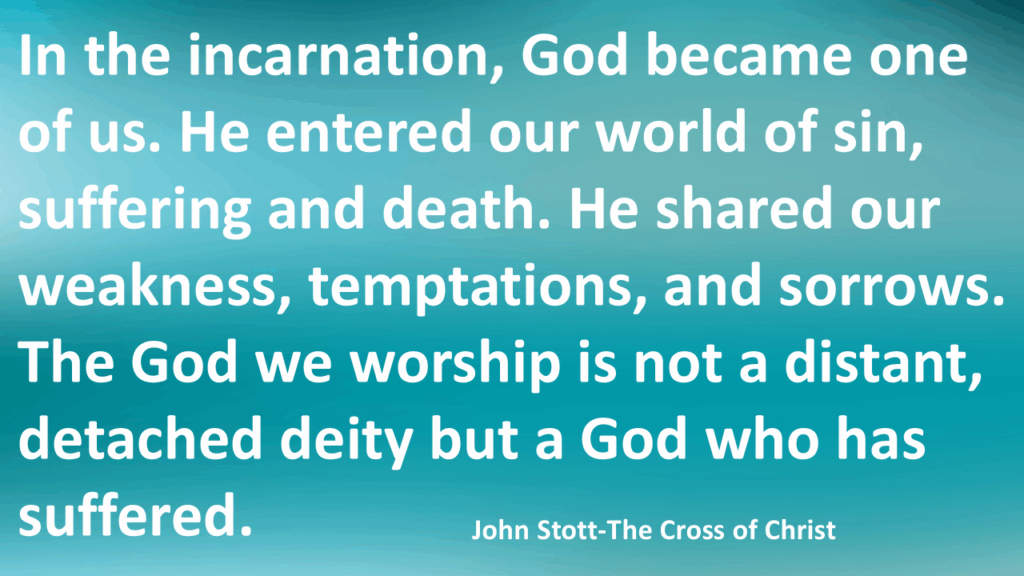
Jesus’s entire ministry was spent living among, befriending, encouraging, and feeding the downtrodden, the outcast, the poor, and the marginalized. As we might say today, He was “in the thick of human suffering” day after day. Though His ultimate mission was to die on the cross for the forgiveness of sins, a significant part of His earthly work was to provide a living, breathing example of active and passionate compassion toward the sufferers of this world.
The Gospels portray His three-and-a-half-year ministry as a continuous outpouring of either words or acts of mercy—healing the sick, comforting the grieving, restoring the shamed, and welcoming the rejected. These were not incidental moments; they were intentional demonstrations of what God’s kingdom looks like when embodied in human form. In doing so, Jesus gave His followers a model to imitate—a pattern of love, mercy, and action toward those in need.
The various ways Jesus personally experienced suffering have already been noted—rejection, betrayal, poverty, homelessness, threats, injustice, torture, and death. But He did more than endure His own pain; He consistently entered into the pain of others. He sought out the brokenhearted, stood beside the oppressed, and touched those deemed untouchable. His ministry was not conducted at a safe distance from the world’s misery—it was carried out in the very heart of it. Jesus had a PhD in suffering.
Jesus Ministry to the Suffering
| Scripture Reference | Act or Event | Type of Suffering Addressed |
|---|---|---|
| Mark 1:40–42 | Touched and healed a man with leprosy | Physical disease, social isolation |
| Luke 17:11–19 | Healed ten lepers | Physical disease, social rejection |
| Mark 5:1–20 | Delivered the demon-possessed man in the Gerasenes | Spiritual oppression, social exclusion |
| Matthew 17:14–18 | Delivered a boy with seizures and a demon | Spiritual oppression, physical affliction |
| Mark 5:35–43 | Raised Jairus’ daughter | Death, family grief |
| Luke 7:11–15 | Raised the widow’s son at Nain | Death, economic vulnerability, loneliness |
| John 11:33–44 | Wept with Mary and Martha, then raised Lazarus | Grief, loss, hopelessness |
| John 8:3–11 | Defended the woman caught in adultery | Public shame, legal injustice |
| Luke 13:10–17 | Healed a woman crippled for eighteen years | Chronic pain, social marginalization |
| Mark 2:1–12 | Healed the paralytic lowered through the roof | Physical disability, sin guilt |
| John 9:1–7 | Restored sight to a man born blind | Physical disability, lifelong marginalization |
| Matthew 9:27–31 | Restored sight to two blind men | Physical disability |
| Mark 7:31–37 | Healed a deaf and mute man | Physical disability, communication isolation |
| Mark 8:1–9 | Fed the 4,000 | Hunger, physical need |
| Matthew 14:13–21 | Fed the 5,000 | Hunger, physical need |
| Matthew 15:21–28 | Delivered the Canaanite woman’s daughter from a demon | Spiritual oppression, parental anguish |
| Matthew 20:29–34 | Restored sight to two blind men near Jericho | Physical disability |
While many of these Scriptures record Jesus responding to physical illness or mental affliction, His compassion and concern clearly extend to victims of evil in all its forms. Whether confronting injustice, defending the shamed, delivering the oppressed, or forgiving those guilty of cruelty, Jesus consistently stepped into the pain caused by human sin. His ministry reveals that God’s care is not limited to the sick and disabled—it also embraces those wounded by the malice, corruption, and injustice of a fallen world.
Therefore, it was necessary for Him to be made in every respect like us, His brothers and sisters, so that He could be our merciful and faithful High Priest before God. Then He could offer a sacrifice that would take away the sins of the people. Since He himself has gone through suffering and testing, He is able to help us when we are being tested.
Hebrews 2:17-18
Through the life of Jesus, God gave the clearest and most vivid demonstration that He is not detached from the effects of evil. In doing so, He fulfilled His own call to “weep with those who weep” and “mourn with those who mourn.” In Christ, we behold both the One who suffered for us and the One who suffers with us.
Challenge Question: If God’s character is best revealed in Jesus, and Jesus lived in close proximity to human suffering rather than avoiding it, what does that suggest about the kind of God Christians believe in?
Premise 3: The Cross Reveals Jesus Suffered Evil In Order To Pay For Our Sins
As discussed the suffering at the hands of evil Jesus experienced personally was profound. Most people don’t fully realize the brutality of the scourging and beating he received after being arrested. Many have seen the horrific video of Rodney King being severely beaten on March 3, 1991. The video shows police repeatedly striking King with batons over 50 times. Four officers repeatedly kicked and used what police called “power strokes” with their batons causing skull fractures, broken bones in legs, permanent nerve damage and numerous cuts and bruises all over his body. The beating lasted 15 minutes that seem like forever when you watch this extreme act of evil. This type of extreme beating within an inch of life is exactly the kind Jesus received after He was arrested. Unlike Rodney King who was primarily beaten with police batons Jesus was first beaten with fist and probably kicks and then tied to a post to be scourged.
Roman scourging was among the most brutal forms of punishment in the ancient world. Administered with a weapon called the flagrum—a whip made of multiple leather thongs embedded with sharp pieces of bone or metal—it was designed to inflict maximum damage. With every strike, the weighted and jagged ends tore into flesh, causing deep lacerations, ripping muscle tissue, and sometimes exposing bone. Unlike the Jewish limit of thirty-nine lashes, Roman practice had no such restraint. The number of blows was determined entirely by the soldiers’ will and the commander’s discretion—meaning the scourging could consist of dozens or even hundreds of strikes, each calculated to weaken and brutalize the victim.
Medical Effects of Roman Scourging on Jesus
| Medical Effect | Description | Likely Outcome in Jesus’ Case |
|---|---|---|
| Severe Lacerations & Tissue Damage | Flagrum’s bone and metal tips tore through skin and muscle, sometimes exposing bone. | Extreme blood loss, severe pain, loss of muscular strength. |
| Hypovolemic Shock | Shock caused by rapid and excessive blood loss. | Drop in blood pressure, fainting or collapse, intense thirst (John 19:28). |
| Extreme Pain & Nerve Damage | Strikes likely hit shoulders, back, buttocks, and legs, damaging nerves. | Radiating pain, possible paralysis or partial loss of sensation in some areas. |
| Heart Strain | Heart forced to pump harder to compensate for low blood volume. | Rapid heartbeat, risk of heart failure under stress of crucifixion. |
| Respiratory Distress | Pain and shock impair breathing; muscle trauma affects chest expansion. | Labored breathing, gasping for air. |
| Muscle Breakdown (Rhabdomyolysis) | Damaged muscle fibers release toxins into blood. | Kidney strain/failure, further weakness. |
| Inability to Bear the Cross | Physical collapse under weight due to trauma and shock. | Required Simon of Cyrene to carry the crossbeam (Matthew 27:32). |
| Accelerated Death on the Cross | Scourging brought victim near death before crucifixion. | Increased likelihood of death within hours instead of days. |
The Roman scourging left Jesus in a state of severe trauma before He ever reached the cross. The medical realities—massive blood loss, shock, respiratory distress, and profound weakness—help explain why He collapsed under the weight of the crossbeam. This was suffering at the outer limits of human endurance.
The arrest, scourging, and crucifixion of Jesus represent the pinnacle of human injustice and cruelty—evil at its most concentrated. From the moment of His arrest, the process was steeped in corruption. Jesus was seized under the cover of darkness, not for legitimate cause, but through the betrayal of one of His own disciples, purchased for the price of a slave. He was subjected to a sham trial before both Jewish and Roman authorities, marked by contradictory testimonies from false witnesses, in blatant violation of the very legal standards His accusers claimed to uphold.
Then came the scourging—an act of sadistic brutality that tore His flesh, drained His strength, and left Him barely alive. Finally, He was condemned to the lowest, most degrading form of execution the ancient world knew—crucifixion—reserved for slaves, rebels, and the worst criminals. Stripped, mocked, and nailed between two thieves, He bore the shame of being counted among society’s dregs. And had Joseph of Arimathea not intervened, His body, in all likelihood, would have been discarded into a mass grave for criminals, denying Him even the dignity of a burial. It was the world’s greatest miscarriage of justice—not simply the killing of an innocent man, but the execution of the only truly righteous person who ever lived.
Jesus Actually Knew This Would All Happen Precisely As It Did
Unlike Rodney King who had no idea that a routine traffic stop would turn into the worst life threatening even he could have conceived of—Jesus knew before He ever left the wonderful confines of heaven that He would be rejected, abandoned by people He loved, cancelled by family members, falsely accused, entrapped, beaten to within an inch of His life, and murdered brutally between two common thieves on a cross. This is exactly what the prophet Isaiah predicted would happen 700 years before it did!
He was despised and rejected by men, man of sorrows and acquainted with grief; and as one from whom men hide their faces he was despised, and we esteemed him not. Surely he has borne our griefs and carried our sorrows; yet we esteemed him stricken, smitten by God, and afflicted. But he was pierced for our transgressions; he was crushed for our iniquities; upon him was the chastisement that brought us peace, and with his wounds we are healed. All we like sheep have gone astray; we have turned—every one—to his own way; and the Lord has laid on him the iniquity of us all. He was oppressed, and he was afflicted, yet he opened not his mouth; like a lamb that is led to the slaughter, and like a sheep that before its shearers is silent, so he opened not his mouth. By oppression and judgment he was taken away;
Isaiah 53:3-10
and as for his generation, who considered that he was cut off out of the land of the living, stricken for the transgression of my people? And they made his grave with the wicked and with a rich man in his death, although he had done no violence, and there was no deceit in his mouth.
This 700 year old prophecy reads like a historical summary of what indeed happened to Jesus. The statistical likelihood that the amazingly accurate details predicted in Isaiah Chapter 23 is 1 in 68,719,476,736.
Isaiah 53 Prophecy to Fulfillment Timeline – Passion Week
| Isaiah 53 Verse & Prophecy | Passion Week Fulfillment | Scripture References |
|---|---|---|
| “Despised and rejected by men” (v.3) | Jesus is rejected by the Jewish leaders and abandoned by His disciples after arrest. | John 1:11; Matthew 26:56; Mark 14:50 |
| “A man of sorrows, acquainted with grief” (v.3) | Jesus laments over Jerusalem earlier in the week; is deeply distressed in Gethsemane. | Luke 19:41–44; Matthew 26:37–38 |
| “He has borne our griefs and carried our sorrows” (v.4) | In the days leading to His death, He heals and ministers, ultimately bearing sin on the cross. | Matthew 8:16–17; 1 Peter 2:24 |
| “He was pierced for our transgressions” (v.5) | Nails driven through His hands and feet; spear pierces His side after death. | John 19:18, 34; Luke 24:39–40 |
| “Crushed for our iniquities” (v.5) | The scourging, crown of thorns, and crucifixion inflict crushing physical and emotional agony. | Matthew 27:26–30; John 19:1–3 |
| “By his wounds we are healed” (v.5) | The wounds of crucifixion bring spiritual healing to believers. | 1 Peter 2:24 |
| “Oppressed and afflicted, yet he did not open his mouth” (v.7) | Silent before the Sanhedrin, Herod, and Pilate despite false accusations. | Matthew 26:62–63; 27:12–14; Luke 23:9 |
| “Like a lamb led to the slaughter” (v.7) | Willingly goes to crucifixion without resistance. | John 1:29; Acts 8:32–35 |
| “Cut off from the land of the living” (v.8) | Jesus dies on the cross at Golgotha. | Luke 23:46; John 19:30 |
| “Assigned a grave with the wicked, but with the rich in his death” (v.9) | Executed between two criminals but buried in Joseph of Arimathea’s tomb. | Matthew 27:38, 57–60 |
| “He had done no violence, nor was deceit in his mouth” (v.9) | Pilate finds no fault in Him; testimony of innocence. | Luke 23:4, 14–15; 1 Peter 2:22 |
| “After he has suffered, he will see the light of life” (v.11) | Resurrection on the third day. | Matthew 28:6; Luke 24:6–7 |
The reason this prophecy in Isaiah is so astonishingly precise is because God revealed it to the prophet Himself. God foreknew, down to the smallest detail, the suffering His Son would endure to become the perfect sacrifice for the remission of sins. Peter’s explained that God foreknew in his sermon to the masses at Pentecost.
This man was handed over to you by God’s deliberate plan and foreknowledge; and you, with the help of wicked men, put Him to death by nailing Him to the cross
Acts 2:23
In the mind and heart of both the Father and the Son, there was no other way to deal with the devastation of evil and suffering once and for all. On the cross, Christ bore the full penalty for sin—the payment demanded by God, the righteous Judge. He endured it all: every lash of the scourge, every gasp for air as His lungs collapsed, every drop of blood running down the rough beams of the cross, where massive nails pierced His ankle bones and wrists.
There has never been a greater demonstration of how deeply God hates evil—and how deeply He loves those harmed by it. We may never fully grasp why He waits to judge evil, or how He can turn it toward ultimate good. But we can know this beyond all doubt: He cares about our pain, and the wreckage caused by sin, enough to send His beloved Son to die at its hands.
Jesus prayed in the Garden, “Father if you are willing, take this cup from me; yet not my will, but yours be done.” (Luke 22:42) It was not the Father’s will for that cup to be removed, because otherwise the world could not be saved. It was the will of the Father for His precious Son to die in order that those who trust in Him might live. The Father sent the Son to suffer and to die, and the Son willingly laid down His life.
Challenge Question: If the cross is the ultimate display of God willingly entering into human suffering, taking on injustice, violence, and death itself, how can it be dismissed as indifference toward evil—when it is, in fact, God’s own statement that He is willing to bear the very weight of the world’s evil to defeat it?
ThinkCube Truth Veracity Grid
- Have I considered the facts carefully and with an open mind?
- Is my conclusion the result of a careful examination of the facts, or is it a conclusion made in spite of the facts?
- Is my conclusion the one that makes the most sense of the evidence?