
Premise 1: Christianity’s Unparalleled Impact On Human History
Throughout two millennia, no single figure has left a more profound and transformative impact on the world than Jesus of Nazareth. His teachings, character, and legacy have not only shaped the lives of individuals but also the course of civilizations. While empires have risen and fallen, the influence of Christianity has continued to grow, leaving an indelible mark on art, science, education, law, charity, and human rights.
H. G. Wells, a secular historian and outspoken skeptic of Christianity, nevertheless offered one of the most striking acknowledgments of Jesus’ historical significance. Writing not as a believer but as a historian, Wells argued that the true measure of greatness is what a person leaves behind to grow—and by that standard, he concluded, Jesus stands unrivaled in human history. This assessment is particularly notable because it does not rest on theology, devotion, or faith claims, but on historical impact alone.
Christianity’s critics often point to failures, hypocrisies, and historical wrongs. But such failures are deviations—not from the core teachings of Christ—but from living them. The positive impact of Christianity on history is both vast and verifiable. Whether through hospitals, universities, human rights, or acts of compassion, the life and teachings of Jesus have inspired movements that changed the world for the better.
This Jesus of Nazareth, without money and arms, conquered more millions than Alexander, Caesar, Mohammed, and Napoleon; without science…He shed more light on things human and divine than all philosophers and scholars combined; without the eloquence of schools, He spoke such words of life as were never spoken before or since, and produced effects which lie beyond the reach of orator or poet; without writing a single line, He set more pens in motion, and furnished themes for more sermons, orations, discussions, learned volumes, works of art, and songs of praise than the whole army of great men of ancient and modern times.
Philip Schaff—Historian
Jesus of Nazareth—a humble carpenter from an obscure province of the Roman Empire—without wealth, political authority, or military force, altered the course of human history more profoundly than any conqueror, emperor, or philosopher. His life and teachings did not merely challenge the prevailing social norms of His time; they introduced a radically new vision of human dignity, sacrificial love, and moral responsibility. The ripple effects of His message revolutionized how people view themselves, their families, and their neighbors—laying the moral and spiritual foundations for movements in compassion, justice, and human rights that continue to shape the modern world.
Biblical Teachings That Shaped Social Reform
| Scripture | Teaching / Principle | Historical / Social Impact |
|---|---|---|
| Amos 5:24 “But let justice roll down like waters, and righteousness like an ever-flowing stream.” | Justice over ritual; rebuke of social injustice and exploitation | Quoted by Martin Luther King Jr.; foundational for civil rights and liberation theology movements. |
| Micah 6:8 “He has told you, O man, what is good; and what does the Lord require of you but to do justice, and to love kindness, and to walk humbly with your God?” | Divine mandate for justice, mercy, and humility | Inspired Christian humanitarian work and social ethics; often cited by reformers and missionaries. |
| Matthew 25:35–40 “For I was hungry and you gave me food… Truly, I say to you, as you did it to one of the least of these my brothers, you did it to me.” | Service to the poor = service to Christ | Motivated the founding of hospitals, food pantries, homeless shelters, and global humanitarian aid. |
| Luke 4:18–19 “The Spirit of the Lord is upon me… to proclaim good news to the poor… liberty to the captives… to set at liberty those who are oppressed…” | Liberation of the oppressed; Gospel as social freedom | Launched Jesus’ mission and shaped liberation theology; inspired social justice advocacy. |
| Galatians 3:28 “There is neither Jew nor Greek, there is neither slave nor free, there is no male and female, for you are all one in Christ Jesus.” | Spiritual and social equality | Used by abolitionists, civil rights leaders, and gender equality advocates across centuries. |
| James 1:27 “Religion that is pure and undefiled before God… is this: to visit orphans and widows in their affliction, and to keep oneself unstained from the world.” | True faith is shown in compassionate action | Fueled Christian orphanages, widow support, foster care, and advocacy for vulnerable populations. |
| Proverbs 31:8–9 “Open your mouth for the mute, for the rights of all who are destitute… defend the rights of the poor and needy.” | Speaking up for the voiceless | Basis for Christian engagement in human rights, anti-trafficking, and advocacy for the marginalized. |
| Acts 2:44–45 “And all who believed were together and had all things in common… they were selling their possessions and belongings and distributing the proceeds to all, as any had need.” | Early Christian communal care | Model for charitable giving, mutual aid, and the monastic and mission traditions of hospitality. |
At the heart of history’s greatest humanitarian movements lies a revolutionary force—the teachings of Jesus and the Scripture that bears His name. Far from being confined to private belief, these words ignited a global legacy of justice, compassion, and reform. From feeding the hungry to freeing the enslaved, sheltering the homeless to defending the voiceless, Christianity’s impact flows from its call to love God and neighbor sacrificially. These ancient commands didn’t just inspire personal piety—they reshaped the conscience of civilizations and continue to call the world to something higher, holier, and profoundly humane.
Jesus and the Bible’s Teaching Laid The Foundations For Successful Societies
Jesus and the Bible’s teachings laid the moral and institutional foundations for some of the most successful and enduring societies in history. His emphasis on human dignity, the sanctity of life, personal responsibility, justice, mercy, and servant leadership became the ethical framework upon which Western civilization was built. The biblical commands to love one’s neighbor, care for the poor, pursue justice, and uphold truth directly influenced the development of law, education, healthcare, charity, and human rights. These values helped shape systems of governance that protect individual freedoms and promote social cohesion. Here are ways Christianity has forever influenced the world:
Healthcare and Compassion: The Birth of Hospitals
Christianity revolutionized the concept of compassion. In the ancient world, the sick and poor were often neglected or discarded. Christians, inspired by Jesus’ example of healing the sick and caring for the marginalized, created the first organized systems of hospital care.
- The Council of Nicaea (325 A.D.) ordered the establishment of hospitals in every cathedral city.
- St. Basil the Great built one of the first public hospitals in Caesarea in the 4th century.
- By the Middle Ages, hospitals run by monks and nuns became widespread across Europe, caring for both the body and soul.
Today’s modern hospital system owes its roots to these early Christian innovations in compassionate care.
Education and Literacy: The Rise of Universities
Christianity also sparked the rise of formal education:
- The monastic and cathedral schools of the early Middle Ages laid the groundwork for the university system.
- Institutions like the University of Paris, Oxford, and Cambridge were founded with Christian theological training at their core.
- The printing press, first used to mass-produce the Bible, ignited a literacy revolution.
Missionaries brought reading and writing to previously illiterate cultures, often translating the Bible into native languages and forming the foundation of written alphabets (e.g., Cyrillic).
Human Rights and the Value of Life
The Christian doctrine that all people are made in the image of God (Genesis 1:27) gave rise to a radically new view of human worth. In the ancient world:
- Infanticide and child abandonment were common. Christianity taught that every child had value, leading to the outlawing of such practices.
- Slavery, while entrenched in the Roman world, was challenged by Christian teachings. Many early abolitionists, such as William Wilberforce, were driven by Christian conviction.
- The concept of inherent human rights, later enshrined in Western law, owes much to Christian theological anthropology.
The Arts, Music, and Culture
Christianity has fueled some of the greatest artistic achievements in history:
- Michelangelo, Leonardo da Vinci, Rembrandt, and Bach created works inspired directly by Christian themes.
- Gothic cathedrals, choral music, and sacred art reflect the Church’s central role in cultural life for centuries.
- Christian themes have inspired more books, poems, paintings, and symphonies than any other worldview in history.
Charity and Humanitarianism
Christian love expressed through service to the poor, the orphaned, the hungry, and the marginalized remains a global force:
- Organizations like World Vision, Compassion International, Samaritan’s Purse, and The Salvation Army are rooted in Christian convictions.
- Christians operate tens of thousands of food pantries, pregnancy help centers, homeless shelters, and orphan ministries worldwide.
- Historically, Christians have led in building schools, digging wells, preventing disease, and defending the oppressed.
Even critics of religion admit the staggering scale of Christian humanitarian aid.
The Moral and Intellectual Foundations of the West
Christianity also shaped the moral vocabulary of Western civilization. Philosopher Jürgen Habermas, a secular thinker, acknowledged:
“Christianity has functioned for the normative self-understanding of modernity as more than just a catalyst. To this day, we have no better options.”
The ideas of universal dignity, equality before the law, compassion, and justice are deeply rooted in the Judeo-Christian worldview. Without it, modern democratic societies would not exist in their present form.
Taken together, these contributions form a legacy that is nothing short of civilization-shaping. From hospitals to universities, from the abolition of slavery to the birth of human rights, from breathtaking cathedrals to global charities, Christianity has not merely influenced history—it has built the moral and institutional architecture of the modern world. The teachings of Jesus did not remain confined to private devotion; they radiated outward, transforming cultures, uplifting the vulnerable, and inspiring generations to pursue truth, beauty, and justice. Even in an increasingly secular age, the ethical foundations laid by Christianity continue to support the very freedoms and values that modern societies cherish. To ignore or dismiss this legacy is not only to overlook history—it is to misunderstand the very world we live in.
Challenge Question: If Christianity is often portrayed as a hindrance to progress, how do we account for the fact that many of the institutions central to modern civilization—such as hospitals, universities, human rights, and charitable aid—trace their origins directly to Christian teachings and movements?
Premise 2: Christianity’s Unparalleled Impact On Human Rights
Throughout history, the Christian worldview has been a driving force behind the recognition and protection of human rights. Rooted in the conviction that every person is made in the image of God (Genesis 1:27), Christianity introduced a radically new vision of human dignity—one that transcended race, gender, class, and status. While no movement has been without its flaws or failures, Christianity uniquely laid the moral and spiritual foundations for many of the rights and freedoms modern society now takes for granted.
Women’s Rights: A Revolutionary Elevation
In the ancient world, women were often viewed as property, denied education, and excluded from civic and religious life. Jesus of Nazareth boldly challenged this status quo. He spoke openly with women (John 4), taught them as disciples (Luke 10:39), and chose them as the first witnesses of His resurrection (Matthew 28:1–10)—a remarkable decision in a culture that did not accept female testimony as valid.
Far from marginalizing women, Jesus treated them with dignity, respect, and a pure, elevating love that stood in sharp contrast to prevailing social norms. His friends and ministry partners included women of various backgrounds—including those considered sinners, outcasts, and ceremonially unclean. He risked His own reputation to minister to them publicly and personally.
The Ancient World vs. the New Testament Vision
| Area | Ancient Norms (Greco-Roman & Jewish Cultures) | Jesus & New Testament Teachings |
|---|---|---|
| Legal Status | Women had limited legal rights; often treated as property of their fathers or husbands. | Jesus addressed women as moral agents and individuals; Paul taught mutual submission in marriage (Eph. 5:21–33). |
| Education | Women were rarely educated; formal study was reserved for men. | Jesus taught women (e.g., Mary of Bethany – Luke 10:39), treating them as disciples. |
| Religious Participation | Women were excluded from temple leadership; often separated in worship. | Women played vital roles in the early church (Acts 1:14; 18:26); mentioned as deacons (Romans 16:1). |
| Public Speech/Testimony | Female testimony was often inadmissible in court; women were expected to be silent. | Women were the first witnesses of Jesus’ resurrection (Matt. 28:1–10); their testimony was honored. |
| Moral Value | Women were blamed for moral downfall (e.g., Eve); considered spiritually inferior. | In Christ, male and female are equally valued (Gal. 3:28); both created in the image of God (Gen. 1:27 reaffirmed). |
| Associations with Men | Men avoided public conversation with women to avoid shame or suspicion. | Jesus openly conversed with women (John 4 – Samaritan woman); welcomed them into His inner circle. |
| Reputation and Purity | Contact with “unclean” women (e.g., menstruating, adulterous, or Gentile) was taboo. | Jesus healed, forgave, and honored such women (Mark 5:25–34; John 8:1–11); He prioritized mercy. |
| Vocational Contribution | Women’s roles were domestic and limited to childbearing or weaving. | Women like Lydia (Acts 16:14), Phoebe (Romans 16:1), and Priscilla (Acts 18:26) served as leaders, hosts, and teachers. |
The early Christian movement followed His example. Women were included as deacons, patrons, and leaders in the growing church (Romans 16). The apostle Paul affirmed this radical inclusion when he declared, “There is neither male nor female, for you are all one in Christ Jesus” (Galatians 3:28). In a world where women were considered less valuable than men, Jesus affirmed their equal worth as image-bearers of God, laying the theological and moral foundation for future movements toward women’s rights and gender equality.
Where the ancient world silenced, sidelined, or shamed women, Jesus and the early church welcomed, honored, and empowered them. This radical shift laid the groundwork for the eventual rise of women’s dignity, education, and social participation in Christian-influenced societies.
While full legal and social equality would take centuries to develop, the seeds were planted in the early church. Many of the first advocates for women’s education, suffrage, and legal protection were Christian reformers who believed in the God-given value and spiritual equality of women.
The Inherent Value of Every Human Life
Perhaps the most revolutionary idea Christianity brought to the world is that every human being has intrinsic worth—not based on social rank, wealth, ethnicity, or ability, but because they are created by God.
In contrast to a world where human value was conditional, Christianity introduced the revolutionary belief that every person bears the image of God and possesses equal, inherent dignity. This foundational truth gave rise to the Christian defense of the vulnerable, care for the poor, and advocacy for justice—principles that later shaped the development of human rights, healthcare, and charitable institutions in Christian-influenced societies.
Ancient Norms vs. New Testament Ethics
| Category | Ancient World Norms (Greco-Roman / Near Eastern) | Jesus & New Testament Teachings |
|---|---|---|
| Infants & Children | Frequently abandoned or exposed (especially girls or disabled); considered expendable. | Jesus welcomed and blessed children (Matt. 19:14); taught that the Kingdom belongs to them (Matt. 18:2–6). |
| Slaves & Servants | Viewed as property; had no legal personhood or rights. | Paul called slaves “brothers” in Christ (Philemon 1:16); all are equal before God (Gal. 3:28). |
| The Poor & Diseased | Often marginalized or blamed for their condition; viewed as cursed or inferior. | Jesus healed lepers (Luke 17), touched the blind (John 9), and declared blessing on the poor (Luke 6:20). |
| Women | Considered inferior; legally and socially subordinate; limited roles in public life. | Jesus honored and uplifted women (John 4, Luke 10); they were key witnesses and leaders in the early church (Rom. 16). |
| Foreigners & Ethnic “Others” | Viewed with suspicion or hostility; excluded from religious and social circles. | Jesus ministered to Gentiles (Matt. 15:21–28); the gospel was extended to all nations (Acts 10:34–35). |
| The Elderly & Disabled | Often seen as burdens; not always cared for beyond their usefulness. | Early Christians cared for widows and the elderly (1 Tim. 5:3–10); Jesus healed the paralyzed and blind (John 5:1–9). |
| Criminals & Outcasts | Publicly shamed, harshly punished, often executed without mercy. | Jesus forgave sinners (Luke 7:36–50), ate with tax collectors (Luke 19), and offered salvation to a thief on the cross (Luke 23:43). |
| Universal Human Worth | Human value tied to status, wealth, citizenship, or power. | Every person is made in the image of God (Gen. 1:27; reaffirmed in James 3:9); Jesus died for all (John 3:16). |
This conviction dismantled the rigid class hierarchies of the Roman Empire and laid the groundwork for modern views of human rights:
- Infanticide and child abandonment, common in Greco-Roman culture, were opposed by early Christians, who rescued and adopted abandoned infants.
- Slaves, who were seen as property, found a new identity and dignity in Christian fellowship. In time, the Christian vision of universal brotherhood fueled abolitionist movements across the world.
- The sick and disabled, often hidden or discarded, were cared for by Christians who saw in them the face of Christ (Matthew 25:40). This led to the creation of hospitals, hospices, and systems of charitable care.
- The poor were not merely tolerated or pitied but honored and lifted up, reflecting Jesus’ own life and teaching.
This view—that every person carries eternal significance—would later influence the formulation of human rights declarations, including the U.N.’s Universal Declaration of Human Rights, much of which echoes biblical language and logic.
Equality Before God—and Before the Law
Christianity also laid the philosophical groundwork for the principle that all people should be equal under the law:
“There is neither Jew nor Greek, slave nor free, male nor female, for you are all one in Christ Jesus.”
Galatians 3:28
“God shows no partiality” (Acts 10:34).
This teaching challenged deeply entrenched systems of privilege and birthed movements that demanded justice regardless of ethnicity, gender, or class. Over time, it inspired the development of legal systems that protect the rights of individuals—not only the powerful but also the poor, the foreigner, the disabled, and the accused.
The biblical vision of justice differs sharply from ancient systems where the powerful ruled without accountability and the weak were disposable. From the Hebrew prophets to the teachings of Jesus, Scripture consistently calls for justice on behalf of the oppressed:
“Let justice roll down like waters, and righteousness like an ever-flowing stream” (Amos 5:24).
God’s character, as revealed in Scripture, is one of fairness and equity. The Mosaic Law protected foreigners, widows, orphans, and the poor—groups often overlooked or mistreated in ancient societies. Later, Jesus’ ministry consistently uplifted the marginalized: He dined with tax collectors, defended the accused, healed the outcast, and declared that the meek, the poor, and the persecuted were blessed.
Ancient World vs. New Testament Vision
| Category | Ancient World Norms | Jesus & New Testament Teachings |
|---|---|---|
| Legal Status by Class | Laws favored the wealthy, citizens, and elites; the poor and slaves had few rights or protections. | God shows no favoritism (Acts 10:34); James condemns partiality in judgment (James 2:1–9); justice is for all (Micah 6:8). |
| Judicial Fairness | Legal systems often biased; bribes common; harsh punishments for lower classes. | Judges and leaders are called to judge righteously and without favoritism (Deut. 16:19; Luke 18:1–8; James 5:1–6). |
| Status in Religious Practice | Only certain classes (e.g., priests, men, the ritually clean) had access to religious life. | Through Christ, all have access to God (Heb. 4:16); both Jew and Gentile are brought near by grace (Eph. 2:11–18). |
| Citizenship Rights | Roman citizenship granted legal privilege; non-citizens had limited protection. | Heavenly citizenship is offered to all in Christ (Phil. 3:20); no distinction in worth or salvation (Rom. 10:12). |
| Gender Equality in Law | Women could not testify in court and had limited inheritance and property rights. | Women are included as equal heirs of salvation (Gal. 3:28; 1 Peter 3:7); their dignity affirmed through Jesus’ ministry. |
| Racial/Ethnic Discrimination | Foreigners, non-citizens, and different ethnic groups were often excluded or subjugated. | Christ broke down dividing walls of hostility (Eph. 2:14–19); salvation offered to every tribe, tongue, and nation (Rev. 7:9). |
| Social Status in the Church | Social hierarchy dominated all institutions. | In the body of Christ, each member is equally essential (1 Cor. 12:12–26); no slave or free in Christ (Gal. 3:28). |
| Inclusion in Leadership | Leadership roles were typically reserved for the elite, male, and educated. | Early church leaders included former slaves (e.g., Onesimus), women (e.g., Phoebe), and Gentiles (e.g., Titus). |
Western legal traditions, especially in Europe and America, emerged from a Judeo-Christian heritage that emphasized the rule of law, individual accountability, and justice rooted in moral absolutes rather than arbitrary power. This biblical ethic inspired reformers throughout history—from abolitionists like William Wilberforce, to civil rights leaders like Dr. Martin Luther King Jr., to countless Christian organizations working globally to combat injustice, trafficking, and poverty.
Challenge Question: If Christianity is often portrayed as regressive or oppressive, how do we explain the fact that many of the world’s most transformative ideas—such as the equal worth of all people, the dignity of women, justice for the poor, and equality before the law—were first advanced, protected, and championed by Christian teachings and communities?
Premise 3: The Global Humanitarian Legacy Of Christianity
Christians are still on the very front lines of as advocates of human rights around the world. Christian churches and organizations remain at the forefront of efforts to defend human dignity, particularly among the world’s most vulnerable populations. Across continents and conflict zones, Christians are leading advocates for the rights of women, children, refugees, and the economically marginalized—not out of political ambition, but because of a deep conviction that human life has sacred worth.
Defending the Oppressed
Organizations like International Justice Mission (IJM) work tirelessly to combat human trafficking, modern-day slavery, and systemic injustice. With teams of lawyers, investigators, and social workers, IJM helps rescue victims and reform broken justice systems in over a dozen countries. There are literally hundreds of Christian Organizations pouring enormous resources to fight battles governments around the world are unable to fight by themselves.
Faith-Based NGOs Fighting Human Trafficking
| Organization | Focus Areas | Key Activities |
|---|---|---|
| International Justice Mission (IJM) | Human trafficking, bonded labor, sexual exploitation, legal injustice | Rescue operations, legal reform, survivor aftercare, justice system strengthening |
| A21 Campaign | Human trafficking awareness, prevention, rescue, and restoration | Prevention education, victim identification, legal prosecution, survivor support centers |
| Exodus Cry | Ending sex trafficking and commercial sexual exploitation | Advocacy, film/media campaigns, survivor care, policy reform |
| Agape International Missions (AIM) | Sex trafficking of women and children (esp. Southeast Asia) | Rescue, rehabilitation, reintegration, church-based community transformation |
| Hope for Justice | Modern slavery and human trafficking | Victim rescue, housing, legal advocacy, anti-trafficking training |
| Freedom Firm | Rescuing and restoring minor girls from sex trafficking | Legal intervention, aftercare homes, vocational training |
| Love Justice International | Interception and prevention of trafficking, esp. in transit hubs | Border monitoring, victim interception, shelter, gospel outreach |
| The Set Free Movement | Modern slavery, poverty, and addiction | Church partnerships, community empowerment, survivor support |
| Rafa House / Rapha International | Child sex trafficking (focus on girls) | Safe houses, trauma care, reintegration programs |
These faith-based organizations approach trafficking not only as a social and legal crisis, but as a moral and spiritual one, reflecting the biblical mandate to “defend the oppressed” and “proclaim liberty to the captives” (Isaiah 61:1). They operate in more than 60 countries, often in the most dangerous regions, where they stand as some of the most effective and compassionate forces for justice.
Caring for Women’s Dignity and Protections
From its origins, Christianity has affirmed the equal worth and dignity of women, rooted in the belief that all people—male and female—are made in the image of God (Genesis 1:27). Jesus defied cultural norms by teaching, healing, and honoring women, elevating their status in a society that often silenced them.
Today, Christian ministries and organizations around the world continue that legacy. They provide safe houses for trafficking survivors, advocate for women’s education and healthcare, and support single mothers and widows through local churches. Groups like Compassion International, A21, and Rapha International work globally to protect women from exploitation and restore their value. Here is a chart of just a few of the worldwide organizations committed to women’s advocacy around the globe:
| Organization | Primary Focus | Key Services for Women |
|---|---|---|
| A21 Campaign | Anti-human trafficking | Rescue, prevention, legal support, survivor care |
| Rapha International | Child trafficking & exploitation | Safe houses, trauma counseling, education, reintegration |
| International Justice Mission (IJM) | Legal justice & human rights | Legal advocacy, protection for abused women, prosecution of perpetrators |
| Hope for Justice | Human trafficking prevention & recovery | Legal assistance, housing, outreach to exploited women |
| Compassion International | Child sponsorship & family support | Healthcare, education, maternal care for mothers and girls |
| World Relief | Refugee resettlement, economic empowerment | Services for refugee women: job training, safety advocacy, and legal aid |
| She Is Safe | Empowering women & girls at risk | Literacy, business skills, rescue from exploitation, gospel outreach |
| Wellspring Living | Domestic sexual exploitation | Residential programs, therapy, education, legal resources |
| New Life Center Foundation (Thailand) | Women escaping abuse, trafficking | Vocational training, legal assistance, discipleship |
| Christian Legal Society | Legal advocacy and support | Legal aid and training for pro bono service to victims, including women |
These Christian organizations are committed to protecting women from abuse, exploitation, and legal injustice, while offering spiritual care, empowerment, and restoration. From legal advocacy in courtrooms to trauma recovery in safe houses, they reflect the biblical conviction that every woman is made in the image of God and is worthy of honor, justice, and protection.
Christianity’s care for women is not political—it is personal, compassionate, and rooted in the gospel message that every woman is deeply loved, inherently valuable, and worthy of protection. Unlike some secular movements, these Christian efforts are not driven by ideology or partisanship. They are fueled by a simple but powerful belief:
If every life matters to God, then every life must matter to us.
Across centuries and continents, Christianity has consistently stood as a force for justice, compassion, and human dignity. Whether defending women from exploitation, rescuing children from trafficking, feeding the hungry, sheltering the homeless, or challenging systems of injustice, Christians have been—and remain—on the front lines of global humanitarian advocacy. This legacy is not the result of political ambition or cultural influence, but of a deep, unwavering belief that every human being is created in the image of God and is therefore infinitely valuable. From ancient commands to love the least to modern missions rescuing the oppressed, Christianity’s impact is not confined to history—it is alive today in countless acts of mercy, sacrifice, and transformation. In a broken world still desperate for healing, the Gospel continues to move hearts, mobilize hands, and build communities where justice rolls down like waters, and love leaves no one behind.
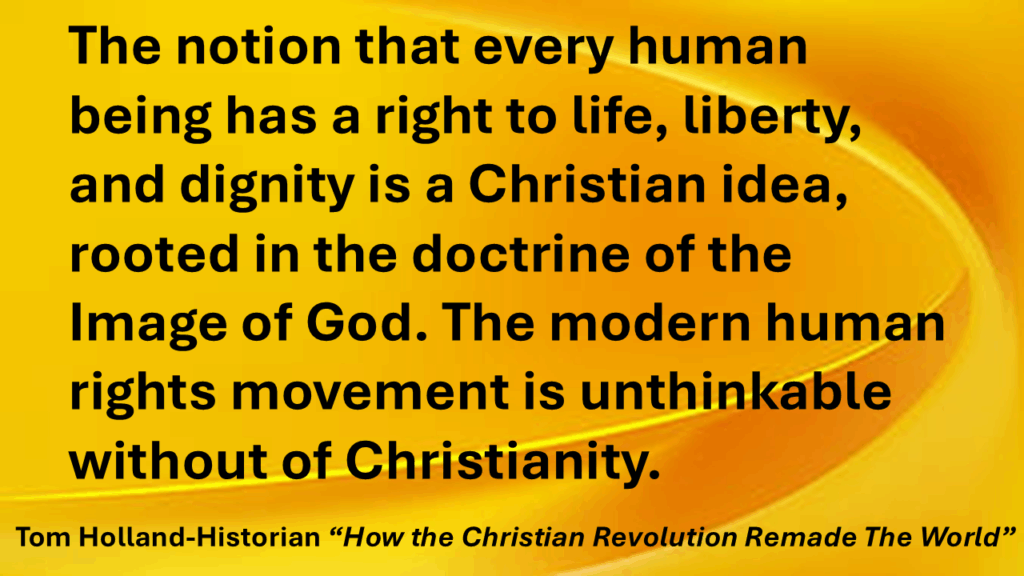
Christianity did not invent compassion or justice, but it uniquely grounded these ideals in the character of God and made them binding moral obligations for all believers. It proclaimed to the world that kings and slaves, men and women, rich and poor all stood equally before their Creator.
While abuses have occurred in the name of religion, the authentic message of Jesus Christ has consistently lifted up the lowly, broken down barriers, and inspired lasting change. The Christian worldview not only transformed individual hearts—it reshaped entire civilizations.
Challenge Question: If Christianity is often dismissed as harmful, oppressive, or irrelevant, how do we explain the fact that it has historically been the leading force behind hospitals, education, human rights, orphan care, anti-slavery movements, and modern humanitarian aid—and continues to be on the front lines of global advocacy today?
ThinkCube Truth Veracity Grid
- Have I considered the facts carefully and with an open mind?
- Is my conclusion the result of a careful examination of the facts, or is it a conclusion made in spite of the facts?
- Is my conclusion the one that makes the most sense of the evidence?