Premise 1: Why Would Anyone Plot And Murder A Moral Teacher
mo·tive
/ˈmōdiv/
a reason for doing something, especially one that is hidden or not obvious.
Almost no serious historian today disputes that Jesus of Nazareth was a real historical figure who lived in the first century AD, carried out a public ministry for several years, and was ultimately crucified by Roman authorities. Even skeptical scholars—such as agnostic New Testament expert Bart Ehrman—argue vigorously for the historical reliability of these basic facts, citing a wealth of evidence from both Christian and non-Christian sources. But this raises the compelling question of motive:
Why would a peaceful, gentle, compassionate teacher—one who healed the sick, fed the hungry, comforted the broken, and welcomed society’s outcasts—be condemned, tortured, and executed in one of the most excruciating ways imaginable
On one side of the coin, Jesus was deeply beloved by the common people. His fame spread far and wide, to the point that He drew crowds of thousands wherever He went. Many were drawn to His humility, His powerful teaching, and—perhaps most notably—His miracles. He healed the blind and lame, fed multitudes with a few loaves and fish, and spoke with an authority and love that transcended anything the people had experienced from their religious leaders.
So what went wrong? Why was such a man treated as a threat?
The answer lies in the other side of the coin.
While the public adored Jesus, the religious and political establishment grew increasingly hostile toward Him. He challenged their hypocrisy, exposed their corruption, and redefined holiness in ways that upended their power structures. He called out their pride, their legalism, and their empty outward religion. He didn’t just offer healing—He claimed divine authority. He forgave sins, accepted worship, and spoke of Himself as the fulfillment of ancient prophecies. In short, He claimed to be more than a teacher. He claimed to be the Son of God.
And that is why He was crucified.
For this reason they tried all the more to kill Him, not only was He breaking the Sabbath,
John 5:18
but He was even calling God His own Father, making Himself equal with God
Plots To Kill Jesus Intensified Because He Didn’t Just Claim to Be God—He Proved It
The Bible records at least 14-16 distinct times attempts, plots, or intentions to arrest or kill Jesus took place. ten of those distinct times were in direct response to witnessing first hand Him doing miracles. Why—pray tell?
Attempts to Kill Jesus in Response to His Miracles
| Miracle | Reaction | Reason Given |
|---|---|---|
| Healing the man with a withered hand (on the Sabbath) Matthew 12:9–14; Mark 3:1–6; Luke 6:6–11 | Pharisees and Herodians plot to destroy Him | His miracle exposed their authority and challenged their interpretation of Sabbath law |
| Healing the paralytic (forgiving sins + miracle) Mark 2:1–12 | Scribes accuse Him of blasphemy | He claimed divine authority to forgive sins, then validated it by healing |
| Healing the invalid at Bethesda John 5:1–18 | Jews seek to kill Him | He healed on the Sabbath and claimed God as His Father, making Himself equal with God |
| Healing the man born blind John 9:1–34; John 9:35–38 | Pharisees excommunicate the healed man; hostility intensifies | The miracle was undeniable and publicly verified |
| Raising Lazarus from the dead John 11:43–53 | Sanhedrin officially plots His death | The miracle was public, irrefutable, and caused many to believe |
| Continued miracles following Lazarus John 11:54–57 | Arrest warrant issued | Fear that belief in Jesus would spread uncontrollably |
| Triumphal entry (response to Lazarus miracle) John 12:9–11 | Chief priests plan to kill Lazarus also | Living proof of Jesus’ power was drawing people to Him |
| Miracles performed in the Temple Luke 19:47–48 | Chief priests seek to destroy Him | His authority was validated by miraculous power |
| Cleansing of the Temple (with healing) Matthew 21:12–15 | Religious leaders become indignant | His miracles affirmed His messianic authority |
| Ongoing public miracles John 12:37–38 | Leaders persist in unbelief and plot | Signs were undeniable, but belief threatened their power |
Jesus was not executed for vague religious claims or private spiritual teachings. He was killed because His miracles were public, repeated, and undeniable, and because those miracles authenticated claims of divine authority that directly threatened the religious establishment. The resurrection of Lazarus marked the decisive turning point—after which the leaders concluded that Jesus must die, not because He lacked evidence, but because He had too much of it.
The resurrection of Lazarus was so undeniable, so public, and so powerful that it shattered the ability of the religious leaders to dismiss Him as merely a misguided teacher or rogue miracle worker.
In that moment, the question of whether Jesus was the Messiah no longer mattered to them. What mattered was the threat He posed. The evidence of divine authority was too compelling—and the crowds were beginning to respond accordingly. Many were starting to believe not just that Jesus was sent from God, but that He was equal with God, just as He claimed.
He cried with a loud voice, “Lazarus come out.” The man who had died came out, his hands and feet bound with linen strips, and his face wrapped with a cloth, Jesus said to them, “Unbind him, and let him go.” Many of the Jews therefore, who had come with Mary and had seen what He did, believed in Him, but some of them went to the Pharisees and told them what Jesus had done. So the chief priests and the Pharisees gathered the council and said, “What are we to do? For this man performs many signs. If we let Him go on like this, everyone will believe in Him, and the Romans will come and take away both our place and our nation.” ...So from that day on they made plans to put Him to death.
John 11:43-53
This was the breaking point. For the religious elite, their entire system of authority, influence, and control was at risk. The rise of Jesus—if not stopped—meant the fall of their power. And so, the paradigm of the Son of God had to be silenced. From that point forward, their plotting turned into a single, focused mission: eliminate Jesus by any means necessary.
What the Resurrection of Lazarus Made the Pharisees Afraid Of:
- Mass Public Belief in Jesus “If we let him go on like this, everyone will believe in him…” (John 11:48)
➤ They feared losing control over the crowds as more people began believing Jesus was the Messiah—or more than a man. - Loss of Religious Authority
➤ Jesus was drawing attention away from the Pharisees and undermining their influence by teaching with unmatched authority and performing undeniable miracles. - Loss of the Temple “…and then the Romans will come and take away both our temple…” (John 11:48)
➤ They feared Rome would view Jesus as a political threat and retaliate by destroying their central place of worship. - Loss of National Identity and Privilege “…and our nation.” (John 11:48)
➤ They feared that belief in Jesus would provoke Rome and jeopardize the relative autonomy the Jewish leaders enjoyed under Roman rule. - Jesus’ Power Over Death
➤ The miracle of raising a man four days dead was unprecedented—it was a divine-level act. This validated His claims to be the Son of God and left the leaders with no natural explanation. - Exposure of Their Hypocrisy and Spiritual Emptiness
➤ Jesus’s authority, compassion, and miracles contrasted sharply with the religious leaders’ legalism and pride, exposing them as spiritually bankrupt. - A Shift in the Entire Religious Paradigm
➤ If Jesus truly was the Messiah—or worse (in their eyes), God in the flesh—then their entire religious system would have to be re-evaluated. This was a threat to everything they had built. - Fulfillment of Messianic Prophecy in Jesus, Not Them
➤ Jesus was fulfilling prophecies they claimed to understand and teach. That meant they had missed or rejected the very One they were supposedly preparing the people to receive.
The raising of Lazarus was the final straw. For three years, Jesus had taught with unmatched authority and demonstrated power over disease, nature, blindness, and demonic forces. But the resurrection of Lazarus was different—it was public, undeniable, and emphatic proof of His divine authority. At that point, Jesus could no longer be ignored, debated, or merely opposed. He had to be eliminated—because He was proving exactly who He claimed to be.
Challenge Question: If Jesus had only been a popular moral teacher and miracle worker, why do you think the Pharisees and religious leaders were so determined to kill Him? What does their reaction reveal about the real threat they perceived—and what does it suggest about Jesus’s true identity?
Premise 2: Jesus’ Resurrection Proved He Was Not Just A Religious Teacher
The reason Jesus was plotted against, arrested, tried, and ultimately crucified was not merely because He was a popular teacher or moral influence. The Pharisees and chief priests understood that the evidence for His divinity was becoming overwhelming. He was not just another passing religious figure, self-proclaimed prophet, or charismatic rabbi who would rise in popularity for a time and then disappear. Jesus was different. His teachings carried divine authority, His miracles defied natural explanation, and His growing influence threatened to overturn everything the religious elite had built.
They feared more than just public acclaim—they feared the implications of His identity. With every healing, every exorcism, every command over nature, and especially with the raising of Lazarus from the dead, Jesus wasn’t just claiming to be the Son of God—He was proving it.
Little did they realize that their plan to kill Him—publicly, shamefully, and violently—would not silence His message but fulfill His mission. By crucifying Him in full view of the crowds, they ensured everyone saw that Jesus had truly died. But instead of ending His movement, the cross became the turning point. His resurrection just days later would serve as the ultimate and irreversible confirmation of His divinity, leaving no room for denial and no recourse for those who opposed Him. In trying to destroy Him, they unknowingly set the stage for the greatest vindication in history.
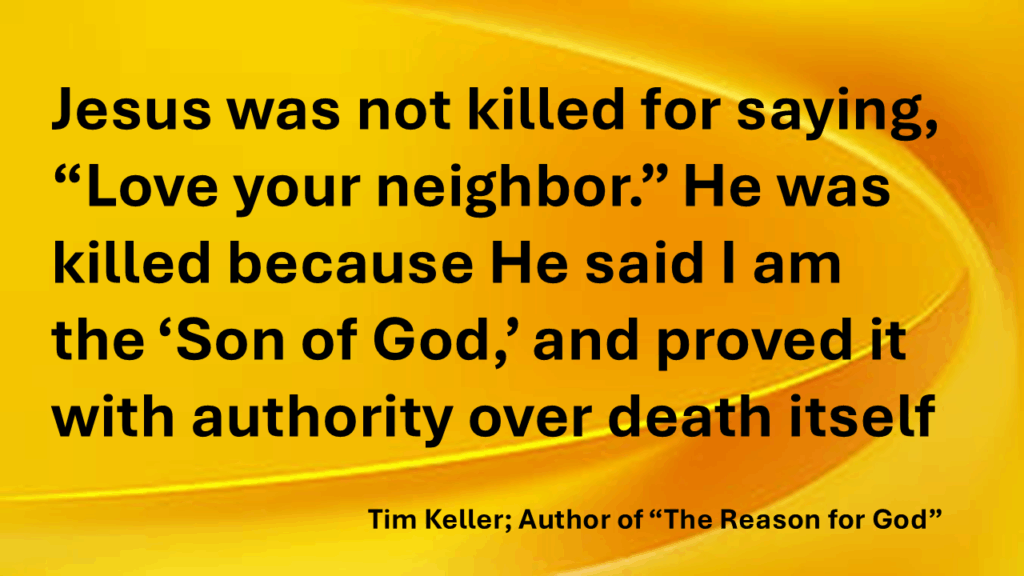
What the religious leaders never anticipated was that Jesus’ public crucifixion would become the most verifiable aspect of His ministry—and the very foundation for belief in His resurrection. The fact that He died openly and was buried in a known tomb made it impossible to fake or fabricate His return from the dead. Yet just days later, eyewitnesses claimed to have seen Him alive, and those same fearful disciples were suddenly bold proclaimers of His resurrection. Within weeks, thousands in Jerusalem—the very city where He was crucified—began to follow Him. The rapid growth of the early church, centered entirely on the belief that Jesus had risen, stands as one of the most compelling historical evidences that His death wasn’t the end—it was the beginning.
The Resurrection of Jesus Sets Him Apart from Every Other Religious Figure in History
Unlike Muhammad, Buddha, Joseph Smith, or any other religious teacher or founder, Jesus didn’t just share spiritual wisdom—He claimed to be the Son of God and proved it by conquering death itself. His resurrection wasn’t a private vision or mystical idea; it was a historical event witnessed by hundreds, in the very city where He had been crucified. His tomb was empty, His followers were transformed, and the early church exploded across hostile territory—all within a generation. No other figure in history foretold their own death and resurrection, then fulfilled it. The resurrection is not just the centerpiece of Christianity—it’s the unrepeatable proof that Jesus is exactly who He claimed to be: God in the flesh, Lord over life and death, and the only Savior of the world.
The Resurrection of Jesus: From Scholars And Skeptics
| Author | Credential | Quote |
|---|---|---|
| Gerd Lüdemann | Atheist historian | “It may be taken as historically certain that the disciples had experiences after Jesus’ death in which Jesus appeared to them as the risen Christ.” |
| Bart Ehrman | Agnostic NT scholar (UNC) | “What is certain is that the earliest disciples believed that Jesus was raised from the dead—and this belief transformed their lives.” |
| Paula Fredriksen | Jewish historian | “I know in their own terms what they saw was the risen Jesus.” |
| E.P. Sanders | Historian (Oxford) | “That Jesus’ followers believed He was resurrected is beyond dispute.” |
| Michael Grant | Classical historian | “The historian cannot explain the rise of Christianity unless the resurrection took place.” |
| H.G. Wells | Historian | “This penniless preacher from Nazareth is irrevocably the very center of history.” |
| N.T. Wright | New Testament historian (Oxford) | “Christianity was born not from a moral teaching, nor from a philosophy of life, but from the belief that something had happened.” |
| James D.G. Dunn | NT scholar | “The resurrection was the belief that gave Christianity its explosive force.” |
| Wolfhart Pannenberg | Systematic theologian | “The resurrection of Jesus is the anticipation of the end of history.” |
| William Lane Craig | Philosopher & historian | “The resurrection of Jesus is the best explanation of the historical facts we have concerning His fate.” |
| Gary Habermas | Resurrection scholar | “The resurrection best explains the empty tomb, the eyewitness claims, and the birth of the Christian movement.” |
| Jaroslav Pelikan | Yale historian & theologian | “If Christ is risen—nothing else matters. If Christ is not risen—nothing else matters.” |
This is why the resurrection is not just a miraculous event—it is the defining line in human history. It forces a choice: either Jesus was who He said He was, or the greatest movement in history was built on a lie that withstood every effort to suppress it. The empty tomb confronted the world with a reality that could not be explained away, even by His enemies. It turned skeptics into believers, persecutors into apostles, and fear into unshakable faith. If Jesus truly rose from the dead, then every claim He made—about God, truth, salvation, and eternity—is validated with absolute authority. There is no middle ground. The resurrection doesn’t leave room for Jesus to be merely a good teacher. It demands that we see Him as He truly is: the risen King, the Son of the living God, and the hope of the world.
Challenge Question: If the empty tomb, multiple eyewitness accounts, and the explosive growth of the early church in Jerusalem all point to the resurrection as a real historical event, what would it say about us—like the Pharisees—if we acknowledged the evidence but still dismissed Jesus as merely a moral teacher?
ThinkCube Truth Veracity Grid
- Have I considered the facts carefully and with an open mind?
- Is my conclusion the result of a careful examination of the facts, or is it a conclusion made in spite of the facts?
- Is my conclusion the one that makes the most sense of the evidence?