Premise 1: Information Must Come From An Intelligent Source
in·for·ma·tion
Merriam Webster Dictionary
/ˌinfərˈmāSH(ə)n/
the attribute inherent in and communicated by one of two or more alternative sequences or arrangements of something (such as nucleotides in DNA or binary digits in a computer program) that produce specific effects.
Information is what you get when things are arranged in a specific order that makes something happen or communicates a message.
- Imagine letters in a sentence, digits in a computer, or molecules in DNA.
- These things can be put together in many different ways—but only some arrangements actually mean something or do something useful.
- For example:
- The letters D-O-G tell you about an animal.
- The DNA sequence ATCG… tells your body how to build a protein.
- The computer code 1010 might tell a machine to perform a task.
The Two Foundational Tenets of The Laws of Information
1. Information is non-material and cannot be reduced to the interaction of matter and energy
Example: Imagine a sandy stretch of beach. With my finger I write a number of sentences in the sand. The content of the information can be understood. Then I write another sentence in the sand. In doing so I am using the same matter as before to display this information. Despite this erasing and rewriting, displaying and destroying varying amounts of information, the mass of the sand did not altar at any time. The information itself is thus massless.
This simple experiment illustrates a profound point: information is immaterial. It is not the sand, or the ink on a page, or the magnetic bits on a hard drive that are the information—they merely carry it. The same material can carry countless different messages, depending on how it is arranged.
This same principle applies to DNA. DNA contains four chemical building blocks—adenine, thymine, cytosine, and guanine. But it is the precise order of these building blocks that carries the genetic instructions needed to build and maintain living organisms.
Think of letters in a sentence. The same letters can be arranged to communicate entirely different messages. Likewise, the information in DNA depends not simply on its chemical ingredients, but on how those ingredients are arranged.
This raises a fundamental question about the origin of life: Where did the information come from? Chemistry explains what DNA is made of and how it works, but explaining how the first biological information originated remains a major scientific challenge.
From an intelligent design perspective, the extraordinary amount of functional information in DNA points to an intelligent source. Matter can carry information, but the existence of matter alone does not explain the origin of the instructions needed for life.
How could unguided natural processes produce the astonishing amount of precisely organized information encoded in DNA? Each human cell contains approximately 3 billion base pairs—equivalent to roughly 750 megabytes of genetic information. Even a small error in a critical section of this code can cause a cell to malfunction or die.
Consider this illustration: Leo Tolstoy’s War and Peace contains approximately 587,000 words. Imagine cutting out every letter of that enormous novel, placing them all in a box, and thoroughly mixing them together. Now dump the letters onto a table.
What are the chances that those hundreds of thousands of letters would arrange themselves into the exact words, sentences, paragraphs, and chapters of War and Peace?
Yet the information contained in human DNA is vastly more extensive and serves an even more remarkable purpose: providing the instructions necessary to build, operate, and maintain a living human being.
If we recognize that the meaningful arrangement of letters in a novel comes from an intelligent author, shouldn’t we seriously consider intelligence as the source of the far more complex information found in DNA?
2. An intelligent sender is the only entity that can produce universal information
An intelligent sender is the only known source capable of producing universal, meaningful information. In all of scientific observation, no instance exists in which purposeful, instructional information—like that found in language, codes, or blueprints—has ever arisen spontaneously from non-intelligent processes. Information always points back to intelligence.
To illustrate this, imagine walking along a beach and seeing a sentence clearly written in the sand. You wouldn’t assume the waves, wind, or random natural forces arranged the grains into coherent language—you would instinctively conclude that a person had written it. Why? Because language is a product of mind.
Design in nature operates on the same principle. If you were to find a Rolex watch lying on the ground, it would be absurd to conclude that it formed itself through random, unguided processes in the sand over time. You would rightly infer that a designer—a skilled, intelligent mind—crafted it.
All biological systems depend on information storage, transfer, and interpretation—a process so precise and purposeful that it reflects more than blind chemistry; it reflects design. From the genetic code stored in DNA, to the molecular machines that read and apply that code, to the neural networks in the human brain that process thought, memory, and emotion, every level of life is governed by systems that resemble language and logic.
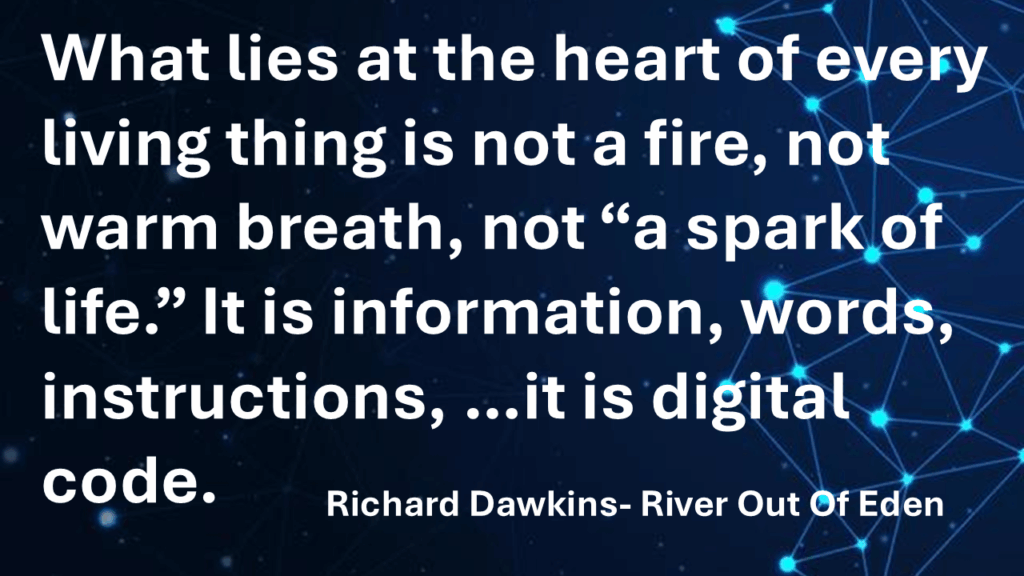
The complex, information-rich systems found in DNA, cellular machinery, and living organisms overwhelmingly point to intentional design. These are not random occurrences—they point to the mind of a Divine Creator who imbued creation with both intelligence and intention. They bear the unmistakable hallmark of an intelligent source—one not limited by chance or material necessity, but guided by purpose, logic, and creativity.
Challenge Question: Bill Gates said “DNA is more complicated than any computer code.” If we would never imagine that books, software, or instruction manuals arise by chance. Why should the information in DNA be any different?
Premise 2: Quantum Complexity Can’t Be The Product of Random Processes
For centuries, atoms were believed to be the smallest, indivisible units of matter. The word atom itself comes from the Greek word atomos, meaning “uncuttable.” But modern atomic physics and quantum mechanics have shattered that view, revealing that atoms are not simple building blocks—but incredibly complex, dynamic systems made of even smaller components governed by deeply intricate laws.
What atomic physics and quantum mechanics have revealed is that even the smallest parts of nature are extraordinarily rich with structure, behavior, and interdependence.
Modern physics reveals that the particles once thought to be simple are, in fact, extraordinarily intricate, interconnected, and finely tuned for the very existence of stars, matter, chemistry, and life itself. What earlier ages pictured as a purely mechanical, predictable clockwork is now understood as a realm of delicate order, embedded information, and vast unseen complexity—all compressed into the tiniest units of matter.
The subatomic realm operates according to finely tuned laws and mathematical regularities that govern the behavior of particles, energy, and forces. Modern science has revealed that even the tiniest components of the universe are marked by structure, predictability, and breathtaking complexity—suggesting a deeper coherence woven into the fabric of reality.
The atom is as complex as the solar system, and it contains worlds within worlds.
George Gamow—Theoretical Physicist wrote (The Biography of Physics)
Atoms, long seen as simple building blocks, now unfold as intricate worlds of mystery and complexity. Atomic physics—the study of the atom’s structure, its energy states, and its interactions with other particles and with electric and magnetic fields—shows just how remarkable these entities are. An atom is roughly a million times smaller than the thickness of a human hair, and about five million hydrogen atoms could fit on the head of a single pin.
A single drop of water contains more atoms than the estimated number of stars in the observable universe—and even more remarkable, each atom is governed by precise laws, finely balanced forces, and stable constants that keep it ordered, coherent, and functional.
Worlds Within Worlds— The Ordered Beauty of Atoms
When we peer into the smallest building blocks of reality—atoms and subatomic particles—we find not chaos or randomness, but a world of astonishing precision, structure, and interdependence.
Atoms are composed of protons, neutrons, and electrons, each with precise properties:
- Protons carry positive charge and define an element’s identity.
- Neutrons stabilize the nucleus; change them, and the atom becomes radioactive.
- Electrons orbit the nucleus in well-defined energy levels governed by quantum laws.
Even a slight imbalance in these relationships would result in the destabilization of matter itself. The exact arrangement and charges are so finely tuned that if changed by even the smallest degree, stable chemistry—and life—would not be possible.
Quantum Mechanics— Behavior with Purpose
At the quantum level, particles behave in ways that defy classical intuition, yet still exhibit order and predictability governed by mathematical laws:
- Electrons exist in orbitals, not fixed paths, and their locations can only be predicted probabilistically—but the probabilities themselves follow precise equations.
- Quantum entanglement shows particles can be connected over vast distances, instantly influencing one another, a phenomenon Einstein famously called “spooky action at a distance.”
- Wave-particle duality reveals that particles like photons behave as both particles and waves, depending on how we observe them.
These are not random behaviors. They reflect highly structured interactions, often with interdependencies that link particles across time and space.
Interdependence at the Quantum Level
No subatomic particle exists in isolation:
- Electrons rely on electromagnetic forces to stay in orbit.
- Atomic nuclei are held together by the strong nuclear force, which must perfectly balance the repulsive force of protons.
- Quarks, the building blocks of protons and neutrons, are held together by gluons and cannot exist independently (a concept called quark confinement).
Each level of structure depends on precise interactions among many parts, and those interactions are governed by fixed laws that enable the possibility of life, chemistry, and the entire material universe.
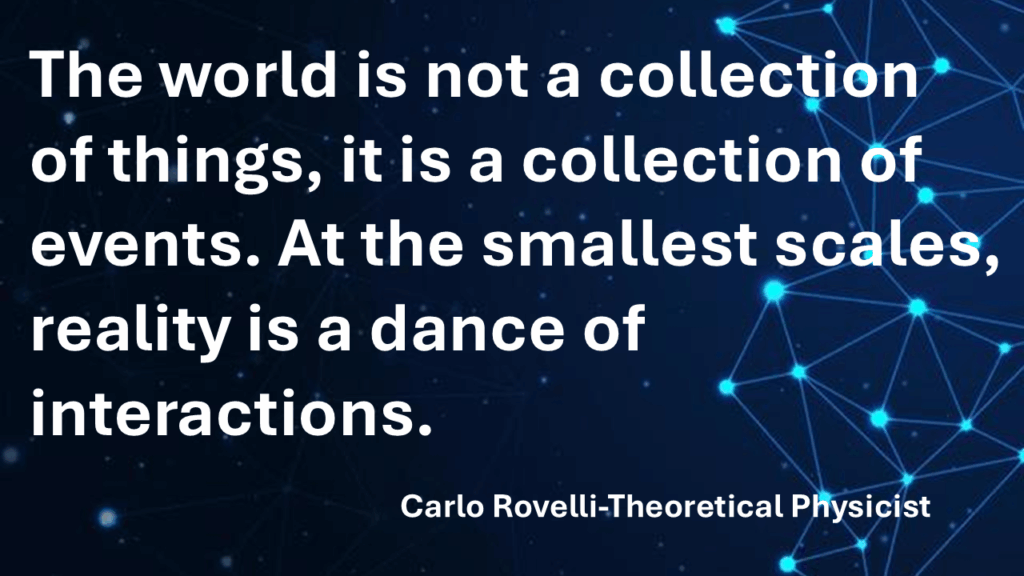
Even the smallest building blocks of matter are anything but simple or random. They possess remarkable structure, follow precise mathematical laws, and interact in highly organized ways.
What does this extraordinary order tell us about the universe?
It points to a profound conclusion: Intelligence is not merely something that emerged within the universe—it is the source of the order and design woven into its very foundation. From the smallest particles to the vastness of the cosmos, the deeper we look, the more evidence we find of the wisdom and creative power of an intelligent Designer.
Challenge Question: If atoms and subatomic particles—the smallest known building blocks of nature—are governed by precise laws, structured interactions, and interdependent forces, what does that suggest about the origin of the universe? Does such order at the smallest scales point more convincingly to random processes or to an intelligent Designer?
Premise 3: The Laws Of Physics Can’t Be The Result Of Random Processes
“The book of nature is written in the language of mathematics.”
Galileo Galilei “The Father of Science”
What Galileo meant was that the natural world follows predictable, discoverable patterns that can be described using mathematical laws. Whether it’s the arc of a falling object, the orbit of a planet, or the behavior of light, nature operates in a way that can be quantified and understood through equations, numbers, and geometry.
Mathematics as the Foundation of Physics
Physics, at its core, is the study of how the universe works, and mathematics is its primary language. Here’s why:
- Newton’s laws of motion are expressed in equations.
- Einstein’s theory of relativity is captured in the famous equation E=mc2E = mc^2E=mc2.
- Quantum mechanics uses probability amplitudes, wave functions, and matrix algebra to predict outcomes.
- Maxwell’s equations describe how electric and magnetic fields interact.
These are not just tools of communication—they are the very structure of the physical laws themselves.
Mathematical Information in the Universe
Galileo’s insight has only deepened with time. Modern physics reveals that the universe is saturated with mathematical information:
- The gravitational force follows the inverse-square law (F=Gm1m2r2F = G \frac{m_1 m_2}{r^2}F=Gr2m1m2).
- The speed of light, Planck’s constant, and other fundamental constants are precise values that govern how particles behave.
- The structure of atoms, the shapes of galaxies, the fine-tuning of physical constants—all follow mathematical patterns that are not arbitrary, but intelligible.
This leads to a profound realization: the universe behaves as if it were built upon a framework of deeply embedded information—highly specific, elegant, and discoverable.
Implication: Order, Intelligibility, and Design
Modern physics has revealed that nature is not chaotic, but ordered—and that human minds are capable of understanding it precisely because that order is mathematical. This has important implications:
- If nature can be written and read like a book, who is the Author?
- If the laws of physics are intelligible and exact, why are they so finely tuned to allow life and discovery?
- As Albert Einstein once said, “The most incomprehensible thing about the universe is that it is comprehensible.”
This echoes Galileo’s insight: the universe is not just matter and energy—it is structured information, intelligible logic, and mathematical harmony. Modern physics confirms this in ever greater detail, revealing a cosmos that is not random, but exquisitely ordered and rich with meaning—a universe that speaks the language of numbers, structure, and reason.
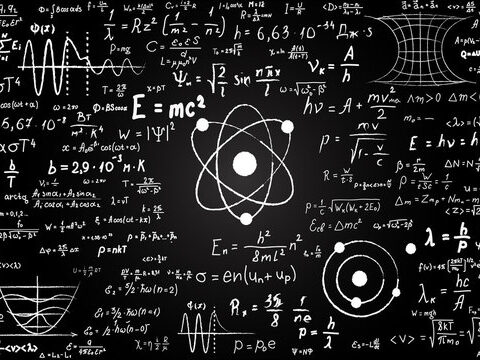
All of the Known Laws of Physics are Based on Mathematical Formulas
- Law of Cosmic Expansion
- Law of Planetary Motion
- Law of Gravitation
- Law of Motion
- Law of Thermodynamics
- Law of Buoncy
- General Relativity
There are 26 physical constants in the Universe. Examples are the speed of light constant, gravitational constant, gas constant etc. They are mathematical values that have never changed since the beginning of the universe and every atomic particle is designed to work as per the parameters of these constants.
8 examples of the 26 constants and their mathematical formulas
Electron rest mass me 9.109 × 10⁻³¹ kg
Proton rest mass Mp 1.6726 × 10⁻²⁷ kg
Electronic charge e 1.6022 × 10⁻¹⁹ C
Speed of light in free space c 2.9979 × 10⁸ m s−1
Permeability of free space µ0 4π× 10−7 H m−1
Permittivity of free space 0 8.854 × 10⁻¹² F m−1
Planck’s constant h 6.626 × 10⁻³⁴ J s
Reduced Planck’s constant h¯ = h/2π 1.0546 × 10⁻³⁴ J
There are at least 15 major branches of physics—such as quantum mechanics, thermodynamics, electromagnetism, and astrophysics—that rely on the precise laws and constants of physics to interpret and validate all other physical data. These constants, like the speed of light, gravitational constant, and Planck’s constant, are foundational and unchanging across time and space. Yet despite their central role, no scientific discipline has been able to explain why these constants exist, why they never vary, or how such exact values could have arisen by chance. Their consistency and fine-tuning continue to suggest an underlying order that defies random explanation.
It’s scientifically impossible to explain how 26 constants have remained precisely fixed at their operating value for billions of years. Further, it’s impossible to scientifically explain how every type of subatomic and atomic particle is designed to work as per the parameters of these 26 constants. Every type of sub-atomic particle in this universe has obeyed these 26 parameters since the universe was created. This is nothing but intelligent design.
Jeff Miller PhD Molecular Mechanisms; UCLA Department of Molecular Genetics
Why The Laws of Physics Can’t Be the Result of Random Natural Processes
The laws of physics and the 26 fundamental constants (like gravity, the speed of light, Planck’s constant, and the fine-structure constant) are not only incredibly precise—they are also essential for a life-permitting universe. Even slight variations in these values would make the formation of stars, planets, chemistry, or life impossible.
But here’s the dilemma: Natural processes depend on the laws of physics to operate. If those laws came into existence, what caused them to exist in the first place?
Why This Poses a Problem for Random Origins
- Randomness presupposes a framework: To call something “random,” there first has to be a setup where events can take place—a space, a clock, and rules for how things work. But those very conditions (space, time, and laws) are exactly what we’re trying to explain in the first place.
- No natural explanation for constants: There is currently no scientific theory that explains why the constants have the values they do. They appear “set” from the very beginning without physical necessity.
- Extremely fine-tuned: The odds of all the physical constants being precisely set to allow life are unimaginably small. Even slight changes in values such as gravity, the speed of light, or the strength of atomic forces would make stars, planets, chemistry, and life impossible. Physicist Roger Penrose calculated that the conditions necessary at the universe’s beginning had a probability of about 1 in 10¹⁰¹²³. To appreciate how small that is, there are only about 10⁸⁰ atoms in the observable universe. Even if every atom represented an entire universe filled with atoms, and each of those atoms represented another universe, you still would not come remotely close to Penrose’s number.
The Core Issue
If the laws and constants came into existence before the universe operated, then random processes couldn’t have selected or fine-tuned them—because randomness itself needs a playing field (physical laws) to operate.
This leads many scientists and philosophers to conclude that:
- The laws and constants are either brute facts (just the way things are with no explanation),
- Or the product of intelligent design—a Mind outside of nature that established order, precision, and purpose.
The astonishing precision and interdependence of the laws and constants that govern the universe point unmistakably beyond chance. Since natural processes require preexisting laws to operate, and those very laws appear finely tuned from the outset, it follows logically that their origin lies outside of nature itself.
You can’t explain the system by chance when chance itself needs a system to exist. This leaves us with the only logical alternative: the existence of a transcendent, intelligent Cause—one not bound by space, time, or matter—who established these laws with purpose and intention. The fine-tuned universe is not an accident—it is the work of a divine Designer.
Challenge Question: If the laws of physics and the fundamental constants were necessary for the universe to operate—and yet had to exist before any natural processes could occur—how can their precise values be explained apart from an intelligent cause? Could such fine-tuning be the product of randomness, even though randomness itself requires a pre-existing system to function?
Premise 4: Coded DNA Can’t Be The Result Of Random Processes
DNA is like a computer program but far, far more advanced than any software ever created
Bill Gates, The Road Ahead
The Human Genome Institute defines DNA as “a molecule that contains biological instructions that make each species unique” —the word “instructions” is a synonym for information.
DNA contains the instructions needed for an organism to develop, survive and reproduce. To carry out these functions, DNA sequences must be converted into messages that can be used to produce proteins, which are the complex molecules that do most of the work in our bodies.
DNA much like atomic mass, chemistry, and the Laws of Physics contains coded language of the most sophisticated variety. It also has information storage ability like the atom and it’s isotopes do. DNA can store 140,000 times more data than iron (III) oxide molecules, which stores information on computer hard drives.
Deoxyribonucleic acid (DNA) has the potential to be a sophisticated, stable, and dense information storage medium. DNA has been used by nature for over 3.5 billion years to store genetic instructions for the development, growth, reproduction, and functioning of organisms and viruses. DNA’s four-letter nucleotide code can be used to represent letters, digits, and other characters, similar to binary code used by computers. DNA can also retain information for thousands of years, and has been recovered after being frozen for thousands of years, and has been recovered after being frozen in the tundra for 2 million years.
Wyss Institute; Harvard
Notice that scientist commonly refer to DNA using descriptors such as information storage medium, binary digital code, letters, digits, and characters.
DNA contains the instructions needed for an organism to develop, survive and reproduce. To carry out these functions, DNA sequences must be converted into messages that can be used to produce proteins, which are the complex molecules that do most of the work in our bodies.
There are an estimated 8.7 million classified species on Earth, and each one contains its own unique set of genetic instructions. Evolutionists claim that this vast reservoir of information arose through random processes and gradually organized itself into the extraordinary complexity we observe throughout the biosphere. Students are taught in middle school science classes that life began when matter, dust, chemicals, and gases spontaneously gave rise to the first single-celled organism through a process known as abiogenesis. What is often not fully discussed, however, is the astonishing genetic complexity found even in a single-celled organism like an amoeba.
The DNA in an amoeba is incredibly complex—so much so that it vastly exceeds human DNA in raw size and reveals the rich, information-heavy nature of even microscopic life. The human genome contains about 3.2 billion DNA base pairs. If each pair were printed as a single letter in a book, it would fill roughly 1,000 books of 500 pages each. Some amoeba species are estimated to possess more than 200 times as much DNA. Using the same analogy, their genetic information would fill over 200,000 books—enough to stock a large university library—yet all of that information exists within a single microscopic cell invisible to the naked eye.This speaks to the intricate design and organizational depth found throughout biology, even in single-celled organisms.
Amoeba & Human DNA Comparison
| Organism | Estimated Genome Size (Base Pairs) | Information Content (Approx.) | Comparison to Humans |
|---|---|---|---|
| Human (Homo sapiens) | ca. 3.2 billion base pairs | ca. 1.5 GB of information | — |
| Amoeba dubia | ca. billion base pairs | ca. 167.5 GB of information | ca. 200× more DNA |
| Amoeba proteus | ca. 290 billion base pairs | ca. 72.5 GB of information | ca. 90× more DNA |
Assuming that the original primeval form of life was some kind of an amoeba—where did it obtain the almost infinite number of bits of information required to be stored in its DNA storage and retrieval system?
A.E. Wilder-Smith; PhD Physical Organic Chemistry, PhD Pharmacology
Is it legitimate to assume that such incredible amounts of information arose spontaneously out of thin air by pure chance?
If you stretched the DNA of a single amoeba it would be a 1/4 mile long. The fact that a so-called “simple” organism like an amoeba holds far more genetic information than a human being raises a profound question:
- If life evolved upward in a stepwise, information-accumulating process, why do simpler organisms possess more DNA?
- If a single cell organism was the first link in the chain of evolution how did so much information arise from non-living matter in perfect sequence and with such complexity?
This overwhelming volume of structured, information-rich code suggests that even the simplest life forms were intentionally encoded with complexity from the beginning—a fingerprint not of chance, but of a Designer.
The idea that even a fully functional, single-celled organism—especially one as information-rich as an amoeba—arose from non-living matter through random natural processes:
- Requires overcoming astronomical odds (10¹⁰⁰ or worse),
- Demands the sudden appearance of encoded, interdependent systems,
- Lacks any experimental support
- Contradicts everything we observe about the origin of information, which always comes from a mind.
Every part of the cell, from its genetic code to its molecular machines, shows evidence of functional order, information, and interdependence—the unmistakable hallmarks of intentional design.
In every area of life, we intuitively recognize that complex, information-rich systems require intelligence. We never attribute language to the wind, blueprints to erosion, or computer code to lightning. Yet the theory of abiogenesis asks us to believe that life, which is far more complex than any man-made system, arose by pure accident—without a mind, without purpose, and without a plan.
The DNA in even the simplest life form is not just matter—it is encoded instruction, a signature of God’s intelligence and intention. Life is not the result of blind forces but the product of a personal Creator who designs, sustains, and gives purpose to all things.
Therefore, the origin of life is not a triumph of randomness—it is a witness to the wisdom of God. The cell, the code, and the cosmos all speak with one voice: “In the beginning, God created.”
Challenge Question: If even the simplest living cell contains vast amounts of organized information—something that, in every other context, we recognize as the product of intelligence—what does this imply about the origin of life, and how should it shape our view of God as Creator?
Premise 5: Nature’s Vast Stores of Information Points To A Intelligent Designer
Nature is not only visually stunning—it is saturated with information at every level. The laws of physics, with their precise mathematical structure, the finely tuned constants that govern the universe, and the intricate systems within biology all point to a world built on intelligible order. From the built-in instructions in DNA to the way living things depend on each other in nature, and even to how tiny particles follow regular patterns, life on Earth is one giant web of connected systems, all packed with information that keeps everything working together. Such layered complexity and specificity suggest not randomness, but design and purpose that presupposes the imprint of intelligence having been woven into the very fabric of nature.
A clear and widely accepted definition of information, particularly in scientific and communication contexts, is:
Information is a sequence of symbols, signals, or data that conveys meaning, purpose, or instruction to a recipient.
Key Elements of Information:
- Symbolic Representation
- Information uses symbols or codes (e.g., letters, numbers, nucleotides in DNA) to represent something beyond themselves.
- Meaning or Purpose
- True information is not random—it carries a message, instruction, or intent that can be interpreted.
- Sender and Receiver
- Information involves a source (sender), a medium (signal or code), and a destination (receiver) that can understand it.
- Order and Structure
- Information has a specific arrangement or syntax that distinguishes it from meaningless noise.
How much Information Does Nature Contain?
In a 2021 paper, physicist Melvin Vopson estimated that each elementary particle in the observable universe carries about 1.509 bits of information—a bit being the smallest unit of information, like a yes/no or 0/1 choice. Using that figure, the total information contained in all the visible matter of the observable universe works out to roughly 6 × 10⁸⁰ bits (a 6 followed by 80 zeros). To appreciate how large that number is, imagine every grain of sand on all the beaches and deserts of Earth. Scientists estimate there are about 7.5 × 10¹⁸ grains of sand.
The universe’s information content would still be roughly 80 billion trillion times greater than the number of grains of sand on Earth. In other words, even our largest earthly numbers fall dramatically short of conveying the staggering amount of information bound up in the matter of the cosmos.
If you took the DNA from every person on Earth and counted all the digital information it holds, you’d have about 13 exabytes, or roughly 10²⁰ bits. That’s on the same breathtaking scale as all the grains of sand on every beach and desert on the planet.
To grasp the magnitude of this figure, consider that it surpasses the total number of words ever spoken by every human being in all of history. To put it in perspective, scientists estimate there are about 10⁸⁰ atoms in the entire observable universe—but the universe can hold 10⁹⁰ bits of information. That means the total amount of information is about ten billion times more than the total number of atoms— It’s a number so vast that it defies direct human comprehension and pushes the boundaries of mathematical imagination.
What’s the point?
The important point of these things is not merely that all the information contained in the Universe is incalculable but that all of the multiple branches of physics research realize that every particle (electron, proton, and neurons) contains coded, organized and purposeful information it the form of bytes or bits. Every branch of biology understands that even the single celled ameoba contains billions of base pairs of digital DNA.
Across at least fifteen recognized branches of quantum physics and some one hundred branches and subfields of biology, not a single discipline has ever produced even one atom—much less something as living and intricate as a blade of grass—entirely from scratch. For all their brilliance, these sciences can only observe, measure, and interpret the breathtakingly precise information that is already woven into the fabric of nature.
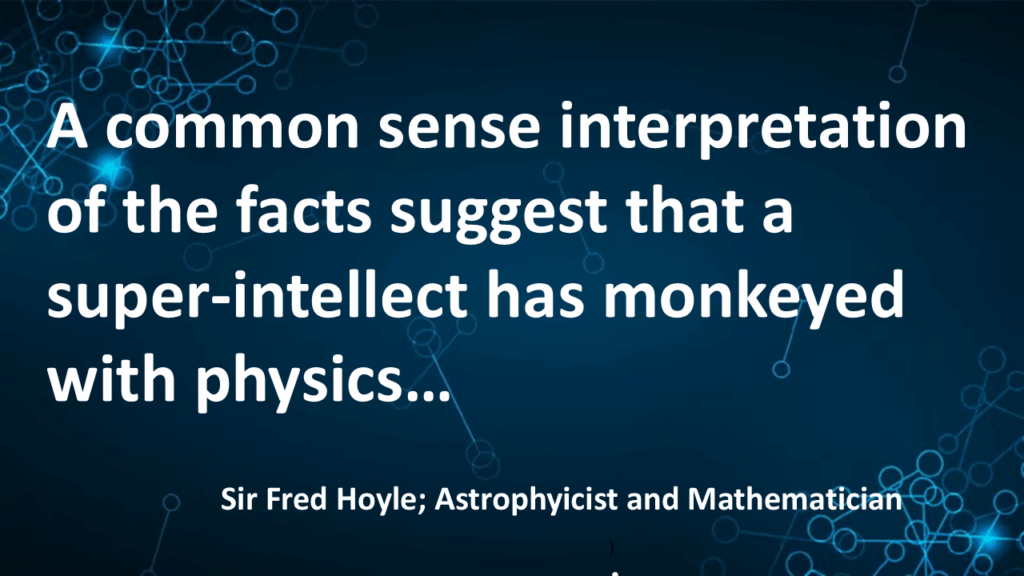
Is it not astonishing to consider that the world’s most brilliant minds, armed with advanced degrees and cutting-edge technology, are required to decode information that, according to a naturalistic worldview, supposedly came into existence by chance—without purpose, intelligence, or design? If the information is truly random, why does it require such intentional and intelligent effort to understand?
Challenge Question: Challenge Question: When we consider the staggering amount of information encoded in human DNA and the extraordinary complexity of the universe, which is more reasonable to believe—that all this order and information arose through unguided natural processes, or that it originated from an intelligent Creator?
ThinkCube Truth Veracity Grid
- Have I considered the facts carefully and with an open mind?
- Is my conclusion the result of careful examination of the facts, or is it a conclusion made in spite of the facts?
- Is my conclusion the one that makes the most sense of the evidence?