Premise 1: Genesis Describes Creation As A Cosmic Demonstration
In the beginning God created the heaven and the earth
Genesis 1:1
There are 5 literary styles in the Bible— Law, Poetry, Wisdom, Prophecy, Letters and Narrative. The book of Genesis and the Creation account in Chapter One is written as narrative history—which means that the primary focus is on the “What” and “Who” of the events detailed. The creation narrative was never intended to be a scientific treatment of origins but was written as a historical documentation of facts concerning what God created and how long it took Him to do it.
In an economy of words the first line of Genesis places supreme emphasis on the “Who” and the “What” of creation.
The emphasis is threefold:
- First God
- Second the universe
- Third the Earth
The author of Genesis opens with the profound and foundational assertion that “In the beginning, God created the heavens and the earth.” This declaration is not offered as a hypothesis to be tested, but as a self-evident truth—a sovereign act of divine will. The narrative proceeds with the implicit understanding that the creation of the universe, life, and all its intricate systems was a miraculous event—utterly beyond the reach of human comprehension or replication. From the very first sentence, Genesis presents creation as the result of supernatural power, not natural processes.
No explanation is given for how God brought matter, energy, time, and life into existence—because the focus is not on explaining the mechanics, but on revealing the identity of the Creator. The text assumes that the origin of the cosmos cannot be reduced to material causes or human reasoning, but is instead the work of a transcendent, eternal, and intelligent Being whose creative act stands outside the realm of nature, time, and human understanding.
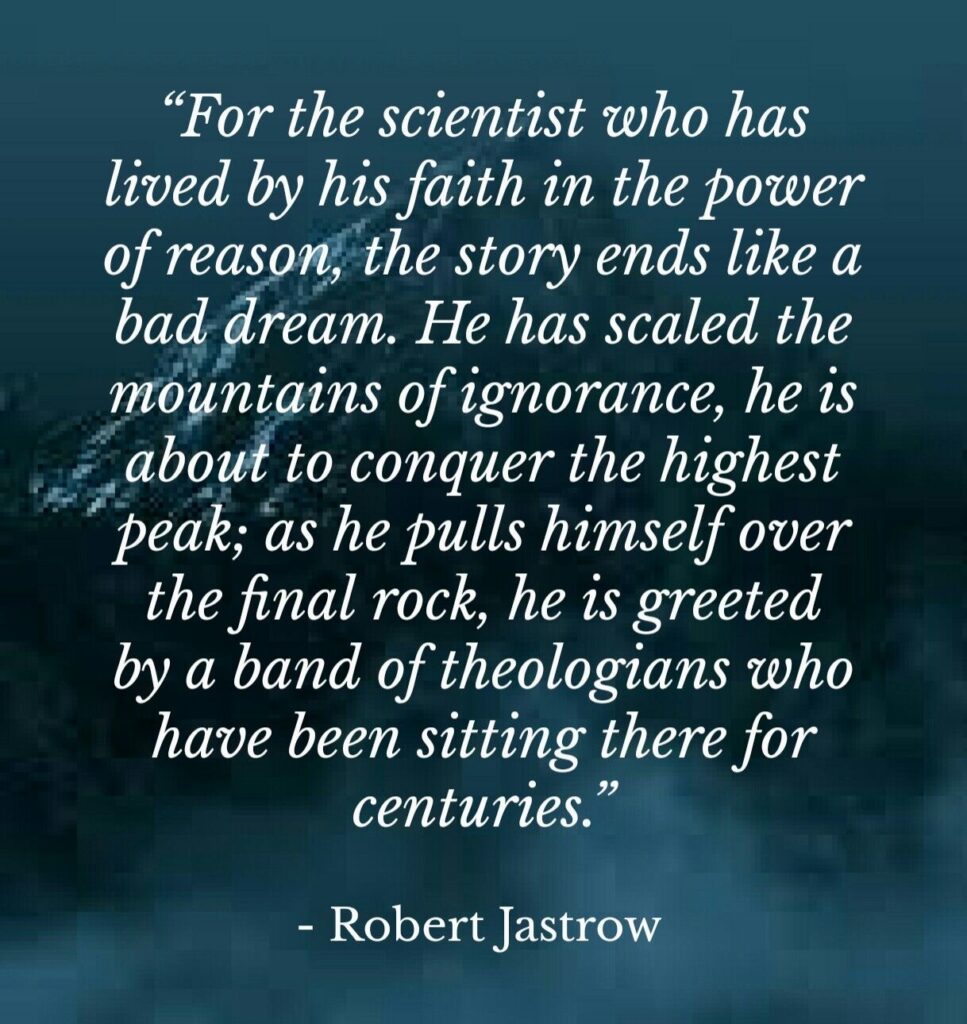
Advances in science are highlighting what the Bible has been stating all along——the creation of the universe, life, biological diversity, information, and laws of physics was not the result of natural processes but a sequence of super-natural events. Robert Jastrow—founder of NASA’s Goddard Institute, and renowned astrophysicist said it this way…
The Bible mentions the Creation event over 100 times and Jesus himself quoted Genesis 10 times— it is always alluded to as a super-natural event that only an infinite God could fully understand and that finite man was the privileged species that would document, superintend and marvel at.
The spontaneous generation of all matter, complex design, and perfect laws is the miracle of all miracles and that is how the creation account is treated throughout Scripture.
But ask the animals, and they will teach you, or the birds in the sky, and they will tell you; or speak to the earth, and it will teach you, or let the fish in the sea inform you. Which of all these does not know that the hand of the Lord has done this?
Job 12:7-10
Is Science Revealing A Super Intelligence That Can Not Be Fully Understood?
Genesis Chapter 1 is not just the Creation Chapter—it is the opening declaration of a far greater reality: that God exists outside of nature, unbound by time, space, or matter. It reveals that He is not part of the created order, but the sovereign cause of it. Every act of creation in Genesis 1 showcases His absolute authority, intentionality, and transcendence over all that exists. In this first chapter, we see the foundations of theology, cosmology, and anthropology—all grounded in the truth that God alone is eternal, self-existent, and supreme over His creation.
God’s Transcendence Revealed In Genesis Chapter 1
| Verse or Concept in Genesis 1 | What It Reveals About God |
|---|---|
| Genesis 1:1 – “In the beginning, God created…” | God exists before time, space, and matter—He is eternal and uncreated |
| Creation by Divine Command – “Let there be…” | God creates effortlessly by His Word—His will alone brings reality into being |
| Creation of Light before Sun – Genesis 1:3 vs 1:14 | Light exists before physical sources, showing God as the ultimate source of light and order |
| Creation of Time – Day and Night established | God establishes time—He is outside and above its flow |
| Creation of Space – Separation of waters, heavens | God defines spatial structure—He is not bound by physical dimensions |
| Creation of Life – Plants, Animals, Humans | Life originates from God, not from nature or chance—He is the giver of life |
| God Names and Orders – Day, Night, Seas, etc. | God assigns names and functions—He brings purpose and order to creation |
| Creation of Man in God’s Image – Genesis 1:26–27 | Human dignity and purpose come from being made in God’s image—He is personal and relational |
| God Blesses and Commissions – Genesis 1:28 | God gives dominion and blessing—He rules with authority and benevolence |
Man was never intended to be able to scientifically explain the origin of the universe, life, or the laws of nature through naturalism, because naturalism only studies what is within nature—yet all these things came from outside of nature. In short, naturalism cannot explain the supernatural origins of nature itself. These mysteries point beyond science to a transcendent Creator—just as Genesis 1 has always declared.
Isaiah 55:8-9 speaks about how God’s intelligence and power are above even the most brilliant scientists paygrade.
“For my thoughts are not your thoughts, neither are your ways my ways,” declares the Lord.
Isaiah 55:8-9
“As the heavens are higher than the earth, so are my ways higher than your ways and my thoughts than your thoughts.
Among all created beings, mankind possesses a unique and unparalleled capacity: the God-given ability to observe, study, reflect upon, and marvel at the wonder and intricacy of creation. This intellectual and spiritual faculty sets humanity apart, enabling us to recognize patterns, seek meaning, and be moved by the beauty and order found in the natural world.
Yet, as profound as our insight may be, it remains finite. While we can grasp glimpses of the grandeur of the universe and appreciate its design, the full depth of knowledge required to completely understand its origin, purpose, and mechanics lies far beyond the boundaries of human comprehension. The miracle of creation—its cause, its coherence, and its complexity—points us not to our own greatness, but to the infinite wisdom of the Creator, whose understanding surpasses all that we can imagine.
Scientific Voices Admitting the Limits of Human Knowledge
| Thinker | Position | Quote |
|---|---|---|
| Richard Feynman | Nobel Prize–winning Physicist (Quantum Electrodynamics) | “If you think you understand quantum mechanics, you don’t understand quantum mechanics.” |
| Werner Heisenberg | Pioneer of Quantum Mechanics | “The universe appears to me like a gigantic and unfathomable thought rather than a machine.” |
| Niels Bohr | Founder of Quantum Theory | “Anyone not shocked by quantum mechanics has not understood it.” |
| Albert Einstein | Physicist, Relativity | “The more I learn, the more I realize how much I don’t know.” |
| John Polkinghorne | Quantum Physicist & Philosopher | “The universe is not only stranger than we imagine; it is stranger than we can imagine.” |
| Max Planck | Founder of Quantum Theory | “Science cannot solve the ultimate mystery of nature… we are confronted with something wholly mysterious.” |
| Paul Davies | Theoretical Physicist | “The deeper physicists dig, the more the universe seems like a vast, unfathomable mystery.” |
| Michio Kaku | Theoretical Physicist (String Theory) | “At the quantum level, the universe is bizarre, unpredictable, and beyond our everyday comprehension.” |
| Stephen Hawking | Cosmologist | “The universe continues to surprise us. Each discovery only opens more questions.” |
Scientific Evidence of Divine Intelligence
| Scientific Field | Modern Discoveries / Advances | Quote By Expert |
|---|---|---|
| Genetics | DNA encodes vast amounts of structured, non-random information comparable to a sophisticated language or software code. | Bill Gates – Co-founder of Microsoft and pioneer in software engineering: “The genetic code is a true code. It’s not a metaphor. It’s not just a likeness to a code—it is a code in every formal sense.” |
| Biology | Molecular machines and integrated cellular systems exhibit extraordinary complexity and coordination. | Michael Behe, Ph.D. – Biochemist, Professor at Lehigh University: “To Darwin, the cell was a black box… we now know it is full of undiscovered and astonishing mechanisms.” |
| Cosmology | The universe’s physical constants appear finely balanced for the existence of life. | Sir Fred Hoyle – Astronomer, cosmologist, Fellow of the Royal Society: “A common sense interpretation of the facts suggests that a superintellect has monkeyed with physics.” |
| Astronomy | Exoplanet discoveries have highlighted the rarity and habitability requirements of Earth-like worlds. | Guillermo Gonzalez, Ph.D. – Astronomer and co-author of The Privileged Planet: “The more we learn about Earth, the more we realize how uniquely tuned it is for life.” |
| Atomic Physics | Fundamental constants such as Planck’s constant and the electromagnetic force appear remarkably precise. | Sir Paul Davies, Ph.D. – Theoretical physicist and cosmologist: “The laws of nature form a system that is extremely fine-tuned and elegant, suggesting design.” |
| Quantum Mechanics | Quantum phenomena reveal a universe governed by deep mathematical order beneath apparent randomness. | John Archibald Wheeler, Ph.D. – Princeton physicist and pioneer of quantum theory: “Quantum theory requires us to abandon the distinction between observer and observed.” |
| Information Theory | Information appears foundational to physical reality and biological systems. | Sir James Jeans – Physicist, astronomer, and mathematician: “The universe begins to look more like a great thought than a great machine.” |
| Chemistry | Life depends upon highly specific chemical relationships, reaction rates, and molecular properties. | Henry F. Schaefer III, Ph.D. – Quantum chemist and member of the National Academy of Sciences: “Chemistry is not random. The elegance and structure reflect an underlying rationality.” |
| Astrobiology | Despite billions of stars and planets, Earth continues to exhibit an unusual combination of life-supporting conditions. | John D. Barrow, Ph.D. – Cosmologist and co-author of The Anthropic Cosmological Principle: “Earth appears to be uniquely suited for life, despite billions of planetary candidates.” |
Is Modern Science Trying to Replace God?
The creation of the universe is God’s cosmic proclamation to all of humanity: “I AM.” It displays His eternal power, matchless intelligence, and divine nature. No matter how far science progresses, it only uncovers more layers of God’s intelligence and power—reminding us that His mind is infinite, His will is sovereign, and His glory fills the heavens.
Many have drawn similar parallels between the Tower of Babel and certain modern scientific pursuits when they are driven by a desire to replace or exclude God rather than to glorify Him.
The Analogy Explained:
In Genesis 1, mankind built the Tower of Babel to “make a name for ourselves” and reach the heavens, attempting to achieve greatness apart from God. Likewise, some modern branches of science have attempted to explain:
- How the universe came from nothing (cosmology)
- How life arose from non-life (abiogenesis)
- How complex information like DNA could arise randomly (genetics)
- How species could evolve upward through random mutations (evolutionary biology)
Numerous multi-million-dollar initiatives across cosmology, astrobiology, genomics, and evolutionary biology are actively researching these questions. Scientists continue refining experiments, expanding scales (e.g., computational evolutionary models, synthetic biology, deeper cosmological observations), but proof in the sense of empirical certainty remains elusive on all four fronts.
Modern science has been seriously attempting to answer these four foundational origin questions for well over a century, with intensified efforts in the past 70–100 years, especially post-WWII. Here’s a breakdown by topic:
1. How the Universe Came from Nothing (Cosmology)
- Early efforts: Began in earnest in the 1920s–30s with Edwin Hubble’s discovery of the expanding universe.
- Big Bang theory: Formulated in the 1940s–60s, followed by steady development of quantum cosmology in the 1980s–present.
- Modern push: Since the 1990s, facilities like the Hubble Space Telescope, Planck, LIGO, and others have been searching for empirical clues about the universe’s beginning.
- Timeframe of active research: ca. 100 years, intensifying over the last 30–50 years.
2. How Life Arose from Non-Life (Abiogenesis)
- Foundational experiment: Miller–Urey experiment in 1952 kicked off modern abiogenesis research.
- NASA, Templeton, and European agencies have since invested millions into understanding prebiotic chemistry and life’s chemical origins.
- Timeframe of active research: ca.70+ years, with increasing urgency since the 1970s.
3. How Complex DNA Information Could Arise Randomly (Genetics/Information Theory)
- Genetic code discovery: DNA’s structure was revealed by Watson and Crick in 1953.
- Origin of information: Researchers since the 1960s have explored how meaningful, functional sequences could arise naturally.
- Large-scale genome projects (like ENCODE) ramped up in the 2000s.
- Timeframe of active research: ca.70 years, with major funding in the past 20–30 years.
4. How Species Could Evolve Upward Through Random Mutations (Evolutionary Biology)
- Darwin’s theory: Published in 1859.
- Modern synthesis (genetics + evolution): Formed in the 1930s–40s.
- Experimental evolution (e.g., Lenski): Began in 1988, testing real-time mutation and adaptation.
- Timeframe of focused, empirical testing: ca.100 years, with experimental evolution intensifying in the past 40 years.
Despite Major Efforts, the Universe’s Origin Remains Elusive
A super collider is one of the most advanced and ambitious scientific instruments ever created. The primary purpose of particle colliders is to recreate and study high-energy conditions—like those just after the Big Bang—by smashing subatomic particles together to uncover the fundamental structure and laws of matter, energy, space, and time. Since 1960 29 Super Colliders have been built costing billions of dollars but none of them have been able to recreate the Big Bang or explain how life or matter originated from nothing.
Largest Super Colliders: Year Built, Size, and Cost
| Name | Year Built | Size / Circumference | Approx. Cost (USD) | Description |
|---|---|---|---|---|
| Large Hadron Collider (LHC) | 2008 | 27 km (16.7 miles) | $4.75 billion + ~$1Billion /year to operate | Largest and most powerful; located at CERN. Discovered the Higgs boson. |
| Tevatron (Fermilab, USA) | 1983 | 6.3 km (3.9 miles) | ~$1.2 billion total | Preceded the LHC; shut down in 2011. |
| Super Proton Synchrotron (SPS) | 1976 | 7 km (4.3 miles) | ~$500 million | Still operational; feeds particles into the LHC. |
| RHIC (Brookhaven, USA) | 2000 | 3.8 km (2.4 miles) | ~$1 billion | Studies quark-gluon plasma and nuclear matter. |
| HERA (DESY, Germany) | 1992 | 6.3 km (3.9 miles) | ~$550 million | Electron-proton collider; shut down in 2007. |
| LEP (CERN, replaced by LHC) | 1989 | 27 km (same tunnel as LHC) | ~$1.3 billion | Predecessor to the LHC, operated until 2000. |
| SppS (CERN) | 1981 | Within SPS infrastructure | ~$200 million | Helped discover W and Z bosons in the early 1980s. |
Despite vast investments in cutting-edge technology, advanced research, and decades of scientific effort—including massive projects like the Large Hadron Collider—no experiment has been able to recreate or fully explain how the universe began. The initial conditions, origin of matter, and emergence of time and space remain beyond the reach of laboratory replication, leaving the ultimate cause of the universe a profound mystery.
Scientists on the Unresolved Origin and Ultimate Cause of the Universe
| Scientist | Credentials | Statement |
|---|---|---|
| James Tour | Chemist and Nanotechnologist; Ranked 7th most influential scientist in the world. | “It is clear, chemist and biologisit are clueless. Those who think scientist understand the issues of prebiotic chemistry are wholy misinformed. Nobody understand them.” |
| Stephen Hawking | Lucasian Professor of Mathematics, University of Cambridge; one of the world’s leading cosmologists | “What is it that breathes fire into the equations and makes a universe for them to describe?” |
| Paul Davies, Ph.D. | Theoretical physicist, cosmologist, and astrobiologist | “Even if we had a theory of everything, it would still not explain why the laws of physics are what they are.” |
| Martin Rees, Ph.D. | Astronomer Royal of the United Kingdom; former President of the Royal Society | “The question ‘Why is there something rather than nothing?’ lies beyond the scope of science.” |
| Sean Carroll, Ph.D. | Theoretical physicist and cosmologist, Johns Hopkins University | “Why is there something rather than nothing? That’s a perfectly good question. We don’t know the answer.” |
| Alexander Vilenkin, Ph.D. | Director, Institute of Cosmology, Tufts University | “The question of what caused the universe to come into being is still unanswered.” |
| Alan Guth, Ph.D. | MIT physicist and founder of inflationary cosmology | “Inflation itself does not tell us what ultimately caused the universe.” |
| Roger Penrose, Ph.D. | Nobel Prize-winning mathematical physicist | “I would say that the origin of the Big Bang is still very much an open question.” |
| Lawrence Krauss, Ph.D. | Theoretical physicist and cosmologist | “Why there is something rather than nothing remains one of the deepest questions of all.” |
| John Polkinghorne, Ph.D. | Former Professor of Mathematical Physics at Cambridge University | “Science can tell us much about how things happen, but not why there is a universe at all.” |
| George Ellis, Ph.D. | Cosmologist; Templeton Prize recipient; co-author with Stephen Hawking | “The issue of ultimate causation is not resolved by cosmology.” |
No matter how far science advances, it remains incapable of creating even the simplest components of life—a single cell, a molecule, an atom, or even a blade of grass—from absolute nothingness. The origin of life from non-life, and the emergence of finely tuned, mathematically precise physical laws that uphold and sustain the universe moment by moment, not only baffle the intellect—they transcend the limits of human understanding. Modern science is so committed to purely natural explanations that, even when its own discoveries point beyond nature to a supreme source, those implications are quickly dismissed or explained away.
Professing to be wise, they became fools… and exchanged the truth of God for a lie.
Romans 1:22,25
The author of Genesis wrote with the profound awareness that he was recording the greatest miracle in cosmic history—the creation of everything from nothing by the will of God. He presents this event not as a subject for scientific dissection, but as a divinely revealed truth that transcends human investigation. The narrative rightly assumes that no one will ever fully comprehend how the first cell, molecule, atom, bacterium, worm, kangaroo, human being, star, planet, natural law, or physical constant came into existence. Rather, mankind is portrayed as a distinct creature—not capable of uncovering the mystery of origins, but uniquely endowed with the ability to study and understand the basics of how creation now operates.
Challenge Question: How do the discoveries in modern science—such as DNA’s coded information, the fine-tuning of the universe, and the complexity of biological systems—challenge the idea of a purely naturalistic origin and instead point to an intelligent Creator whose power and wisdom surpass human understanding?
Premise 2 : Which Worldview Affirms Scientific Reality Best?
When it comes to questions about the Big Bang, evolution, or creation—where many facts remain incomplete and significant mysteries still exist—the most reliable way to determine what is likely true is through a method called Inference to the Best Explanation (IBE). This approach works by gathering all the known evidence, comparing the possible explanations, and selecting the one that best accounts for everything we observe. Scientists, historians, and experts across many fields rely on IBE because truth is often uncovered not through absolute proof, but through identifying the explanation that most coherently fits the evidence. In everyday terms, it simply means choosing the explanation that makes the most sense of reality.
faith : firm belief in something for which there is no proof
Mirriam Webster Dictionary
The Big Bang theory posits that the universe originated approximately 13.8 billion years ago from an extremely dense point of singularity, which then expanded rapidly to become the vast cosmos we observe today. In contrast, the Bible declares that an eternal, omnipotent God created the universe ex nihilo—out of nothing—through a supernatural act of divine will. While these explanations differ in nature and source both rely on foundational assumptions no one witnessed, and that cannot be proven empirically. They both require faith!
The biblical account openly affirms that creation was a miraculous event, transcending the boundaries of natural law and human comprehension. It does not attempt to explain the mechanics of creation in scientific terms, because its aim is theological, not technical. Evolutionists, by contrast, often present their theory as a purely empirical, fact-based explanation of life’s origins and development. Yet, central components of evolutionary theory—such as abiogenesis (life emerging from non-life), the spontaneous emergence of complex genetic information, and the full transitional pathway from simple to complex organisms—remain unobserved and unprovable and also have to be taken on faith.
| Creation Miracles | Evolution Miracles |
| Universe out of nothing | Universe out of nothing |
| Life from invisible life force | Life from non-living chemicals and dust |
| Complexity and Design by Intelligent Designer | Complexity and Design appearing randomly without purpose or direction |
| Infinite Intelligence creating all Information | Information arising by itself without a directing source |
| Infinite Intelligence creating Laws of Physics and 26 essential constants for life and its sustainment | Laws of Physics and the 26 mathematically precise constants essential to life emerging simultaneously and perfectly at the exact moment the Big Bang took place |
| Infinite Intelligence designing 8.7 million species with their own DNA blueprints | 8.7 million species emerging and evolving randomly from bacteria into humans |
In this light, both worldviews—Creationism and naturalistic evolution—rest on key presuppositions that go beyond direct observation. Creationists acknowledge a supernatural God as the source of life and order, while evolutionists assume that time, chance, and natural processes alone can account for life’s complexity. Neither perspective can be proven empirically. Ultimately, both perspectives require a measure of faith—faith either in a transcendent Creator or in the sufficiency of undirected natural processes. The critical distinction lies not in whether faith is present, but in whether that faith is placed in the Designer or in the design itself.
Questions That Cannot Be Proven Empirically in Either Worldview
| Foundational Question | Creationist Perspective | Naturalistic Evolutionary Perspective |
|---|---|---|
| Why does anything exist rather than nothing? | A self-existent Creator brought the universe into existence. | The universe ultimately arose through natural processes, though the ultimate cause remains unknown. |
| What caused the beginning of the universe? | God intentionally created space, time, matter, and energy. | The Big Bang marks the beginning of the observable universe, but its ultimate cause remains uncertain. |
| Why do the laws of physics exist? | Physical laws were established by an intelligent Lawgiver. | Physical laws are fundamental features of reality whose origin is not yet explained. |
| Why are the constants of nature precisely life-permitting? | Fine-tuning reflects intentional design. | Fine-tuning resulted from chance, necessity, a multiverse, or another natural explanation yet to be demonstrated. |
| How did life first arise from non-life? | Life originated through divine action. | Life emerged through natural chemical processes that have not yet been directly observed producing living cells. |
| What is the ultimate source of biological information? | Information originates from an intelligent mind. | Information ultimately arose through unguided natural processes. |
| Why is the universe comprehensible through mathematics? | Human reason reflects an intelligent Creator and orderly creation. | Mathematical order is a fundamental feature of nature whose ultimate explanation remains debated. |
| What is the ultimate basis for consciousness? | Consciousness originates from a conscious Creator. | Consciousness emerged from physical processes, though its ultimate origin remains unresolved. |
| What grounds objective moral values and duties? | Morality is rooted in God’s character and nature. | Morality emerged through natural, social, or evolutionary processes. |
| What is humanity’s ultimate purpose? | Human purpose is derived from God’s intentions. | Purpose is created or discovered by individuals and societies. |
Neither worldview can place the origin of the universe, origin of natural laws, origin of life, origin of consciousness, or ultimate meaning and purpose into a laboratory and directly test them. The disagreement is not whether assumptions exist, but which assumptions best explain the evidence.
Which Worldview Matches the Reality We See in Nature Best?
co·her·ence
/kōˈhirəns/ noun1. the quality of being logical and consistent
2. the quality of forming a unified whole
Naturalist insist that evolution is a fact of science. However, according to the rules of science it shouldn’t even be considered a hypothesis since there is no conceivable way that it can be tested. This is the very argument evolutionist use against Creationism—that it can’t be proved, tested or repeated.
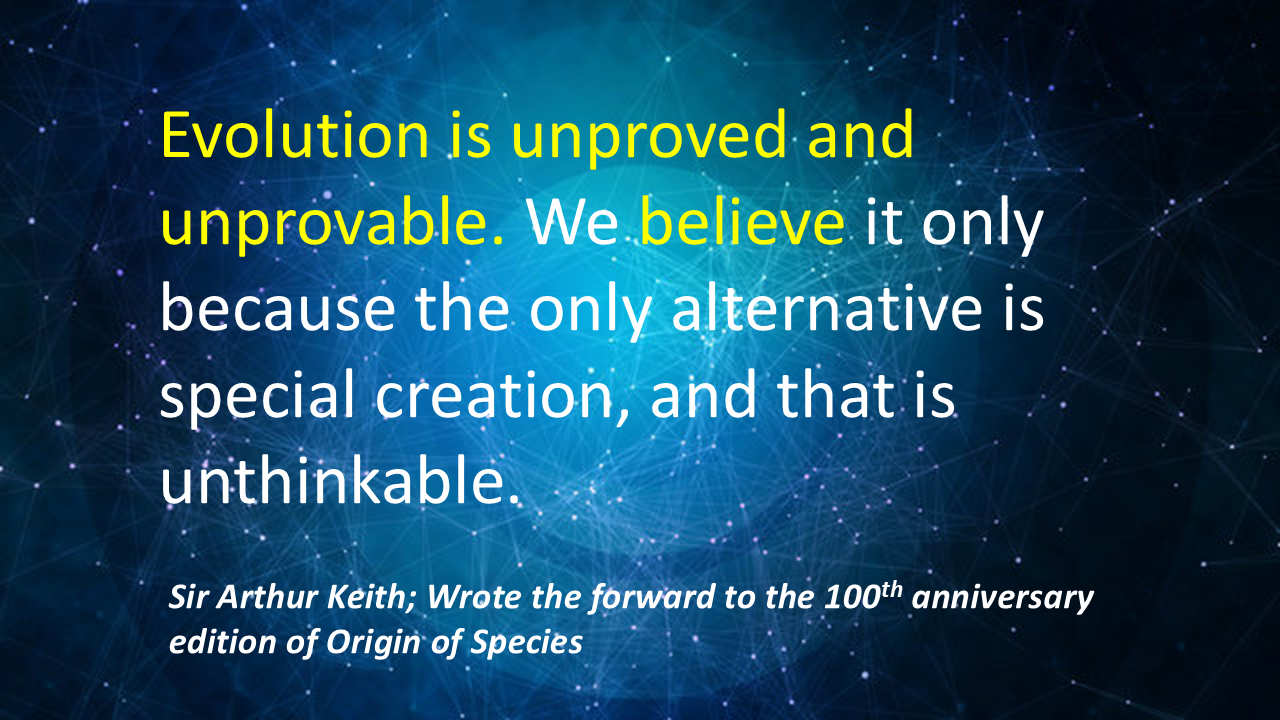
Neither creation nor evolution fulfills the criteria of a scientific theory. There were no human observers to the origin of the universe, the origin of life, or to the origin of a single living thing. These events occurred in the unobservable past and are not repeatable in the present. Creation and evolution are inferences based on circumstantial evidence.
When a worldview cannot be empirically proven—as is the case with both evolution and creationism—it must be evaluated based on how logically and coherently it aligns with what is actually observed in the natural world. In the absence of direct, repeatable evidence for the origin of life or the universe, the rational credibility of any explanatory model hinges on its ability to account for the data we do have: the complexity of life, the fine-tuning of physical laws, the sudden appearance of fully formed species in the fossil record, and the existence of objective moral reasoning and consciousness in humanity.
Which Worldview Aligns Better With Scientific Observations?
| Scientific or Philosophical Observation | Creationism | Evolution |
|---|---|---|
| First Cause (Origin of the Universe) | Attributes the origin of the universe to God—an eternal, immaterial, intelligent cause | Offers no explanation for the origin of matter, energy, or the laws of nature |
| Genetic Limits | Asserts that organisms reproduce “after their kind” with built-in boundaries | Assumes mutations can accumulate to produce entirely new kinds over time even though modern science has proven that 90% of mutations are neutral, most ofthe rest are negative, and only 1% beneficial. |
| Fossil Record | Predicts sudden appearance and stasis, matching the fossil record | Predicts gradual transitions, which are missing from fossil layers. |
| Living Fossils | Consistent with creation—organisms remain unchanged over supposed millions of years | Problematic—implies lack of evolutionary change over vast time periods |
| Irreducible Complexity | Supports intelligent design—many biological systems cannot function if reduced | Cannot explain how organisms survived whilecomplex systems like heart, eyes, etc. evolved step-by-step over millions of years. |
| Origin of Life (Abiogenesis) | Life comes from life (biogenesis), consistent with experimental evidence | Proposes life arose from non-life, which has never been observed despite countless modern attempts to do so under pristine lab conditions. |
| Genetic Information | DNA seen as a product of intentional design with purpose | Claims information arose through random mutation and selection even though the emergence of usuable information has never been observed to emerge randomly without a information source. |
| Speciation | Allows for variation within kinds, but not unlimited change | Requires unlimited change over time to form all current species. Science first proposed tens to hundreds of million of years, now say three to four billion years. |
| Human Cognition and Morality | Humans uniquely reflect God’s image—capable of abstract thought, ethics, worship | Difficult to explain how morality, conscience, or altruism evolved naturally |
| Human Creativity and Reason | Implies divine origin of logic, language, art, and innovation | Struggles to account for the leap from animal instinct to advanced intellect |
| Observation & Repeatability | Creationist predictions (e.g., genetic stability, fossil stasis) are testable and do not contradict the Laws of Physics. | Many evolutionary claims are historical and not subject to direct testing and violate established scientific laws. |
| Entropy and Thermodynamics | Aligns with the law of increasing entropy—complexity tends to decay | Assumes increasing complexity over time—contradicts 2nd Law of Thermodynamics |
Modern scientific discoveries—from the stability of genetic information and the fossil record’s lack of transitional forms to the irreducible complexity of biological systems and the unique moral and cognitive capacities of human beings—consistently affirm the predictions of creation rather than evolution. The limitations of mutations, the impossibility of life arising from non-life, and the observable boundaries of speciation all undermine the evolutionary narrative while aligning with the biblical claim that life was created “after its kind.” Furthermore, the human capacity for language, reason, and morality points not to random processes, but to a purposeful Creator who made mankind in His image.
Ultimately, when empirical proof is unavailable, worldviews must be judged by their explanatory power, internal consistency, and ability to make sense of the observable world. A worldview that best fits the evidence with the fewest contradictions is not only intellectually satisfying but also provides a more reasonable foundation for belief.
The best data we have are exactly what I would have predicted, had I nothing to go on but the five books of Moses, the Psalms, and the Bible as a whole.
Arno Penzias — Physicist, Nobel Prize 1978, co-discoverer of cosmic microwave background radiation
Creationism offers such a foundation—coherently accounting for the origin of life, the limits of genetic variation, the uniqueness of human consciousness, and the purposeful order seen throughout nature. Unlike naturalistic explanations that often rely on chance and unproven assumptions, creationism aligns with both reason and revelation, offering a comprehensive and theologically grounded understanding of reality.
Challenge Question: In light of the scientific limitations of mutation, the absence of transitional forms in the fossil record, and the uniqueness of human morality and cognition, which worldview—creationism or evolution—offers a more coherent and consistent explanation for the origin and design of life? Why does that matter for how we understand our purpose and place in the universe?
Premise 3: Creationism Explains The Origins And Laws Of Physics Best
genesis
Merriam Webster Dictionary
ˈjen-ə-səs
the origin or coming into being of something : the process or mode of origin
If the evolutionist refuses to believe in God, he must still believe in some kind of uncaused First Cause. He must also either believe matter came into existence out of nowhere or else believe matter is eternal. Otherwise it would be like saying In the beginning there was nothing, which exploded.
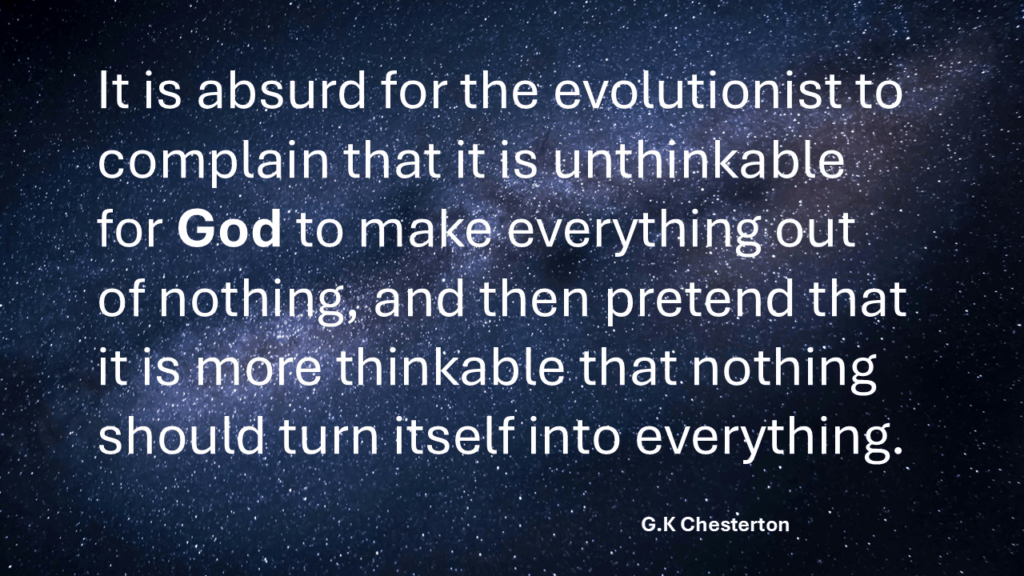
Most people don’t realize it, but when followed to its logical conclusion, naturalism seems to suggest that the universe, its laws, life, and nature itself were ultimately created by nature. In other words, nature created itself? Philosophers call this a logical absurdity. For nature to create itself, it would first have to exist before it existed in order to bring itself into existence. See the problem?
The law of cause and effect which is universally accepted and followed in every field in science stipulates not only that every effect must have a cause but that: Every cause must be superior to it’s effect! In other words eternal matter must have an eternal cause, infinite space must have an infinite first cause.
Whereas Evolution cannot provide a first cause which every effect must have— The Bible is in harmony with the Law of First Causes and explains that God is the infinite and eternal first cause.
Before the mountains were brought forth, Or ever you had formed the earth and the world,
Psalm 90:2
From everlasting to everlasting you are God
Herbert Spencer a well known biologist and anthropologist discovered that all the reality in the universe can be contained in five categories:
- Time
- Force
- Action
- Space
- Matter
All five of these categories are contained in the first sentence of Genesis
In the beginning God created the heavens and the earth
Genesis 1:1
- Time (In The Beginning)
- Force (God)
- Action (Created)
- Space (Heavens)
- Matter (Earth and Universe)
If science has shown that God does not exists, it has not been by appealing to Big Bang Cosmology. The hypothesis of God’s existence and the facts of contemporary cosmology are consistent.
David Berlinski; American Author and Philosopher, Princeton and Columbia
Based on our observations of the world, we know that the first cause must have certain characteristics:
For example, it must be powerful, eternal, necessary, changeless, intelligent, and creative. The first cause must be powerful enough to have created this universe. It must be eternal, having no beginning or end. It must be necessary, meaning there had to be a first cause that’s existence was not contingent on anything else. It must be intelligent and creative to have caused a world of diversity and order. It must be changeless because the first cause had nothing before it to influence it. The God of the Bible satisfies these requirements.
What About the Laws of Nature?
The theory of evolution is a biological framework that explains variation and adaptation within living organisms, but it offers no account for the origin of the physical laws and constants that make the universe—and life itself—possible. If the universe arose solely through random, unguided natural processes, then the laws of physics and the 26 universal constants (such as gravity, electromagnetism, and the strong nuclear force) would also have to be the product of spontaneous chance. However, these laws are not random—they are precise, mathematically consistent, and finely tuned to allow for the stability of matter, energy, and biological complexity.
The process of Evolution is totally dependent on these laws which means they had to be precisely in place the second the universe came into existence for life to be possible. Science cannot logically explain how they came into being or why they remain fixed. Their existence and constancy point instead to an intelligent cause beyond nature—one that designed the framework in which evolution could even function.
Creationism vs. Naturalism: Which Aligns Better with Physics And Fine-Tuning
| Scientific Feature | Creationism | Naturalism/Evolutionary View |
|---|---|---|
| Law of Causality | Affirms that every effect must have an adequate cause—points to a First Cause (God) | Struggles to explain how the universe caused itself or came from “nothing” |
| First and Second Laws of Thermodynamics | Consistent with a created universe that had a beginning and is running down | Hard to reconcile a self-originating universe that defies thermodynamic decay |
| Law of Biogenesis | Life comes only from life—supports a Creator as the origin of living systems | Violates this principle by claiming life arose from non-living chemicals |
| Fine-Tuning of the Universe | Indicates intentional calibration by an intelligent Designer | Attributes cosmic precision to random chance or multiverse speculation |
| 26 Universal Constants (e.g., gravity, electromagnetism) | Creationism views these as deliberately set to allow life | Naturalism has no mechanism for why these constants exist or are life-permitting |
| Anthropic Principle | Life exists because the universe was designed for it | Suggests we are here by accident in one of many universes—unprovable speculation |
| Speed of Light, Gravitational Constant, Planck’s Constant | Viewed as immutably fixed by a rational Mind | Viewed as inexplicably stable without explanation or source |
| Information in Physics (e.g., entropy, quantum structure) | Reflects intelligent order and design embedded in creation | Assumed to be an emergent property from chaos without a designer |
| Mathematical Order of Physical Laws | Reflects the mind of a rational Creator—“the language of God” | Seen as a coincidence or natural product of unknown forces |
| Origin of Physical Laws | Creationism affirms they were established by the Creator at the beginning | Offers no explanation for why laws exist or remain consiste |
The evolutionary model presupposes that the universe and all it contains—including life, matter, energy, and even the laws of physics—can be fully explained through undirected natural processes. By this logic, if evolution is true in a comprehensive, naturalistic sense, then even the physical laws and the 26 finely tuned constants that make life possible must have themselves arisen randomly and evolved over time.
If this were true then the laws along with matter and energy would still be evolving now just as they did in the past. However, all scientific observations made to date confirm that these laws of nature are constant and unchanging. This is why scientist actually call them “Constants”. Is it coherent to say that things that these mathematically precise “laws and constants” randomly evolved into being constant?
Scientific observation has confirmed that these laws are not in flux, but are constant and unchanging, pointing not to random emergence but to intentional establishment —consistent with the biblical claim of a rational Creator who “upholds all things by the word of His power” (Hebrews 1:3).
The Universe Was Fine-Tuned The 1st Second Of It’s Existence
The law of gravity, the laws of thermodynamics, the laws of motion, and all other basic laws have apparently always functioned just the way the do now contrary to the basic evolution model
Henry Morris; Scientific Creationism
The laws of physics and the fundamental constants—such as gravity, the speed of light, and the strength of the electromagnetic force—had to be precisely in place from the very first second of the universe’s existence because even the slightest deviation would have made the formation of matter, stars, planets, or life impossible. For example, if gravity were even slightly stronger or weaker, the universe would have either collapsed in on itself or expanded too rapidly for galaxies to form. These constants govern the behavior of energy and matter, so if they weren’t perfectly calibrated from the very beginning, the universe would be chaotic, lifeless, or non-existent. This immediate fine-tuning strongly suggests intentional design, not random emergence.
Fine-Tuning of the Laws and Constants of Physics
| Fundamental Requirement | Why It Matters |
|---|---|
| Gravity | If gravity were only slightly stronger, the universe could have rapidly collapsed into itself. If slightly weaker, matter would have dispersed too quickly for stars, galaxies, or planets to ever form. |
| Speed of Light | The speed of light governs the relationship between space, time, energy, and matter. Altering it would fundamentally change the structure and behavior of the entire universe. |
| Electromagnetic Force | This force holds electrons in orbit around atoms and enables all chemistry. Even small changes would prevent stable atoms, molecules, and the chemical reactions required for life. |
| Strong Nuclear Force | This force binds protons and neutrons together in atomic nuclei. If slightly weaker, most elements beyond hydrogen could not exist. If slightly stronger, stars and chemistry would be radically altered. |
| Weak Nuclear Force | This force plays a critical role in stellar fusion and element formation. Small changes could prevent stars from producing the elements necessary for planets and living organisms. |
| Initial Fine-Tuning | These constants had to be correctly calibrated from the very first instant of the universe’s existence. There was no opportunity for trial-and-error adjustments later. |
| Consequence of Significant Variation | A universe with even modestly different values would likely contain no stable stars, no planets, no chemistry, and no possibility for life. |
| Key Observation | The fundamental laws and constants appear to have been precisely configured before the first star ignited, the first atom formed, or the first planet existed. |
The creation model agrees with what scientist have observed that the laws of physics are not in process but are constant and predictable which is why they are called “laws”. Creationist believe that the universe and the laws that govern and sustain it were created at the exact same time.
The chance that all of the Laws of Physics and the 26 essential constants required for survival emerging spontaneously through a random explosion at precisely the same instant has been calculated to be 1 in 10^(10^123). That’s a number so incomprehensibly large that writing it out would require more space than exists in the observable universe.
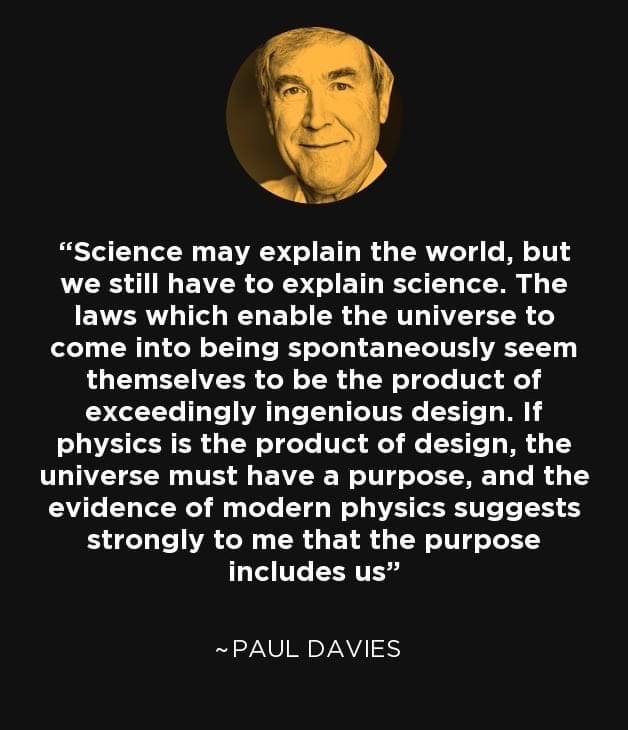
Since the laws of physics and the fundamental constants of nature are essential for life to exist, they must have been precisely in place from the very moment the universe came into being. This necessity aligns seamlessly with the creationist model, which holds that an intelligent Creator established the universe with order, purpose, and life-sustaining conditions from the outset.
Challenge Question: If the theory of evolution depends on fixed, finely tuned physical laws and constants to operate, yet cannot explain their origin or precision, is it reasonable to believe they arose by chance—or does their existence point more plausibly to an intelligent Creator?
Premise 4: Creationism Adheres To Rules Of Logic Best
When examined through the lens of logic, information science, and observational consistency, the naturalistic theory of evolution encounters profound philosophical and scientific challenges. It asserts that the universe, life, and vast stores of biological information emerged from unguided, random processes involving only matter and energy. This claim defies the foundational laws of logic:
Violation of the Law of Cause and Effect (Law of Causality)
Logic dictates that every effect must have an adequate cause. Complex biological systems, vast amounts of digital-like genetic information, and the fine-tuned laws of physics are all effects that demand a sufficient cause.
Naturalistic evolution, however, posits that these effects arose from purely random, unguided interactions of matter and energy—without an intelligent cause. This violates the law of causality, which insists that highly ordered outcomes must be the result of proportionately capable causes.
Contradiction of the Law of Non-Contradiction
The law of non-contradiction states that something cannot be both true and not true at the same time in the same respect.
Evolutionary theory often claims that life arose through random, purposeless processes—but then assigns purpose-like functions to natural selection, implying that it “chooses” beneficial traits or “favors” survival advantages. This is a logical contradiction: attributing intentionality and goal-oriented behavior to a process declared to be mindless and purposeless.
Violation of the Law of Information
Information science observes that meaningful, functional information—such as that found in human language, computer code, or DNA—always originates from a conscious mind.
Evolutionists claim that DNA, which contains vast quantities of specified, complex instructions, arose from non-living matter through unguided physical processes. This defies the logical and scientific principle that information does not spontaneously emerge from chaos, but always reflects intelligence and intent.
Illogical Expectation of Spontaneous Order from Chaos
To claim that the finely tuned constants of the universe (such as the gravitational constant, the strong nuclear force, and the cosmological constant) emerged randomly at the moment of the Big Bang is to assume that order and precision naturally flow from disorder without guidance.
Logically, randomness produces confusion and disorder—not coherence. Suggesting that the laws that uphold the universe arose from a chaotic explosion contradicts what we observe: explosions destroy order—they don’t create it. If a thousand piece jigsaw puzzle box exploded—would it emerge in order?
Special Pleading (Logical Fallacy)
Naturalistic evolution often claims immunity from the rules it applies to other systems. For example:
- It denies that intelligent design can be inferred from complexity in biology,
- Yet accepts intelligent design when found in coded languages, architecture, or machines.
This inconsistency is a form of special pleading—accepting a principle in some cases while arbitrarily excluding it in others.
Creation vs. Evolution: Logical Coherence Comparison
Ultimately, when empirical proof is out of reach, the most reasonable worldview is the one that best accounts for what is observable and logically consistent. In this light, creationism offers a far more coherent, rational, and logically sound explanation for the origin of life, the laws of nature, and the information that governs all living things.
In contrast to evolution, the creationist model aligns with the laws of logic. It posits a rational, intelligent Creator as the source of the universe’s order, life’s complexity, and the embedded information that sustains all living systems. It does not shy away from the necessity of faith, but neither does it ignore the evidence of logic, causality, and purposeful design.
| Logical Principle | Creationist Model | Naturalistic Evolution |
|---|---|---|
| Law of Cause and Effect | Affirms a sufficient cause—an intelligent Creator—as the origin of complex effects. | Violates: Claims complex effects (life, laws) arise from unguided matter and energy. |
| Law of Non-Contradiction | Consistent: Attributes purpose and design to a purposeful agent (God). | Contradicts itself: Assigns purpose to a purposeless process (natural selection). |
| Law of Information | Consistent: Information originates from a conscious mind—God as the source of DNA information. | Violates: Claims complex information arose spontaneously from non-intelligent sources. |
| Spontaneous Order from Chaos | Rejects that order can come from chaos without intelligence; credits divine design. | Assumes precise order came from random explosion (Big Bang), defying logic. |
| Special Pleading (Logical Fallacy) | Applies inference to design universally, not selectively (nature, code, etc.). | Engages in special pleading—accepts design in technology, denies it in biology. |
You Don’t Have To Be Isaac Newton To See The Logic
The seventeenth-century mathematician and philosopher Sir Isaac Newton had a mechanical replica of our solar system made in miniature. At its center was a large golden ball representing the sun, and revolving around it were smaller spheres attached at the ends of rods of varying lengths. They represented Mercury, Venus, Earth, Mars, and the other planets. These were all geared together by cogs and belts to make them move around the sun in perfect harmony.
One day as Newton was studying the model, an atheist friend stopped by for a visit. Marveling at the device and watching as the scientist made the heavenly bodies move in their orbits, the man exclaimed, “My, Newton, what an exquisite thing! Who made it for you?” Without looking up, Sir Isaac replied, “Nobody.” “Nobody?” his friend asked. “That’s right! I said nobody! All of these balls and cogs and belts and gears just happened to come together, and wonder of wonders, by chance they began revolving in their set orbits and with perfect timing.”
His friend undoubtedly got the point. The existence of Newton’s machine presupposed a maker, and even more so the earth and its perfectly ordered solar system.
The story of Sir Isaac Newton’s mechanical solar system model illustrates a foundational truth rooted in logic and common sense: order and complexity require a designer. When Newton jokingly claimed that his intricate device had no maker, his friend instantly recognized the absurdity of the idea—because no rational mind believes that precision and purpose arise by accident.
But this is what the Lord says: I would no more reject my people than I would change my laws that govern night and day, earth and sky.
Jeremiah 33:25
The creationist worldview affirms what logic, experience, and observation consistently tell us: where there is design, there must be a Designer. The existence of life, order, and intelligibility in the universe points not to chance, but to purpose. Creation harmonizes with the laws of logic, causality, and information, offering a far more coherent explanation for the origin and structure of reality. In this light, belief in a Creator is not only a matter of faith—but of reason.
Challenge Question: Considering the Laws of Science and the Rules of Logic—which worldview harmonizes with the Laws of Physics and the rules of logic the most?
Premise 5: Creationism Explains The Fossil Record Best
And God said, “Let the land produce living creatures according to their kinds: the livestock, the
Genesis 1:24-25
creatures that move along the ground, and the wild animals, each according to its kind.” And it was so
Extensive research and decades of exploration into the fossil record have revealed a pattern that fundamentally contradicts the expectations of Darwinian evolution but powerfully affirms the model of creation. Instead of a gradual progression of life forms evolving through countless transitional stages, the evidence shows that species appear suddenly, fully formed, and with no clear evolutionary precursors.
This abrupt appearance—known in scientific circles as the “Cambrian Explosion” and echoed in other fossil layers—presents a serious challenge to the theory that life diversified through slow, incremental changes driven by random mutation and natural selection. If evolution were true, the fossil record should be overflowing with transitional forms—partial structures, half-formed systems, and experimental organisms bridging one type to another. But what we actually find is the opposite: well-defined, complex organisms emerging in the geological record without evolutionary ancestry.
This remarkable pattern is precisely what one would expect if life was created according to distinct kinds, as described in the biblical account of creation. Each species enters the scene fully equipped with its unique biological systems, interdependent organs, and genetic integrity already in place—reflecting deliberate design, not accidental emergence.
Rather than animal kinds coming about by natural selection somehow adding new genes and organs to pre-existent ancestors as Darwin’s ideas predicted, the fossil record provides no hint in the lowest known fossil-bearing rocks (named “Precambrian” and “Cambrian”) of single-celled organisms morphing into the multi-celled creatures. The “Cambrian Explosion” describes the sudden appearance of all the radically-different blueprint types of each animal all in one rock system. This gap—which occurs globally—should not even exist if evolutionism is true.
Jonathan Wells; Icons of Evolution: Science or Myth—Much of What We Teach About Evolution is Wrong
The Fossil Record Agrees With The Creation Account
The fossil record reveals a striking and consistent pattern: organisms appear abruptly and fully formed, from the lowest geological layers upward. Rather than displaying a slow, step-by-step evolutionary development, the fossil strata show complex life forms emerging suddenly, without a trail of simpler, transitional ancestors beneath them.
In the lowest layers, such as those from the Cambrian period, we find an astonishing diversity of complex, multicellular organisms—many with highly specialized features like eyes, segmented bodies, and jointed limbs—appearing all at once in what is commonly referred to as the Cambrian Explosion. These organisms are not primitive or partially developed; they are anatomically complete and functionally integrated. This sudden emergence contradicts the gradualist predictions of Darwinian evolution, which requires innumerable intermediate forms leading up to such complexity over vast stretches of time.
I saw in the fossil records rapid burst of change, new species appearing seemingly out of nowhere and then remaining unchanged for millions of years hauntingly reminiscent of creation.
Max Pagel; Oxford Biologist
As we ascend through the geological layers, the same pattern repeats: new life forms appear suddenly and exhibit fully functional structures, rather than showing a gradual buildup of complexity. There is a top-down pattern in the fossil record—not a bottom-up progression. Major body plans (phyla) appear early and remain remarkably stable, while variation tends to occur within already-established kinds.
| The Ways The Fossil Record Agrees With The Creation Account and Not Evolution |
| Of the 43 living land animal orders, such as carnivores, rodents, bats, and apes 97.7% have appeared in the fossil record fully formed with no intermediates |
| Of the 178 living land animal families, such as dogs, bears, hyenas, and cats 87.8% have appeared in the fossil record fully formed with no intermediates |
| There is separation from other phyla by definite and unbridgeable gaps with no ancestor-descendant/bottom-top transitions |
| All forms suddenly appear as unique body plans with fully-formed structures |
| All phyla are represented in the fossil record demonstrating fossil-record completeness |
| All show no innovative change in their basic anatomical form after they first appear as fossils—only minor, top-down variation within a blueprint design. |
Evolutionists believe that all of Earth’s estimated 8.7 million species evolved from a single-celled common ancestor through a gradual process over billions of years. However, the fossil record presents a striking contradiction to this view. Paleontologists have uncovered evidence showing that both simple single-celled organisms and complex multicellular life forms existed side by side from the very beginning of the geological record.
“We paleontologists have said that the history of life supports gradual adaptation, all the while knowing that it does not.”
Niles Eldredge—Curator of Paleontology, American Museum of Natural History
This simultaneous appearance of biological simplicity and complexity undermines the evolutionary model, which requires a slow, stepwise progression from simple to complex life. Instead, it aligns far more closely with the account given in the first chapter of Genesis, which states that God created plants, sea creatures, birds, animals, and insects fully formed and functioning from the start. Rather than evolving upward through blind natural processes, life appears in the fossil record with immediate and advanced complexity—just as Scripture declares.
Fossil Record: Creation vs. Evolution
| Fossil Record Feature | Creation Model Alignment | Evolution Model Alignment |
|---|---|---|
| Sudden Appearance of Species | Matches: Life appears fully formed as described in Genesis. | Contradicts: Expects gradual development over time. |
| Lack of Transitional Forms | Matches: Distinct kinds are created separately with no intermediates. | Contradicts: Predicts numerous transitional fossils that are lacking. |
| Stasis (Little to No Change Over Time) | Matches: Life reproduces “after its kind” with stability over time. | Contradicts: Predicts constant evolutionary change. |
| Complexity from the Beginning | Matches: God created fully functional organisms from the start. | Contradicts: Complexity should build gradually, not appear suddenly. |
| Simultaneous Coexistence of Simple and Complex Life | Matches: Genesis implies complex life existed from the beginning. | Contradicts: Expects a clear progression from simple to complex. |
| Explosion of Life Forms (e.g., Cambrian Explosion) | Matches: Reflects the sudden creation of many life forms by God. | Contradicts: Sudden diversity is unexplained by gradual mechanism |
Evolutionary Scientists on the Abrupt Appearance of Life Forms in the Fossil Record
| Scientist | Credentials | Representative Statement |
|---|---|---|
| Richard Dawkins | Evolutionary biologist, Oxford University; author of The Blind Watchmaker | “It is as though they were just planted there, without any evolutionary history.” (referring to the Cambrian explosion) |
| Douglas Futuyma | Professor of Ecology and Evolution, Stony Brook University; author of a leading university evolution textbook | “If they did appear in a fully formed state, they must indeed have been created by some omnipotent intelligence.“ |
| Mark Ridley | Evolutionary biologist, Oxford University; former editor of Evolution journal | “No real evolutionist… uses the fossil record as evidence in favour of the theory of evolution as opposed to special creation.” |
| Stephen Jay Gould | Harvard paleontologist; one of the most influential evolutionary theorists of the 20th century | “The extreme rarity of transitional forms in the fossil record persists as the trade secret of paleontology.” |
| Douglas Erwin | Smithsonian Institution Paleontologist | “The origin of animal body plans during the Cambrian Explosion remains a major unresolved problem.” |
| David Raup | Curator of Geology, Field Museum of Natural History, Chicago | “Ironically, we have even fewer examples of evolutionary transition than we had in Darwin’s time.” |
| Colin Patterson | Senior Paleontologist, British Museum (Natural History), London | “I fully agree with your comments on the lack of direct illustration of evolutionary transitions in my book.” |
| Steven Stanley | Professor of Paleobiology, Johns Hopkins University | “The known fossil record fails to document a single example of phyletic evolution accomplishing a major morphological transition.” |
| Derek Ager | President, British Geological Association | “The point emerges that if we examine the fossil record in detail… we find again and again not gradual evolution, but the sudden explosion of one group at the expense of another.” |
| George Gaylord Simpson | One of the founders of modern evolutionary theory; Harvard paleontologist | “The most striking feature of the history of life is the sudden appearance of major groups.” |
These acknowledgments from leading scientists highlight the complexities and gaps in the fossil record that challenge the gradualist model of evolution. The sudden appearance and stasis observed in the fossil record align more closely with the concept of special creation, as described in the book of Genesis, than with the expectations of Darwinian evolution.
Charles Darwin candidly acknowledged that the fossil record posed “the most obvious and gravest objection which can be urged against my theory.” He recognized that if complex organisms were found to appear suddenly and fully formed in the geological layers—without the countless transitional stages his theory required—it would present a serious blow to the credibility of evolutionary theory. In fact, Darwin admitted that such an occurrence would have to be considered nothing short of “miraculous,” something his naturalistic framework could not accommodate.
To the question why we do not find rich fossiliferous deposits belonging to these assumed earliest periods prior to the Cambrian system, I can give no satisfactory answer.
Charles Darwin—The Origin of Species
Modern Paleontology has confirmed Darwin’s greatest fear that the sudden appearance of fully formed complex organisms in the geological layers can only be classified as miraculous which is exactly what the Genesis account of creation stipulates. The fossil record affirms not Darwin’s theory, but the Genesis account of creation, which declares that life appeared by the intentional act of a Creator. What Darwin feared might undermine his theory has, over time, become one of the strongest evidences in favor of special creation.
In short, the fossil record doesn’t whisper evolution—it proclaims creation. The absence of transitional fossils and the sudden, stable appearance of diverse life forms affirm a Creator’s hand far more convincingly than the blind mechanics of undirected natural processes ever could.
Challenge Question: What is the best explanation is for the fact that 97.7 percent of animal phyla suddenly appears in the fossil record fully formed and altogether?
Premise 6: Creationism Explains Diversity In Nature Best
spe·cies
1. A group of organisms that can interbreed and produce fertile offspring in nature, are reproductively isolated from other groups.
2. a kind or sort.
Evolution postulates that all the diversity of life arose from single-celled organisms gradually evolving into the vast complexity we observe today. However, the fossil record reveals a striking contradiction to this idea: from the very beginning, both single-celled and fully complex multicellular organisms appear side by side. There is no clear progression through intermediate forms—no two-celled or three-celled transitional organisms—just either single-celled life or fully developed complexity.
Remarkably, the Bible aligns with what the fossil record actually shows. The book of Genesis describes animals, plants, fish, birds, and insects as being created fully formed from the outset. Beyond this, Genesis offers an early glimpse into the concepts of genetics and taxonomy. The word Genesis itself comes from the Greek genetikos, meaning “origin” or “generation”—the same root from which we derive terms like gene and genetics.
Moreover, the phrase “according to their kind” is used 11 times in the first chapter of Genesis. The Hebrew word for “kind,” miyn, is widely understood to mean a distinct category or species. This may represent the earliest known written reference to the concept of species in recorded language.
The Missing 85%: What Darwin Didn’t Know About Life on Earth
When On the Origin of Species was published in 1859, only about 15% of the earth’s estimated 8.7 million species had been documented. This means Darwin wrote his foundational work on evolution without knowledge of 85% of Earth’s biodiversity. He certainly had no awareness that each of these species—from the simplest bacteria to humans—possesses a completely unique, information-rich DNA code.
Modern genetics has since revealed that every species carries its own distinct set of genetic instructions—blueprints that govern design, development, operation, and maintenance. These DNA codes are not interchangeable between species and cannot be successfully merged. The biological barriers between species are hardwired at the genetic level.
Even more striking is the fact that the fossil record shows the sudden appearance of fully formed species with no evidence of gradual transition. This implies that the DNA of these organisms also appeared suddenly—fully intact and functional from the start.
This is exactly what the biblical account of creation describes. Genesis not only depicts animals, birds, fish, insects, and humans as being created fully formed, but it repeatedly uses the phrase “according to their kind”—a term closely aligned with what we now call species. The Hebrew word miyn, translated as “kind,” conveys the idea of distinct, bounded categories of living organisms.
In contrast, evolutionary theory asserts that the universe began with the Big Bang, and that life somehow emerged spontaneously from non-living chemicals. From this first single-celled organism, it is said that all life evolved gradually into ever more complex forms, ultimately culminating in human beings.
However, modern genetics has shown that while small-scale changes, or microevolution, do occur within a species—such as variations in beak size or fur color—these are limited adaptations. Genome research confirms that mutations merely cause minor alterations within existing genetic information. Large-scale transformations—such as fish scales evolving into feathers or gills turning into lungs—are not genetically feasible.
Biological Boundaries of Species That Challenge Macroevolution
| Boundary / Limitation | Description | Why It Challenges Evolution |
|---|---|---|
| Genetic Isolation | Each species has a unique DNA structure and gene pool | Prevents successful interbreeding across species; no genetic bridge for evolution |
| Reproductive Barriers | Species cannot interbreed with others, or produce sterile offspring (e.g. mule) | Blocks genetic mixing necessary for gradual transformation into new species |
| Information Limits of DNA | DNA encodes complex, specific information for that species’ form and function | Random mutations have never been shown to generate new information-rich systems |
| Irreducible Complexity | Many biological systems require all parts to function | Partial or step-by-step evolution would be nonfunctional and selected against |
| No Transitional Genomes Observed | Fossil and genetic records lack functional “halfway” species | Suggests species appear fully formed, not gradually assembled |
| Mutation Boundaries | Mutations are rare, often harmful, and only cause small-scale variation | Cannot account for major innovations like wings, eyes, or lungs from scratch |
| Epigenetic Limits | Organism development is also controlled by non-DNA factors | Adds layers of complexity not accounted for in random mutation + selection |
| Species Stability Over Time (“Stasis”) | Most species remain unchanged in form across fossil layers | Opposes the idea of constant transformation predicted by evolution |
| Gene Pool Boundaries | Breeding produces variation only within fixed limits (e.g., dog breeds) | No evidence of genetic drift creating entirely new body plans or organisms |
| Horizontal Genetic Incompatibility | Cross-species DNA insertions usually fail or are lethal | Prevents the kind of genetic blending |
The sudden appearance of fully formed organisms in the earliest fossil strata points to fully developed, functional DNA from the very beginning. This is precisely what is described in the first chapter of Genesis: living creatures and plants created by design, each according to their kind.
First There Were Plants
Then God said, “Let the earth sprout vegetation, plants yielding seed,
Genesis 1:11
and fruit trees bearing fruit after their kind, with seed in them
The word kind is also where we get the our English word kin or kinfolk from. The Bible implies specifically that there numerous species of plants created all at once that were not descendants of each other, and that their DNA was in their seed.
As of current scientific estimates, there are approximately 390,000 known species of plants on Earth.
Breakdown:
- Flowering plants (angiosperms): ca. 300,000 species
- Conifers and other gymnosperms: ca. 1,000 species
- Ferns and their relatives: ca. 10,000 species
- Mosses, liverworts, and hornworts (bryophytes): ca. 20,000–25,000 species
- Algae (plant-like organisms): ca. 40,000 species (classification varies; not always considered true plants)
These numbers are continually updated as new species are discovered and classifications are refined. On average, scientists discover and formally describe about 2,000 to 2,500 new plant species each year.
More than 35,000 new species (kinds) of flowering plants may be lying undiscovered in cupboards around the world. Botanists believe that of the 70,000 flowering plants have yet to be found, over half may already be in collections awaiting classification.
(BBC.com)
Which is more plausible? The Bible teaches that God created plants and animals separately, each with its own distinct genetic characteristics and biological design. Evolutionary theory proposes that plants and animals descended from a common biological ancestor.
Next There Were Fish and Birds
So God created the great creatures of the sea and every living thing with which the water teems and that moves about in it, according to their kinds, and every winged bird according to its kind
Genesis 1:21
Once again several taxonomic species (this time fish and birds) were created all at once according the their genetic classifications (kinds or species). As of the most recent estimates, there are approximately 35,000 recognized species of fish worldwide.
Breakdown:
- Bony fish (Osteichthyes): ~33,000 species
(e.g., salmon, trout, bass, clownfish) - Cartilaginous fish (Chondrichthyes): ~1,200 species
(e.g., sharks, rays, skates) - Jawless fish (Agnatha): ~100 species
(e.g., lampreys, hagfish)
Fish represent the most diverse group of vertebrates on Earth, inhabiting nearly every aquatic environment—from deep oceans to high mountain streams. New species are discovered regularly, especially in deep-sea and freshwater habitats that remain underexplored.
Biologist are discovering 150 new species of fish every year. Experts estimate that characterizing the 5,000 species of marine fish that are now unknown will take another 30 years
(US News & World Report)
Which is more plausible? The Bible teaches that God created fish and birds separately, each according to its own kind, with distinct genetic characteristics and biological designs—an account consistent with their appearance as distinct groups in the fossil record. Evolutionary theory proposes that fish gave rise to amphibians, followed by reptiles which evolved into birds. Which the fossil record does not affirm.
Animals, Insects, Reptiles, Amphibians, and Bacteria
Then God said, “Let earth bring forth living creatures after their kind: a cattle and creeping things and beasts of the earth after their kind“; And God made the beast of the earth after their kind, and the cattle after their kind, and everything that creeps on the ground after its kind.
Genesis 1:24-25
Notice the double amplification in the text: each group is not only categorized separately—beasts, cattle, and creeping things—but each is explicitly stated to have been created “after its kind.” This repetition emphasizes that every group is genetically distinct, uniquely designed, and brought into existence fully formed.
There is no suggestion of gradual development or common descent among them. Instead, the language strongly indicates that these creatures were created simultaneously, each with its own complete genetic blueprint, without evolving from a shared ancestor. This directly opposes the evolutionary framework of slow, transitional progression and instead affirms a pattern of intentional, organized creation. This is exactly what DNA and the fossil record point exclusively to.
Every living organism—from a human to a single-celled bacterium—possesses a species-specific DNA blueprint. This DNA encodes instructions that determine structure, metabolism, reproduction, and interaction with the environment. Even the smallest protist or obscure fungus carries an information-rich code that distinguishes it from every other form of life.
Estimated Number Species (Each With It’s Own Genetic Blueprint)
| Category | Estimated Number of Described Species | Genetic Note |
|---|---|---|
| Animals (Total) | 8,700,000 (estimated, includes all groups) | All have unique animal DNA sequences tailored to their body structures and functions |
| — Insects | 1,000,000+ | Each insect species has a distinct genome regulating body plan, wings, metamorphosis |
| — Mammals | 6,500 | Complex genomes with neurological, skeletal, and reproductive specializations |
| — Birds | 11,000 | Unique avian DNA coding for feathers, flight, song, etc. |
| — Fish | 34,000 | Diverse aquatic genomes adapted to various marine environments |
| — Reptiles | 11,000 | Genomes include traits for scales, temperature regulation |
| — Amphibians | 8,300 | Amphibious life cycles encoded in their DNA |
| Plants | 390,000 | Each plant species has its own genetic instructions for photosynthesis, reproduction, etc. |
| Fungi | 150,000 | Includes molds, mushrooms—each with its own DNA regulating decomposition and spore growth |
| Protists (unicellular) | 140,000 | Genetically diverse group—includes amoebas, algae |
| Bacteria | 30,000 described (millions estimated) | Simple prokaryotic genomes, but with species-specific genes for survival, metabolism |
| Archaea | 1,000+ described | Extremophile microbes with unique DNA adapted to harsh environments |
The existence of approximately 8.7 million distinct species, each with its own comprehensive genetic blueprint, is mind-boggling from a design diversity standpoint for several reasons:
- Unique Genetic Codes:
Each species possesses a DNA sequence containing billions of base pairs that encode precise instructions for building and maintaining its body—everything from metabolism, cellular structure, immune function, to behavior. These are not simple templates; they are complex, layered systems of information. - No Copy-and-Paste Simplicity:
While some genetic elements are shared across life (indicating functional design patterns), the level of specificity and differentiation across species is astounding. For example, a hummingbird’s DNA differs vastly from that of a whale, yet both represent finely tuned systems suited to entirely different environments. - Integrated Functionality:
Each genetic blueprint is not just a list of traits—it’s an interconnected system where thousands of genes interact in orchestrated harmony. A small disruption in just one gene can render an entire organism nonviable, making the successful existence of 8.7 million such systems statistically improbable without intelligent direction. - Design Diversity:
From microbes that thrive in boiling sulfur vents to elephants, eagles, and orchids, the diversity of form, function, and adaptation demonstrates not just complexity but creativity—an explosion of innovation that reflects not random mutation but purposeful, intelligent design.
The idea that 8.7 million unique, functionally integrated genetic blueprints—each precisely tailored to produce a distinct, living organism—could arise through blind, undirected processes stretches statistical credibility beyond the breaking point.
Such extraordinary complexity and diversity, operating with stunning precision across ecosystems, cannot be reasonably attributed to chance or natural selection alone. Rather, this vast biological tapestry points powerfully and unmistakably to a Designer of unimaginable wisdom, power, and intentionality—one who crafted life with purpose, order, and boundless creativity. The more we uncover about the genetic code and the intricate interdependence of living systems, the more compelling the case becomes for creation by an intelligent and personal Creator.
Challenge Question: If each of the 8.7 million species possesses a unique and functionally precise genetic blueprint, what is the more rational explanation: that such vast biological complexity arose from unguided, random processes—or that it reflects the intentional design of an intelligent Creator?
Premise 7: Creation Fits The Boundaries We See In Nature Best
It is scientifically problematic to claim that reptiles, amphibians, animals, and bacteria all share a common evolutionary ancestor based on what we now know about DNA complexity and the limitations of mutations:
- Each group has a distinct genetic code that governs its structure, function, and reproduction. These codes are not only unique but incompatible with one another, making gradual genetic transformation from one group to another biologically implausible.
- Mutations, which evolution depends on for genetic change, are overwhelmingly neutral or harmful, and even beneficial ones only cause minor adjustments within a species. They have never been observed to create entirely new body plans, organs, or biological systems required for one major group to become another (e.g., bacteria becoming amphibians).
- No transitional DNA structures or mechanisms have been found that would explain how the vast informational leaps needed for such transformations could occur by chance.
The Reproduction Roadblock
A plain reading of Genesis Chapter One infers that plants and animals were created to reproduce within the boundaries of their kind. Evidence to support this is clearly seen in the world today—dogs cannot breed with cats, and horses cannot breed with cows.
Why is this so important? Because this is in harmony with the Genesis creation account that plants, animals, insects, fish, and birds were created as individual species ready to mature and breed within their own kinds.
Evolution posits not only that plants and animals share the same common ancestor, but that all organisms animals, fish, insects, and birds descended from each even though it is impossible for them to inter-breed. If Evolution is true—How did species multiply and avoid extinction while they were in the process of developing into another species and the reproductive system and organs were incompatible?
Reproductive boundaries present one of the most significant and underappreciated challenges to the theory of evolution—especially when it comes to transitional species.
Here’s why:
1. Reproductive Isolation Between Species
Different species typically cannot interbreed. Even when they can (e.g., a horse and donkey producing a mule), the offspring are usually sterile, meaning the line cannot continue. Evolution requires continuous reproduction for natural selection to act—but transitional forms would face enormous reproductive barriers.
2. Transitional Organisms Would Be Genetically Incompatible
Supposed transitional species would need to have partially developed organs, systems, or reproductive anatomy, which may not function well enough to allow for survival or successful reproduction. A halfway-evolved reproductive system, for example, would not be viable—reproduction is an all-or-nothing process.
3. Mating Pool Problem
A single transitional organism (e.g., one halfway between a reptile and a bird) would need another compatible mate with the exact same transitional traits to produce offspring. The odds of two identical transitional organisms evolving simultaneously and finding each other in the wild are astronomically low.
4. The “One-Time Leap” Problem
If a major evolutionary leap (e.g., fish to amphibian) somehow occurred in one generation, the new creature would still have to:
- Find a mate with the same leap,
- Produce viable offspring,
- Pass on the beneficial traits without error.
Evolution by slow, step-by-step mutation offers no practical mechanism to explain how viable reproduction could occur at every stage.
Survival of the Fittest two primary criteria:
A. The ability to survive and adapt to one’s environment.
B. The ability to successfully reproduce and pass traits to future generations.
Evolutionary biologists frequently emphasize that the second factor—reproductive success—is ultimately the more important of the two. An organism may survive for many years, but if it fails to reproduce, its traits are not passed on and its evolutionary contribution ends.
This raises an important question regarding the origin of complex reproductive systems. Reproduction depends on highly coordinated, genetically compatible structures and processes functioning correctly from the outset. Without fully operational reproductive mechanisms, organisms could neither survive as populations nor pass on new traits. Any transitional form lacking the necessary components for successful reproduction would become an evolutionary dead end rather than a link in a continuous chain.
Creationism Echoes What We See In Nature
In Genesis 1, the phrase “according to their kinds” appears repeatedly—11 times—as God creates plants, sea creatures, birds, land animals, and humans. This repetition is not merely poetic; it carries deep theological and doctrinal meaning.
1. Intentional Design, Not Gradual Development
The use of “kinds” (Hebrew: miyn) implies distinct categories of life, each created with purpose, order, and boundaries. Rather than arising through a blind process of mutation and selection, each kind is intentionally crafted by God, fully formed and functionally complete from the beginning.
“God made the beasts of the earth according to their kinds, and the livestock according to their kinds…” (Genesis 1:25)
This affirms intelligent design, not evolutionary randomness. It declares that life did not emerge by accident but by divine command.
2. Fixed Boundaries in Nature
“Kinds” reflect divinely established limits in biology. While variation can occur within a kind (e.g., dog breeds or different types of birds), the Genesis account suggests no crossing between kinds. This mirrors what we observe in modern genetics: species may adapt within boundaries, but they do not evolve into entirely new, unrelated forms.
This aligns with the biblical principle of order—that God is not a God of confusion (1 Corinthians 14:33), but of structure, purpose, and intentional separation.
3. A Reflection of God’s Creative Authority
By assigning each kind its form and function, God displays His sovereignty over creation. Each kind is a unique expression of His wisdom and power, bearing testimony to His glory (Psalm 104:24). This multiplicity of life—each after its kind—speaks of the diversity within unity that echoes God’s own triune nature.
4. A Rebuttal to Naturalism
The doctrine of “kinds” fundamentally opposes the evolutionary narrative that all life shares a common ancestor. Instead, it teaches that life is manifold but not genealogically unified, and that God created biological boundaries not to be crossed.
5. Humanity as a Special Kind
Though not labeled explicitly as a “kind,” humans are set apart by being made in the image of God (Genesis 1:26). This distinction underscores the spiritual and moral uniqueness of mankind and highlights that humans are not merely advanced animals but image-bearers with dominion and moral responsibility.
The repeated phrase “according to their kinds” in Genesis 1 affirms that all living things were created distinct, fully formed, and within fixed boundaries. This reflects a Creator who brought life into existence by design and decree, not by chance. Whereas evolution claims that all life emerged through gradual, unguided mutations from a common ancestor, the biblical account declares that life’s diversity is the result of intentional, categorical acts of creation, each with its own genetic integrity and purpose. The word “kinds” underscores this divine order, revealing a world not shaped by randomness, but by the wisdom and sovereignty of God.
Challenge Question: If the Bible states that God created all living things “according to their kinds”—each fully formed and distinct—how do the reproductive barriers and genetic limitations observed in nature today support or challenge the theory of evolution and the idea of common ancestry?
Premise 8: Genesis Describes The Earth We See The Best
In the beginning God created the heavens and the earth. The earth was empty, a formless mass cloaked in darkness. And the Spirit of God was hovering over its surface
Genesis 1:1
The opening sentence of Genesis introduces the blank canvas upon which God would create His masterpiece. The Hebrew terms tohu (formless) and bohu (void) describe the Earth as initially lifeless and desolate—like every other planet, a barren wasteland. But the very next verse marks a turning point: “the Spirit of God was hovering over the surface of the waters.” This signifies that God was beginning to set Earth apart, consecrating it as the one place in the cosmos where biological life would flourish and human history would begin.
Earth vs Other Planets: Conditions for Life
| Planet | Chemical Condition | Biological Viability | Environmental Factors |
|---|---|---|---|
| Mercury | Mostly iron and rock; lacks atmos-phere | No water, extreme temper-ature swings, biologically inert | No atmos-phere or magnetic field; extreme temper-ature shifts |
| Venus | Carbon dioxide-rich atmos-phere; sulfuric acid clouds | Surface heat exceeds 800°F—inhos-pitable to all known life | Crushing pressure, toxic clouds, runaway green-house effect |
| Mars | Carbon dioxide atmos-phere; iron oxide-rich soil | Thin atmos-phere, no liquid water—no confirmed life | Thin atmos-phere, dust storms, cold and dry |
| Jupiter | Hydrogen and helium gas giant; no solid surface | No surface, intense radiation—life not possible | No solid ground, massive storms, intense radiation belts |
| Saturn | Hydrogen and helium gas giant; icy core | Extreme pressure and cold—life unsustain-able | Low density, extreme weather, no land surface |
| Uranus | Methane, hydrogen, helium; extremely cold | No solid surface, extreme cold—no potential for biology | Axial tilt and atmos-phere unsuitable for life |
| Neptune | Methane, hydrogen, helium; frigid and stormy | Extreme cold, high winds—no evidence of life | Supersonic winds, ice storms, toxic atmos-phere |
| Earth | Nitrogen, oxygen atmos-phere; stable chemistry for life | Abundant water, oxygen, organic molecules—teeming with life | Moderate climate, protective magnetosphere, balanced eco-systems |
Science Is Confirming That The Earth Is An Exclusive Planet
Science is increasingly confirming that Earth is not just another planet among billions, but an exclusive and distinguished home uniquely suited for life. From its perfect distance from the sun to its protective magnetic field, stable climate, abundant liquid water, and rich biodiversity. Despite the discovery of thousands of planets, none have been found to match the delicate balance of conditions that make our planet habitable. Far from being ordinary, Earth appears to be remarkably fine-tuned for life, prompting deeper questions about purpose, design, and our place in the universe.
Earth is not just different—it is designed for life. Its life-permitting conditions are not shared by any other known planet, aligning perfectly with Genesis 1’s depiction of Earth being set apart by God as the center of biological and human history.
a·noint
/əˈnoint/
chosen by or as if by divine authority; chosen for a sacred, high, or special purpose
Since becoming fully operational in 2022, the James Webb Space Telescope (JWST) has been capturing some of the most breathtaking and detailed images of the cosmos ever seen. Roughly the size of a tennis court and equipped with a gold-plated primary mirror, this $10-billion observatory is the largest, most advanced, and most powerful space telescope ever constructed. Orbiting nearly a million miles from Earth, JWST is able to peer deep into the universe—revealing ancient galaxies, star nurseries, and cosmic structures with unprecedented clarity, and pushing the boundaries of human understanding about the origins and design of the universe.
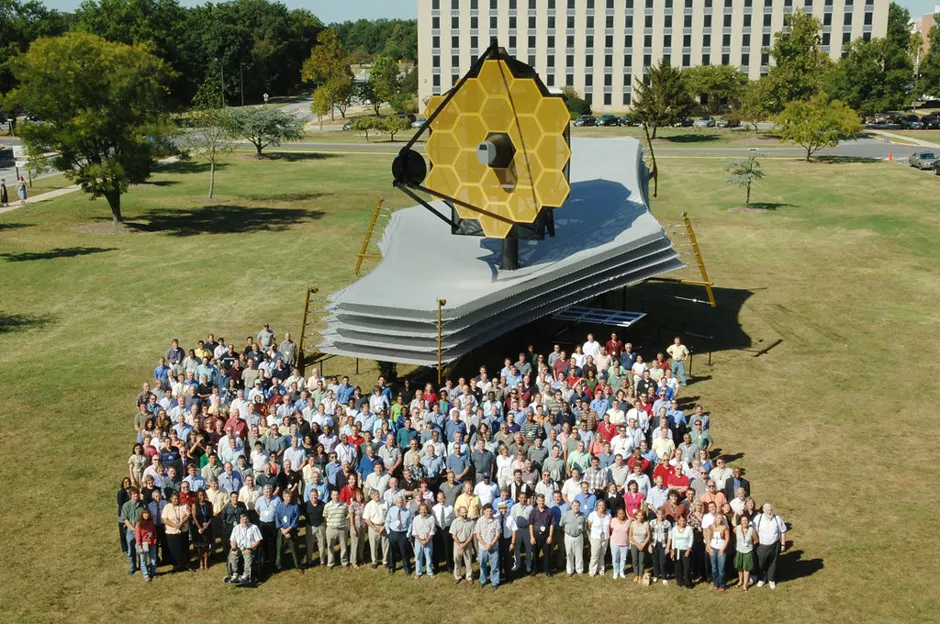
Using its infra-red telescope, the JWST observatory can examine objects
BBC Science Focus Magazine
over 13.6 billion light-years away. Because of the time it takes light to travel
across the Universe, this means that the JWST will effectively be looking at objects
13.6 billion years ago, an estimated 100 to 250 million years after the Big Bang.
Just recently, an international team of astronomers used the James Webb Space Telescope (JWST) to image an exoplanet six times the size of Jupiter, located roughly 12 light-years—or about 70 trillion miles—from Earth. The spectacular images captured by JWST are exceeding astronomers’ expectations in clarity and detail. Yet, what they are revealing is far from what evolutionary scientists had anticipated.
Many are baffled to discover that the telescope’s data doesn’t align with current theories of galaxy formation and cosmic evolution. While the images are visually awe-inspiring to the general public, they have stirred quiet confusion—and in some cases, outright alarm—within the scientific community. In a wave of technical papers published since July 12, astronomers repeatedly express shock: the universe appears to contain far more galaxies than expected, and those galaxies are surprisingly smooth, compact, and fully formed—even at extreme distances. In other words, most ancient galaxies look remarkably similar to nearby ones, contradicting the assumption that galaxies evolve gradually over billions of years.
To everyone who sees them, the new James Webb Space Telescope (JWST) images of the cosmos are beautifully awe-inspiring. But to most professional astronomers and cosmologists, they are also extremely surprising—not at all what was predicted by theory. In the flood of technical astronomical papers published online since July 12, the authors report again and again that the images show surprisingly many galaxies, galaxies that are surprisingly smooth, surprisingly small and surprisingly old. Lots of surprises, and not necessarily pleasant ones. One paper’s title begins with the candid exclamation:
Eric J Lerner; Physicist
“Panic!”
Two Revelations That Are Troubling For Evolutionist
- Fully formed galaxies at extreme distances appear structurally identical to those nearby, suggesting that galaxies did not gradually evolve but appeared suddenly and mature—echoing the biblical phrase: formless and void.
- Despite scanning portions of over 2 trillion galaxies in the observable universe, JWST—like its predecessor Hubble—has found no evidence of life, let alone intelligent life, on any other planet.
Far from supporting naturalistic theories of cosmic evolution, the James Webb Space Telescope is unintentionally affirming the extraordinary uniqueness of Earth. In a universe of unimaginable scale and complexity, our planet remains the only known home to life—and more strikingly, to intelligent, conscious beings capable of wonder, worship, and discovery. These findings align more closely with the view that Earth was intentionally designed and uniquely placed, not the random byproduct of blind cosmic forces.
The James Webb Telescope is revealing that of the 2 trillion galaxies and countless stars in the Universe the Earth is the only planet that not only has life— but intelligent life.
Why is this so critical for evolutionists? Because it’s becoming increasingly difficult to explain how the Big Bang, through random processes, could have produced just the right combination of chance, chemicals, and energy to generate life and liquid water only on Earth—while none of the millions of galactic systems observed by JWST show similar results.
If all planets and galaxies originated from the same initial explosion using the same raw materials, why isn’t life showing up elsewhere? The uniqueness of Earth poses a growing challenge to naturalistic explanations, and increasingly points to purposeful design rather than cosmic coincidence.
The Earth Is Designed Exclusively for Life
| Essential Condition For Life | Why Condition Is Essential |
| Liquid Water | All known forms of life require liquid water |
| Energy | Planet needs to be in right zone near star to get right amount of heat to keep water liquid |
| Nutrients | Planets need systems to deliver nutrients to organisms such as water cycle or volcanic activity. Nutrients need to be spread out so they are not too hard to obtain like on gas planets. |
| Chemical Ingredients | Life needs certain chemical elements like carbon, hydrogen, nitrogen, oxygen, phosphorus, and sulfur to form organic molecules. These elements make up 98% of living matter on earth. |
| Atmosphere | A protective atmosphere can keep a planet warm and protect it from radiation. |
| Distance from the star or sun | A planet needs to be far enough away from it’s star to avoid being too hot or too cold |
| Core | A planet’s core can provide geothermal energy, cycle raw materials, and create a magnetic field to protect from radiation |
Here is a list of essential contingencies that makes the Earth perfect for life. To assume all six contingencies happened to the Earth through random natural processes as the result of a chaotic explosion begs the question: Why didn’t this happen to any other planet then?
| Life must be in the right type of galaxy | Of the 3 types of galaxies, only spiral galaxies (like the Milky Way) can support life |
| Life must be in the right location in the galaxy | We are situated in just the right place in the Milky Way to avoid harmful radiation |
| Life must have the right type of star | While most stars are too large, too luminous, or too unstable to support life, our sun is just the right size and age |
| Life must have the right relationship to its host star | If the Earth were slightly closer or farther from the sun water would either freeze or evaporate |
| Life needs surrounding planets for protection | A habitable planet must have large surrounding bodies (such as Jupiter and Uranus) to protect it from incoming comets |
| Life requires the right type of moon | If the Earth did not have a moon of the right size and distance, it would be inhabitable. The moon stabilizes the Earth’s tilt, preventing extreme temperatures and thus creating a stable, life-friendly environment |
fine-tuned
/ˌfīnˈto͞oned/
1. precisely adjusted for the highest level of performance, efficiency, or effectiveness
Fine-tuning refers to the surprising precision of nature’s physical constants and the early conditions of the universe. To explain how a habitable planet like Earth could even exist, these fundamental constants have to be set to just the right values (like tuning a dial to find just the right radio station). If the universe had physical constants with even slightly different values, the universe simply could not support life: it would expand too quickly, or never form carbon atoms, or never make complex molecules like DNA.
| Physical Constants | Precision Required |
| Gravitational force constant | If larger stars would be too hot and would burn up too quickly and too unevenly. If smaller stars would remain so cool that nuclear fusion would never ignite — hence no heavy-element production. |
| Electromagnetic force constant | If larger there would be insufficient chemical bonding. Elements more massive than boron would be too unstable. If smaller there would be insufficient chemical bonding and inadequate quantities of either carbon or oxygen. |
| Strong nuclear force constant | If larger there could be no hydrogen and nuclei essential for life would be unstable. If smaller there would be no other elements other than hydrogen. |
| Weak nuclear force constant | If larger there would be too much hydrogen converted to helium in the Big Bang causing too much heavy element material. If too little helium produced from Big Bang would cause too little heavy element material to be made and not expulsion of heavy elements from stars would result. |
| Ratio of electromagnetic force constant | If larger there would be no stars of less than 1.4 solar masses, hence short stellar life spans and uneven stellar luminosities. If smaller there could be no stars of more than 0.8 solar masses and there could be heavy element production. |
| Ratio of electron to proton mass | If larger there would be insufficient chemical bonding for stable molecules to be possible. If smaller there would be insufficient chemical bonding for stable molecules to be possible. |
Each of the four fundamental forces of nature had to be carefully fine-tuned for life: gravity, electromagnetism, the strong nuclear force, and the weak nuclear force. In particular, the ratio of the electromagnetic force to the gravitational force must be delicately balanced to one part in 10 to the 40th power or:
10,000,000,000,000,000,000,000,000,000,000,000,000,000
If the ratio varied even slightly, then our universe would not have small and large stars, which are both necessary for a planet to sustain life. How delicate a balance is this? Imagine covering one billion continents the size of North America with coins. Stack the coins in columns that reach to the moon. Paint one coin red and place it in one of the columns. Blindfold a friend and have her attempt to pick it out. The odds are roughly 1 in 10 to the 40th power that she will.
Hugh Ross; The Creator and the Cosmos
The Fine-tuning Of Constants Point To A Creative Intelligence
To believe that the universe came into existence through purely natural processes, one must explain how gravity could have emerged and immediately balanced itself with electromagnetism during the very first zeptosecond (a trillionth of a billionth of a second) after the universe began—with a precision tolerance of less than 1 in 10⁴⁰.
If the universe were the product of gradual evolution over billions of years, we would expect to see evidence of chaotic adjustments or failed configurations. But we don’t. Instead, the evidence confirms that fundamental forces like gravity and electromagnetism were flawlessly calibrated at the very moment of creation.
If the universe evolved over billions of years, why does the evidence prove that gravity and electromagnetism were set precisely the first time—exactly when the universe began? The only way that this would be possible is if an intelligence knew ahead of time what this precise setting should be, and that gravity was essential to this process.
This level of fine-tuning is beyond comprehension. How could unthinking, unknowing forces or particles “self-adjust” to such a razor-thin margin, where any deviation—either greater or smaller—would have resulted in the universe collapsing or expanding too rapidly for matter to form? There is no trial-and-error in the first instant of time. The constants had to be set perfectly from the very beginning.
The only way that this would be possible is if an intelligence knew ahead of time what this precise setting should be, and that gravity was essential to this process.
This overwhelming uniqueness continues to affirm what many have long believed—Earth is not a cosmic accident, but a divinely crafted home for life, and for intelligent beings capable of seeking their Creator.
The more I examine the universe, and the details of its architecture, the more evidence I find that the Universe in some sense must have known we were coming.
Freeman Dyson; Physicist and winner of Templeton Prize, and Max Planck Medal
Astronomers employ a range of sophisticated methods to detect planets beyond our solar system, including direct imaging, gravitational microlensing, stellar wobble (radial velocity method), and the transit method, which detects dips in a star’s brightness as a planet passes in front of it. As of September 2023, scientists have identified 5,502 exoplanets orbiting stars within our own galaxy, the Milky Way.
Only one of the 5,502 planets is fine-tuned to sustain life…Earth!
Challenge Question: With over 5,502 exoplanets discovered and none showing the precise conditions necessary to sustain life, does the extraordinary fine-tuning of Earth suggest random cosmic chance—or intentional design by a Creator who uniquely prepared our planet for life?
Premise 9: The Bible Describes The Uniqueness Of Mankind The Best
Then God said, “Let us make mankind in our image”, in our likeness, so that they may rule over the fish in the sea and the birds in the sky, over the livestock and all the wild animals, and over all the creatures that move along the ground.” So God created mankind in his own image, in the image of God he created them; male and female he created them.
Genesis 1:26-27
Cognition and Abstract Thought Is Evidence of the Imprint of God
The word “mankind” carries the same genetic implication as the word “kind” used for plants, animals, birds, and insects—indicating reproduction within distinct boundaries. However, mankind stands uniquely apart: it is the only “kind” not grouped with any other living beings.
The uniqueness of this moment is underscored in Genesis 1:26, where the narrative shifts from the third person to the first person plural: “Then God said, ‘Let Us make man in Our image, according to Our likeness.’” This marks a divine dialogue within the **Holy Trinity—Father, Son, and Holy Spirit—**and signals the creation of a being unlike any other: one who would bear the image of God.
To be made in God’s image means that mankind alone was endowed with moral, spiritual, and intellectual capacities that reflect God’s nature. Unlike the animals, humans possess the ability to reason, to choose between right and wrong, to create, to worship, and—most significantly—to perceive, contemplate, and commune with their Creator. These qualities not only distinguish humanity from the rest of creation but also equip them to fulfill the divine mandate of stewardship over the earth.
In both language and structure, the Genesis account highlights mankind’s sacred distinction—a creation not only made by God but also made for relationship with God.
I think therefore I am
Rene Descartes
Evolutionary theory postulates that human beings are merely a higher, more developed form of animal, with no fundamental distinction in essence—only in degree. According to this view, consciousness, morality, and spirituality are not unique or divinely imparted qualities, but rather emergent properties that evolved gradually from natural processes to aid in survival and social cohesion. In this framework, the human mind is reduced to a byproduct of brain chemistry, morality is shaped by evolutionary utility, and spiritual awareness is viewed as an illusion or adaptive trait—
Nature, according to Darwin, was the product of blind chance and a blind struggle, and man, a lonely intelligent mutation, scrambling with the brutes for his sustenance. To some the sense of loss was irrevocable; it was as if an umbilical cord had been cut, and men found themselves part of a cold passionless universe
J.W. Burrow; Introduction to the Origin of Species
If humans are biologically related to all species—why then are we the only species endowed with uniquely advanced capacities? Unlike our so-called closest evolutionary relatives, humans alone are rational, volitional beings—capable of reasoning, choosing, contemplating, and creating. We possess the unparalleled gift of cognition, enabling us to engage in abstract thought, moral reflection, artistic expression, and complex language. We can formulate philosophies, ponder eternity, invent technologies, develop moral systems, and envision realities that do not yet exist.
If these abilities were merely the product of shared genetics or evolutionary advancement, why is there such a vast and unbridgeable cognitive and spiritual gap between humans and every other species—including those with whom we share the highest genetic similarity? Does this not suggest that human uniqueness cannot be explained by biology alone, but rather points to something far greater: that we were intentionally created in the image of a rational, moral, and creative God?
Even Darwin wrestled with the the difficulty of explaining human consciousness and our ability to contemplate the universe in purely naturalistic terms.
“The impossibility of conceiving that this grand and wondrous universe with our conscious selves arose through chance, seems to me the chief argument for the existence of God.”
Charles Darwin—Letter to Nicholaas Doedes (1873)
Darwin’s words do not prove the existence of God, nor do they mean that he rejected his own theory of evolution. But they reveal something important: even Darwin recognized the profound mystery of conscious human existence. We are not merely creatures who exist within the universe—we are creatures who can step back, contemplate the universe, search for its meaning, distinguish between right and wrong, create beauty, pursue truth, and even ask why we exist at all.
Human Spiritual Consciousness Is The Source of Abstract Thought
ab·stract thought
the ability to consider and process ideas, concepts, and situations that are not physically present or directly observable.
Evolution teaches that the primary difference between mankind and other species is simply a larger, more developed brain—an evolutionary advantage that supposedly enables higher reasoning and complex behavior. But the Bible paints a much deeper and more profound picture. According to Scripture, what truly separates human beings from the rest of the animal kingdom is not just intelligence, but a spiritual consciousness—a soul uniquely breathed into humanity by God.
This Spiritual Awareness Enables Humans To Transcend Basic Instincts And Wrestle With The Ultimate Questions:
- What is the meaning of life? Is there a God?
- Why am I here?
- What happens after death?
These are not questions of survival or reproduction; they are reflections of an eternal imprint within us—one that echoes the image of our Creator.
It is this God-given soul that compels us to pursue truth, beauty, justice, and meaning, to compose symphonies, write poetry, construct moral frameworks, and yearn for something beyond ourselves. Far from being an evolutionary accident, our spiritual consciousness is evidence of divine intention, setting humanity apart as beings capable of worship, relationship, and eternal purpose—not just creatures of instinct, but reflections of a personal, spiritual, and eternal God.
Mankind is the Species God Uniquely Created to Know Him
The materialistic worldview claims that man is merely the product of impersonal time, chance, and matter—a random outcome of evolutionary processes. According to this view, humanity has no more eternal value, inherent dignity, moral responsibility, or ultimate purpose than any other organism on the evolutionary ladder.
Yet, while every other animal is preoccupied with basic instincts like survival and reproduction, mankind is uniquely consumed with higher pursuits—such as religion, philosophy, science, literature, art, and music. These distinct preoccupations point to something far greater than biology or survival—they reveal a being designed not just to live, but to think, create, seek truth, and ultimately know the One who gave life purpose in the first place. Here is a chart with cognitive attributes exclusive to man.
| Human Cognitive Attribute | Description | Why It Is Significant |
|---|---|---|
| Abstract Reasoning | Ability to think about concepts such as justice, infinity, truth, and meaning. | Enables philosophy, mathematics, theology, and advanced science. |
| Self-Awareness | Awareness of oneself as a distinct individual with an identity and personal history. | Leads to introspection, personal responsibility, and purpose-seeking. |
| Moral Reasoning | Capacity to evaluate actions as right or wrong apart from instinct alone. | Forms the basis for ethics, law, and accountability. |
| Spiritual Awareness | Universal tendency to seek God, worship, pray, and contemplate the transcendent. | Found across virtually every civilization and culture in history. |
| Complex Language | Ability to communicate abstract ideas through symbolic language, grammar, and writing. | Makes possible education, literature, and cumulative knowledge. |
| Creative Imagination | Capacity to envision realities that do not presently exist. | Produces art, music, inventions, architecture, and innovation. |
| Future Planning | Ability to anticipate distant outcomes and organize life around long-term goals. | Enables civilizations, economies, and generational planning. |
| Scientific Inquiry | Desire to understand the laws governing the universe. | Gives rise to science, technology, and discovery. |
| Aesthetic Appreciation | Recognition and creation of beauty for its own sake. | Inspires art, music, poetry, and cultural expression. |
| Search for Meaning and Purpose | Persistent questioning of life’s ultimate significance. | Produces religion, philosophy, worldview formation, and existential reflection. |
| Awareness of Mortality | Understanding that one’s life will eventually end. | Leads to questions about eternity, legacy, and the afterlife. |
| Capacity for Worship | Ability to consciously direct reverence, devotion, and allegiance toward a higher reality. | Distinguishes mankind’s universal pursuit of the divine. |
Evolutionary theory maintains that all of the cognitive attributes discussed above—reason, morality, language, creativity, self-awareness, spirituality, abstract thought, and the pursuit of meaning—arose through a gradual evolutionary process somewhere along the lineage between ape-like ancestors and modern humans. Yet the theory still struggles to explain how such an extraordinary cognitive leap occurred.
The question is not merely how humans became slightly more intelligent than other animals, but how an entirely new category of thought emerged. How did a creature driven primarily by instinct acquire the ability to solve mathematical equations, compose symphonies, formulate scientific laws, ponder the origin of the universe, contemplate eternity, and seek a relationship with God?
The gulf between instinct and abstract reasoning appears immense. No known biochemical process explains how unguided mutations and natural selection could transform a mind focused on survival and reproduction into one capable of philosophy, morality, self-sacrifice, scientific inquiry, and spiritual reflection.
The Biblical view says, “Man was created by God in His image, and is loved by God. Mankind is not merely a distinguished species—it is the species God uniquely created to know Him. Unlike any other creature in the natural world, human beings were made in the image and likeness of God, endowed with the capacity for relationship, reason, morality, and worship. While animals may exhibit instinct and limited intelligence, only humanity possesses a spiritual nature capable of seeking truth, discerning right from wrong, and longing for meaning beyond the material world.
Genesis 1:1 says, “In the beginning, God…” Before there was anything physical, there was consciousness
Sharon Dirckx—Former Athiest Neuroscientist; “Am I Just My Brain?”
in the form of the Father, Son, and Holy Spirit—the Trinity. The unembodied mind of God, which has always existed, gave rise to everything else. The Bible also says that human beings were made in God’s image. Consequently, it makes sense to say that because God has a mind, we have a mind, because God thinks, we think; because God is conscious, so are we. That would explain a lot, wouldn’t it?
God did not design humanity to simply exist or survive, but to reflect His character, to steward His creation, and most importantly, to enter into fellowship with Him. From the beginning, Scripture makes clear that God’s purpose for mankind was deeply personal: to walk with Him, know His will, and share in His divine love. This unique calling is not the result of evolutionary progress, but the intentional act of a loving Creator who formed man from the dust and breathed into him the breath of life—marking him as both physical and spiritual, temporal and eternal.
Humanity’s ability to contemplate the divine, pursue truth, and experience the transforming power of grace is not an evolutionary anomaly—it is evidence of design, purpose, and destiny rooted in God’s desire to be known and glorified through the lives of those He made in His image.
Challenge Question: If mankind were merely the result of impersonal time, chance, and matter—as materialism claims—how do we account for our deep longing for meaning, pursuit of truth, creativity, moral awareness, and spiritual hunger? Do these uniquely human qualities point to evolutionary utility, or to the intentional design of a Creator who made us in His image for relationship with Himself?
Premise 10: The Bible Describes The Purpose Of The Universe Best
“The heavens declare the glory of God, and the sky above proclaims his handiwork.”
Psalm 19:1
Another profound way humans differ from animals is our unique capacity to worship. Worship is the soul’s way of attributing honor, weight, and worth to something—or someone—greater than itself.
Imagine a world where no one had ever seen, tasted, or touched water. Then one day, a man arrives and announces that he has combined two atoms of hydrogen with one atom of oxygen and created water. He would likely be hailed as a genius and awarded a Nobel Prize on the spot. Now imagine someone who didn’t just combine the elements—but actually created hydrogen and oxygen themselves, both of which are essential to life. What would you say about Him?
H₂O is just one of over 166 billion known molecules in the chemical universe database, and yet if we encountered it for the first time today, it would absolutely astonish us. This one molecule—covering 71% of Earth’s surface, yet absent in liquid form on any other known planet—is only one among millions of marvels in creation that would overwhelm us with wonder if we were seeing them for the first time.
The Bible declares that the wonders of the universe—its precise order, natural laws, breathtaking beauty, staggering biodiversity, and intricate design—bear daily witness to the existence of a supremely intelligent, unimaginably powerful, and endlessly creative God.
The heavens proclaim the glory of God.
Psalm 19:1-4
The skies display his craftsmanship.
Day after day they continue to speak;
night after night they make him known.
They speak without a sound or word;
their voice is never heard.
Yet their message has gone throughout the earth,
and their words to all the world.
“There is no speech, nor are there words; their voice is not heard.” In other words, creation itself is silent revelation, but it is revelation that can’t go unnoticed by anyone. Day after day, night after night means God is making His Cosmic Deity apparent every second of everyone’s life as long as they can either see, hear, breathe, touch, feel, and think.
Creation is God’s Emphatic Appeal to Man to Recognize His Supreme Existence
The creation of the universe was not only the origin of space, time, and matter—it was a cosmic revelation of the nature and glory of God Himself. According to Scripture creation serves as God’s first act of self-disclosure, declaring His eternal power, divine nature, and unfathomable wisdom to all humanity.
Everyone on Earth—scientist and non-scientist alike—can look at creation and see undeniable evidence of God’s nature.
For since the creation of the world, His invisible attributes—His eternal power and divine nature—
Romans 1:20
have been clearly seen, being understood through what has been made, so that they are without excuse
1. God is Eternal
Creation had a beginning, but its cause must exist outside of time. The universe cannot create itself, and time cannot begin without a timeless source. The very existence of space, time, and matter points to a cause that has no beginning—an eternal God who precedes all things.
Consider these important truths:
- Time had a beginning: If time itself began with the universe, its ultimate cause must exist beyond the limitations of time.
- Nothing can create itself: For the universe to create itself, it would have to exist before it existed—a logical impossibility.
- God is uncreated: Unlike the physical universe, which had a beginning, God has always existed. He is not dependent upon anything for His existence.
The universe requires an explanation for its existence, but an eternal God requires no beginning or creator. He is the uncaused Cause, the timeless Creator from whom all things ultimately originate.
“Before the mountains were brought forth, or ever you had formed the earth and the world, from everlasting to everlasting you are God.”
Psalm 90:2 (ESV)
2. God is Infinitely Powerful
Genesis 1 opens with the astonishing claim:
“In the beginning, God created the heavens and the earth.”
This act was ex nihilo—out of nothing. No human or angelic power can create even a grain of sand from nothing. But God spoke, and the universe leapt into existence. That effortless command (“Let there be…”) reveals a power so immense, so unlimited, that it humbles the most advanced human intellect.
By faith we understand that the universe was created by the word of God, so that what is seen was not made out of things that are visible.
Hebrews 11:3
3. God is Infinitely Intelligent
Every scientific discovery—from DNA’s information code to the fine-tuned constants of physics—points to precision beyond human comprehension. For example:
- The DNA molecule functions like a digital code, storing encyclopedic instructions for life in a language of four chemical letters.
- Physical laws such as gravity, electromagnetism, and nuclear forces are precisely calibrated to sustain life.
- The universe’s expansion rate, cosmic microwave background, and elemental abundances all match delicate balances.
These aren’t accidental or chaotic—they are signs of an intelligent Creator who designed with purpose. The more science reveals, the more we see how deeply embedded wisdom is in the structure of the cosmos.
Great is our Lord, and abundant in power; his understanding is beyond measure!
Psalm 147:5
4. God is Infinitely Creative
No two snowflakes are exactly alike. From the microscopic complexity of a single cell to the unimaginable vastness of the universe, creation displays extraordinary diversity, beauty, and ingenuity. Every species, ecosystem, and galaxy reveals a Creator whose imagination and creativity know no limits.
Consider these remarkable examples:
- The Diversity of Life: Millions of species exhibit unique characteristics, intricate designs, and specialized abilities suited to their environments.
- The Beauty of Creation: From the brilliant colors of tropical fish and butterflies to the breathtaking landscapes of mountains and oceans, nature displays extraordinary artistic beauty.
- The Wonders of the Universe: Billions of galaxies, countless stars, and remarkable celestial formations reveal creativity on a scale beyond human comprehension.
The extraordinary variety, complexity, and beauty of the natural world reflect the boundless creativity of an infinitely imaginative God. His creation is not merely functional—it is filled with beauty, wonder, and seemingly endless variety, inviting us to marvel at the Creator behind it all.
“O LORD, how manifold are your works! In wisdom have you made them all; the earth is full of your creatures.”
Psalm 104:24 (ESV)
5. God is Infinitely Ordered and Precise
The universe operates according to remarkably precise mathematical laws, physical constants, and finely balanced parameters. From the motion of planets to the behavior of subatomic particles, nature follows consistent, measurable principles that govern the entire cosmos. The extraordinary mathematical order of the universe reflects the precision of its Creator.
Consider these remarkable examples:
- The Laws of Physics: Gravity, electromagnetism, and the laws of motion operate according to consistent mathematical principles, governing everything from atoms to galaxies.
- Precisely Balanced Constants: Fundamental constants, including the gravitational constant and the strengths of nuclear forces, have values that permit the existence of stars, chemical elements, and life. Even small changes to certain constants could make life impossible.
- The Mathematics of the Universe: Complex mathematical equations accurately describe planetary orbits, the behavior of light, and the movement of celestial bodies, revealing an extraordinary mathematical structure underlying physical reality.
The universe is not governed by unpredictable chaos but by consistent laws, precise mathematical relationships, and finely balanced physical parameters. From the smallest particles to the largest galaxies, creation displays an astonishing degree of order and predictability. These remarkable characteristics point to a Creator whose precision and order are reflected throughout the cosmos.
“He has made the earth by his power; he has established the world by his wisdom, and by his understanding has stretched out the heavens.”
Jeremiah 10:12 (ESV)
The point is that the infinitely profound creation reveals an infinitely profound God who created and continues to create. A first grader can look up at the stars, feel atmosphere on there face, air in his lungs, and perceive with his conscious soul that the beauty, design, and perfect order they are seeing is the result of a higher power and supreme intelligence.
Even the most skeptical scientist should be able to look at the miniature universe within the atom, the irreducible complexity of living bodies, or the vast libraries of information encoded in DNA and recognize undeniable evidence of God’s infinite power and intelligence. These features of the natural world are not the result of chaos or chance, but of intentional design—each one bearing the signature of a Creator whose brilliance exceeds human comprehension.
God has Provided Several Testimonials of His Existence, Power, Wisdom and Purposefulness
- The created order of nature which He spoke into existence
- The Bible which he inspired men to write which tells how and why
- The exclusiveness of human cognition and creativity from other creatures
- The moral consciousness of humans that distinguishes us from brute nature and the base principal of survival of the fittest
These are the internal and external attestors God has provided to every man, women, and child on earth to recognize His existence and give proper weight or “gravitas” to it.
“Their line has gone out through all the earth, their utterances to the end of the world“
Every day and night the complexity, beauty, and order of every natural thing in the universe speaks of a Creator God. God is the creator, He is the informer, He is the Law maker, and He is the Sustainer. From the orbit of planets to the behavior of atoms, from the instinct of birds to the conscience of man, creation speaks with a single unified voice: “There is a God, and He is glorious.” It reveals not just that God exists, but what kind of God He is—one worthy of reverence, awe, and worship.
Whether your an academic or a native on a primitive island—Nature’s complexity, order, design, vastness and beauty are all plain indicators that God uses to clearly communicate three basic things to all people everywhere:
- He exist
- He Is Infinitely great.
- He desires to be known by the men and women made in His image.
The Universe is God’s open invitation to seek not just more not just more knowledge of the world He created— but also the knowledge of Him contained in His written word.
Challenge Question: If the complexity, order, and beauty of the universe seem to point to something beyond mere chance, could it be that creation is actually a clue pointing us toward the existence of a Creator—and if so, what would that mean for how we view life, purpose, and our place in the universe?
ThinkCube Truth Veracity Grid
- Have I considered the facts carefully and with an open mind?
- Is my conclusion the result of a careful examination of the facts, or is it a conclusion made in spite of the facts?
- Is my conclusion the one that makes the most sense of the evidence?