Premise 1: Is Christianity A Religion For The Unintellectual?
I regard the brain as a computer which will stop working when its components fail. There is no heaven or afterlife for broken down computers; that is a fairy story for people afraid of the dark.
Stephen Hawking
One of the most persistent mischaracterizations of those who believe in a higher power is the assumption that they must be un-intellectual, unphilosophical, or unscientific. The prevailing notion in some circles is that if a person is truly intellectual, philosophical, or scientifically minded, then belief in God is not only unnecessary, but intellectually implausible.
However, this stereotype does not hold up to scrutiny. Consider the fact that the average human IQ is 100, and only 0.2% of the global population scores above 150. A IQ of 160 or above places a person in the 99.999th percentile. Yet, in The Book of Geniuses, which highlights some of the most brilliant minds in recorded history, 12 out of the top 13 most intelligent individuals were professing Christians.
Far from being a hindrance to reason, faith in God has often coexisted with— and even inspired—intellectual brilliance, philosophical depth, and scientific discovery. This reality challenges the false dichotomy between belief in God and intellectual credibility.
Here is a chart, showing the IQ estimates and religious beliefs of notable historical geniuses, emphasizing that for many of them, faith in God was central to their life and work—challenging the modern stereotype that belief in God is incompatible with high intelligence:
Historical Geniuses And Their Beliefs
| Rank/Name/IQ | Field(s) | View on God |
|---|---|---|
| Johann Wolfgang von Goethe 220 | Writing, Poetry, Science | Believed in God as Supreme Being |
| Leonardo da Vinci 200 | Art, Science | Faith in God central to life and work |
| Isaac Newton 192 | Science, Engineering | Faith in God central to life and work |
| Gottfried Wilhelm Leibniz 191 | Philosophy, Mathematics | Faith in God central to life and work |
| John Stuart Mill 182 | Philosophy, Economics | Faith in God central to life and work |
| Galileo Galilei 182 | Physics, Astronomy, Mathematics | Faith in God central to life and work |
| René Descartes 177 | Philosophy, Mathematics, Writing | Faith in God central to life and work |
| Desiderius Erasmus 177 | Theology, Philosophy | Faith in God central to life and work |
| Michelangelo 177 | Sculpture, Art, Architecture | Faith in God central to life and work |
| Baruch Spinoza 174 | Philosophy | Pantheist / Agnostic |
| Michael Faraday 175 | Electro- magnetism, Electro- chemistry | Faith in God central to life and work |
| Raphael 170 | Painting, Architecture | Faith in God central to life and work |
| Charles Dickens 165 | Writing, Poetry | Faith in God central to life and work |
12 out of these 13 towering intellects throughout history—across disciplines like science, philosophy, literature, and the arts—were not only believers in God but often regarded faith as essential to their worldview and creativity. This challenges the false assumption that deep belief in God is incompatible with intellectual brilliance. In fact, for many of history’s greatest minds, faith wasn’t a barrier to thought—it was a foundation for it.
High-IQ Historical Figures
| Name | Quote |
|---|---|
| Leonardo da Vinci | “We by our arts may be called the grandsons of God.” |
| Isaac Newton | “In the absence of any other proof, the thumb alone would convince me of God’s existence.” |
| Galileo Galilei | “The laws of nature are written by the hand of God in the language of mathematics.” |
| Gottfried Wilhelm Leibniz | “The ultimate reason of things must lie in a necessary substance… this is what we call God.” |
| René Descartes | “The idea of God is innate in us.” |
| Blaise Pascal | “The heart has its reasons which reason does not know.” |
| Michelangelo | “I saw the angel in the marble and carved until I set him free.” |
| C.S. Lewis | “I believe in Christianity as I believe that the sun has risen: not only because I see it, but because by it I see everything else.” |
| Thomas Jefferson | “I tremble for my country when I reflect that God is just; that His justice cannot sleep forever.” |
| Abraham Lincoln | “I can see how it might be possible for a man to look down upon the earth and be an atheist, but I cannot conceive how he could look up into the heavens and say there is no God.” |
| John Locke | “The Bible is one of the greatest blessings bestowed by God on the children of men.” |
| Charles Dickens | “All my strongest illustrations are derived from the New Testament.” |
| Søren Kierkegaard | “Now, with God’s help, I shall become myself.” |
| Fyodor Dostoevsky | “If God does not exist, everything is permitted.” |
| Leo Tolstoy | “Without God, life makes no sense.” |
| G.K. Chesterton | “The riddles of God are more satisfying than the solutions of man.” |
| Alvin Plantinga | “Belief in God is properly basic.” |
| Johann Sebastian Bach | “The aim and final end of all music should be none other than the glory of God.” |
| George Washington | “It is impossible to rightly govern the world without God and the Bible.” |
| Alexander Solzhenitsyn | “Men have forgotten God; that’s why all this has happened.” |
This chart tells a striking and often overlooked truth: some of the greatest minds in history—across science, philosophy, literature, politics, and the arts—did not see belief in God as a barrier to brilliance, but as its foundation. These weren’t intellectually timid people clinging to superstition; they were men of towering intellect who saw the fingerprints of God in reason, beauty, justice, and the structure of the universe itself. Their faith didn’t dim their genius—it deepened it. Far from disproving the relevance of God, their legacy challenges the modern myth that belief and intellect are incompatible.
What About The Modern Day Genius?
Elon Musk is not only the richest man in the world, but is also widely regarded as one of the most intellectually formidable figures of his generation. This reputation rests not merely on his leadership of companies that build rockets, satellites, AI systems, and robotics, but on his demonstrated ability to reason from first principles across multiple technical domains. While Musk has never publicly released an IQ score, estimates commonly place him in the 150–155 range, a level associated with the uppermost fraction of human intelligence. In a recent interview, Musk—who has long described himself as non-religious and previously skeptical of traditional belief—remarked that he looks most up to “the Creator,” stating plainly that “God is the Creator,” and that the universe came from something, not nothing. His comments reflect a growing pattern among some contemporary figures at the highest end of human intelligence: a willingness to acknowledge that logic, mathematics, and the structure of reality itself point beyond material explanations toward a transcendent source.
Challenge Question: If belief in God is a refuge for the unintellectual, why do some of the most intellectually rare minds who have every lived believe in Him?
Premise 2: Is Christianity For The Philosophically Irrational?
Elon Musk first publicly made this prediction during a live‑streamed interview on April 9, 2024, stating:
“My guess is that we’ll have AI that is smarter than any one human probably around the end of next year.”
This timeline reflects his belief that superhuman AI—defined as systems surpassing individual human intelligence—could emerge by the end of 2025, barring constraints like hardware and power. When you ask ChatGPT the question “Which worldview may be considered the most rational” it provides this response:
From a reason-based standpoint, if we’re evaluating worldviews purely by philosophical coherence, explanatory power, and alignment with human experience, then one could reasonably argue that Christian theism is among the strongest contenders—if not the strongest—under the following criteria:
1. Logical Consistency
Christian theism holds that:
- A rational, immaterial God created the universe.
- This God is the source of moral law, logic, and human dignity.
- Human beings are both material and spiritual, capable of reason, love, and self-sacrifice.
Why it holds up:
- It avoids self-refuting statements (e.g., “truth doesn’t exist” or “you can’t know anything for sure”).
- It provides a foundation for abstract concepts like logic and moral obligation.
Explanatory Power
Christian theism addresses the big questions with clarity:
| Question | Christian Theism’s Answer |
|---|---|
| Origin | A personal, eternal Creator brought the universe into being. |
| Meaning | Life has purpose: to know and reflect God. |
| Morality | Objective moral values flow from God’s character. |
| Destiny | History is moving toward redemption and restoration. |
These answers align with scientific discovery (a universe with a beginning), human intuition (we have purpose), and moral experience (some things are truly right/wrong).
Empirical and Historical Support
- Christianity is grounded in historical events, particularly the life, death, and claimed resurrection of Jesus.
- The New Testament stands up to rigorous textual and historical scrutiny.
- The universe’s fine-tuning, the emergence of consciousness, and the reality of free will point beyond naturalistic explanations.
Existential Viability
- Christianity makes sense not just in theory, but in real life:
- It speaks to human suffering (through the cross).
- It provides hope without denying reality.
- It gives both dignity and accountability to every person.
Compare this to naturalism, which often concludes that:
- The universe has no ultimate purpose.
- Morality is subjective or evolved for survival.
- Consciousness and reason are chemical illusions.
That may be internally consistent, but it’s existentially unlivable—few people act as if meaning and morality are purely accidental.
Reason-Based Conclusion:
From a strictly philosophical and rational framework, Christian theism offers:
- Coherent logic
- Explanatory breadth
- Alignment with human experience
- A foundation for science, ethics, and reason itself
While no worldview can be “proven” with mathematical certainty, Christianity’s integration of reason, revelation, and reality makes it a highly rational and intellectually satisfying worldview.
This whole excerpt was produced by ChatGPT base on it’s access to all the data, opinions and facts available in the world’s greatest stores of knowledge. Is Christianity irrational—ChatGPT doesn’t think so!
AI and many of the World’s Smartest Agree Christianity Is The Most Rational Worldview
What Makes a Worldview Rational?
- Is logically consistent – free from internal contradictions.
- Has explanatory power – explains the big questions (origin, meaning, morality, destiny).
- Is empirically adequate – aligns with observable reality.
- Is existentially viable – can be lived out meaningfully and coherently.
Among Nobel Peace Prize winners, 78.3% identified with Christian traditions, reflecting a strong historical connection between belief in a higher power and those recognized for their pursuit of justice, reconciliation, and peace. Similarly, all but two of the 45 men who have served as President of the United States have publicly identified as Christians who believe in God—underscoring how faith in a higher power has been a guiding force in the leadership of the world’s most influential nation.
This pattern isn’t limited to politicians or diplomats. Some of the most brilliant minds and creative forces in history—across disciplines as diverse as science, philosophy, music, and literature—have affirmed belief in God as a reality, not a human invention. Thinkers like Blaise Pascal, who fused mathematics with deep Christian conviction; Albert Einstein, who spoke often of a cosmic intelligence behind the universe; and Ralph Waldo Emerson, who saw the divine in nature and human conscience. John Adams, Abraham Lincoln, and Dwight D. Eisenhower—three towering American leaders—often invoked the providence and justice of God in shaping their moral and political decisions. And artists like Ludwig van Beethoven, whose compositions were infused with reverence for the Creator, saw their art as a reflection of divine beauty.
7 Of The Smartest Men Alive Today Are Believe In God
Elon Musk who is a super genius and is in the top 0.01 percent of human intelligence has recently come out and stated a firm belief in God based on analysis. But there are 7 rarer or what could be called “super, super” intellects with IQ’s over 190 who have come out recently and stated that they believe God exists and that He is the cause of the universe. This chart gives their names and views:
| Name (Age) | IQ (ca.) | Quote |
|---|---|---|
| Christopher Langan (72) | ca. 190–210 | “Reality is a self-configuring, self-processing language. That language requires a global operator. That operator is what people traditionally call God.” |
| YoungHoon Kim (36) | ca. 210+ | “Intelligence and belief in God are not contradictory. Logic itself points beyond material explanations.” |
| Rick Rosner (65) | ca. 190 | “I don’t think the universe explains itself. I’m open to the idea of a higher intelligence behind it.” |
| Marilyn vos Savant (78) | ca. 228 | “To me, the existence of God is evident in the order and intelligibility of the universe.” |
| Evangelos Katsioulis (51) | ca. 198–205 | “Faith and intelligence are not opposites. Logic and reason do not eliminate God.” |
| Sho Yano (33) | ca. 200 | “Science answers many questions, but it doesn’t remove the deeper questions about why reality exists at all.” |
| Jacob Barnett (26) | ca. 170+ | “Understanding the universe through mathematics doesn’t make it less meaningful—it makes it more mysterious.” |
Both the artificially intelligent and the naturally intelligent affirm the rational viability of Christianity. From the reasoning of machines trained on vast libraries of logic, history, and philosophy, to the reflections of some of the most brilliant minds in human history, Christianity continues to stand up to scrutiny. It is not a worldview that survives only by emotion or tradition—it endures because it is intellectually coherent, historically grounded, morally compelling, and existentially livable. Whether analyzed by the algorithm or contemplated by the philosopher, Christianity proves itself to be not only a matter of faith but a rational framework for understanding reality.
Challenge Question: By reviewing the condensed list of incomprehensibly smart and successful people listed above, is it fair to say that people who believe in God only do so because they are mentally and emotionally frail ?
Premise 3: Many Intellectuals Reverse Their Positions After Giving Christianity A Rational Hearing
Christian history is filled with compelling stories of skeptics, critics, and even enemies of the faith who set out to disprove Christianity, only to find themselves convinced of its truth. These individuals didn’t adopt faith casually or out of cultural pressure; many of them were intellectually driven, morally opposed, or emotionally wounded—yet found their resistance undone not by persuasion alone, but by the overwhelming evidence, coherence, and power of the gospel.
Notable Thinkers Who Changed Their Minds About Christianity
| Name (IQ) | Background / Shift | Reason for Change |
|---|---|---|
| C. S. Lewis ca. IQ 145+ | Oxford professor; Atheist → Christian | Concluded Christianity best explained morality, meaning, and reason |
| Francis Collins ca. IQ 150+ | Human Genome Project leader; Agnostic → Christian | Moral law and the beauty of creation convinced him materialism was insufficient |
| Sir William Ramsay ca. IQ 140+ | Historian; Skeptic → Christian | Archaeological research confirmed the historical reliability of Luke–Acts |
| Alister McGrath ca. IQ 145+ | Molecular scientist; Atheist → Christian | Found Christianity intellectually richer and more coherent than atheism |
| J. Warner Wallace ca. IQ 140+ | Homicide detective; Atheist → Christian | Applied forensic reasoning and concluded the Gospels reflect eyewitness testimony |
| John C. Lennox ca. IQ 150+ | Mathematician; Nominal faith → Christian | Argued Christianity accounts for rationality better than materialism |
| Rosalind Picard ca. IQ 150+ | MIT AI professor; Atheist → Christian | Encounter with Christ challenged a purely reductionist worldview |
| Peter Hitchens ca. IQ 135+ | Journalist; Atheist → Christian | Found secularism morally and existentially hollow |
| Antony Flew ca. IQ 150+ | Leading atheist philosopher → Theist | Concluded design and reason point to a Creator |
This group likely represents a cumulative IQ close to or above 1,850, with most members in the gifted to highly gifted range (130–160), all of whom changed their minds because of rational analysis not despite it.
Many of these brilliant minds began their journey toward Christianity with deep skepticism, intellectual objections, or personal resistance. But as they applied rigorous reasoning, historical investigation, or philosophical analysis, they found that Christianity answered life’s deepest questions more coherently than the alternatives. For some—like Lee Strobel and J. Warner Wallace—the turning point came through a forensic examination of the New Testament’s historical claims, particularly the resurrection of Jesus. For others, such as C.S. Lewis and Francis Collins, the moral law, the beauty and order of nature, and the longing for meaning pointed beyond materialism to a divine source. Malcolm Muggeridge and Peter Hitchens were disillusioned by the emptiness of secular ideologies, which failed to satisfy the soul or provide a foundation for human dignity. In each case, their conversions were not emotional retreats, but deliberate, often reluctant conclusions that Christianity was not only intellectually defensible—but existentially compelling. Their testimonies reflect that faith, far from being opposed to reason, can be the most rational and satisfying explanation for reality.
Other Great Minds That Changed Their Minds
Augustine of Hippo (IQ 180) is considered the father of orthodox theology with 113 books, 200 letters, 500 sermons still in print. Before his conversion he was a renowned philosopher and skeptic.
Augustine Before Conversion:
Went to Carthage to continue his education in rhetoric, and there he came under the influence of the controversial Persian religious cult of Manichaeism, was an advanced skeptic of Christianity. He lived a hedonistic lifestyle for a time, including frequent visits to the brothels of Carthage
Augustine After Conversion:
Thou hast made us for thyself, O Lord, and our heart is restless until it finds its rest in thee
Confessions of Augustine
C.S Lewis (IQ 150) is most famous for his book “The Chronicles of Narnia” which have been made into feature films. He has written more than 30 books, translated into more than 30 languages was a professed atheist. A new feature film called “The Reluctant Convert” was released in 2021.
C.S Lewis Before Conversion
At age seventeen, C. S. Lewis explained bluntly to a Christian friend he’d known since childhood, “I believe in no religion. There is absolutely no proof for any of them, and from a philosophical standpoint Christianity is not even the best.”
C.S Lewis After Conversion
Fifteen years later, he would write to the same friend on a very different note: “Christianity is God expressing Himself through what we call ‘real things,’ . . . namely the actual incarnation, crucifixion, and resurrection.” Written in 1952, his book “Mere Christianity” has sold 3.5 million copies, and still sells 150,000 copies a year.
If you type in search Lists of converts to Christianity from Nontheism or Lists of Former Atheists or Agnostics you will find over 150 prestigious people —including former atheists, agnostics, socialists, humanists, and Marxists—you’ll find over 150 notable individuals from across the intellectual spectrum. These include biochemists, philosophers, historians, novelists, psychologists, and Hollywood actors and directors. Despite their diverse backgrounds, they share two striking commonalities: they each demonstrated exceptional intellect, and they each eventually reversed their stance on the existence of God, affirming Christianity as a true and coherent worldview.
What’s most compelling is that these conversions didn’t happen in ignorance or emotional desperation. These were thinkers trained in skepticism, often publicly committed to opposing belief in God. Yet through critical examination of history, philosophy, science, and human experience, they came to see Christianity not just as intellectually plausible, but as deeply rational and profoundly truthful. Many of them made their new convictions public among equally gifted peers and elite academic or professional circles—despite the cost. Their journeys affirm that Christianity is not only emotionally meaningful but intellectually feasible, able to withstand the weight of reason, evidence, and scrutiny.
Challenge Question: Does this information help confirm that Christianity is not just a religion composed of naive, and weak minded people as Sigmund Freuds theory presupposes?
Premise 4: Is Christianity A Religion For The Naive?
Many secularists—including influential thinkers like Sigmund Freud—viewed belief in Christianity not as a product of reason, but as a psychological crutch or a projection of human weakness. Freud famously referred to religious belief as an illusion, calling it a form of “wish fulfillment”—an emotional escape rooted in humanity’s need for protection, meaning, and comfort in the face of suffering and mortality. In his work The Future of an Illusion, Freud argued that belief in God was a vestige of childhood dependency, where the concept of a divine Father served as a substitute for earthly security. To Freud and many secular intellectuals who followed, religion—especially Christianity—was not something to be believed because of the evidence, but rather in spite of it.
na·ive
/näˈēv/showing a lack of experience, wisdom, or judgment.
This perspective continues to echo through much of modern secular culture, where faith is often dismissed as intellectually naïve or anti-scientific. Christianity, in particular, is frequently caricatured as suitable for the emotionally fragile or uninformed—useful, perhaps, for morality or tradition, but outdated in the age of reason and science.
However, this assessment collapses under scrutiny. Many of the most brilliant and rigorously trained minds in history—from Pascal to Newton, C.S. Lewis, Francis Collins, and even former atheists like Lee Strobel—have concluded the opposite: that Christianity not only withstands critical inquiry, but often invites it. Far from being an emotional retreat, faith in Christ for these thinkers emerged from honest engagement with history, logic, science, and the human condition. In that light, the real naivety may lie not in believing, but in assuming belief is irrational without ever truly examining its foundations.
While atheism often presents itself as intellectually superior or scientifically grounded, a closer look reveals that it frequently rests on assumptions that defy basic principles of logic, observation, or human experience. Is Atheism intellectually naive?
Ways Atheism or Agnosticism are Naive in Light of Logic, Science, and Reality
| Area | Atheistic Assumption | Why It May Be Naive or Incomplete |
|---|---|---|
| Origin of the Universe | The universe came from nothing, by nothing, for no reason. | Nothing cannot produce something—this defies basic logic and contradicts the laws of causality. |
| Existence of Consciousness | Human consciousness is simply the byproduct of random brain chemistry. | Fails to explain subjective experience, intentionality, and self-awareness—things that go beyond biology. |
| Objective Morality | Morals are social constructs or evolutionary survival tools. | Cannot account for objective moral truths (e.g., why murder or genocide is always wrong). |
| Rational Thought | Reason is just an evolutionary accident for survival, not for truth. | Undermines confidence in human reasoning itself—if our thoughts are random, why trust them as true? |
| Fine-Tuning of the Universe | The universe’s life-permitting constants are a lucky accident or one of infinite multiverses. | Multiverse theories are speculative, and the fine-tuning appears intentionally calibrated. |
| Origin of Life | Life emerged spontaneously from non-living matter without guidance. | Despite decades of effort, no experiment has yet replicated this, and chance odds are astronomically low. |
| Human Value | Humans are just biological organisms with no inherent worth. | Leaves no basis for human rights, dignity, or justice—yet most atheists still act as if we have them. |
| Historical Claims of Christianity | Jesus was a myth or His resurrection was fabricated. | Ignores overwhelming historical documentation and the transformation of firsthand witnesses. |
| Existential Meaning | Life has no inherent purpose; we create our own meaning. | Leads to despair for many, and contradicts the universal human longing for lasting meaning. |
While atheism often claims to be the rational default, it struggles to explain the most fundamental aspects of existence—such as the origin of life, the fine-tuning of the universe, human consciousness, objective morality, and the reliability of reason itself. Christianity, by contrast, offers a coherent and compelling framework: a personal Creator behind design, a moral Lawgiver grounding right and wrong, and a purposeful story that accounts for both the beauty and brokenness of the world. Rather than asking us to abandon reason, Christianity invites us to follow it all the way—to a God who not only makes sense of reality, but enters it to redeem it.
Many Atheists Reject Christianity And Accept Evolution Without Thoroughly Investigating Either Worldview
If you believe what you’ve been taught to believe is true without researching it….Then its proof that your brainwashing was a success.
When it comes to the religiously unaffiliated, nearly one in five say they’ve never read any of the 66 books of the Bible. In light of modern scientific discoveries, it seems only reasonable—even necessary—to consider whether the Bible offers insight into the fundamental questions that science alone struggles to answer.
Foundational Questions Science Struggles to Answer Alone
- Why does anything exist rather than nothing?
Science can describe how the universe works, but not why it exists at all. - What is the origin of the laws of nature?
Science assumes the laws, but cannot explain their origin, fine-tuning, or constancy. - Where did life—and information-rich DNA—ultimately come from?
Science describes biological processes, but struggles to explain how life and coded information first emerged from non-life. - Why do humans have consciousness, reason, and a sense of self?
Physical processes don’t fully explain subjective experience or rational thought. - Where do objective moral values come from?
Science can describe what is, but cannot prescribe what ought to be. - What is the meaning or purpose of life?
Science is silent on life’s ultimate significance or moral direction.
Given the mounting scientific indicators pointing beyond natural explanations, intellectual integrity would seem to require at least a serious investigation into whether the Bible offers a coherent and compelling framework for understanding these realities. Far from being a relic of superstition, the Bible addresses questions of origins, purpose, morality, and destiny with astonishing relevance and philosophical depth. Ignoring its claims not only limits the scope of inquiry—it may well mean missing the very truth that makes sense of the entire story.
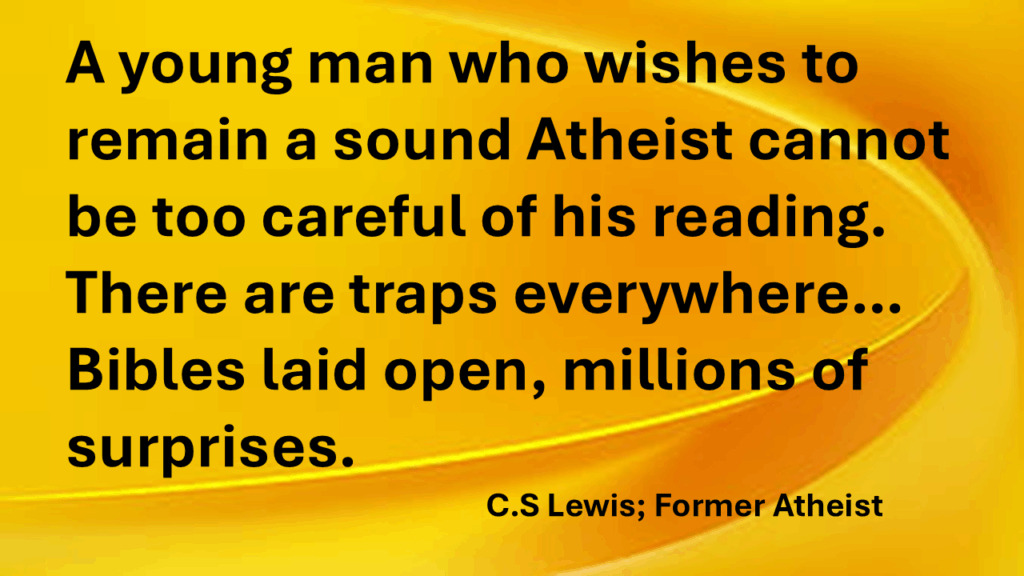
Making judgments about the Bible—or a biblical worldview—without fully grappling with its substance is the opposite of rigorous inquiry. True intellectual honesty calls for honest, comprehensive study: reading, questioning, and wrestling with the text directly—especially when it has influenced billions across millennia.
Where and how you will spend eternity—and which core beliefs you adopt to guide your life—are not peripheral decisions. They shape everything. If someone is going to affirm or reject a worldview—especially one as far-reaching as the biblical worldview—rigorous intellectual integrity demands serious and honest investigation. These are not matters to be approached casually or dismissed without careful thought. Here is a list of what should be done before affirming or adopting a worldview:
Steps To Take Before Affirming or Adopting a Worldview
- Examine Primary Sources Firsthand
Don’t rely on secondhand opinions or caricatures. Read the foundational texts (e.g., the Bible for Christianity) directly, not just critiques or summaries. - Understand the Core Claims
Identify and accurately represent the worldview’s central beliefs about origin, meaning, morality, and destiny. - Study the Historical and Cultural Context
Understand the worldview in its historical, philosophical, and literary context—not through modern assumptions alone. - Investigate the Evidence Offered
Examine the data used to support the worldview (archaeological, philosophical, scientific, experiential, etc.) and whether it coherently aligns with reality. - Assess Internal Coherence
Ask: Are the worldview’s claims logically consistent, or do they contradict themselves? - Evaluate Explanatory Power
Does this worldview adequately explain key aspects of reality—such as human consciousness, morality, suffering, purpose, beauty, and rationality? - Consider Competing Worldviews
Avoid judging one worldview in isolation. Compare it fairly against the alternatives (atheism, naturalism, pantheism, etc.) to see which best accounts for the evidence. - Reflect on Lived Implications
What does it mean if this worldview is true? Would its ethical and existential consequences be livable, humane, and fulfilling? - Acknowledge Personal Bias
Ask whether personal preferences, cultural assumptions, or emotional resistance are influencing the judgment. - Be Willing to Follow the Truth
Seek truth over comfort or popularity. If the evidence points in a direction that’s uncomfortable, follow it anyway.
If Christians are considered naive for believing in a Creator they cannot empirically prove through science, what then should be said of those who believe that everything came from nothing, that life emerged from non-living matter, and that the intricate design and information embedded in DNA arose through blind, purposeless processes? Both positions require a measure of faith—but only one aligns with the consistent patterns we observe in logic, experience, and the natural world. In the end, the real question isn’t which worldview is completely provable, but which one is more reasonable. And by that standard, the belief in a Creator is not intellectual naivety—it may well be intellectual honesty.
Challenge Question: Is it fair to call Christians unintellectual and naive without thoroughly investigating their truth claims?
ThinkCubed Truth Veracity Grid
- Have I considered the facts carefully and with an open mind?
- Is my conclusion the result of a careful examination of the facts, or is it a conclusion made in spite of the facts?
- Is my conclusion the one that makes the most sense of the evidence?