Premise 1: Creation Points To A Cause That Is Outside Of Nature
First Cause
The original, uncaused source from which everything else ultimately derives its existence.
The Law of Causation Points to a First Cause
One of the most fundamental principles of reason is that whatever begins to exist must have a cause. Things do not simply create themselves or appear from absolute nothingness.
The question is not simply how the universe developed into what we observe today, but what caused the universe to exist in the first place.
The ancient philosophical principle Ex nihilo nihil fit—”out of nothing, nothing comes”—captures this reasoning. Absolute nothingness has no matter, energy, properties, or causal power. It cannot produce anything.
Modern Cosmology Points to a Beginning of the Universe
For centuries, many scientists believed the universe was eternal—that matter, energy, and space had always existed. However, discoveries in modern cosmology have provided compelling evidence that the observable universe has a finite history.
Consider two important discoveries:
1. The Expansion of the Universe
Scientists have discovered that the universe is expanding. Imagine dots drawn on the surface of a balloon. As the balloon inflates, the dots move farther apart. Likewise, as the universe expands, distant galaxies generally move farther apart.
Now imagine reversing the process. As the balloon deflates, the dots move closer together. Similarly, tracing the universe’s expansion backward leads to an extremely hot, dense early state approximately 13.8 billion years ago.
This discovery overturned the traditional picture of a static, unchanging universe and provides powerful evidence for a finite cosmic history.
2. The Second Law of Thermodynamics
The Second Law of Thermodynamics tells us that in an isolated system, entropy increases over time. Energy gradually becomes less available to perform useful work.
Consider a fire burning in a fireplace. Unless additional fuel is supplied, the fire eventually burns out. The energy has not disappeared, but it has become dispersed and less useful.
The universe is likewise undergoing irreversible physical processes. This raises a profound question: If the universe had existed eternally in its present thermodynamic condition, why has it not already reached a state of maximum entropy?
Together, cosmic expansion and thermodynamics provide important support for the argument that the universe has a finite past rather than an infinite history of the same physical conditions.
The Origin of the Universe Still Requires an Explanation
The Big Bang theory describes the universe’s early expansion and development, but it does not establish what ultimately caused the universe to exist.
This distinction is crucial.
Explaining how the universe developed after its earliest known state is not the same as explaining why matter, energy, space, and time exist at all.
The First Law of Thermodynamics tells us that energy is conserved within the physical systems to which the law applies. It does not explain the ultimate origin of the universe or why those physical laws exist.
This leaves us with three fundamental questions:
- Where did the original matter and energy come from?
- Why does the universe exist rather than nothing at all?
- What caused the universe to begin?
The Universe Cannot Be the Cause of Its Own Existence
Something cannot create itself because it would have to exist before it existed—a logical contradiction. Likewise, if space, time, matter, and energy began to exist, their ultimate cause cannot simply be another event dependent upon those same things.
This principle forms the foundation of the Cosmological Argument for God’s existence, which can be summarized in three simple statements:
The Cosmological Argument therefore points beyond the physical universe to a cause that is not dependent upon the universe for its existence.
- Whatever begins to exist has a cause.
- The universe began to exist.
- Therefore, the universe must have a cause.
Such a cause would need to be:
- Eternal: Not itself brought into existence.
- Uncaused: Not dependent upon a prior cause.
- Immaterial: Not composed of the physical matter it brought into existence.
- Transcendent: Not bound by the space and time of the created universe.
- Immensely powerful: Sufficient to bring the universe into existence.
These are precisely the attributes Christianity ascribes to the Creator.
The Biblical Explanation of Origins
“In the beginning, God created the heavens and the earth.”
The opening words of Scripture make a remarkable declaration. The universe is not eternal, self-created, or the product of absolute nothingness. It exists because an eternal God brought it into existence.
Genesis does not begin by attempting to explain where God came from. Instead, it identifies God as the One who already existed before creation. This answers the familiar question, “Who created God?”
The Law of Causation does not say that everything must have a cause. It says that whatever begins to exist requires a cause. God, by definition, is eternal and uncreated. He never began to exist and therefore does not require a cause.
“Before the mountains were brought forth, or ever you had formed the earth and the world, from everlasting to everlasting you are God.”
Psalm 90:2
Why the Biblical Explanation Makes Sense
The biblical account offers a coherent explanation for the existence of a universe that cannot account for its own ultimate origin.
Science investigates the physical universe and the processes by which it operates. The Cosmological Argument takes the evidence of the universe’s finite history and asks the deeper philosophical question: What ultimately caused it to exist?
Christianity answers that the universe owes its existence to an eternal, uncaused Creator who exists independently of the physical world. Rather than violating the Law of Causation, the biblical explanation provides the ultimate foundation for it: the universe has a cause, but that cause is not itself something that began to exist.
“You can invoke neither time nor space nor matter nor energy nor the laws of nature to explain the origin of the universe. General relativity points to the need for a cause that transcends those domains. And theism affirms the existence of such an entity — namely, God.
Stephen Meyer—Philosopher of Science, Cambridge
The universe cannot explain its own existence simply by appealing to the matter, energy, and physical laws that are themselves part of the universe. The biblical account identifies the ultimate First Cause as the eternal God—One who did not come into existence but brought everything else into existence.
‘The best data we have are exactly what I would have predicted had I nothing to go on but the first five books of Moses, the Psalms and the Bible as a whole.’
Arno Penzias—Nobel Prize Physics
You can either believe that nature created itself or that God created nature. One choice presents a logical absurdity; the other offers a rational explanation grounded in an eternal, uncaused Creator who brought the universe into existence.
The universe had a beginning. God did not. The universe requires a cause. God is the uncaused Cause.
Challenge Question: If the universe had a beginning and could not have caused itself, which explanation is more reasonable: that it ultimately came from nothing without a cause, or that it was brought into existence by an eternal, uncaused Creator?
Premise 2: The Fine Tuning Of The Universe Points To God
The universe is not a chaotic collection of matter and energy. From the smallest atom to the largest galaxy, it operates according to remarkably precise mathematical laws and finely balanced physical constants.
Fine-tuning refers to the remarkable precision of the laws, constants, and forces that govern our universe. These fundamental properties of physics have incredibly precise numerical values that make life possible. Even slight changes to some of these values would result in a universe incapable of supporting life.
The universe operates according to consistent, mathematically describable laws that govern everything from the movement of galaxies to the behavior of subatomic particles. Scientists have identified hundreds of physical laws, principles, and mathematical relationships that describe how our universe functions. What makes this even more remarkable is that the fundamental laws governing the universe were already in place from its earliest moments, establishing the precise mathematical framework upon which the entire universe operates. How could this precision be the result of random, natural spontaneous processes?
Eight Major Laws and Principles of Physics
| Physical Law | Description | Mathematical Formula |
|---|---|---|
| Law of Universal Gravitation | Governs the attraction between objects, keeping planets in orbit and galaxies together. | F = G(m₁m₂)/r² |
| First Law of Thermodynamics | Energy cannot be created or destroyed within an isolated system, only transferred or transformed. | ΔU = Q − W |
| Second Law of Thermodynamics | The total entropy of an isolated system cannot decrease, governing how energy spreads and transforms. | ΔS ≥ 0 |
| Laws of Electromagnetism | Govern electricity, magnetism, and light, making atoms, chemistry, and life possible. | Maxwell’s equations |
| Laws of Motion | Describe how objects move and respond to forces, from everyday objects to spacecraft. | F = ma |
| Laws of Quantum Mechanics | Describe the behavior of matter and energy at atomic and subatomic levels. | E = hf |
| Law of Conservation of Momentum | The total momentum of an isolated system remains constant. | p₁ + p₂ = constant |
| Einstein’s Mass-Energy Equivalence | Demonstrates that mass and energy are interchangeable and mathematically related. | E = mc² |
26 Fundamental Physical Constants and Parameters
| Physical Constant | Description | Mathematical Value |
|---|---|---|
| 1. Speed of Light (c) | Maximum speed at which information travels through space. | 299,792,458 m/s |
| 2. Gravitational Constant (G) | Determines the strength of gravity. | 6.67430 × 10⁻¹¹ N·m²/kg² |
| 3. Planck Constant (h) | Relates photon energy to frequency. | 6.62607015 × 10⁻³⁴ J·s |
| 4. Fine-Structure Constant (α) | Determines the strength of electromagnetic interactions. | ≈ 1/137.036 |
| 5. Cosmological Constant (Λ) | Associated with the universe’s accelerating expansion. | ≈ 1.1 × 10⁻⁵² m⁻² |
| 6. Elementary Charge (e) | Magnitude of the electric charge of a proton or electron. | 1.602176634 × 10⁻¹⁹ C |
| 7. Electron Mass (mₑ) | Mass of an electron, important to atomic structure. | 9.109 × 10⁻³¹ kg |
| 8. Proton Mass (mₚ) | Mass of a proton, a major component of atomic nuclei. | 1.673 × 10⁻²⁷ kg |
| 9. Neutron Mass (mₙ) | Mass of a neutron, important to nuclear stability. | 1.675 × 10⁻²⁷ kg |
| 10. Muon Mass (mμ) | Mass of a heavier relative of the electron. | ≈ 105.66 MeV/c² |
| 11. Tau Particle Mass (mτ) | Mass of the heaviest charged lepton. | ≈ 1776.86 MeV/c² |
| 12. Up Quark Mass | Mass parameter of a fundamental particle found in protons and neutrons. | ≈ 2.16 MeV/c² |
| 13. Down Quark Mass | Mass parameter of another fundamental particle in ordinary matter. | ≈ 4.70 MeV/c² |
| 14. Strange Quark Mass | Mass parameter of a heavier quark found in certain particles. | ≈ 93.5 MeV/c² |
| 15. Charm Quark Mass | Mass parameter of a heavier quark involved in particle interactions. | ≈ 1.27 GeV/c² |
| 16. Bottom Quark Mass | Mass parameter of a heavy quark. | ≈ 4.18 GeV/c² |
| 17. Top Quark Mass | Mass of the heaviest known elementary particle. | ≈ 172.6 GeV/c² |
| 18. Higgs Boson Mass | Mass of the particle associated with the Higgs field. | ≈ 125.25 GeV/c² |
| 19. W Boson Mass | Mass of a particle that mediates the weak nuclear interaction. | ≈ 80.37 GeV/c² |
| 20. Z Boson Mass | Mass of a neutral mediator of the weak nuclear interaction. | ≈ 91.19 GeV/c² |
| 21. Fermi Constant (Gᶠ) | Characterizes the strength of low-energy weak interactions. | ≈ 1.166 × 10⁻⁵ GeV⁻² |
| 22. Strong Coupling Constant (αₛ) | Describes the strength of the strong nuclear interaction at a specified energy scale. | ≈ 0.118 at Z-boson mass |
| 23. Weak Mixing Angle (sin²θᵂ) | Describes electroweak mixing in particle physics. | ≈ 0.231 at Z-boson scale |
| 24. Higgs Vacuum Expectation Value (v) | Sets the scale of electroweak symmetry breaking. | ≈ 246.22 GeV |
| 25. Hubble Constant (H₀) | Describes the universe’s present expansion rate. | ≈ 67–73 km/s/Mpc |
| 26. Cosmic Microwave Background Temperature (T₀) | Temperature of the radiation remaining from the early universe. | ≈ 2.7255 K |
Far from being a cosmic coincidence, the Earth displays a convergence of finely adjusted factors that appear deliberately coordinated, not accidentally assembled. These aren’t general “nice-to-haves,” but exacting parameters that must all align simultaneously. Even minor deviations would render life impossible.
Imagine a control panel containing 30 tuning knobs, each representing a fundamental constant or parameter governing our universe. These knobs control such things as the strength of gravity, electromagnetic forces, nuclear forces, and the expansion of the universe. What makes this remarkable is that some of these knobs have an extraordinarily narrow range of settings that permit life. Even a seemingly insignificant adjustment to certain settings could have enormous consequences.
Why Precision Matters
| Physical Parameter | How Precise Is the Setting? | What Happens if the Setting Changes? |
|---|---|---|
| Strong Nuclear Force | Just 0.5% stronger or weaker | Stars would produce far less carbon or oxygen, making life as we know it extremely unlikely. |
| Electromagnetic Force | Just 4% stronger or weaker in the same model | Stars could produce far less carbon or oxygen, severely reducing the possibility of life. |
| Cosmological Constant | Approximately 1 part in 10¹²⁰ relative to a theoretical scale | If sufficiently larger, galaxies and stars could never form. No stars, no Earth-like planets, no life. |
| Density Fluctuations | Approximately 1 part in 100,000 | Too small, and galaxies and stars might never form. Too large, and the universe could become too violent for stable planetary systems. |
| Early-Universe Matter Density | Had to be perfectly balanced. | Too high, and the universe could collapse before life developed. Too low, and stars and planets might never form. Either way, no life as we know it. |
These factors—and many others—are not independent coincidences. Each one requires prior conditions, and each interacts with the others. Change any part of the system, and the entire biosphere collapses. The more we study Earth’s properties, the clearer it becomes that habitability is the result of an extraordinarily coordinated suite of parameters, not the arbitrary byproduct of blind natural processes.
‘A commonsense interpretation of the facts suggests that a superintellect has monkeyed with physics, as well as chemistry and biology.”
Sir Fred Hoyle—Astronomer; formulated the theory of Stellar Nucleosynthesis
The question is not simply how these laws operate, but why the universe possesses such remarkable mathematical order in the first place. How could this massive amount of precision intelligence be the product of random natural processes?
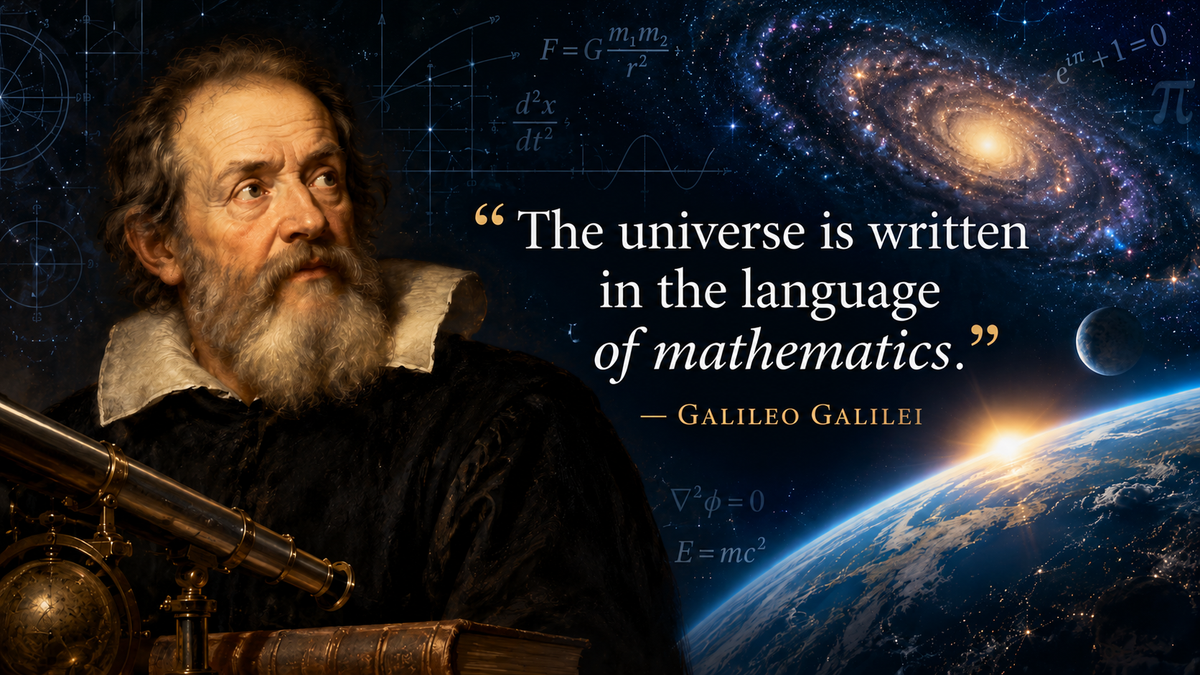
Consider what the fine-tuning of our universe reveals. From the strength of gravity to the forces that hold atoms together, the fundamental properties of our universe operate in remarkable harmony. Many of these settings are so critical that even small adjustments could eliminate the conditions necessary for life. Yet from the universe’s earliest moments, these laws and constants have worked together to make a life-supporting universe possible.
Life, it seems, is not an incidental component of the universe, burped up out of a random chemical brew on a lonely planet to endure for a few fleeting ticks of the cosmic clock. In some strange sense, it appears that we are not adapted to the universe, the universe is adapted to us.
Tim Folger—Science Writer; Discover Magazine
The remarkable mathematical order of our universe is exactly what we would expect if it were the work of an all-knowing, purposeful God. What science has uncovered about the universe’s fine-tuning provides compelling reasons to believe that the universe is not the product of blind chance, but the deliberate work of a Creator who intended life to exist.
Challenge Question: If even slight changes to the universe’s fundamental constants could make life impossible, which is more reasonable to believe—that these extraordinarily precise settings are the result of blind chance, or that they reflect the intentional design of an intelligent Creator?
Premise 3: The Information In DNA Points To An Intelligent Creator
“The machine code of the genes is uncannily computer-like.
Richard Dawkins
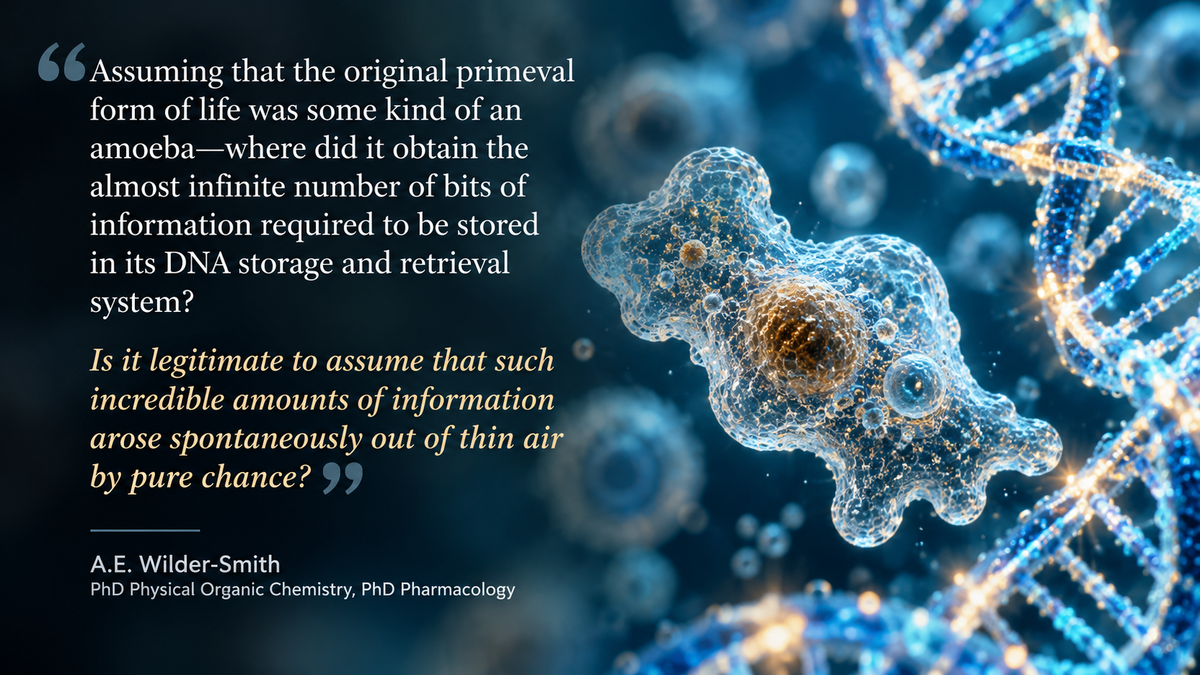
One of the most remarkable discoveries of modern science is that life depends upon information—not merely matter and energy. Inside every living cell is DNA, an extraordinary information-storage system containing detailed instructions that direct the development, operation, and reproduction of living organisms.
Consider the astonishing complexity of this system. A single human cell contains approximately 3 billion pairs of genetic letters, representing roughly 750 megabytes of information when expressed using a simple digital encoding. These instructions are stored in microscopic structures, yet they help coordinate the countless biological processes necessary to sustain life.
What makes DNA especially remarkable is not simply the enormous amount of information it contains, but the purposeful arrangement of that information. Just as the letters of an alphabet must be arranged in meaningful sequences to communicate instructions, the chemical components of DNA must be organized into specific sequences to perform their biological functions.
Chemistry can explain the molecular structure of DNA and how cells read and copy its instructions. But explaining how the functional genetic information necessary for the first living organisms originated remains one of science’s great challenges.
An intelligent sender is the only entity that can produce universal information
Throughout human experience, complex systems of functional instructions are familiar products of intelligence. Computer software, engineering blueprints, and written languages all demonstrate that intelligent minds can organize information to accomplish specific purposes. Advocates of intelligent design argue that the information contained in DNA exhibits similar characteristics, pointing toward an intelligent source rather than unguided processes alone.
The Law of Information states that any meaningful and purposeful information must come from and intelligent source.
The implications are profound. If intelligence is a demonstrated source of complex, functional information, then the extraordinary genetic instructions found within every living organism provide a compelling reason to consider an intelligent Creator as the ultimate source of life.
Imagine walking onto a construction site and discovering a detailed set of blueprints for a magnificent skyscraper. Every measurement, structural component, electrical circuit, and plumbing system has been carefully specified. These plans contain thousands of precise instructions that must work together for the building to function as intended.
Would anyone reasonably conclude that the blueprints originated when ink accidentally spilled onto paper, arranging itself into thousands of meaningful instructions? Of course not. We recognize that complex, functional instructions are the product of intelligence because that is what our experience consistently demonstrates.
Now consider DNA. Unlike a skyscraper’s blueprints, which merely describe how a building should be constructed, DNA contains instructions that living cells actually read and use to manufacture proteins, regulate biological processes, and reproduce. The information is not simply stored—it is part of an extraordinary system that puts those instructions into action.
If the detailed instructions for constructing a skyscraper point unmistakably to an intelligent architect, how much more should the elaborate genetic instructions necessary for life cause us to consider an intelligent Creator?
The extraordinary information encoded in DNA, the intricate machinery within living cells, and the remarkable coordination of biological systems all provide compelling evidence of purposeful design. These are not merely collections of chemicals, but highly organized systems operating according to precise instructions. Their complexity, functionality, and interdependence bear the unmistakable hallmarks of intelligence, foresight, and intention. Rather than pointing to blind chance, they reveal the wisdom and creativity of a Divine Creator who designed life with extraordinary precision and purpose.
Challenge Question: If we recognize intelligence as the source of complex, functional information in human technology, why should we dismiss intelligence as a possible explanation for the mathematical precision, atomic complexity, and extraordinary biological information found throughout creation?
Premise 4: Life Reveals The Hallmarks Of An Intelligent Designer
One of the most compelling arguments for intelligent design is the extraordinary complexity and coordination found throughout living organisms. From the microscopic machinery operating within individual cells to the intricate organs and systems that sustain life, nature is filled with examples of interdependent systems—multiple components that must work together to perform an essential function.
Consider the challenge these systems present to Darwinian evolution. According to evolutionary theory, the extraordinary complexity of living organisms developed through countless small genetic changes, or mutations, accumulating over millions of years. Natural selection preserves beneficial changes that improve an organism’s chances of surviving and reproducing. Over countless generations, these small changes are believed to produce increasingly complex biological structures and systems.
But this raises an important question: How could numerous specialized components gradually develop when they depend upon one another to perform an essential function?
Consider the human heart and lungs. The heart pumps blood throughout the body, while the lungs supply that blood with oxygen. Blood vessels transport the oxygen, and an elaborate network of nerves and chemical signals helps regulate the entire process. These systems must work together to sustain human life. A functioning heart without an adequate means of obtaining oxygen would be useless, just as lungs without an effective circulatory system could not deliver oxygen throughout the body.
How did such remarkably coordinated systems develop through countless small, unguided changes? Advocates of intelligent design argue that explaining the individual components is only part of the challenge. Evolutionary theory must also explain how these components originated, developed their specialized functions, and became integrated into systems capable of sustaining life.
Darwin himself recognized that explaining the gradual development of complex biological structures presented a significant challenge to his theory.
“If it could be demonstrated that any complex organ existed, which could not possibly have been formed by numerous, successive, slight modifications, my theory would absolutely break down.”
Charles Darwin—On The Origin of Species, Chapter 6 “Difficulties on Theory”
He used the human eye as a prime example of this challenge, recognizing the extraordinary difficulty of explaining how such a sophisticated organ, with its many interdependent components, could have developed through countless small evolutionary changes. In a letter to his friend and fellow scientist Asa Gray in 1860, Darwin candidly acknowledged his struggle with the complexity of the eye:
“The eye to this day gives me a cold shudder, but when I think of the fine known gradations, my reason tells me I ought to conquer the cold shudder.”
Charles Darwin — Letter to Asa Gray, February 1860
Understanding Irreducible Complexity: The Car Engine
Imagine discovering a fully functioning automobile engine. It contains hundreds of carefully engineered components—pistons, cylinders, valves, a crankshaft, a fuel system, and an ignition system—all working together in precise coordination.
Now imagine someone suggesting that this engine developed gradually through countless small, accidental changes over millions of years. One part appeared, followed by another thousands of years later, and eventually all the components came together to form a functioning engine.
But here is the problem: An engine cannot perform its intended function unless its essential components are present, properly assembled, and working together. A piston without a cylinder accomplishes nothing. A crankshaft without connecting rods cannot drive the engine. And without a fuel or energy source, the entire system remains motionless.
We immediately recognize that an automobile engine is the product of intelligent engineering because its components are designed to work together toward a specific purpose.
The Evidence Points to an Intelligent Creator
Now consider the extraordinary engineering found throughout living organisms. The human heart, lungs, circulatory system, nervous system, and countless microscopic cellular machines exhibit remarkable coordination and interdependence. These biological systems are not merely collections of individual parts; they are sophisticated arrangements of specialized components working together to sustain life.
The central challenge posed by irreducible complexity is explaining how systems that depend upon multiple cooperating parts could develop through a series of small, unguided changes. Advocates of intelligent design argue that the coordinated organization of these systems is more consistent with purposeful engineering than with blind evolutionary processes.
If we readily recognize intelligent design behind a relatively simple automobile engine, how much more should the extraordinary complexity, precision, and coordination found throughout living organisms point us toward an intelligent Creator?
Irreducible Complexity and the Cambrian Explosion
One of the most remarkable discoveries in paleontology is an event known as the Cambrian explosion, which occurred approximately 539 million years ago. During a relatively brief period in Earth’s history, the fossil record reveals the sudden appearance of an extraordinary variety of complex animals possessing dramatically different body structures and biological systems.
Before this period, the fossil record contains mostly simpler organisms, including microscopic life and soft-bodied creatures. Then, during the Cambrian explosion, we find an astonishing diversity of animals with complex eyes, specialized digestive systems, sophisticated nervous systems, jointed limbs, and protective skeletons. Many of the major groups of animals we recognize today trace their early evolutionary history to this remarkable period.
Why does this present a challenge to Darwinian evolution?
Darwin proposed that complex living organisms developed gradually through countless small changes accumulating over enormous periods of time. Under this explanation, we would expect to find evidence of simpler ancestral organisms and intermediate stages leading toward increasingly complex animal designs.
Yet the Cambrian explosion reveals the sudden appearance of sophisticated animal body plans without any fossils of organisms in a state of transition or “between forms”. What makes this discovery particularly significant is that many of these animals represent entirely new body plans—the fundamental architectural designs that determine how an animal’s body is organized.
The Two Major Challenges
1. Where are the long sequences of transitional organisms that would document the gradual development of these dramatically different designs?
2. Where did the enormous influx of new genetic information suddenly come from that was necessary to construct these dramatically different body plans?
The vast fossil record is dominated by recognizable, fully formed organisms, while many of the transitional stages expected under Darwin’s theory remain poorly documented or absent. Advocates of creationism argue that this pattern challenges the gradual development of life proposed by Darwinian evolution and is more consistent with the biblical account of distinct created kinds. Charles Darwin himself recognized that the scarcity of transitional fossils presented one of the most serious difficulties for his theory, a challenge that continues to fuel debate over the history of life on Earth.
Why, if species have descended from other species by insensibly fine gradations, do we no everywhere see innumerable transitional forms? Why is not all nature in confusion instead of the species being, as we see them, well defined? It is undoubtedly the gravest objection which can be urged against my theory.
Charles Darwin—On the Origin of Species; Chapter 6: “Difficulties On Theory”
The Cambrian explosion provides not just a negative case against Darwinian evolution, but also a compelling positive argument for intelligent design.
This is also affirmative evidence for design, because in our experience information invariably is the result of conscious activity. Here we have the geologically sudden infusion of a massive amount of new biological information needed to create these body plans, far beyond what any Darwinian mechanism can produce. Darwinism simply can’t account for it; design is a better explanation.
Stephen Meyer—Lee STtroebel’s “”The Case For A Creator”
Modern evolutionary scientists still struggle to explain how the Cambrian explosion produced such extraordinary biological diversity, the same way Charles Darwin struggled to explain it. Creationists argue that, just as sophisticated engineering requires knowledge and foresight to organize numerous components into functioning systems, the emergence of complex animal designs points to intelligence, planning, and purposeful coordination.
From atoms and molecules to living cells and the estimated 8.7 million species of organisms on Earth, nature reveals extraordinary feats of engineering and remarkable interdependent complexity. Such sophisticated design cannot reasonably be attributed to random, mindless processes. These marvels of creation point not merely to intelligence, but to a superintelligence of unimaginable knowledge, wisdom, and creative power.
Challenge Question: If even our simplest machines require intelligent engineering, how can we reasonably attribute the extraordinary complexity, coordination, and interdependence of living organisms to countless unguided mutations rather than the purposeful design of an intelligent Creator?
ThinkCube Truth Veracity Grid
- Have I considered the facts carefully and with an open mind?
- Is my conclusion the result of a careful examination of the facts, or is it a conclusion made in spite of the facts?
- Is my conclusion the one that makes the most sense of the evidence?