Premise 1: Religious Pluralism Only Appears To Be Enlightened
en·light·ened
/inˈlītnd,enˈlītnd/
having or showing a rational and well informed outlook.
Many today view religious pluralism—the belief that all religious paths ultimately lead to the same God—as a mark of enlightenment. It is often praised as tolerant, inclusive, and modern. Yet this view collapses under logical scrutiny. According to Aristotle’s law of non-contradiction, two opposing truth claims cannot both be true at the same time and in the same way. The world’s major religions, however, make mutually exclusive claims about God, salvation, human nature, and the afterlife. These differences are not minor or semantic—they are fundamental and irreconcilable. As a result, while all religions can be sincerely believed, it is illogical to say they can all be true simultaneously.
The term “enlightenment” has increasingly come to mean alignment with modern or secular thinking, but its original and truer meaning refers to the pursuit and acceptance of rational, objective truth. True enlightenment is not the denial of distinctions, but the recognition of them. To dismiss the essential doctrinal differences between the world’s religions is not a mark of intellectual sophistication—it is either a willful disregard for truth or a lack of awareness about what those religions actually teach.
The major world religions not only differ in their descriptions of who God is—whether personal, impersonal, singular, triune, or nonexistent—but also in how one is meant to reach or relate to the divine. Christianity teaches salvation by grace through faith in Jesus Christ. Islam emphasizes submission to Allah through obedience to the Five Pillars. Hinduism presents multiple paths to union with Brahman, including devotion, knowledge, and ritual action. Buddhism seeks liberation through self-discipline and enlightenment, without reference to a personal god. These aren’t slight variations—they represent entirely different roadmaps for the human-divine relationship, each claiming to be the true path.
The Illusion of Unity
Stephen Prothero, a respected scholar of world religions and a former consultant on American religious history at the Smithsonian National Museum, has forcefully argued that religious pluralism must be seriously reconsidered. In multiple works, including his influential book God Is Not One, Prothero underscores that the world’s major religions do not simply teach the same truths using different language. Through careful analysis of what each tradition says about the nature of God and the path to salvation or enlightenment, he concludes that these religions are fundamentally distinct—and often doctrinally incompatible. Far from being interchangeable, their core teachings contradict one another in ways that cannot be reconciled. Prothero insists that just as all religions are not the same, God is not a universally agreed-upon concept shared across faiths. To ignore or downplay these differences, he warns, is not a mark of intellectual sophistication but a profound misunderstanding and misrepresentation of religion itself.
It is comforting to pretend that the great religions make up one big, happy family. But this sentiment, however well-intentioned, is neither accurate or ethically possible.
Stephen Prothero— Author of New York Times Bestseller “Religious Literacy”
Universalism Undermines Truth and Understanding
| Claim of Religious Universalism | What It Actually Does | Why It’s a Problem |
|---|---|---|
| “All religions teach the same core truths.” | Ignores or glosses over major theological contradictions. | Misrepresents foundational doctrines and disrespects genuine differences. |
| “All paths lead to the same God.” | Assumes a common destination despite contradictory descriptions of God and salvation. | Violates basic logic (law of non-contradiction) and confuses seekers. |
| “Doctrinal differences aren’t important.” | Treats truth claims as optional or symbolic rather than central. | Reduces deeply held beliefs to cultural expressions rather than truth statements. |
| “Being sincere is what really matters.” | Elevates subjective feeling over objective truth. | Encourages relativism and downplays the need to discern what is actually true. |
| “Religions are just different languages saying the same thing.” | Assumes all religious language points to the same reality. | Overlooks the fact that many religious claims are mutually exclusive and incompatible. |
| “Unity is more important than truth.” | Prioritizes emotional or social harmony over theological clarity. | Creates a false sense of peace while avoiding hard but necessary questions about truth. |
Religious universalism may appear compassionate and enlightened on the surface, but beneath its appeal lies a fundamental disregard for truth. By flattening profound and contradictory beliefs into a single vague pathway, it sacrifices clarity for comfort and unity for illusion. True enlightenment does not come from denying distinctions but from recognizing and grappling with them honestly. To claim that all religions lead to the same God is not a sign of deeper understanding—it is a refusal to take the world’s faiths seriously on their own terms.
Discussion Question 1 : How or on what basis is it enlightened to tell people and cultures that have spent years studying and practicing their doctrinally distinct religions that their distinctions don’t matter?
Premise 2: Religious Pluralism Only Appears To Be Tolerant
in·tol·er·ant
Oxford Dictionary
/ˌinˈtäl(ə)rənt/
not tolerant of views, beliefs, or behavior that differ from one’s own.
The differences among the world’s major religions are well documented, yet religious pluralists continue to insist that there are many valid paths to God. Despite clear and undeniable contradictions in core doctrines—such as the nature of God, the means of accessing Him, and the reality of eternity—many well-meaning and even educated individuals persist in holding an inaccurate view of other faiths. Why is this the case?
One of the primary reasons is the belief that religious pluralism is humble and loving. For many, it feels judgmental or intolerant to suggest that someone else’s religion might be wrong. As a result, those who claim that faith in Jesus Christ is the only way to God are often viewed as arrogant, narrow-minded, or dismissive of others. But is it truly arrogant to carefully study the world’s religions, compare their teachings, and arrive at the conclusion that the claims of Christ are uniquely true? On the contrary, such a decision can reflect intellectual honesty and spiritual conviction—not pride or intolerance.
Ironically, religious pluralists make their own exclusive truth claim: that all religions ultimately lead to God. Yet this claim directly contradicts what the religions themselves teach. Christianity, Islam, Judaism, Buddhism, and others each deny that the others offer the true path to salvation or enlightenment. To assert that they all do is not an act of humility, but a redefinition of those faiths according to one’s own preference—a stance that is neither tolerant nor intellectually consistent.
How Religious Pluralism Minimizes and Redefines Religions
| Religious Claim | What the Religion Teaches | What Pluralism Implies | Result |
|---|---|---|---|
| Christian Beliefs: Jesus is the only way to God | “No one comes to the Father except through Me” (John 14:6) | Jesus is one of many valid ways to God | Denies the exclusivity central to Christian beliefs |
| Islam: Allah is the only true path | “There is no god but Allah, and Muhammad is his messenger” | Islam is just one expression of a universal truth | Rejects Islam’s claim of final, exclusive revelation |
| Judaism: Covenant with YHWH is unique | Salvation is through obedience to God’s law; denies Jesus as Messiah | Judaism leads to the same God as religions it doctrinally rejects | Erases Judaism’s doctrinal fixed terms |
| Buddhism No personal god, focus on enlightenment | Enlightenment is through inner awakening, not with a deity | Buddhism somehow leads to the same personal God it explicitly denies | Conflicts with Buddhism non-theistic worldview |
| Hinduism: Many gods, ultimately Brahman | Salvation is absorption into Brahman via various paths (devotion, knowledge, works) | Hinduism’s view of ultimate reality is equated with personal theism | Altars Hinduism metaphys-ical pillars |
| Pluralism itself | All religions are equally valid paths to the same divine reality | Makes its own exclusive claim: that no one religion holds all the truth | Replaces traditional doctrines with a modern, unrecogni-zed worldview |
The claim that all paths lead to the same God actually minimizes other religions by asserting a new religious claim. When someone says all paths lead to the same God, they blunt the distinctions between religions, throwing them all in one pot, saying: “See, they all get us to God so the differences don’t really matter.”
Jonathan Dodson— Masters Divinity Gordon-Conwell Seminary
This isn’t tolerance; it’s a power play
Religious pluralism imposes its own belief system—one that effectively rewrites the core teachings of each faith. Instead of honoring diversity, it reduces deeply held convictions to interchangeable options in a universal framework that none of them actually affirm. Religious pluralism actually minimizes other religions by overriding their distinct doctrines and replacing them with a new, pluralistic belief system.
Discussion Question: Is it truly tolerant or humble to claim that all religions lead to God when the founders and leaders of those religions explicitly deny that claim? Doesn’t insisting that this pluralistic view is correct—while declaring all opposing religious views to be wrong—meet the very definition of intolerance?
Premise 3: Religious Pluralism Is A Faith Based Concept
The statement “All paths lead to the same God” is, in itself, a faith-based assertion—not a neutral or objective fact. It is a theological claim that assumes a particular view of God, salvation, and truth—namely, that all religious traditions, regardless of their differences, are ultimately pointing to the same divine reality. This idea cannot be proven empirically or historically; it is a belief grounded in a specific worldview, often rooted in modern Western ideals of inclusivity, relativism, and personal spirituality.
Ironically, while this claim is often presented as more enlightened or tolerant than exclusive religious views, it is actually just as dogmatic. It asserts a universal truth that directly contradicts what the major world religions themselves teach. Christianity, Islam, Judaism, Hinduism, and Buddhism each make specific and often exclusive claims about who God is (or if God exists at all), how one can know or reach God, and what the ultimate purpose of life is. To say that they are all fundamentally the same is not a conclusion based on careful theological comparison, but rather an act of imposing a new belief system over theirs.
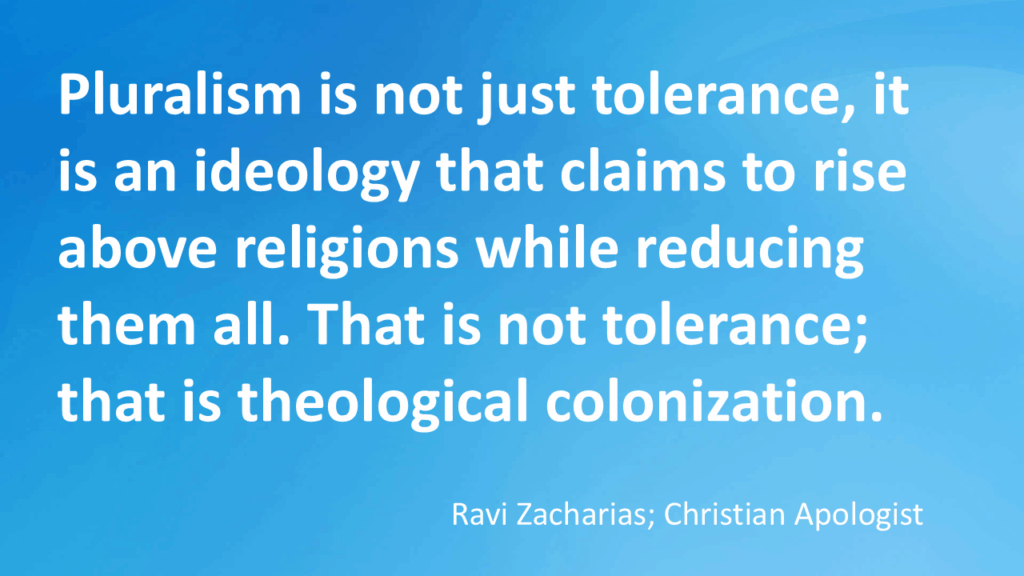
In this way, the statement “All paths lead to the same God” is not a position above religious claims—it is a religious claim. It does not eliminate exclusivity; it simply replaces the exclusivity of traditional faiths with its own.
The World’s Main Religions Contain 3 Main Components:
- Who or what God is
- How or why you should live concerning salvation of your soul
- What heaven is or how you get there
The Dogmatic Components of Religious Pluralism
| Core Question | Religious Pluralism’s Answer |
|---|---|
| Who or What is God? | God is the same ultimate reality behind all religious expressions, whether personal or impersonal. |
| How or Why Should You Live? | Live ethically and sincerely according to your tradition; all sincere paths are valid. |
| What is Heaven / How Do You Get There? | All souls ultimately reach the same divine reality or spiritual destination, regardless of path. |
Religious pluralism offers generalized answers to life’s deepest questions by claiming all religions point to the same ultimate reality. It teaches that God is universally the same across faiths, that sincere ethical living in any tradition is sufficient, and that all paths lead to the same spiritual destination. In doing so, it dismisses the distinct and often contradictory teachings of individual religions, replacing them with its own unified—but unproven—theological framework.
God is not one. Faith in the unity of all religions is just that—faith.
Stephen Prothero—God is Not One
Religious pluralism functions as a pseudo-religion because, while claiming to be neutral and inclusive, it actually makes its own exclusive truth claims. It offers a specific belief about God—that all faiths lead to the same divine reality—and redefines salvation and the afterlife in a way that contradicts what major religions teach. Rather than honoring each religion’s distinct doctrines, pluralism overrides them with its own system, effectively creating a new belief framework that substitutes theological differences with generalized unity. In doing so, it becomes not a bridge between religions, but a competing worldview.
Discussion Question: If religious pluralism claims that all religions lead to the same God—a belief that cannot be proven and contradicts what the religions themselves teach—should it be considered a faith system in its own right rather than a neutral or enlightened perspective?
ThinkCube Truth Veracity Grid
- Have I considered the facts carefully and with an open mind?
- Is my conclusion the result of a careful examination of the facts, or is it a conclusion made in spite of the facts?
- Is my conclusion the one that makes the most sense of the evidence?