
Premise 1: The Miracle Of Divine Inspiration
The Bible is supernatural not only because of how it was written, but because of what it is—the living Word of the living God. Unlike any other book in history, the Bible claims divine authorship. It was written by over 40 authors across 1,500 years in three different languages and diverse cultural settings—yet it tells one continuous, cohesive story centered on God’s redemptive plan through Jesus Christ. This internal unity, despite such variety, cannot be explained naturally; it reveals a superintending divine mind behind the text. Jesus Himself said that Scripture was inspired.
Man should not live by bread alone, but by every word that comes out of the mouth of God
Jesus —Matthew 4:4
The phrase “every word that comes out of the mouth of God” refers to the totality of God’s revealed Word—not just select teachings or moral sayings, but every word that God has spoken, preserved, and delivered through Scripture. This includes the commands, promises, prophecies, histories, and even the difficult or challenging parts of the Bible. Jesus is affirming that all of Scripture is God-breathed (as Paul later states in 2 Timothy 3:16), meaning it originates directly from the divine mind and will, not merely human invention.
In Matthew 4:4 Jesus in no uncertain terms affirms that the ultimate source of Scripture is God Himself. While God’s Word is delivered through the lips and pens of human authors, it is God who sovereignly superintends the entire process. The apostle Paul—who authored thirteen New Testament books—also emphasizes this divine oversight, explaining that Scripture is not merely human in origin but is guided and inspired by God Himself.
All Scripture is breathed out by God and profitable for teaching, for reproof, for correction, and for training in righteousness.
2 Timothy 3:16
This powerful statement affirms that the Bible is not merely a collection of human ideas or reflections, but a divinely inspired revelation. The word inspiration (inspirare) in Latin actually means to “breathe into“. God, by His Spirit, worked through a variety of human authors—each with distinct personalities, writing styles, and cultural contexts—to communicate His truth with precision and authority. The result is a unified yet diverse collection of texts, encompassing historical records, poetry, narrative, prophecy, wisdom literature, and apostolic letters. Though these genres differ in form, they all share one ultimate source: the breath of God, ensuring that Scripture is both fully divine and profoundly human in its expression—perfectly suited to teach, correct, and transform lives.
While there are moments in Scripture where God directly imparts His words to human messengers in a manner resembling dictation, the broader pattern of biblical inspiration reveals a richer, more dynamic process. Rather than bypassing the minds and personalities of the authors, God most often worked through them—guiding their thoughts, emotions, experiences, and perspectives to communicate His truth. These writers were not passive instruments, but willing participants whose unique voices and styles were used by God to convey His eternal message.
God sometimes breathed His words into the human writers to be recorded much as dictation. He said to Jeremiah “Behold I have put my words in your mouth” (Jeremiah 1:9). God’s divine truth more often flowed through the minds, souls, hearts, and emotions of His chosen human instruments. Yet, by whatever means, God divinely superintended the accurate recording of His divinely breathed truth by His divinely chosen men in a supernatural way.
John MacArthur, Theologian and Pastor
Whether through historical narrative, poetry, prophecy, or instruction, the end result was not merely human insight but the very Word of God. Throughout the writing process, God supernaturally guided the biblical authors so that, while expressing themselves through their own personalities and circumstances, they faithfully recorded His truth without error in what He intended to communicate. This divine-human collaboration did not weaken the message—it guaranteed its authority. The Bible is God’s self-revelation to humanity, communicated with precision, power, and purpose. That is why Scripture occupies a unique place among all books and why God consistently calls His people to treasure, obey, and proclaim it.
For You have exalted above all things Your name and Your Word
Psalm 138:2
What David is saying in this Psalm is that separating God from His Word is as impossible as deciding whether the bullet or the bullet hole came first. The Bible is not God—yet it is the authoritative expression of His voice. Scripture is God’s self-revelation, conveyed through human authors whom He directed in what to write. To honor God is to honor His Word, because His Word reflects His character, His truth, and His name.
The Apostle Peter also Affirmed that Scripture Originates and is Inspired by God
But know this first of all, that no prophecy of Scripture is a matter of one’s own interpretation, for no prophecy was ever made by an act of human will, but men moved by the Holy Spirit spoke from God.
2 Peter 1:20-21
The word translated as “matter” in some biblical passages comes from the Greek word ginetai, which means “comes into being” or “originates from.” This emphasizes that Scripture is not the product of human invention, but something that has its origin in God. Additionally, the phrase “moved by” (as used in 2 Peter 1:21) carries the idea of being “carried along,” much like a sailboat is carried along by the wind. It illustrates how the Holy Spirit guided the biblical authors—not by dictation, but by directing their thoughts and words according to His divine purpose.
Reasons Why God Chose Humans to Reveal His Infallible Truth
1. To Reflect the Incarnation Principle
Just as Jesus Christ—God in the flesh—entered the world through human form, so too God’s Word came to us through human language, culture, and personality.
“The Word became flesh…” (John 1:14)
Likewise, Scripture is divine truth clothed in human words.
Throughout the Bible God often chooses to work in and through people—highlighting both His power and His grace.
2. To Demonstrate His Sovereignty and Power
By using imperfect people, God shows that the power and authority of Scripture do not depend on the worthiness or intellect of the human authors, but on His divine breath working through them.
“We have this treasure in jars of clay to show that the surpassing power belongs to God and not to us.” —2 Corinthians 4:7
3. To Engage Human History and Culture
God’s truths were delivered in real places, at real times, through real people—rooting divine revelation in historical reality, not myth.
This makes Scripture relatable, contextual, and verifiable, unlike abstract philosophies or detached revelations.
4. To Preserve Human Freedom While Ensuring Divine Accuracy
God did not dictate Scripture like a mechanical scribe. He used each writer’s vocabulary, personality, and perspective, yet superintended the process so that the result was exactly what He intended.
“Men spoke from God as they were carried along by the Holy Spirit.” —2 Peter 1:21
This shows cooperation between the divine and human, without compromising either.
5. To Invite Trust, Not Coercion
If God only revealed truth by overwhelming displays of force or supernatural writing in the sky, faith would be compelled, not chosen.
By using human writers and testimonies, God invites a relational response of faith—grounded in reason and evidence, but requiring trust.
6. To Build a Covenant Community
By entrusting truth to prophets, apostles, and teachers, God was forming a people, not just distributing data. The human mediation of Scripture ties us into a relational, covenantal story rather than a mere instruction manual.
God chose humans to participate in divine revelation because He created us in His image—with the ability to reason, communicate, and relate. Using human authors allowed God’s truth to be conveyed in ways we could understand, relate to, and preserve. Through divine inspiration, He ensured their words were His message—uniting the human and divine to reveal Himself and His redemptive plan.
Inside The Miracle of Divine Inspiration
The fact that most of the New Testament authors were called apostles is deeply significant, as it underscores their unique role as divinely commissioned messengers and eyewitnesses of Jesus Christ. The term apostle means “one who is sent,” and in the New Testament context, it refers to individuals personally chosen by Christ to authoritatively teach, proclaim, and preserve His message. Their writings carry the weight of firsthand testimony and divine commission, marking them not merely as religious thinkers but as official representatives entrusted with communicating the Word of God. This apostolic authority forms the foundation for the credibility and canonization of the New Testament.
a·pos·tle
/əˈpäs(ə)l/
A messenger, envoy, or commissioned representative
Before questioning whether God inspired, moved, or superintended the writing of Scripture, one must first ask the more fundamental question: Is such a thing even possible?
Christians believe that God created humanity in His own image, endowing men and women with spiritual awareness and the unique capacity to reflect on existence, purpose, morality, and God Himself. Given this honorable distinction among all creatures—along with the extraordinary gift of language and written expression—is it truly implausible to believe that such a profoundly creative and sovereign God could also guide, or “carry along,” chosen individuals to write exactly what He intended about Himself and His redemptive plan for the world?
The same God who created atoms, trees, galaxies, and the human mind is more than capable of guiding chosen men to write exactly what He intended—through their own voices, experiences, and styles. If God can design the cosmos and the intricacies of life, inspiring the writing of His Word is not only possible—it is entirely reasonable. Through this divine-human partnership, God has revealed His nature, His plan for humanity, and His eternal purposes for heaven and earth. Here are examples where God appoints men to be his divine messengers.
God Appointing Human Mouthpieces in Scripture
| Person(s) | Scripture Reference | Description |
|---|---|---|
| Moses | Exodus 4:15–16 | God tells Moses He will be with his mouth and give him words; Aaron will speak for him. |
| Aaron | Exodus 7:1 | God makes Moses “as God” to Pharaoh, and Aaron as his prophet/spokesperson. |
| Prophets (general) | Deuteronomy 18:18 | “I will raise up a prophet… and I will put my words in his mouth.” |
| Isaiah | Isaiah 6:8–9 | God sends Isaiah: “Go, and say to this people…” |
| Jeremiah | Jeremiah 1:7–9 | God says: “You shall go to all to whom I send you… I have put my words in your mouth.” |
| Ezekiel | Ezekiel 3:4, 10–11 | God commands Ezekiel to speak His words to the house of Israel. |
| Amos | Amos 3:7–8 | “The Lord God does nothing without revealing his secret to his servants the prophets.” |
| John the Baptist | Matthew 11:10; Isaiah 40:3 | A voice crying in the wilderness, sent to prepare the way of the Lord. |
| Jesus Christ | John 12:49–50 | Jesus says He speaks only what the Father commands Him to say. |
| Apostles | Matthew 10:19–20 | Jesus tells them the Spirit of the Father will speak through them when they testify. |
| Paul | 1 Corinthians 2:13 | Paul claims to speak truths “taught by the Spirit, not by human wisdom.” |
| Prophets & Teachers | 2 Peter 1:20–21 | “Men spoke from God as they were carried along by the Holy Spirit.” |
If God is capable of creating the universe by His word, parting seas, raising the dead, and entering human history through the incarnation of Christ, then the miracle of divine inspiration is not only reasonable—it is entirely consistent with His nature and power. In fact, compared to the grandeur of other biblical miracles, the idea that God could sovereignly guide human authors to write His truth without error is both logical and expected. Just as He used ordinary means—like loaves and fish—to accomplish extraordinary outcomes, so too He used fallible human writers to communicate His infallible Word. The miracle of inspiration is not an irrational leap of faith; it is a natural extension of the kind of God Scripture reveals—a God who acts, speaks, and makes Himself known, and who grants His image-bearers the profound privilege of participating in that revelation.
“God, in revealing Himself, stooped to speak in human language, through human authors, so that His truth could be known, trusted, and shared.”
Wayne Grudem—Systematic Theologian
The miracle of biblical inspiration, then, is not only that God spoke, but that He superintended the entire process in such a way that every word written was exactly what He intended—down to the smallest detail—without negating the individuality of the human writer. Scripture is not partly divine and partly human; it is fully both. The result is a unified, God-breathed revelation, delivered through a diverse set of human instruments, yet miraculously preserved in its accuracy, authority, and purpose. This divine supervision ensured that the final product—the Bible—is nothing less than the trustworthy and eternal Word of God, communicated through chosen men under the guidance of the Holy Spirit.
Challenge Question: If God is powerful enough to create the universe and endow humans with reason, language, and moral awareness, what valid reason would there be to doubt His ability to guide human authors in recording His Word accurately?
Premise 2: The Miracle Of Divine Prophecy
om·nis·cience
Dictionary of Oxford Languages
/ämˈniSH(ə)ns/
the state of knowing everything.
While God chose to use human beings as the instruments through which the Bible was written—allowing their personalities, cultural contexts, and writing styles to shape the text—He also ensured that it bore supernatural trademarks that would make His divine authorship unmistakable. Chief among these is the Bible’s consistent and verifiable use of fulfilled prophecy, which serves as compelling evidence that Scripture was not merely the product of human imagination or religious tradition, but the revelation of an omniscient and sovereign God.
About one-fourth of the Bible is related to predictive prophecy, or predictions which, at the time of their utterance, were still future. The Bible is filled with these unique proofs of being inspired by the Holy Spirit. The Bible contains hundreds of specific prophecies, many of which were recorded centuries before their fulfillment. These prophetic statements are often detailed, naming future people, places, events, and outcomes that no human author could have predicted with such accuracy. Unlike vague or symbolic predictions common in man-made religious texts, biblical prophecies are rooted in real-world history and are often fulfilled in public and verifiable ways.
For instance, the Old Testament accurately foretold the destruction of major cities centuries before the events occurred. Ezekiel 26 predicted that the proud Phoenician city of Tyre would be conquered, scraped bare “like the top of a rock,” and its debris cast into the sea—a prophecy remarkably fulfilled through successive invasions, culminating in Alexander the Great’s construction of a causeway using the city’s rubble 250 years later. Isaiah 13 similarly foretold the downfall of Babylon, then the greatest empire in the world, predicting that it would ultimately become permanently desolate rather than rebuilt like other ancient capitals.
Scripture also foretold the rise and succession of world empires. In Daniel 2 and 7, written during the Babylonian exile, God revealed the future dominance of Medo-Persia, Greece, and Rome, accurately describing a sequence of kingdoms that would shape world history centuries before they appeared.
Such precision is humanly impossible and points directly to a God who exists outside of time, declaring “the end from the beginning” (Isaiah 46:10). No other book in human history contains this level of detailed, fulfilled prophecy. This prophetic accuracy validates both the truthfulness of Scripture and the omniscience of its Author—making God’s superintendence of the Bible not only credible, but unmistakable.
The Bible’s Fulfilled Prophecies Authenticate the Bible
What makes biblical prophecy especially powerful is that it operates under the highest possible standard: perfection. God stakes His own credibility on the absolute reliability of what He declares. Unlike human predictions, which allow for error or revision, divine prophecy must be fulfilled exactly as stated—without exception or alteration. Even a single failed prediction would disqualify the prophet and dishonor the integrity of God Himself (Deuteronomy 18:21–22). As He says through the prophet Isaiah:
Remember the former things long past,
Isaiah 46:9-10
For I am God, and there is no other; I am God, and there is no one like Me,
Declaring the end from the beginning And from ancient times things which have not been done,
If even one of the Bible’s prophecies were to fail, it would call into question the very nature of God Himself. Scripture repeatedly presents God as all-knowing, sovereign, and utterly truthful—a God who cannot lie (Titus 1:2) and who declares “the end from the beginning” (Isaiah 46:10). Prophecy, by its very nature, is a test of divine credibility. If God foretells an event and it does not come to pass, then His omniscience (knowing the future), sovereignty (controlling the future), or truthfulness (speaking only what is true) would all be undermined.
If what a prophet proclaims in the name of the Lord does not take place or come true, that is a message the Lord has not spoken.
Deuteronomy 18:21-22
In Deuteronomy 18:21–22, God Himself sets the standard. This reveals how tightly God’s authority is bound to the absolute accuracy of His word. One failed prophecy would not simply be a historical error—it would indicate a break in divine perfection, rendering God untrustworthy and Scripture unreliable.
Criteria for fulfilled prophecy:
- The prediction must be written before the events that it predicts
- the fulfillment must correspond exactly to the prediction
The Bible contains approximately 2,500 prophecies that foretell specific events in detail many years, sometimes centuries before they occur. Of the 2,500 detailed prophecies found on the pages of the Bible—2,000 have already been fulfilled to the letter with no errors. The remaining 500 or so are still in the future.
Prophecies Demonstrating God’s Perfect Omniscience
| Prophecy And Prediction Date | Scripture | Fulfillment |
|---|---|---|
| Messiah to be born in Bethlehem Ca. 700 B.C. | Micah 5:2 | Ca. 6-4 B.C. Matthew 2:1 |
| Virgin birth of the Messiah Ca. 700 B.C. | Isaiah 7:14 | Ca. 6-4 B.C. Matthew 1:22–23 |
| Messiah betrayed for 30 pieces of silver Ca. 500 B.C. | Zechariah 11:12–13 | A.D. 30 Matthew 26:14–15; 27:3–10 |
| Crucifixion foretold (pierced hands and feet) Ca. 1000 B.C. | Psalm 22:16 | A.D. 30 John 20:25–27 |
| Messiah silent before accusers Ca. 700 B.C. | Isaiah 53:7 | A.D. 30 Matthew 27:12–14 |
| Messiah dies with wicked, buried with rich Ca. 700 B.C. | Isaiah 53:9 | A.D. 30 Matthew 27:38, 57–60 |
| Destruction of the Second Temple Ca. A.D. 30 | Matthew 24:1–2 | Josephus AD 70 |
| Fall of Babylon Ca. 700-600 B.C. | Isaiah 13:19–22; Jeremiah 51 | Nabonidus Tablet 539 BC |
| Rise of Cyrus (named before birth) Ca. 700 B.C. | Isaiah 44:28–45:1 | Nabonidus Tablet 539 BC |
| Israel scattered and regathered Ca. 1400/580 B.C. | Deut. 28:64; Ezekiel 36–37 | Josephus AD 70 / 1948 |
| Nations will persecute and hate the Jews throughout history Ca. 1400 B.C. | Deuteronomy 28:65–67 | Throughout history |
| Messiah’s bones not broken Ca. 1000 B.C. | Psalm 34:20 | A.D. 30 John 19:33–36 |
| Messiah enters Jerusalem on a donkey Ca. 500 B.C. | Zechariah 9:9 | A.D. 30 Matthew 21:6–9 |
| Darkness at Messiah’s death Ca. 750 B.C. | Amos 8:9 | A.D. 30 Luke 23:44–45 |
| Messiah to be resurrected Ca. 1000 B.C | Psalm 16:10 | A.D. 30 Acts 2:31 |
| Messiah to ascend to heaven Ca. 1000 B.C. | Psalm 68:18 | A.D. 30 Acts 1:9 |
Key Observations:
- These prophecies span over 1,000 years and were fulfilled hundreds of years later, many verifiable through both biblical and secular history.
- Unlike vague predictions, these are specific, time-sensitive, and high-risk—making their perfect fulfillment an unmistakable sign of divine omniscience.
- No other religious text or worldview offers a comparable record of fulfilled prophecy.
The majority of the 2,500 prophecies in the Bible are independent of each other making the odds of them all being fulfilled by chance without error is less than 102000 (that is 10 with 2,000 zeros written after it)! This number is so unimaginably large that there are not enough atoms in the entire observable universe to write it out using one atom for each digit.
According to PhD astrophysicists and qualified American science professors, the odds of the more than 2,500 prophecies found in the Bible being fulfilled by chance are 1 with 2,000 zeros after it. According to the mathematical science of probability, if a number has more than 50 zeros after it, the odds of that happening by chance is virtually impossible. This is irrefutable proof that the Bible is inspired by God.
Hugh Ross—Canadian Astrophysicist and Trotter Prize Winner
The details, timing, and specificity of fulfilled biblical prophecy offer compelling evidence that these predictions could not have originated from human insight or chance. Unlike vague or symbolic forecasts found in other ancient texts, the Bible’s prophecies often name specific people, places, events, and timeframes—many written centuries in advance of their fulfillment.
What is the likelihood of a person predicting today the exact city in which the birth of a future leader would take place, well into the 22nd century?
This is indeed what the prophet Micah did 700 years before the Jesus’s birth.
But you, O Bethlehem Ephrathah,
Micah 5:2
who are too little to be among the clans of Judah,
from you shall come forth for me
one who is to be ruler in Israel,
whose coming forth is from of old,
from ancient days.
What is the likelihood of predicting the precise manner of death that a new unknown religious leader would experience, a thousand years from now – by a manner of death presently unknown, and to remain unknown for hundreds of years?
Yet, this is what David did in 1000 B.C concerning the crucifixion of Jesus. (Psalm 22:16-18)
My enemies surround me like a pack of dogs;
Psalm 22:16-18
an evil gang closes in on me.
They have pierced my hands and feet.
I can count all my bones.
My enemies stare at me and gloat.
They divide my garments among themselves
and throw dice for my clothing.
What is the likelihood of predicting the specific date of the appearance of some great future leader, hundreds of years in advance?
This is what Daniel did, 530 years before Christ. (Daniel 7:13)
“I saw in the night visions,
and behold, with the clouds of heaven
Daniel 7:13
there came one like a son of man,
and he came to the Ancient of Days
and was presented before him.
There are Over 351 Prophecies about Jesus in the Old Testament
One of the most remarkable evidences of the Bible’s divine origin is the sheer number of detailed prophecies about the coming Messiah—fulfilled with precision in the life of Jesus. These were not vague predictions, but specific promises written centuries before His birth. In fact, there are over 351 Old Testament prophecies that point directly to Jesus Christ, confirming that His life, death, and resurrection were not random events, but the fulfillment of a divine plan foretold long before it unfolded. Here are just a few of the 351.
The Messiah Jesus was born of a virgin (Isaiah 7:14) in Bethlehem (Micah 5:2), as a descendant of Abraham (Genesis 12:1–3), Isaac (Genesis 17:19), and Jacob (Genesis 28:14). He was betrayed by a friend (Psalm 41:9) for 30 pieces of silver that were used to purchase the potter’s field (Zechariah 11:13). Then he was mocked and ridiculed, pierced in his hands and feet, and lots were cast for his clothing (Psalm 22:7, 16, 18). He died (Daniel 9:26) as a sacrifice for our sins and was buried in a rich man’s tomb (Isaiah 53:8–10). After a short time in the grave, he lived again (Psalm 16:10; Isaiah 53:10). Below is a chart of the probabilities of even just 8 of these 351 prophecies being fulfilled:
| Prophecy and Details | Location in Bible | Years Before Event Occurred | Probability of Fulfillment |
| Jesus born in Bethlehem | Micah 5:2 | ca. 768 years | 1 in 105 or 100,000 |
| A messenger will prepare the way for the Messiah | Malachi 3:1 | ca. 466 years | 1 in 103 or 1,000 |
| Jesus will enter Jerusalem on a donkey | Zechariah 9:9 | ca. 513 years | 1 in 102 or 100 |
| Will be betrayed by a friend and suffer wounds in His hands | Zechariah 13:6 | ca. 513 years | 1 in 103 or 1,000 |
| Betrayed for 30 pieces of silver | Zechariah 11:12-13 | ca. 513 years | 1 in 1011 or 100,000,000,000 |
| Betrayal money be used to purchase Potter’s field | Zechariah 11:13 | ca. 513 years | 1 in 105 or 1,000,00 |
| Messiah will remain silent while afflicted | Isaiah 53:7 | ca. 772 years | 1 in 103 or 1,000 |
| Messiah will die by having His hands and feet pierced | Psalm 22:16 | ca. 963 years | 1 in 104 or 10,000 |
When the individual probabilities for these eight prophecies are combined, the odds of their accidental fulfillment become astronomically small—approximately 1 in 10²⁸. Even after adjusting for the estimated 88 billion people who have lived since these prophecies were given, the probability of one individual fulfilling all eight by mere coincidence is still only 1 in 10¹⁷—one chance in one hundred quadrillion. Such overwhelming odds point not to chance, but to divine orchestration.
If you took 100 million silver dollars and lay them on the face of Texas they would cover all of the state two feet deep. Now mark one of these silver dollars and stir the whole mass thoroughly…Blindfold a man and tell him…he must pick up the marked silver dollar. What chance would he have of getting the right one? Just the same chance that the prophets would have of writing eight prophecies and having them come true in any one man’s life.
Peter Stoner—Science Speaks
The consistent, specific, and historically verified fulfillment of prophecy throughout Scripture offers overwhelming evidence that the Bible is not a product of human imagination, but the revelation of an all-knowing, sovereign God. From the rise and fall of empires to the precise details of Jesus’ life, death, and resurrection, these predictions—made centuries in advance—unfold with divine accuracy.
To declare a thing shall come to pass long before it is in being, and to bring it to pass. This is nothing or this is the work of God.
Justin Martyr
No other book in history bears such supernatural fingerprints. Far from being a comforting invention or religious myth, the Bible stands as a living testimony to God’s omniscience, faithfulness, and redemptive plan for humanity. Its fulfilled prophecies do not simply inspire faith—they demand it.
Challenge Question: If the Bible were merely a human invention, how can we account for the hundreds of detailed prophecies—many written centuries in advance—that were fulfilled with such precision?
Premise 3: The Miracle Of Unity Across Time And Authors
The fact that the Bible was written by over 40 different authors—across 66 books, spanning more than 1,500 years—is nothing short of miraculous. These authors came from vastly different time periods, cultures, occupations, and socio-economic backgrounds: kings and shepherds, prophets and fishermen, poets and physicians. They lived in different regions, often separated by centuries, and wrote in various literary genres including history, law, poetry, prophecy, wisdom, biography, and letters. Yet despite all this diversity, the Bible presents a single, unified narrative—one consistent theme of God’s redemptive plan and one central figure: Jesus Christ. Such remarkable coherence, without contradiction, across so many contributors and generations, is not merely human achievement—it is a compelling testimony to the divine authorship behind the human hands.
Though written by numerous authors over many centuries, the Bible tells one continuous, unified story—much like a grand symphony composed of many movements. Each book may have its own tone, tempo, and instrumentation, but all work together to build a single, harmonious theme: the creation of humanity by God, our fall into sin, and God’s unfolding plan of redemption through Christ. It’s not a collection of disconnected notes, but a divinely orchestrated masterpiece.
cross ref·er·ence
Repeated reference or accompanying information of the same subject found in a different place in a text or book.
In 2007, Lutheran pastor Christoph Römhild and Chris Harrison, a professor at Carnegie Mellon University, assembled what they refer to as a digital dataset of cross-references which are conceptual links between verses connecting locations, people, and phrases found in different parts of the Bible. The chart above is a visual representation of the 63,000 cross-reference dataset.
- The bar chart that runs along the bottom represents all of the chapters in the Bible, starting with Genesis 1 on the left.
- Books alternate in color between light and dark gray, with the first book of the Old and New Testaments in white.
- The length of each bar denotes the number of verses in that chapter (for instance, the longest bar is the longest chapter in the Bible, Psalm 119).
- Each of the 63,779 cross references found in the Bible are depicted by a single arc – the color corresponds to the distance between the two chapters, creating a rainbow-like effect.
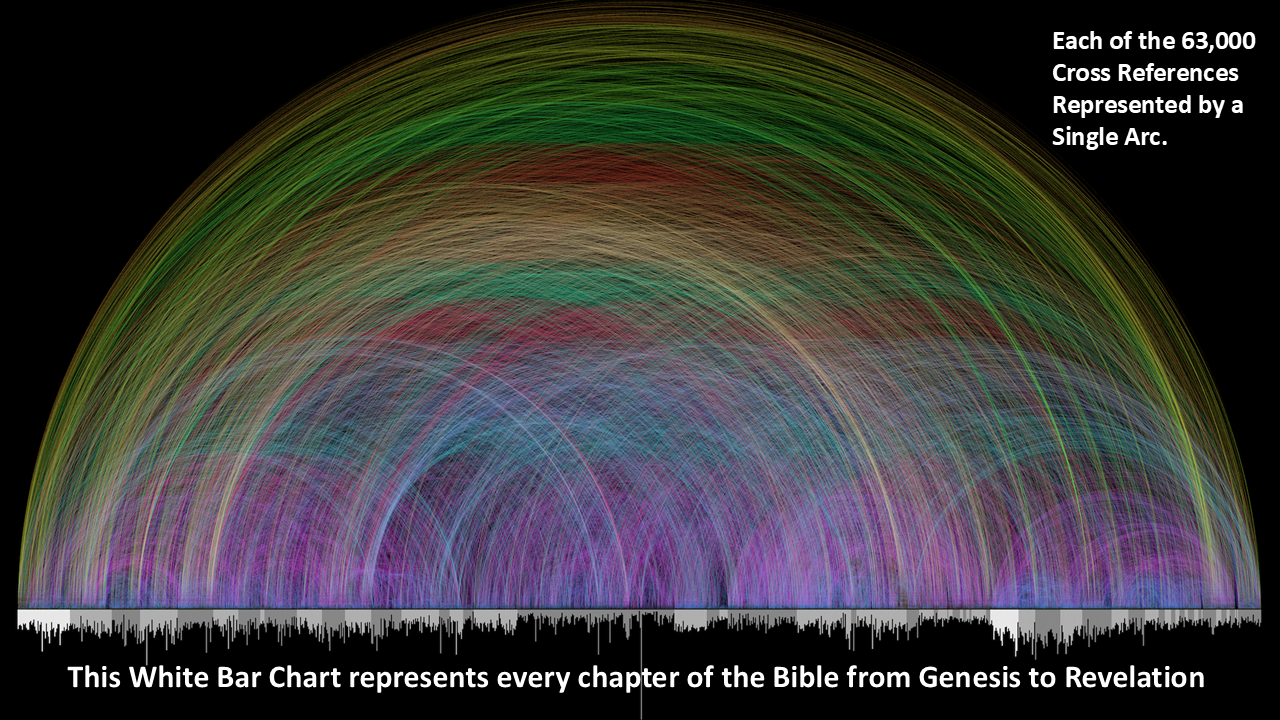
The sheer interconnectedness of the Bible demonstrates more than literary symmetry—it reflects a self-authenticating structure that is unique among ancient texts. Scripture does not merely contain truth claims; it verifies and reinforces them internally, across genres, centuries, authors, and covenants. Prophecies given in one era are fulfilled in another. Doctrinal truths echoed in poetic form find precise exposition in apostolic letters. Historical narratives are revisited in prophetic warnings, later clarified in gospel accounts, and then reflected upon in epistles—each layer adding validation to the previous without contradiction.
This internal harmony, independent of human coordination, functions as its own witness to divine origin. No external authority is needed to validate Scripture’s reliability when the text itself exhibits the fingerprints of omniscient authorship—one that transcends time, geography, and human limitation. Such unity amidst complexity is not the mark of random assembly or collaborative ingenuity, but of a supernaturally orchestrated revelation, offering coherence and confirmation from within its own pages. This internal testimony is one of the strongest evidences that the Bible is not merely about God’s Word—it is God’s Word.
The Bible is an extraordinary compilation—66 books written over more than a millennium by dozens of authors who lived in different eras, spoke different languages, and came from all walks of life. Among them were kings and prophets, farmers and fishermen, scholars and servants, writing in settings as varied as royal courts, deserts, prisons, and pastoral hillsides. Their writings span a wide range of genres—law codes, songs, prophecies, personal letters, eyewitness accounts, and ancient history.
Now imagine giving one page of a story to each of these individuals—across centuries and continents—without letting them collaborate or compare notes. The idea that such a diverse group could produce a single, coherent narrative with unified themes, flawless moral consistency, and a central figure running from beginning to end defies human explanation. And yet, that is exactly what we find in the Bible.
The 66 books of the Bible were written over 1,400 years by writers not only separated by hundreds of years but hundreds of miles. They belonged to diverse walks of life ranging from Kings, soldiers, fishermen, priest, sheep herders, tent makers, and a physician just to name a few. The writings belong to a variety of literary types including law, history, biography, poetry, letters, memoirs, and prophecy.
FF Bruce—Professor of Biblical Criticism, University of Manchester
Consider for a moment —What if multiple authors had each written a single page of the Bible? What if each author wrote in different genres, in different centuries and in different countries, with no “master plan” for them to consult? What is the likelihood that it would make any sense at all?
For all that, the Bible is not simply an anthology; there is a unity which binds the whole together.
An anthology is compiled by an anthologist, but no anthologist compiled the Bible.
The Divine Thread: Tracing Jesus Through the Entire Bible
Every book of the Bible either directly references Jesus, points toward Him, or contributes to the unfolding story that ultimately centers on Him. While not every book names Him explicitly, each one plays a role in preparing for, pointing to, portraying, or proclaiming Christ. This is a core belief in biblical theology, often summarized as the Christ-centered unity of Scripture or the “Divine thread”.
The metaphor of Jesus as the “divine thread” or the “scarlet thread” refers to the idea that the entire Bible—though written over centuries by diverse authors—tells one unified story centered on Jesus Christ. This thread weaves through every book, theme, and covenant, linking them together with a common purpose: the revelation of God’s redemptive plan through His Son.
Christ in Every Book of the Bible (with Author, Date, and Country of Origin)
| Book | Christ Reference | Author & Date | Country of Origin |
|---|---|---|---|
| Genesis | Promised Seed of the Woman | Moses (c. 1450–1400 BC) | Egypt/Israel |
| Exodus | Our Passover Lamb | Moses (c. 1450–1400 BC) | Egypt/Israel |
| Leviticus | Great High Priest | Moses (c. 1450–1400 BC) | Sinai/Israel |
| Numbers | Lifted One (Bronze Serpent) | Moses (c. 1450–1400 BC) | Sinai/Israel |
| Deuteronomy | Prophet like Moses | Moses (c. 1400 BC) | Moab/Israel |
| Joshua | Captain of Our Salvation | Joshua (c. 1350 BC) | Canaan |
| Judges | Deliverer and Judge | Samuel (c. 1050 BC) | Canaan |
| Ruth | Kinsman-Redeemer | Samuel (c. 1050 BC) | Moab/Israel |
| 1 & 2 Samuel | True King | Samuel, Nathan, Gad (c. 1000–900 BC) | Israel |
| 1 & 2 Kings | Righteous King | Jeremiah (c. 560 BC) | Judah |
| 1 & 2 Chronicles | Restorer of the Kingdom | Ezra (c. 450 BC) | Judah |
| Ezra | Faithful Scribe | Ezra (c. 440 BC) | Babylon/Judah |
| Nehemiah | Rebuilder of What’s Broken | Nehemiah (c. 430 BC) | Judah |
| Esther | Hidden yet Sovereign Deliverer | Unknown (c. 400 BC) | Persia |
| Job | Redeemer in Suffering | Unknown (c. 2000–1800 BC) | Uz/Mesopotamia |
| Psalms | Worshipful King | David & others (c. 1000–400 BC) | Israel |
| Proverbs | Wisdom of God | Solomon (c. 950 BC) | Israel |
| Ecclesiastes | Meaning in Life | Solomon (c. 935 BC) | Israel |
| Song of Songs | Lover of Our Souls | Solomon (c. 950 BC) | Israel |
| Isaiah | Suffering Servant | Isaiah (c. 700 BC) | Judah |
| Jeremiah | Weeping Prophet | Jeremiah (c. 580 BC) | Judah |
| Lamentations | Man of Sorrows | Jeremiah (c. 586 BC) | Judah |
| Ezekiel | Glory of God | Ezekiel (c. 571 BC) | Babylon |
| Daniel | Son of Man | Daniel (c. 530 BC) | Babylon |
| Hosea | Loyal Husband | Hosea (c. 720 BC) | Israel |
| Joel | Outpourer of the Spirit | Joel (c. 835–800 BC) | Judah |
| Amos | Plumb Line of Justice | Amos (c. 760 BC) | Israel |
| Obadiah | Judge of the Proud | Obadiah (c. 850 BC) | Judah |
| Jonah | Risen Prophet | Jonah (c. 780 BC) | Israel |
| Micah | Peace Bringer | Micah (c. 735 BC) | Judah |
| Nahum | Avenger of God’s People | Nahum (c. 650 BC) | Judah |
| Habakkuk | Watchtower of Salvation | Habakkuk (c. 620 BC) | Judah |
| Zephaniah | Mighty to Save | Zephaniah (c. 625 BC) | Judah |
| Haggai | Restorer of Worship | Haggai (c. 520 BC) | Judah |
| Zechariah | Pierced One | Zechariah (c. 520–480 BC) | Judah |
| Malachi | Sun of Righteousness | Malachi (c. 430 BC) | Judah |
| Matthew | Messiah and King | Matthew (c. AD 60–65) | Israel |
| Mark | Servant Redeemer | Mark (c. AD 55–60) | Rome |
| Luke | Perfect Son of Man | Luke (c. AD 60) | Rome |
| John | Son of God | John (c. AD 85–90) | Judea |
| Acts | Ascended Lord | Luke (c. AD 62) | Rome |
| Romans | Righteousness of God | Paul (c. AD 57) | Corinth |
| 1 & 2 Corinthians | Sanctifier | Paul (c. AD 55–56) | Corinth |
| Galatians | Our Freedom | Paul (c. AD 49) | Galatia (Turkey) |
| Ephesians | Head of the Church | Paul (c. AD 60) | Ephesus |
| Philippians | Joy of the Church | Paul (c. AD 61) | Philippi |
| Colossians | Fullness of Deity | Paul (c. AD 60–62) | Colossae |
| 1 & 2 Thessalonians | Returning King | Paul (c. AD 51–52) | Thessalonica |
| 1 & 2 Timothy | Faithful Shepherd | Paul (c. AD 63–66) | Ephesus |
| Titus | Sound Doctrine | Paul (c. AD 64) | Crete |
| Philemon | Mediator and Friend | Paul (c. AD 60) | Rome |
| Hebrews | Final High Priest | Unknown (c. AD 60–70) | Rome |
| James | Mature Faith in Action | James (c. AD 45–49) | Jerusalem |
| 1 & 2 Peter | Chief Cornerstone | Peter (c. AD 60–68) | Rome/Asia Minor |
| 1, 2 & 3 John | Love Incarnate | John (c. AD 85–95) | Ephesus |
| Jude | Keeper from Falling | Jude (c. AD 65) | Ephesus |
| Revelation | Triumphant King | John (c. AD 95) | Patmos |
The Bible although written by different authors in different centuries has a single theme running all the way through it. Like the rings in the trunk of a tree—It tells the unified coherent story of humanity’s creation by God, humanity’s rebellion against God, and God’s redemption of his people.
It’s like flicking between 66 different stations and finding that each is advancing the same story. As well as having a single theme, the Bible has a single here. Each of these 66 documents, even the ones written hundreds of years before Jesus’ birth, are all singing the same song. And the song, consistently is about Jesus. As Jesus said: These are the very Scriptures that testify about Me”
Barry Cooper, Can I Really Trust The Bible
What are the odds?
The odds that every book of the Bible—written by over 40 authors across roughly 1,500 years, in three languages, from vastly different regions and cultures—would all point to the same central figure, Jesus Christ, are astronomically low from a purely human standpoint.Statistically and logically, such consitency is impossible without a single guiding mind behind it.
Simply Put:
- The probability that independent writers across 15 centuries could produce such a cohesive, Christ-centered revelation by coincidence is functionally zero.
- This overwhelming unity is one of the Bible’s strongest evidences of divine authorship.
The remarkable unity of the Bible—spanning over a millennium, written by dozens of authors from vastly different backgrounds, and yet telling one coherent story centered on Jesus Christ—points undeniably to a supernatural origin. No human coordination could account for such prophetic precision, thematic harmony, and spiritual depth across 66 books. This tapestry of truth, woven through centuries, bears the unmistakable signature of divine authorship. The Bible is not merely a religious document; it is the living revelation of a God who speaks, acts, and fulfills His redemptive plan through His Word.
Challenge Question: How does the unity, consistency, and Christ-centered focus of the Bible—despite its diverse authorship over centuries—support the claim that it is of divine rather than human origin?
Premise 4: The Miracle Of Divine Preservation
The preservation of the Bible is one of history’s most extraordinary phenomena. Thousands of ancient books have been lost to time, their contents surviving only in fragments or disappearing altogether. Great civilizations have risen and fallen, libraries have been destroyed by fire and war, and countless literary works have vanished forever. Yet the Bible has endured through every age. Written over a span of more than fifteen centuries on fragile materials such as papyrus and parchment, copied entirely by hand for centuries before the invention of the printing press, and relentlessly opposed by kings, emperors, dictators, and skeptics, Scripture has survived against all historical odds.
History confirms those promises in remarkable fashion. Throughout the centuries, rulers repeatedly attempted to eradicate the Scriptures. The Roman emperor Diocletian ordered every copy of the Bible he could find to be burned. During the Middle Ages, many sought to suppress its translation into the common language of ordinary people. Totalitarian regimes in the twentieth century confiscated and destroyed Bibles in an effort to silence Christianity. Yet every campaign to eliminate God’s Word ultimately failed. Governments collapsed, empires crumbled, persecutors disappeared, and philosophies came and went, but the Bible continued to be copied, translated, distributed, and proclaimed throughout the world. Here are some interesting facts about the Bible’s astonishing preservation:
Interesting Fact 1: Rome Tried to Burn The Bible Out of Existence
In AD 303, Roman Emperor Diocletian launched a massive campaign to completely wipe Christianity from the face of the earth. He issued an imperial edict ordering every Bible burned and executed any Christian caught harboring one. He even built a monument declaring that the Christian superstition had been “extinguished.”
- The Irony: Only 25 years later, the Roman Empire capitulated. The new Christian Emperor, Constantine, commissioned the historian Eusebius to prepare 50 high-quality copies of the Bible at imperial expense. The very empire that tried to burn the Book ended up funding its mass production.
Interesting Fact 2: The Atheist Voltaire’s Prophecy Falls Flat
In the 18th century, the famous French philosopher and atheist Voltaire made a bold, public prediction. He declared: “One hundred years from my day there will not be a Bible in the earth.”
- The Irony: Only 50 years after Voltaire’s death in 1778, the Geneva Bible Society purchased his former home in Ferney, France. They used his actual printing presses and his property to print, store, and distribute crates of Bibles across Europe.
Interesting Fact 3: It Has a Statistical “Manuscript Mountain”
When compared to any other piece of ancient literature, the statistical survival of the New Testament is entirely unprecedented.
| Work | Surviving Manuscripts | Time Gap from Original to Earliest Copy |
| Plato’s Writings | 7 copies | ca. 1,200 years |
| Caesar’s Gallic Wars | 10 copies | ca. 1,000 years |
| Homer’s Iliad | ca. 1,800 copies | ca. 400 years |
| The New Testament | 5,800+ Greek (20,000+ total) | 30 to 150 years |
- The Irony: f you were to stack all of the manuscripts of all the other academically accepted ancient works it would measure 2 feet high. If you stacked all of the manuscripts of the New Testament alone it would measure over 3,937 feet high or 4 1/2 empire state buildings stacked on top of each other.
The Irony: The New Testament is frequently held to a far higher evidential standard than other ancient writings. Yet by virtually every manuscript measure—number of surviving copies, age of the earliest manuscripts, and textual agreement—it stands on stronger historical footing than nearly every other academically accepted work from antiquity.
Interesting Fact 4: Ancient Scribes Used Human “Data Verification”
The Jewish scribes (the Masoretes) who copied the Old Testament Scriptures used copying standards that bordered on obsessive-compulsive.
- The Rules: Scribes were strictly forbidden from writing even a single letter from memory. They had to look at the master copy, speak the word aloud, wipe their pen, and write.
- The Middle Letter: To ensure accuracy, they literally counted every single letter on a finished page. They knew, for example, that the exact middle letter of the Torah was the oversized Hebrew letter Vav (ו) in the word gachon (belly) in Leviticus 11:42.
- The Takeaway: If a scribe completed a massive, expensive scroll and the middle letter was off by even one character, the entire scroll was immediately disqualified, destroyed, or buried. It wasn’t just copyist work; it was a manual, ancient form of digital checksum verification.
Interesting Fact 5: A 1,000-Year Leap in Time Proved It Works
Before 1947, the oldest surviving Hebrew Old Testament manuscript we had was the Aleppo Codex, dating to around AD 930. Critics argued that over thousands of years, the text must have changed like a giant game of “telephone.”
- The Qumran Discovery: In 1947, a Bedouin shepherd boy threw a rock into a cave at Qumran and shattered a clay jar. Inside was the Great Isaiah Scroll, dating to roughly 100 BC—instantly leaping backward 1,000 years in manuscript history.
- The Final Analysis: When scholars compared the 100 BC scroll to the AD 930 scroll, they found them to be 95% identical. The tiny 5% of differences consisted entirely of minor spelling variations (like “honour” vs. “honor”) and obvious slips of the pen. Not a single spelling variation changed the meaning of the text, altered a historical fact, or modified a theological doctrine.
Interesting Fact 6: The Bible Survived Every Major World Empire
The Bible has outlived every civilization that tried to suppress or replace it.
- Egyptian Pharaohs are gone.
- Assyria is gone.
- Babylon is gone.
- Greece is gone.
- Rome is gone.
- Nazi Germany is gone.
- The Soviet Union is gone.
The Irony: Every government that attempted to eliminate Scripture has disappeared into history, while the Bible continues to be translated, printed, and read by billions around the world.
Interesting Fact 7: Archaeology Keeps Finding the Bible Was Right
For centuries skeptics claimed many biblical people and places were legendary because no archaeological evidence existed.
Then discoveries began appearing.
Examples include:
- The House of David inscription (Tel Dan Stele)
- Pontius Pilate inscription
- Pool of Bethesda
- Pool of Siloam
- Hezekiah’s Tunnel
- Cyrus Cylinder (supporting Persian policy toward conquered peoples)
The Irony: Time after time, archaeology has moved people, cities, and events from the category of “myth” to history. archaeologists are continually uncovering new evidence that confirms the people, places, and events described in the Bible. Each year, the Bible Archaeology Report publishes a list of the Top 10 Biblical Archaeology Discoveries , highlighting the most significant findings from that calendar year. Tablets, coins, synagogues, city ruins, walls, monuments, tombs, and other artifacts are regularly unearthed—further verifying the historical accuracy of the biblical record.
Interesting Fact 8: The Bible Had Independent “Fact Checkers” Across History
One of the strongest evidences for the Bible’s preservation is that its text was copied, translated, and preserved by multiple independent communities separated by centuries, geography, language, and even religious disagreements. Humanly speaking, there was no way for these groups to coordinate their work—yet they consistently preserved the same Scriptures.
- The Dead Sea Scrolls (Qumran): Hidden in caves for nearly 2,000 years, these manuscripts were copied by the isolated Essene community and predate the Masoretic Text by about 1,000 years. When discovered in 1947, they demonstrated remarkable agreement with the later Hebrew manuscripts.
- The Masoretic Text: Carefully preserved by Jewish scribes centuries after the Dead Sea Scrolls were hidden. Despite the vast separation in both time and geography, it faithfully preserves essentially the same Hebrew text.
- The Septuagint: Translated into Greek in Egypt more than two centuries before Christ by Jewish scholars working independently of later Hebrew scribes. It preserves the same Old Testament narrative and provides an early witness to the Hebrew Scriptures.
- The Samaritan Pentateuch: Preserved for over two thousand years by the Samaritans, a community that had been separated from mainstream Judaism since before the Babylonian exile. Despite some sectarian differences, it overwhelmingly confirms the text of the first five books of Moses.
- The New Testament Manuscripts: Thousands of Greek manuscripts were copied independently by churches scattered throughout Israel, Syria, Asia Minor, Egypt, North Africa, and Europe. With no centralized authority coordinating their work, they nevertheless preserve essentially the same New Testament.
- Ancient Bible Translations: Early translations into Latin, Syriac, Coptic, Armenian, Georgian, Ethiopic, and Gothic were produced in different countries and languages. Together they provide independent confirmation that the biblical text remained remarkably stable as it spread throughout the ancient world.
The Amazing Part:
Imagine asking six students in different countries to copy the same 1,000-page document by hand over the next thousand years—with no internet, no phones, no mail service, and no communication with one another. Then compare all of their copies centuries later and find they agree to an extraordinary degree. That is essentially what we discover with the biblical manuscripts. This vast manuscript evidence has allowed paleographers to identify and analyze copying variants with great precision. Remarkably, the small percentage of differences—roughly 5% or less—consists primarily of minor scribal errors, such as slips of the pen or spelling variations that do not affect meaning. As a result, scholars estimate that the biblical text is 95–98% textually accurate across all manuscripts.
Interesting Fact 11: The Bible Predicted Its Own Preservation
Long before the invention of the printing press, before libraries, publishing houses, or digital storage, the Bible repeatedly made an astonishing claim: God Himself would preserve His Word forever. If that claim were false, history would have eventually exposed it. Yet after thousands of years of copying, persecution, censorship, wars, revolutions, and countless attempts to destroy it, the Bible remains the most well-preserved, widely distributed, and influential book in human history.
| Scriptures Promising The Preservation Of The Bible | Passage |
|---|---|
| Isaiah 40:8 | “The grass withers, the flower fades, but the word of our God will stand forever.” |
| Psalm 119:89 | “Forever, O LORD, Your word is firmly fixed in the heavens.” |
| Matthew 24:35 | “Heaven and earth will pass away, but My words will never pass away.” |
| 1 Peter 1:24–25 | “‘All flesh is like grass and all its glory like the flower of grass. The grass withers, and the flower falls, but the word of the Lord remains forever.’ |
| Psalm 12:6–7 | “The words of the LORD are pure words, like silver refined in a furnace on the ground, purified seven times. You, O LORD, will keep them; You will guard them from this generation forever.” |
| Isaiah 59:21 | “‘And as for Me, this is My covenant with them,’ says the LORD: ‘My Spirit that is upon you, and My words that I have put in your mouth, shall not depart out of your mouth, or out of the mouth of your offspring, or out of the mouth of your children’s offspring,’ says the LORD, ‘from this time forth and forevermore.'” |
| Psalm 111:7–8 | “The works of His hands are faithful and just; all His precepts are trustworthy; they are established forever and ever, to be performed with faithfulness and uprightness.” |
| Ecclesiastes 3:14 | “I perceived that whatever God does endures forever; nothing can be added to it, nor anything taken from it. God has done it, so that people fear before Him.” |
The Bible did not merely survive history—it predicted that it would. Long before the rise and fall of empires, the invention of the printing press, or the countless attempts to silence it, Scripture declared that God’s Word would endure forever. Every preserved manuscript, every recovered scroll, every new translation, and every Bible still being read today stands as another witness to that remarkable claim.
The Bible Is Thriving Like Never Before
How does a collection of ancient writings survive thousands of years of persecution, censorship, war, book burnings, political revolutions, and relentless criticism—only to become the most translated, most published, most distributed, and most widely read book in the history of civilization?
If Scripture’s own claim is true—“The grass withers, the flower fades, but the word of our God stands forever” (Isaiah 40:8)—then perhaps its extraordinary preservation is not merely an accident of history, but evidence of the God who promised to preserve it.
“The Bible has not only survived the ages; it has triumphed over them.”
Bernard Ramm—Protestant Christian Evidences
For more than 2,000 years, critics, governments, philosophers, and dictators have repeatedly predicted the Bible’s extinction. Yet today it is not merely surviving—it is flourishing on a scale unmatched by any other book in history.
| The Bible by the Numbers | What It Means |
|---|---|
| 5+ Billion Copies | More than 5 billion Bibles have been printed or distributed, making it by far the best-selling and most widely distributed book in human history. |
| 100,000+ Every Day | Hundreds of thousands of Bibles are printed, purchased, or distributed every single day around the world. |
| 750+ Languages | The entire Bible has been translated into more than 750 languages—more than any other book in history. |
| 1,700+ Languages | The New Testament is available in over 1,700 languages, allowing billions to read the life of Christ in their own language. |
| 3,800+ Languages | Portions of Scripture have been translated into over 3,800 languages, with thousands more translation projects currently underway. |
| 1+ Billion Bible Apps | The YouVersion Bible App alone has surpassed 1 billion installs, making Scripture available to anyone with a smartphone. |
| 370,000+ New Downloads Every Day | More than 11 million new Bible apps are installed every month—over 370,000 every day. |
| 17+ Million Daily Readers | More than 17 million people open the Bible through YouVersion every single day. |
| Every Nation on Earth | Scripture is read digitally in every country on earth, including many places where printed Bibles are difficult to obtain. |
Even in nations where the Bible has been historically banned, confiscated, or severely restricted, Scripture continues to flourish. China—despite strict government control over Bible distribution—is now among the world’s leading nations for Bible printing and distribution. In Iran, home to what many researchers describe as the fastest-growing underground church movement in the world, underground Bible distribution has increased by an astonishing 687%. And across the former Soviet Union, where possessing or smuggling a Bible behind the Iron Curtain was once a criminal offense, millions of Scriptures are now being distributed throughout 36 former communist nations. History has repeatedly demonstrated that efforts to suppress God’s Word have only fueled its spread.
How many anvils have you had,” said I, “To wear and batter all these hammers so?” “Just one,” said he, and then with twinkling eye, “The anvil wears the hammers out, you know.”And so, thought I, the Anvil of God’s Word For ages skeptic blows have beat upon; Yet, though the noise of falling blows was heard, The Anvil is unharmed, the hammers gone.
John Clifford —British Theologian
The preservation of the Bible is therefore more than a fascinating historical fact; it is compelling evidence of divine providence. Christians believe the same God who inspired His Word also sovereignly preserved it throughout history. The Bible’s endurance is not merely the result of fortunate circumstances or human determination. Rather, it reflects the faithfulness of a God who promised that His revelation would never perish. As every generation has come and gone, the Word of God has remained exactly as He declared—living, enduring, and continuing to accomplish His purposes.
Challenge Question: What explanation best accounts for the Bible’s extraordinary preservation? Is it simply the product of remarkable human effort and historical coincidence, or does the cumulative evidence point to the providential hand of the God who declared that “the word of our God will stand forever.”
Premise 5: Jesus Affirmed The Bible As The Supernatural Word Of God
And He came to Nazareth, where He had been brought up. And as was His custom, He went to the synagogue on the Sabbath day, and He stood up to read. And the scroll of the prophet Isaiah was given to Him. He unrolled the scroll and found the place where it was written, “The Spirit of the Lord is upone Me, because He has annointed Me to proclaim good news to the poor. He has sent me to proclaim liberty to the captives and the recovering of sight to the blind, to set at liberty those who are oppressed, to proclaim the year of the Lord’s favor.” And He rolled up the scroll and gave it back to the attendant…today this Scripture has been fulfilled in your hearing.
Luke 4:16-20
In Luke 4:16–20, Jesus enters the synagogue in His hometown of Nazareth, takes the scroll of Isaiah, reads a prophetic passage about the coming of the Messiah, and then boldly declares, “Today this Scripture has been fulfilled in your hearing.” With this statement, Jesus is not merely associating Himself with a prophetic text—He is claiming to be its direct fulfillment. But just as significant is what He does by standing before the people, unrolling the sacred scroll, and reading from it publicly. In doing so, Jesus affirms the authority, inspiration, and divine origin of the Old Testament. By treating the Scriptures as the very words of God and applying them to Himself, Jesus offers one of the clearest endorsements possible: He not only fulfills the Word—He confirms it as God’s Word.
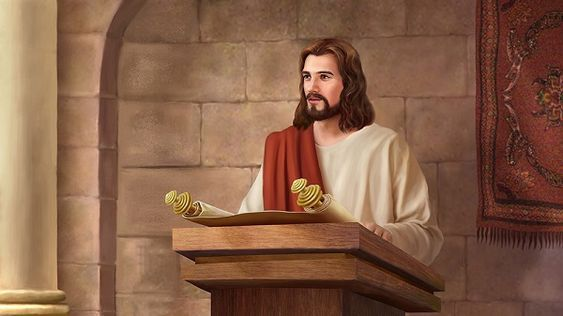
Jesus did not treat the Scriptures as optional, outdated, or merely symbolic. Throughout His ministry, He affirmed the truthfulness, authority, and divine origin of the Old Testament. Whether responding to critics, instructing His followers, or revealing His mission, Jesus consistently grounded His words and actions in the written Word of God. Far from reinterpreting or dismissing it, He embraced Scripture as historically reliable, theologically authoritative, prophetically fulfilled, and ultimately centered on Himself. The following points highlight how Jesus interacted with Scripture and what that reveals about its nature and purpose.
1. He Treated Scripture as Historically Accurate
Jesus referenced Old Testament people and events—such as Adam and Eve, Noah’s flood, and Jonah’s ordeal—as real occurrences, not myths or parables. This shows that He believed these events truly happened and affirmed the historical truth of the biblical record.
Supporting Scripture:
- “Just as it was in the days of Noah, so will it be in the days of the Son of Man.” – Luke 17:26
- “The men of Nineveh will rise up at the judgment… for they repented at the preaching of Jonah.” – Matthew 12:41
2. He Quoted Scripture as Authoritative
Jesus frequently quoted the Old Testament with phrases like “It is written,” treating it as the final authority in moral, theological, and spiritual matters. He used Scripture in debate, teaching, and spiritual warfare, showing His complete trust in its divine origin.
Supporting Scripture:
- “It is written: ‘Man shall not live by bread alone, but by every word that comes from the mouth of God.’” – Matthew 4:4
- “Scripture cannot be broken.” – John 10:35
3. He Used Scripture to Reveal and Validate God’s Plan
Jesus saw the Old Testament as a progressive revelation of God’s redemptive plan, with Himself at its center. He cited Messianic prophecies, sacrificial systems, and historical patterns as types and shadows that found their fulfillment in His life and mission.
Supporting Scripture:
- “Do not think that I have come to abolish the Law or the Prophets; I have not come to abolish them but to fulfill them.” – Matthew 5:17
- “Everything written about me in the Law of Moses, the Prophets, and the Psalms must be fulfilled.” – Luke 24:44
4. He Clearly Stated That Scripture Pointed to Him
Jesus explicitly stated that the Scriptures were not just moral instruction or history—they ultimately point to Him. He challenged His audience to see that the entire biblical narrative testifies to His identity and mission.
Supporting Scripture:
- “You search the Scriptures because you think that in them you have eternal life; and it is they that bear witness about me.” – John 5:39
- “Today this Scripture is fulfilled in your hearing.” – Luke 4:21
The reading of Scripture was the center piece of synagogue worship where Jesus went every Sabbath. Jesus was a Jewish rabbi that preached the Scripture and the New Testament records Jesus’s ministry in the synagogue more than 10 times. The Bible is what Jesus was the actual center of, what he preached, and what he commanded to be respected as holy.
Jesus’ consistent, reverent, and literal use of Scripture—both in teaching and self-identification—proves He viewed it as God-breathed truth, historically valid and spiritually authoritative. To Jesus, Scripture was not human speculation—it was divine revelation.
Jesus Reading, Quoting and Teaching from the Bible Provides it’s Greatest Authentication
One of the most compelling authentications of the Bible’s divine authority is that Jesus Himself read, memorized, quoted, and taught from it throughout His ministry. He treated the Scriptures not as ancient literature or cultural tradition, but as the very Word of God—living, authoritative, and binding. Whether He was resisting temptation in the wilderness, answering critics, teaching the crowds, or encouraging His disciples, Jesus consistently grounded His words in Scripture, often beginning with, “It is written…” His reverence for the written Word was so profound that He not only quoted it verbatim but built His identity and mission upon it.
Statements by Jesus Affirming the Authority and Permanence of Scripture
| Scripture Reference | Key Statement by Jesus | Main Point Emphasized |
|---|---|---|
| Matthew 5:18 | “One jot or one tittle shall in no wise pass from the law, till all be fulfilled.” | Every detail of the Law will remain until fully fulfilled. |
| Matthew 24:35 | “Heaven and earth shall pass away, but my words shall not pass away.” | Jesus’ words are eternal and unchanging. |
| John 10:35 | “…and the Scripture cannot be broken…” | Scripture is infallible and authoritative. |
| Luke 16:17 | “It is easier for heaven and earth to pass away than for one stroke of the Law to fail.” | The Law is more enduring than creation itself. |
| Matthew 4:4 | “Man shall not live by bread alone, but by every word that proceeds out of the mouth of God.” | Every word of Scripture is necessary and life-giving. |
| Matthew 22:29 | “You are in error because you do not know the Scriptures or the power of God.” | Ignorance of Scripture leads to doctrinal error. |
| Luke 24:44 | “Everything must be fulfilled that is written about me in the Law, Prophets, and Psalms.” | The entire Old Testament is prophetic and fulfilled in Christ. |
Jesus referred to the Law, the Prophets, and the Writings—the three main divisions of the Hebrew Scriptures—as a unified testimony about Himself (Luke 24:44). He upheld even the smallest details of the text, saying, “Not a jot or a tittle will pass from the Law until all is fulfilled” (Matthew 5:18). He rebuked religious leaders for not understanding the Scriptures properly and affirmed that eternal truths—such as God’s nature, the resurrection, and salvation—were all revealed within its pages. By His example, Jesus unmistakably declared that the Bible is not merely man’s words about God but God’s words to man. If the incarnate Son of God viewed Scripture this way, no higher endorsement is possible.
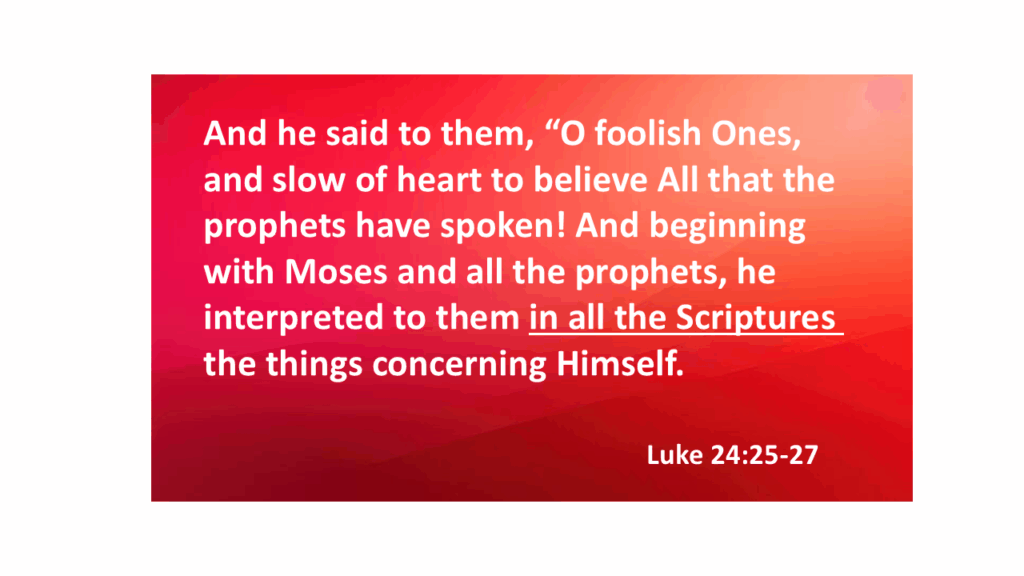
How foolish you are, how slow you are to believe everything the prophets said! Was it not necessary for the Messiah to suffer these things and then to enter His glory? And Jesus explained to them what was said about Himself in all the Scriptures, beginning with the books of Moses and the writings of all the prophets.
Luke 24:25-27
In every New Testament Gospel account, Jesus repeatedly uses the phrase “It is written…”—a clear and intentional reference to the authority of the Old Testament Scriptures. This phrase appears seven times in Matthew, four times in Mark, five times in Luke, and once in John, demonstrating that this was not a passing habit but a consistent pattern in His teaching and response to both temptation and opposition.
Jesus Repeatedly Quoted and Affirmed the Old Testament
In total, Jesus directly quotes the Old Testament approximately 78 times throughout the Gospels, drawing from the Law, the Prophets, and the Writings. Whether He was confronting Satan in the wilderness, engaging with religious leaders, teaching the crowds, or instructing His disciples, Jesus grounded His words and actions in the written Word of God. Here is a chart of Old Testament Scriptures quoted by Jesus in the New Testament:
| Old Testament Subject And Reference | New Testament References And Times Quoted |
|---|---|
| Marriage—Genesis 1:27; 5:2 | Mark 10:6–8—4 Times |
| Holiness—Leviticus 19:12 | Matthew 5:33—6 Times |
| Keeping Oaths—Numbers 30:2 | Matthew 5:33—1 Time |
| Ten Commandments—Exodus 20:12–16 | Luke 18:20—30 Times |
| Ten Commandments—Deuteronomy 5:16–20 | Luke 10:26–28—45 Times |
| The Sabbath—1 Samuel 21:1–6 | Mark 2:25—1 Time |
| Judgment—1 Kings 10:1–9 | Matthew 12:42—1 Time |
| Messianic Prophecy Psalm 118:22–23 | Mark 12:10—26 Times |
| Messianic Prophecy Isaiah 6:9 | Matthew 13:13–14—21 Times |
| End Times—Daniel 9:27 | Matthew 24:15—8 Times |
| God’s House—Jeremiah 7:11 | Mark 11:17—3 Times |
| Salvation—Hosea 6:6 | Matthew 9:13—3 Times |
| Death, burial, resurrection Jonah 1:17 | Matthew 12:40—1 Time |
| Jesus Would Cause Division— Micah 7:6 | Matthew 10:35–36—1 Time |
| Betrayal of Jesus—Zechariah 13:7 | Matthew 26:31—2 Times |
| John The Baptist—Malachi 3:1 | Matthew 11:10—3 Times |
The sheer number, variety, and consistency of Jesus’ quotations from the Old Testament affirm not only His deep knowledge of Scripture, but His unwavering view that it is the authoritative and inspired Word of God. Far from dismissing or revising the Old Testament, Jesus upheld it, fulfilled it, and used it as the foundation for His teachings—leaving no doubt that He endorsed every word as divinely true.
Jesus Mentioned and Affirmed Historical People and Events Found in Scripture
Jesus mentioned and affirmed historical people and events found in Scripture as real, authoritative, and meaningful. He didn’t treat the Old Testament as myth, allegory, or religious folklore—He referenced its people, places, and events as literal history. From Adam and Eve to Noah’s flood, from the destruction of Sodom and Gomorrah to Jonah’s encounter with the great fish, Jesus spoke of these moments not with symbolic detachment but with historical certainty. Below is a chart with examples of Old Testament people affirmed by Jesus:
| Old Testament Figure | New Testament Reference | Context / Summary |
|---|---|---|
| Adam and Eve | Matthew 19:4–6 | Jesus affirms creation and marriage design: “male and female…” |
| Moses | Matthew 19:7 | Jesus references Mosaic Law about divorce |
| Cain and Abel | Matthew 23:35 | Jesus condemns bloodshed from Abel to Zechariah |
| Noah | Luke 17:26 | Jesus compares His return to the days of Noah |
| Jonah | Matthew 12:39–41 | Jesus affirms Jonah’s time in the fish as a sign of His resurrection |
| Abraham | John 8:39–42 | Jesus acknowledges Abraham as the father of Israel |
| Lot | Luke 17:28–32 | Jesus warns about judgment using Lot’s escape from Sodom |
| Isaac | Matthew 22:31–32 | Jesus quotes God’s words: “I am the God of Abraham, Isaac, Jacob” |
| Jacob | Luke 20:37–38 | Affirms that God is the God of the living, referencing Jacob |
| David | Mark 12:35–37 | Jesus cites Psalm 110 to affirm David calling Messiah “Lord” |
| Solomon | Matthew 12:42 | Jesus refers to Solomon’s wisdom and the Queen of Sheba’s visit |
| Queen of Sheba | Matthew 12:39–41 | Jesus uses her as an example of one who sought true wisdom |
| Isaiah | Matthew 12:15–21 | Jesus affirms Isaiah’s prophecy about the servant of the Lord |
| Daniel | Matthew 24:15 | Jesus refers to the “abomination of desolation” spoken by Daniel |
| Elijah | Mark 9:11–13 | Jesus says Elijah “has come,” referring to John the Baptist |
| Elisha | Luke 4:27 | Jesus references Elisha’s healing of Naaman the Syrian |
| Zechariah | Matthew 23:34–36 | Jesus references Zechariah as a prophet who was murdered |
Jesus also affirmed the historical reliability of Old Testament events, treating them not as myths or allegories but as real occurrences grounded in time and space. He spoke of people like Adam, Noah, Abraham, Moses, and Jonah as actual historical figures, and referenced major events such as the creation, the flood, the destruction of Sodom, and the Exodus as factual. In doing so, Jesus validated the Old Testament not only as inspired Scripture but also as an accurate account of God’s actions in human history. His affirmations reinforce that the biblical narrative is rooted in reality, not religious storytelling.
Examples of Old Testament Events Affirmed by Jesus
| Event | New Testament Reference | Context / Summary |
|---|---|---|
| Giving of the Law to Moses | Matthew 8:4 | Jesus refers to the command Moses gave for offering after healing |
| Moses as writer of the Law | Matthew 8:4 | Affirms Moses as the human author of First 5 Books of Law |
| God providing manna in the wilderness | John 6:48–50 | Jesus identifies Himself as the true Bread from Heaven, referencing manna |
| Persecution of Old Testament prophets | Matthew 5:11–12 | Jesus compares mistreatment of His followers to that of past prophets |
| Popularity of false prophets | Luke 6:26 | Warns that false prophets were praised in ancient Israel |
| Death of Lot’s wife | Luke 17:28–32 | Cites her turning to salt as a warning about disobedience and judgment |
| Destruction of Sodom and Gomorrah | Luke 17:28–32 | Uses Sodom’s destruction as a symbol of sudden judgment |
| Destruction of Tyre and Sidon | Matthew 11:21–22 | Jesus says they would have repented if they saw His miracles |
| Creation of Adam and Eve | Matthew 19:4–5 | Jesus affirms God created them “male and female” and instituted marriage |
| Cain and Abel | Luke 11:50–52 | Refers to Abel’s murder as part of a long line of martyrdom |
| Noah’s flood | Matthew 24:37–39 | Compares the days of Noah to conditions before His return |
| Jonah and the great fish | Matthew 12:38–41 | Affirms Jonah’s experience as a sign of His burial and resurrection |
| The burning bush | Mark 12:26 | Jesus references God’s declaration to Moses: “I am the God of Abraham…” |
| The bronze serpent in the wilderness | John 3:14 | Compares His crucifixion to Moses lifting the serpent for healing |
| David eating the consecrated bread | Mark 2:25–26 | Uses David’s action to defend the disciples’ Sabbath behavior |
| Widow of Zarephath (Elijah’s time) | Luke 4:25–26 | Mentions the widow who was fed during a famine as a sign of God’s provision |
| Naaman the Syrian healed by Elisha | Luke 4:27 | References a Gentile general healed miraculously through Elisha |
| Murder of Zechariah (son of Berechiah) | Matthew 23:35 | Cites Zechariah’s murder as part of Israel’s history of rejecting God’s messengers |
In light of Jesus’ teachings, actions, and statements, it is unmistakably clear that He held the Scriptures in the highest regard. He affirmed their historical accuracy, submitted to their authority, revealed God’s redemptive plan through them, and pointed to Himself as their ultimate fulfillment. For anyone who claims to follow Christ, embracing His view of Scripture is not optional—it is essential. To trust Jesus is to trust the very Word He trusted, quoted, fulfilled, and proclaimed as unbreakable truth. The authority of the Bible, then, rests not merely on religious tradition or church teaching, but on the conviction and example of Christ Himself.
Challenge Question: If Jesus affirmed the Old Testament as historically accurate and divinely authoritative, what implications does that have for how we should view and interpret Scripture today?
Premise 6: The Bible’s Power To Transform Lives Proves It Is Supernatural
The Bible was written for us and by people like us. Though divinely inspired, its message was delivered through real human beings—fallible, diverse, and relatable. Over the span of 40 generations, more than 40 different authors—spanning every imaginable walk of life—contributed to its pages. Among them were kings and peasants, poets and prophets, fishermen and philosophers, statesmen and shepherds, scholars and soldiers. One was a physician; others were tentmakers, tax collectors, and craftsmen. Still others were once prostitutes, widows, foreigners, or social outcasts.
The people in the Bible faced fear, failure, betrayal, poverty, temptation, illness, and doubt—yet they also encountered grace, healing, forgiveness, and divine purpose. Some were educated; others were untrained. Some were moral, others broken. Yet God used each one to tell a story that spans not just centuries, but the full spectrum of human experience.
This is what makes the Bible so powerful and personal: its message is both timeless and timely, universal yet intimate. It doesn’t speak to some idealized version of humanity—it speaks to the real world we live in and the real hearts we carry. In every story, command, lament, and promise, we hear the voice of a God who knows us, meets us where we are, and invites us into something eternal.
It is a book about both the sublime and the unspeakable, it is a book also about life the way it really is. It is a book about people who at one and the same time can be both believing and unbelieving, innocent and guilty, crusaders and crooks, full of hope and full of despair. In other words it is a book about us.
Frederick Buechner, Wishful Thinking
The Bible is God’s Miracle Message to Man
The Bible is not merely a record of human history—it is His story, and His story transforms lives. Every book of the Bible either alludes to, testifies of, or prophesies about Jesus Christ, revealing God’s redemptive plan through Him from beginning to end.
While it’s true that a person can observe the natural world and discern the “what” of God’s creative wisdom—by looking at the universe’s design, order, and complexity—man cannot truly know the “Who,” the “why,” or the ultimate purpose behind it all without divine revelation. God chose to reveal Himself, not just through the general revelation of nature alone, but through special revelation in Scripture, which unfolds His character, His intentions, and His plan for humanity.
How then will they call on him in whom they have not believed? And how are they to believe in him of whom they have never heard?
Romans 10:14-17
So faith comes from hearing, and hearing through the word of Christ.
God’s revelation of His plan for humanity was not hidden in mystery or veiled in philosophical abstraction—it was written plainly, in human language, through divinely inspired Scripture, so that communicative man could understand it. At the heart of this revelation is the message that Jesus Christ is the solution to our greatest problem—sin—and the conqueror of our greatest adversary—death. This redemptive plan starts in Genesis and culminates in the book of Revelation.
Rather than writing His message in the sky or engraving it on stone for all time, God chose to unfold His redemptive plan through the lives and pens of shepherds, prophets, kings, fishermen, and apostles—demonstrating that the Gospel is both divine in origin and accessible to all. The saving message of the Gospel doesn’t whisper—it bleeds through every page, declaring that a holy God loves sinful people enough to redeem them through His Son.
“I have written these things to you who believe in the name of the Son of God so that you may know that you have eternal life.”
1 John 5:13
Why Not Read the Bible for Yourself?
1 John 5:13 powerfully captures the purpose of Scripture—not to leave us guessing, but to give us certainty, confidence, and clarity about the most important truth in life: eternal life through Jesus Christ. John doesn’t say, “I’ve written so you can wonder,” or “so you can feel inspired.” He says, “so that you may know.” The Bible was written not to obscure truth, but to reveal it, not to create confusion, but to provide certainty. It invites us into a relationship with God that is not based on blind faith or emotional highs, but on a knowable, anchored truth grounded in the life, death, and resurrection of Jesus Christ.
It is Christ Himself, not the Bible, who is the true word of God. The Bible, read in
C.S. Lewis
the right spirit and with the guidance of good teachers, will bring us to him.
St. Augustine of Hippo was always brilliant (IQ 180) , but not always a Christian. In fact he was an renowned skeptic, humanistic philosopher, and famous teacher of rhetoric. He couldn’t find truth in Christianity because he saw it as a religion for the simple-minded. At the age of 31 he heard a small child’s voice chanting a song “Take up and read, take up and read”.
I arose, interpreting it to be no other than a command from God to open the book, and read the first chapter I should find. I seized, opened, and in silence read that section on which my eyes first fell: “Not in rioting and drunkenness, not in chambering and wantonness, not in strife and envying; but put ye on the Lord Jesus Christ, and make not provision for the flesh, in concupiscence.”
Saint Augustine
No further would I read; nor needed I: for instantly at the end of this sentence, by a light as it were of serenity infused into my heart, all the darkness of doubt vanished away.
Is it Possible to be a Pre-meditated Unbeliever of Something?
It is one thing to chose to not believe something because it’s not true—but it’s also possible to unbelieve something that could be true. A Barna Research study conducted in 2018 revealed that six in ten Americans (58%) believe the message of the Bible has transformed their life. Surprisingly, among the 42% who said it hadn’t, only 18% had ever actually read any of the New Testament. That raises a fair question: Have you ever been misrepresented by someone who clearly didn’t know you? Perhaps you thought, “How can they say these things about me—they’ve never even taken the time to get to know me?”
The same logic applies to Scripture. How can anyone claim the Bible cannot be trusted—or that it doesn’t change lives—if they’ve never read it? Dismissing it without investigation is like declaring a food tastes terrible without ever taking a bite. Skepticism without inquiry isn’t wisdom—it’s avoidance. And just as it’s possible to believe something too easily, it’s also possible to disbelieve too lazily. Genuine seekers ask questions—and then take the time to explore the answers.

The Bible is the most widely read, printed, and distributed book in history. According to the Guinness Book of World Records, over 5 billion copies have been sold or distributed—far surpassing its nearest competitor at around 800 million.
The Bible is the only book in the world that predicts the future, lays out God’s plan of salvation, and still changes lives thousands of years after it was written. That is no ordinary book…That is a supernatural book!
Billy Graham
Why has this ancient book had such enduring global impact? Because it changes lives. Since the first century, governments have banned it, burned it, censored it, and outlawed its teaching, and yet its message of hope, truth, purpose, and eternal life continues to spread like wildfire. Its staying power isn’t in political protection or cultural trends—it lies in the fact that the Bible speaks to the human heart with divine authority, unchanging truth, and transforming grace.
Challenge Question: Many skeptics readily dismiss a book that has reshaped lives, families, and entire civilizations for over 2,000 years—often under persecution—yet have never seriously examined even the New Testament’s contents. Is this intellectually honest?
ThinkCube Truth Veracity Grid
- Have I considered the facts carefully and with an open mind?
- Is my conclusion the result of careful examination of the facts, or is it a conclusion made in spite of the facts?
- Is my conclusion the one that makes the most sense of the evidence?