Premise 1: The Bible Says The Existence Of God Is Obvious
But God shows his anger from heaven against all sinful, wicked people who suppress the truth by their wickedness. They know the truth about God because he has made it obvious to them.
Romans 1:18-21
For ever since the world was created, people have seen the earth and sky. Through everything God made, they can clearly see his invisible qualities—his eternal power and divine nature. So they have no excuse for not knowing God. Yes, they knew God, but they wouldn’t worship him as God or even give him thanks. And they began to think up foolish ideas of what God was like. As a result, their minds became dark and confused.
Romans 1:18–21 explains that every person has an inherent awareness of God because God has clearly revealed Himself through creation and internal understanding. This passage forms a foundational argument for natural revelation—the idea that God’s existence and divine nature can be perceived through the world around us. Here’s a breakdown of what these verses mean:
Romans 1:18–21 (Summary & Explanation)
Verse 18: “The wrath of God is revealed from heaven…”
This speaks of God’s just anger against all forms of ungodliness and wickedness. Notably, it says people “suppress the truth”—meaning, deep down, they are aware of certain truths (like God’s existence), but choose to reject or ignore them.
Verse 19: “What can be known about God is plain to them…”
This means God has not hidden Himself. He has made key aspects of His nature—such as His existence, power, and divine attributes—obvious or evident to all people.
Verse 20: “His invisible attributes…have been clearly perceived…”
God’s invisible qualities (like His eternal power and divine nature) are made visible and understandable through what He has made. In other words:
- The complexity, order, beauty, and design in nature point unmistakably to a Creator.
- This general revelation is so clear that people are “without excuse” if they deny God’s existence.
God has Never Been Without a Witness To His Existence
The phrase “God has never been without a witness to His existence” means that throughout all of human history, in every generation and every corner of the earth, there has always been some form of testimony—whether through nature, conscience, miracles, prophets, Scripture, or the inner awareness of people—that points to the reality of God’s existence. This concept appears both in natural theology and in Scripture, emphasizing that God has continually made His presence and nature known to humanity.
Biblical Basis:
- Creation as a Witness
Romans 1:19–20 – “For what can be known about God is plain to them, because God has shown it to them. For his invisible attributes…have been clearly perceived…in the things that have been made.” Nature itself declares God’s existence, power, and divine nature. - Conscience as a Witness
Romans 2:14–15 – “They show that the work of the law is written on their hearts, while their conscience also bears witness…” Every human has a moral awareness pointing to a divine lawgiver. - Prophets and Scriptures
God has repeatedly sent messengers and revealed Himself through Scripture: Hebrews 1:1–2 – “God, who at various times and in various ways spoke in time past to the fathers by the prophets…” - The People of God as Witnesses
God has maintained a faithful remnant—individuals or communities—who proclaim and demonstrate His reality, even in times of widespread disbelief. Isaiah 43:10 – “You are my witnesses,” declares the Lord. - Jesus Christ as the Ultimate Witness
John 1:18 – “No one has ever seen God; the only God, who is at the Father’s side, he has made him known.”
Theological Implication:
This truth affirms that no one has been left entirely in ignorance of God’s existence. Whether through external revelation (nature, miracles, history) or internal awareness (conscience, longing for eternity), God has always provided some means by which His existence could be perceived.
God reveals His existence and attributes through creation, conscience, and reason, apart from Scripture. It affirms that all people are accountable for how they respond to what God has made known.
Challenge Question: Do you believe that the complexity of the world, our sense of right and wrong, and our deep questions about life and eternity point to the existence of God—or are they just random parts of human nature with no real meaning or purpose?
Premise 2: Atheists Suppress The Evidence Of God’s Existence
sup·press
/səˈpres/
to stop it, restrain it, or prevent it from being seen, heard, or felt
When Romans 1:18 says that people “suppress the truth” about God, it means they actively resist, restrain, or hold down the knowledge of God that is already evident to them.
The Greek word for “suppress” is katechō (κατέχω), which means:
- To hold back
- To restrain
- To hinder
- To stifle or prevent from being acknowledged
This implies an intentional act—not ignorance, but willful denial or rejection.
What Truth Are Atheist Suppressing?
The verses make it clear:
- God exists
- He is powerful and divine
- This is clearly seen in creation (v.20)
- People have an internal awareness of Him (v.19)
Despite this, people choose to ignore or deny it, often because:
- They prefer autonomy over submission to God
- They are morally resistant to being accountable to a holy Creator
- They pursue desires that conflict with God’s standards
Biblical Examples of Suppressing Truth:
- Pharaoh saw God’s power through miracles but hardened his heart.
- The Israelites witnessed God’s provision in the wilderness yet turned to idols.
- Modern secularism often acknowledges the complexity of nature but attributes it solely to chance.
In Practical Terms:
Suppressing the truth is like:
- Seeing the sun but denying it’s shining
- Hearing a warning siren but choosing to ignore it
- Covering your ears and saying “I don’t hear anything”
It’s not that people can’t know the truth—it’s that they don’t want to. The suppression is both moral and volitional. When we say that “the suppression is both moral and volitional”, we mean that the act of denying or rejecting the truth about God involves two key aspects:
Moral Suppression
This means people reject the truth about God because it confronts their moral behavior. It’s primary motive—to avoid moral accountability.
- People often know that acknowledging God would mean they must change how they live—repent, submit, or live under God’s moral standards.
- Instead, they suppress the truth because it exposes sin, guilt, accountability and their independence.
John 3:19–20 — “People loved darkness rather than light because their deeds were evil… everyone who does evil hates the light and does not come to the light, lest his deeds should be exposed.”
Example: A person might intellectually believe in God but resist fully embracing it because doing so would require giving up a sinful habit or lifestyle they enjoy.
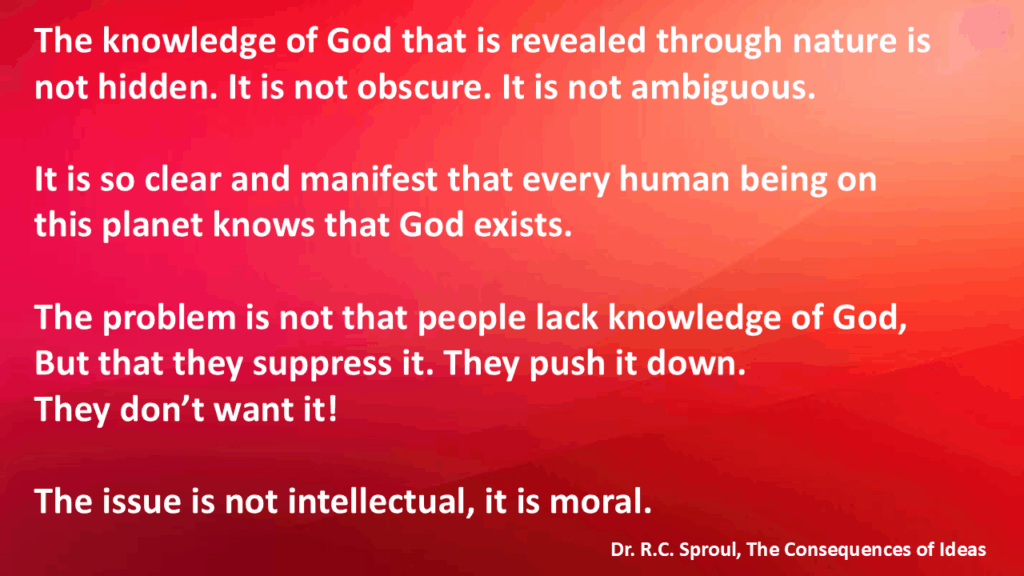
Volitional Suppression
This means the rejection is an act of the will—it is a choice. It’s primary motive—to preserve autonomy and control.
- People are not neutral; they choose to suppress the truth.
- It’s not that they can’t believe, but that they won’t believe.
- This is an act of willful resistance to what they already know or sense to be true.
Romans 1:21 — “Although they knew God, they did not honor him as God or give thanks to him…”
Example: Someone may feel a deep inner sense that there is a God but chooses to ignore it, distract themselves, or rationalize it away.
So when Paul says people suppress the truth, he’s not just describing ignorance—he’s describing a deliberate, inward resistance to God’s revelation, motivated by both moral discomfort and personal will.
Man’s problem is not lack of evidence for God, but rebellion against the evidence. God has made Himself known so plainly that only those who do not want to see can miss Him
J.I. Packer; Knowing God
Suppressing the truth means resisting the reality of God’s existence and authority, despite the evidence in creation, conscience, and reason. It is a willful rejection driven by a desire to live without moral accountability. Romans says this is the root of humanity’s estrangement from God.
This suppression is the root of humanity’s estrangement from God because it reflects a deeper spiritual rebellion — a desire for autonomy, to live independently of divine authority and moral accountability. Instead of responding to the truth with worship and gratitude, mankind chooses self-exaltation, exchanging the truth of God for lies and worshiping created things rather than the Creator. This willful exchange leads to a darkened understanding, moral decay, and spiritual separation from God.
In essence, estrangement from God is not because He is distant or unknowable, but because humanity chooses to suppress the truth about Him. This alienation is the result of rejecting God’s rightful place as Lord, and it is only healed when the heart turns back to Him in humility and faith.
Challenge Question: Do you believe that the complexity of creation, the human moral conscience, and mankind’s innate spirituality point more convincingly toward the existence of God or His non-existence?
Premise 3: The Wrath Of God And The Denial Of His Existence
But God shows his anger from heaven against all sinful, wicked people who suppress the truth by their wickedness.
Romans 1:18
What the Apostle Paul is condemning is not ignorance of the truth but the deliberate refusal to accept it and act on it. the knowledge of God’s power and nature has been evident, but it has been stifled by human unrighteousness. Because this God has made this knowledge universally available, people are accountable for their response to it.
When the Bible says that “God shows His anger from heaven against all sinful, wicked people who suppress the truth by their wickedness” (Romans 1:18, NLT), it means that:
1. God’s Anger (“Wrath”) is Righteous and Just
- This is not irrational rage, but holy opposition to sin and evil.
- God’s wrath is the rightful response of a morally perfect being against rebellion, injustice, and the corruption of what is good.
- It’s revealed from heaven, meaning it is divine, authoritative, and not based on human emotions or flaws.
2. “Sinful, Wicked People” Refers to All Who Rebel Against God’s Truth
- The words “sinful” and “wicked” describe active moral rebellion—not just occasional wrongs, but a lifestyle of rejecting God’s will.
- According to Paul, this includes people who know the truth about God (through creation, conscience, or reason) but choose to ignore or reject it.
3. They “Suppress the Truth by Their Wickedness”
- The Greek word used here means to restrain, stifle, or hold down the truth.
- People are not ignorant of God’s existence—they actively resist it because acknowledging Him would require them to change.
- Their wicked behavior isn’t just the result of ignorance; it’s an intentional effort to avoid accountability to God.
In short: They don’t want the truth, because the truth exposes their sin.
4. God’s Wrath is Already Being Revealed
- Paul uses the present tense (“is being revealed”), suggesting this isn’t only future judgment but also a current reality.
- God’s judgment can be seen in:
- The consequences of sin (Romans 1:24–32)
- Moral decay in society
- A “giving over” to self-destructive desires (v. 24, 26, 28)
God’s Wrath is Both Present and Future
The wrath of God is being revealed from heaven…
Romans 1:18
Romans 1:18 says, “The wrath of God is being revealed from heaven…”
Paul uses the present tense, showing that God’s wrath is not only a future event but something actively at work in the world right now. At the same time, the Bible teaches that a future, final expression of God’s wrath is coming. These are two distinct but connected aspects of divine judgment:
Present Wrath: Allowing Sin’s Consequences
This is often referred to as “God’s passive wrath”—not lightning bolts from the sky, but a judicial abandonment where God lets people go their own way.
Romans 1:24, 26, 28 – “Therefore God gave them over…”
Three times, Paul says God “gave them over” to their sinful desires.
What this means:
- God allows people to experience the natural consequences of their rebellion.
- He lifts His restraining hand, letting individuals or societies pursue sin and suffer its degrading effects (e.g., broken relationships, addiction, cultural decay, etc.).
- This is a form of judgment where God permits self-destruction as a result of persistent rejection of His truth.
Think of it like a doctor who warns a patient about smoking. If the patient refuses, the doctor steps back—not out of indifference, but because the patient has rejected wisdom. The disease becomes the consequence.
Future Wrath: Final Judgment
While present wrath is unfolding now, Scripture teaches that a final, climactic judgment will take place at the end of history.
Romans 2:5 – “You are storing up wrath against yourself for the day of God’s wrath, when His righteous judgment will be revealed.”
Revelation 20:11–15 – Describes the Great White Throne Judgment where every person is judged according to their deeds.
What this means:
- God’s justice will one day be fully and perfectly executed.
- All evil, sin, and rebellion will be accounted for.
- Those who refused God’s grace will face eternal separation from Him (2 Thess. 1:9; Matthew 25:46), while the redeemed will receive eternal life.
The clearest expression of God’s present wrath is that He allows people to have what they desire—a life without Him. His future wrath will involve giving them what they deserve—just and final retribution for persistent sin. Yet in His great mercy, God has provided overwhelming evidence of His existence, along with a way of escape from both of these tragic outcomes. The door of His mercy begins to open the moment we stop suppressing the truth. Wrath can be replaced by mercy the instant we acknowledge the evidence and seek God with all our heart.
And without faith it is impossible to please God, because anyone who comes to him must believe that He exists and that he rewards those who earnestly seek Him
Hebrews 11:6
Hell is the end result of a person freely choosing to live apart from God, continuing that path into eternity. God’s wrath is seen in allowing people to follow their desire to rule their own lives without Him. But the good news of the gospel is that Jesus took our place, bearing the wrath we deserved, so that the door to God’s mercy could be opened for us.
Challenge Question: If God has made both His existence and His mercy so evident, what does it reveal about the human condition that many still choose to suppress the truth—what might be the deeper reasons behind that resistance?
ThinkCube Truth Veracity Grid
- Have I considered the facts carefully and with an open mind?
- Is my conclusion the result of a careful examination of the facts, or is it a conclusion made in spite of the facts?
- Is my conclusion the one that makes the most sense of the evidence?