
Premise 1: Christianity’s Core Beliefs Instill A Deep Concern For The Poor That Mobilizes It’s Adherents
Throughout history, Christianity has been one of the most influential forces in advocating for the dignity and care of the poor. Far from being a marginal issue, concern for the poor is woven into the very heart of the Christian faith. From the teachings of Jesus to the practices of the early church, to the work of Christian missions and charities today, believers have been mobilized by a theological conviction that the poor matter deeply to God—and therefore must matter to them. Concern for the poor is a major biblical theme, running from the laws of Moses to the teachings of Jesus and the apostles.
There are over 2,000 passages that address the poor and marginalized in the Bible.
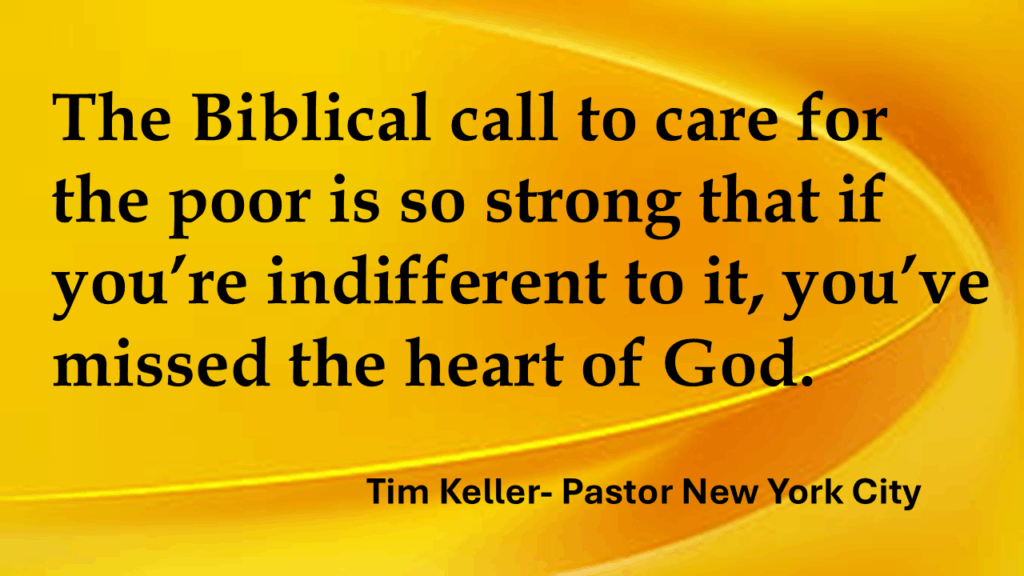
Rooted in Scripture: God’s Heart for the Poor
The Bible speaks frequently and passionately about poverty—not only as a social issue but as a spiritual priority. In both the Old and New Testaments, caring for the poor is not optional; it is a mark of genuine faith and godliness.
- Proverbs 14:31 – “Whoever oppresses the poor shows contempt for their Maker, but whoever is kind to the needy honors God.”
- Isaiah 1:17 – “Learn to do good; seek justice, correct oppression; bring justice to the fatherless, plead the widow’s cause.”
- Matthew 25:40 – “Truly I tell you, whatever you did for one of the least of these brothers and sisters of mine, you did for me.”
- Galatians 2:10 – “They asked us to remember the poor, the very thing I was eager to do.”
The teachings of Jesus Christ reflect a radical concern for the vulnerable. He was born into poverty, ministered among the marginalized, and declared in Luke 4:18 that He came to “proclaim good news to the poor.”
Theological Foundations for Compassion
Why has Christianity always placed such emphasis on the poor? Because its core doctrines demand it.
- Imago Dei (Image of God)
Every person, regardless of status, wealth, or background, is created in the image of God (Genesis 1:27). This gives inherent worth to every human being and compels believers to treat the poor not as charity cases but as equals before God. - The Incarnation
In Christ, God humbled Himself and entered into human poverty (Philippians 2:5–8). Jesus did not merely help the poor—He became poor. This sets the pattern for believers to engage with and identify with those in need. - The Great Commandment
Jesus summarized the entire law with two commands: Love God and love your neighbor as yourself (Matthew 22:37–39). True love is not abstract; it acts. Caring for the poor is a tangible way to fulfill this command. - Faith That Works
The apostle James warns that faith without works is dead (James 2:14–17), especially when it fails to meet the needs of the hungry or destitute. Biblical faith must result in compassionate action.
The Early Church: Mobilized by Mercy
The first Christians were known for their radical generosity. Acts 2:44–45 describes how the early believers “had all things in common” and “sold their possessions and goods and distributed them to all, as any had need.”
Roman historians and critics of Christianity were often struck by how the early Christians cared not only for their own poor but for all who were in need—widows, orphans, slaves, and even the sick during plagues. This selfless compassion was a major factor in the growth and credibility of the early church.
Christianity’s Ongoing Legacy of Compassion
Throughout history, Christian concern for the poor has taken organized, institutional forms:
- Monasteries in the Middle Ages functioned as hospitals, schools, and centers of food distribution.
- The Salvation Army, founded in 1865 by William Booth, aimed to bring both spiritual and material aid to the urban poor.
- Mother Teresa, perhaps the most iconic modern example, dedicated her life to serving the poorest of the poor in Calcutta out of her devotion to Christ.
- Countless missionary organizations, hospitals, orphanages, and relief agencies have been founded and operated by Christians compelled by their faith to care for the needy.
Even today, in many parts of the world, Christian organizations provide more humanitarian aid than any other single religious or secular group. Whether through disaster relief, clean water projects, education, or medical care, Christians continue to be mobilized by their belief that faith must be lived out in love, especially toward the least and the vulnerable.
Christianity Does Not Treat Poverty As a Peripheral Issue
Christianity does not treat poverty as a peripheral issue. It is a central concern, rooted in the very identity of God and the teachings of Jesus Christ. The poor are not an afterthought in Christian theology—they are the very ones Jesus prioritized.
For believers, this concern is not just an ethical option—it is an act of worship and a sign of authentic discipleship. As long as the church remains faithful to its Lord, it will continue to care for the poor—not out of obligation, but out of love for the One who said, “Whatever you did for the least of these, you did for me.”
Christianity does not view helping the poor as mere charity—it sees it as obedience to God and evidence of authentic faith. The teachings of the New Testament consistently call Christians to be generous, just, and sacrificial in their care for others. The early church shared resources freely (Acts 2:44–45), and apostles like Paul and James emphasized that true religion means caring for widows, orphans, and the poor (James 1:27; Galatians 2:10).
Someone with a religious affiliation is more than two times more generous than someone without a religious affiliations.
David King—School of Philanthropy University of Indiana
A majority of these Responsive Christians believes that helping the poor, in turn, helps Christians understand the heart of Christ (58 percent). And most have spent significant time praying for the poor (53 percent). Forty–four percent of Responsive Christians say that their churches should prioritize spending resources to address poverty in other countries.
While the world often overlooks or misrepresents Christianity’s role in society, the evidence is clear: Christianity has produced more NGOs dedicated to poverty alleviation than any other religious or secular movement. Its impact is not just historical—it is global, daily, and ongoing. This outpouring of compassion is not incidental but flows directly from the heart of the Christian gospel: that we are to love our neighbor, serve the least, and give freely, just as Christ gave Himself for us.
Challenge Question: If the Bible consistently contains more than 2,000 verses emphasizing justice, compassion, and care for the poor—arguably more than any other moral topic—why is Christianity so often portrayed as harmful to society and the individual?
Premise 2: Christianity Is the Driving Force Behind The World’s Leading Poverty-Focused Non-Government Organizations
One of the most overlooked yet undeniable realities of global humanitarian aid is that Christianity has been the primary catalyst for the creation and operation of countless Non-Governmental Organizations (NGOs) focused on poverty alleviation. From the earliest expressions of the faith, Christians have been mobilized by biblical convictions to serve the poor, the sick, the orphaned, and the marginalized—not as a peripheral concern, but as a central expression of authentic discipleship.
Today, a majority of the world’s most active and impactful poverty-focused NGOs are either explicitly Christian in origin or inspired by Christian principles. These organizations operate in nearly every country and on every continent, bringing food, clean water, education, medical care, and sustainable development to millions.
Historical Roots
From the early church’s care for widows and orphans (Acts 6), to the establishment of monastic hospitals and hospices in the Middle Ages, and the rise of mission-based schools and clinics in the 19th and 20th centuries, the Christian commitment to alleviating human suffering has shaped entire institutions of care.
What makes Christian humanitarian work distinct is not just generosity, but its theological foundation: the belief that every person is made in the image of God (Genesis 1:27) and is therefore worthy of dignity, compassion, and justice. In the U.S. alone, there are over 160,000 Christian nonprofit organizations. Ranging from homeless shelters, disaster relief, orphanages, children’s hospitals to every other humanitarian need on the spectrum. Globally, Christian humanitarian agencies operate in virtually every nation.
Sample List of Christian NGOs Focused on Poverty Alleviation
| Organization/Founding | Focus Areas | Reach |
|---|---|---|
| World Vision | Child sponsorship, disaster relief, food | 100+ countries |
| Compassion International | Child development, education, health | 25+ countries |
| Samaritan’s Purse | Emergency relief, food, shelter, medical aid | Global |
| Catholic Relief Services | Disaster response, sustainable development | 100+ countries |
| Tearfund | Water, sanitation, livelihoods, disaster aid | 50+ countries |
| Food for the Hungry | Hunger relief, community transformation | 20+ countries |
| The Salvation Army | Homelessness, addiction, emergency relief | 130+ countries |
| HOPE International | Microfinance, small business support | 16+ countries |
| Christian Aid | Aid, development, climate response | 30+ countries |
| Mission of Hope | Health, education, jobs in Haiti | Haiti |
| Lutheran World Relief | Agricultural development, disaster aid | Dozens of countries |
| Adra International | Education, emergency relief, healthcare | 96+ countries |
| World Renew | Food security, disaster response, livelihoods | 40+ countries |
| Bread for the World | Advocacy to end hunger and poverty | U.S. and global advocacy |
| Convoy of Hope | Disaster services, children’s feeding programs | 50+ countries |
| Heifer International | Livestock and sustainable agriculture | 21 countries |
| Mercy Ships | Hospital ships providing free surgery | Global (Africa, Asia) |
| International Justice Mission (IJM) | Legal justice, ending slavery and trafficking | Dozens of countries |
Christianity Accelerates Public Involvement In Poverty Alleviation
Research published in the New Zealand Journal of Social Sciences highlights why religion—especially Christianity—plays such a powerful role in the global fight against poverty. Drawing from sociology and development studies, the researchers identify three key reasons that explain this influence:
Social Capital
One of the most common explanations is the concept of social capital, popularized by Harvard political scientist Robert Putnam. Social capital refers to the value created through social networks, shared trust, and mutual support.
“Faith communities are arguably the single most important repository of social capital in America.” — Robert Putnam
Religious congregations bring people together regularly and foster deep connections. These relationships encourage people to participate more actively in both charity work and civic engagement, helping them organize, share resources, and support one another in collective efforts to alleviate poverty.
Religious Content
Religious teachings provide powerful moral values, beliefs, and practices that motivate people to act.
As economist Bernardo Kliksberg notes in his study on faith and development:
“Religious content connects belief with action, making it a powerful mobilizing force.”
In Christianity, teachings like caring for the poor, seeking justice, and loving your neighbor are central. These values inspire believers to give generously, volunteer, and build organizations that serve those in need.
Cultural Power
Religion also holds significant cultural power—the ability to shape ideas, influence public opinion, and inspire action by appealing to shared symbols, stories, and moral convictions.
This includes:
- The moral authority of faith leaders
- The use of religious language and imagery that resonates deeply with the public
- Justice and compassion narratives that motivate widespread support
Christianity’s influence reaches beyond church walls into politics, media, and education—amplifying its capacity to rally people around the cause of poverty alleviation.
These three forces—social capital, religious content, and cultural power—are mutually reinforcing. Together, they explain why Christian communities and networks are among the most active and effective forces in the world when it comes to mobilizing aid, advocacy, and action for the poor.
Christianity And Global Benevolence
| Name | Credentials | Quote |
|---|---|---|
| Robert Putnam | Professor of Public Policy, Harvard University; leading scholar on social capital | “Religious values—especially those found in Christianity—connect belief with action, making them among the most powerful mobilizing forces for solidarity and aid to the poor.” |
| Bernardo Kliksberg | Economist; advisor to the UN, World Bank, and UNESCO; expert on development and poverty | “Religious values—especially those found in Christianity—connect belief with action, making them among the most powerful mobilizing forces for solidarity and aid to the poor.” |
| Rodney Stark | Distinguished Professor of Sociology; historian of religion | “Christian theology created the moral obligation to care for the poor, the sick, and the suffering—an obligation that had no real parallel in the ancient world.” |
| Tom Holland | British historian; author of Dominion | “The ideals of compassion, charity, and the dignity of the weak that shape modern humanitarianism are not classical values. They are Christian ones.” |
| Alvin J. Schmidt | Historian and sociologist; author of How Christianity Changed the World | “Virtually every major charitable institution in the West—hospitals, orphanages, poor relief—was founded as a direct result of Christian beliefs and practices.” |
| Nicholas Kristof | Pulitzer Prize–winning journalist, The New York Times | “The groups that are most effective in fighting poverty around the world are often faith-based—especially Christian—whether people like that fact or not.” |
| Arthur Brooks | Former President of the American Enterprise Institute; scholar of charitable behavior | “Religious people—especially Christians—are far more likely to give, volunteer, and care for the poor, even outside their own religious communities.” |
| Jonathan Sacks | Moral philosopher | “The idea that we are morally obligated to care for the stranger, the poor, and the vulnerable entered history through the biblical tradition and transformed the moral imagination of the West.” |
Far from being a passive influence, Christianity provides both the moral foundation and the organizational strength to help fight global poverty on a large scale. If Christians were absent or uninvolved, millions of lives would be left without vital support—clean water would run dry, clinics would close, children would go unsponsored, and countless communities would lose their most faithful advocates. The absence of Christian compassion and mobilization would leave a devastating void in global humanitarian efforts. Christianity’s presence isn’t just helpful—it’s indispensable to the worldwide pursuit of justice, dignity, and hope for the poor.
Challenge Question: If Christianity were truly a harmful or outdated force in society, how do we explain the overwhelming number of humanitarian efforts, NGOs, and global poverty initiatives that are led by Christians—often in the world’s most dangerous and neglected regions? Wouldn’t the absence of this faith-driven compassion leave a moral and practical vacuum?
Premise 3: Christianity Leads In Commitment To The Most Vulnerable
Besides leading the world in food collection and distribution to the poor. Whether its orphans, malaria, Aids, hospitals, clean water or disaster relief …you name it and Christians lead the way in caring, sacrifice, and staffing to meet these challenges in every country in the world.
Across the globe, Christians—both individuals and faith-based organizations—are responsible for a disproportionately large share of humanitarian work. From orphan care and AIDS treatment to malaria prevention and clean water initiatives, followers of Jesus Christ have long stood at the forefront of compassion-driven service, motivated by biblical teachings and a commitment to human dignity.
This isn’t just anecdotal. The data and the legacy of Christian outreach show a consistent pattern: when disaster strikes, when children are abandoned, when illness spreads, and when water is scarce, Christian individuals and ministries are among the first to arrive and the last to leave.
Orphan Care and Child Advocacy
Christians have always had a deep concern for orphans, inspired by verses like James 1:27:
“Religion that is pure and undefiled before God the Father is this: to visit orphans and widows in their affliction…”
Globally, millions of orphans and vulnerable children are cared for through Christian-sponsored:
- Foster and adoption networks (e.g., Bethany Christian Services)
- Sponsorship programs (e.g., Compassion International, World Vision)
- Children’s homes and rescue missions
These ministries provide not just food and shelter, but education, medical care, and spiritual mentorship, giving children hope and a path forward.
Catholic managed orphanages house 5.5 million orphans alone. This does not include all other Christian organizations or denominations.
Malaria and AIDS Prevention
In parts of Africa and Asia where malaria and HIV/AIDS devastate communities, Christian NGOs and missionaries have built clinics, distributed mosquito nets, and offered preventive education in remote regions where government resources are lacking.
Notable efforts include:
- MAP International and Medical Teams International, which provide medicines and train local health workers.
- Catholic Relief Services and Samaritan’s Purse, which support HIV-positive communities with care, counseling, and medication access.
Faith-based hospitals are often the only healthcare providers in impoverished regions. These ministries reduce death rates while doing so with dignity, prayer, and love.
Medical and Dental Missions
Christian doctors, nurses, and dentists serve the world’s poorest populations, often volunteering their expertise at personal cost. Through medical missions:
- Thousands of people receive free surgeries, dental care, eye care, and vaccinations.
- Ships like Mercy Ships bring entire floating hospitals to the shores of underserved nations.
- Remote clinics, like those run by Christian ministries in Latin America and sub-Saharan Africa, offer lifesaving interventions where no formal health system exists.
The motivation isn’t profit or politics—it’s love for God and neighbor (Luke 10:27).
Clean Water Initiatives
Over 2 billion people lack access to safe drinking water, yet many of the world’s clean water projects are funded, drilled, and maintained by Christians.
Organizations like:
- Living Water International
- Water Mission
- Compassion International
- Samaritan’s Purse
… install wells, filters, and sanitation systems in regions where waterborne disease claims countless lives—especially among children. These efforts provide both physical relief and spiritual hope, as villagers often hear the gospel alongside the sound of clean water flowing for the first time.
Disaster Relief and Emergency Response
When floods, earthquakes, wars, or hurricanes strike, Christian relief organizations are often the first on the scene. Their work includes:
- Search and rescue
- Emergency food, water, and shelter
- Trauma care and counseling
- Long-term rebuilding of homes, schools, and churches
Notable examples:
- Convoy of Hope provides rapid disaster relief globally.
- Samaritan’s Purse airlifts emergency supplies within hours of a crisis.
- Catholic charities serve across borders, often risking their own lives.
These groups often partner with local churches to ensure aid reaches the most vulnerable, including the elderly, disabled, and isolated.
In orphan care, medical missions, disaster response, and the fight against disease and poverty, Christians provide the lion’s share of global humanitarian support outside of government channels. Their contributions are not just impactful—they are indispensable.
Christianity Putting It’s Resources, Personnel and Money Where It’s Mouth Is
While critics often reduce Christianity to mere belief or outdated ideology, the global impact of Christian compassion tells a very different story. Across continents and crises, Christians are not only preaching about justice and mercy—they are actively investing their money, manpower, and mission efforts to bring healing, hope, and relief to the world’s most vulnerable. From drilling clean water wells in remote villages to delivering medical care in disaster zones, Christianity has consistently put its resources where its message is—demonstrating that its teachings on love, generosity, and dignity are more than words. They are a call to action.
While exact figures are unavailable, it’s clear that Christian organizations comprise the majority of international NGOs, especially in sectors like humanitarian aid, development, health, and justice. The sheer global presence of Christian NGOs, operating in virtually every country and combining moral conviction with effective organization, provides a compelling case for Christianity’s dominant role in world relief efforts. This represents enormous amounts of resources, money, personnel, training etc. Here are just a few of the thousands of high impact global Christian charities and the sheer numbers involved:
| Organization/Donations | Volunteers / Staff | Key Resource Contributions |
|---|---|---|
| World Vision Intl. 3.14 Billion Donated Just In 2023 Alone | 33,000 paid staff across 100+ countries | ● Distributed 9.6 million insecticide‑treated nets in 2023 ● Trained 35.2 million people in disease prevention and supported ~184,000 community health workers in 2023 |
| Samaritan’s Purse Over 758 million Donations, 245 million donated goods in 2021 | Thousands of volunteers per crisis 5,700 volunteers in Hurricane Helene relief | ● Installed 8 water treatment systems in Honduras, serving 20,000 people/day during Hurricane response ● Distributed 3,700 personal water filters and 2,100 hygiene kits in one relief campaign ● Delivered over 100 million lbs of food, water, and supplies to Ukraine, aiding 5.5 million people and treating ~18,000 patients in field hospitals |
| International Justice Mission (IJM) Multimillion dollar global operations (fully donor-supported) | Thousands of local and international staff | Provides rescue, restoration and legal advocacy to victims of trafficking and slavery across dozens of countries (specific figures vary by year) |
| Mercy Ships Fundraised via global donors (multimillion USD) | Medical professionals volunteering months-long rotations | Provides free surgical care via hospital ships to tens of thousands of underserved patients per year |
| Other Christian NGOs (e.g., Compassion Int’l, Food for the Hungry, Tearfund…) Annual donations range from USD 50 million to 1 billion+ | Combined thousands of volunteers and staff | Provide child sponsorship, microfinance, clean water, refugee aid, and malaria bed nets; exact reach varies by organization |
These figures demonstrate the massive scale of Christian-led humanitarian efforts. Through donations, volunteers, and resources, these organizations reach millions yearly, often in areas where few others operate—proving that Christian compassion powers global relief in a transformative, measurable way.
The resources, personnel, and infrastructure mobilized through the hundreds of thousands of Christian NGOs worldwide are nothing short of staggering. These organizations operate across nearly every country, offering aid and advocacy in areas ranging from healthcare and education to disaster relief and human trafficking prevention. The number of patients treated, orphans cared for, victims rescued, and communities fed, clothed, and sheltered is beyond calculation.
Examples of humanitarian support Christians provide in the United States alone:
- Hospitals—20% of all hospitals are Christian supported
- Homeless Shelters—60% of all shelters are Christian funded
- Pregnancy Help Centers— 3,000 Centers nationwide or 80-90% of all Pregnancy Support
- Food Pantries—65% of all food pantries are faith based/35,000-40,000 nationwide
- Orphans—2.5 Billion – 3.3 Billion Dollars given by 35 million individuals for orphan care
If Christians were to withdraw from global humanitarian efforts, the consequences would be catastrophic: millions would face neglect, disease, hunger, and abandonment, particularly in the world’s most vulnerable regions. Far from being an outdated or passive force, Christianity remains one of the most dynamic and mobilized movements for justice, compassion, and mercy in the modern era.
Challenge Question: If Christianity is often criticized for being outdated, oppressive, or intellectually untenable, how do we reconcile that with the fact that Christian organizations provide a disproportionately large share of humanitarian aid in areas like orphan care, food distribution, homeless services, medical missions, and pregnancy support—often at great cost and with little recognition?
ThinkCube Truth Veracity Grid
- Have I considered the facts carefully and with an open mind?
- Is my conclusion the result of a careful examination of the facts, or is it a conclusion made in spite of the facts?
- Is my conclusion the one that makes the most sense of the evidence?