Premise 1: All Humans Are Hypocrites
The term hypocrite traces its origin to the world of ancient Greek drama. In that context, it referred to stage actors who used masks to portray specific characters. These masks—often exaggerated in expression—helped the audience distinguish between roles, especially when a single actor played multiple parts. The theater was, and still is, symbolized by the iconic twin masks of comedy and tragedy. From this dramatic tradition emerged the concept of being “two-faced”—a person hiding their true identity behind a façade.
Over time, the word hypocrite evolved to describe someone who pretends to be something they are not, especially in terms of virtue, morality, or belief. And while the wooden masks of ancient theater have disappeared, the behavior remains deeply human.
If social media has revealed anything about modern culture, it is this: people everywhere feel pressure to present a version of themselves that is polished, curated, and often far better than reality. Whether through carefully chosen photos, filtered lifestyles, or performative opinions, many now live with a digital mask—projecting confidence, success, or moral superiority while concealing doubt, failure, or contradiction. In a way, everyone carries a modern-day mask that is worn from the office to the online world.
We may not walk onto a physical stage, but in our effort to impress, protect, or be accepted, we often perform. The ancient concept of hypokrisis—putting on a face to play a part—remains deeply relevant today.
Psychologist Verify that Hypocrisy Has Always Been A Part of the Common Human Condition
Psychologists have long recognized that hypocrisy is not an anomaly unique to religious settings but a persistent feature of the human condition. Across cultures and belief systems, people routinely experience a gap between stated values and actual behavior—a tension driven by self-justification, social pressure, and moral blind spots. Modern psychology confirms what history and common experience already suggest: hypocrisy is a universal human struggle, not evidence that any one belief system is false.
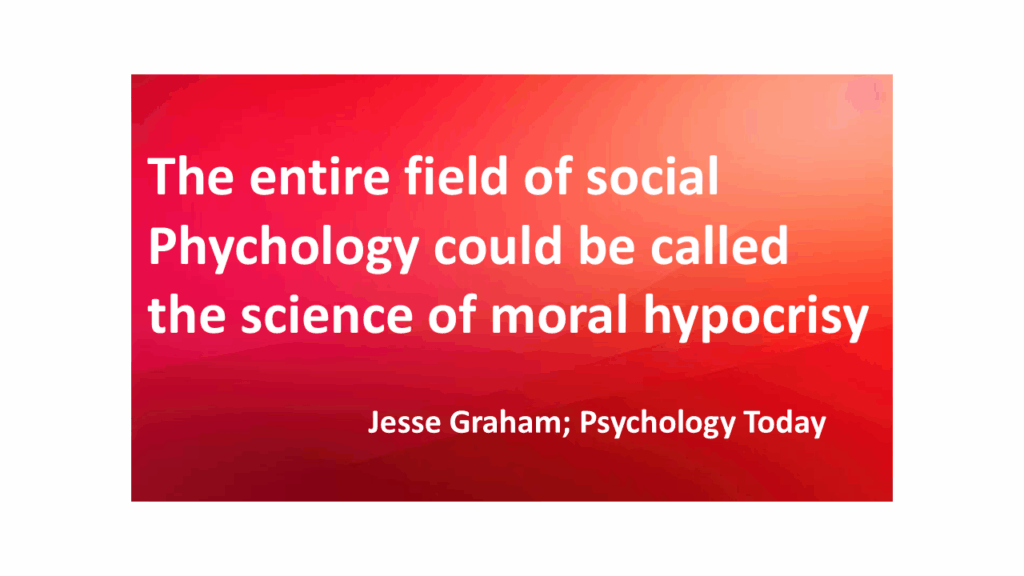
The Psychology Department at the University of Southern California conducted a revealing study on moral hypocrisy in human behavior and arrived at several thought-provoking conclusions. Their findings suggest that—whether consciously or not—people often claim to uphold certain principles, but fail to act in accordance with them. In some cases, their behavior may not even reflect those principles at the level of thought or conviction.
The researchers identified three primary categories of moral hypocrisy that almost everyone falls into at some point: moral duplicity, moral double standards, and moral weakness.
1. Moral Duplicity
This is the classic form of hypocrisy—where a person deliberately misrepresents their moral standing or motives. It’s when individuals pretend to be acting ethically or selflessly while hiding ulterior motives. For instance, a coworker might sign a declaration stating they have no external business interests that conflict with their employer, even though you know they secretly do. That situation places you in a moral dilemma of your own: should you remain loyal to your friend, or report the inconsistency for the sake of professional integrity?
2. Moral Double Standards
This form of hypocrisy is subtler and more common. It arises when people judge others more harshly than they judge themselves for committing the same wrong. Imagine being furious at a driver who blows through a crosswalk without stopping—yet later, when you’re running late and do the same thing, you rationalize it by saying you were in a hurry. The offense is the same, but your evaluation changes based on who committed it.
3. Moral Weakness
Here, people genuinely believe in a moral principle but fail to act on it consistently. This isn’t about deceit or unfair judgment—it’s about failing to live up to one’s own standards. For example, someone might passionately advocate against texting while driving, but still find themselves glancing at their phone behind the wheel. Or a person might claim that civic duty demands everyone vote, but then skip Election Day themselves out of inconvenience.
In each of these cases, the gap between belief and behavior is revealing. While we often recognize hypocrisy in others with ease, it can be far more difficult to detect in ourselves. This study highlights the complexity of human morality: it’s not merely about what we profess to value, but how consistently we live out those values in the real world.
This raises an important question: if everyone is, at times, guilty of pretending to be more moral, more virtuous, or more consistent than they actually are—is it fair to single out Christians for the same behavior?
Challenge Question: Have you ever been guilty of pretending to be more virtuous, smarter, or consistent than you really are? Have you ever upheld a standard and then violated that same standard?
Premise 2: Judging Christians For Their Hypocrisy And Judgmentalism Is Duplicitous
du·plic·i·ty
/do͞oˈplisədē/
contradictory doubleness of thought, speech, or action
Hypocrisy—or moral duplicity—has been shown to be a common trait across all walks of life, affecting both religious and non-religious individuals alike. To explore this phenomenon in greater depth, Dr. Jesse Graham and his team conducted a comprehensive study focused on moral hypocrisy. Participants were asked to respond to three simple online questions:
- What are your most important personal values?
- What actions have you taken that were either consistent or inconsistent with those values?
- What recent actions made you feel guilty?
The majority of respondents identified honesty, care, fairness, and loyalty as their core moral values. Interestingly, the most common violations of these values involved dishonesty and betrayal of trust—especially when people lied to friends or loved ones. These particular failings also triggered the deepest feelings of guilt, suggesting a strong internal moral awareness despite external inconsistencies.
Isn’t it Hypocritical to Judge Other Hypocrites?
It’s common to hear the criticism that Christians are hypocrites, but this often stems from an unrealistic expectation—that they should be perfect. The truth is, expecting Christians to live flawlessly at all times is no more fair than expecting ourselves to be flawless. Everyone struggles with inconsistency between what they believe and how they live, and Christians are no exception. In fact, the very foundation of the Christian faith is the admission that no one is perfect and that all people are in need of grace. When Christians fall short, it doesn’t necessarily mean they are hypocrites—it often just means they are human. The truth is, hypocrisy within ourselves is easier to find than we might think.
Many forms of hypocrisy and image management go unnoticed not because they are rare, but because they are so deeply woven into everyday life. People often violate their own values—such as honesty, loyalty, or fairness—not through blatant deceit, but through subtle compromises they may not even recognize. The chart below outlines common ways individuals engage in image pretension or moral duplicity, along with overlooked examples that reveal how easily and frequently these behaviors can occur in ordinary settings.
Common Violations And Examples of Overlooked Violations
| Common Violations | Examples of Overlooked Violations |
|---|---|
| Moral Duplicity – Pretending to uphold high moral standards while acting otherwise | – Publicly condemning actions you privately justify or commit |
| Vanity / Pride – Projecting an idealized version of oneself to gain admiration | – Highlighting only achievements to impress others – Hiding flaws to appear superior |
| Inauthenticity – Hiding one’s true character, beliefs, or struggles to maintain a certain image | – Faking agreement or belief to fit in – Avoiding vulnerability to maintain control of your image |
| Social Hypocrisy – Acting virtuous in public while contradicting those values privately | – Applying strict standards to others while excusing yourself – Performing goodness for public praise rather than genuine conviction |
| Impression Management – Deliberately shaping others’ perceptions to protect or elevate status | – Crafting your image to gain approval, even at the expense of truth or trust – Downplaying failures to preserve reputation |
| False Humility – Pretending to be humble while subtly seeking praise or superiority | – Saying “I’m not that great” while hoping others disagree – Pretending to defer praise while inwardly seeking recognition |
| Unfair Comparison (implicit) – Holding others to higher standards while excusing your own image polishing | – Criticizing others’ self-promotion while doing it subtly yourself – Dismissing your own flaws as “harmless” while exaggerating others’ faults |
| Surface Loyalty (implicit) – Maintaining loyalty for appearances while being disloyal privately | – Publicly supporting someone while privately undermining them – Being loyal only when it doesn’t cost you anything |
These overlooked violations are not unique to Christians—they are deeply human tendencies. Yet many who accuse Christians of hypocrisy often engage in the very same behaviors themselves. Condemning others while excusing personal compromise is a textbook example of moral duplicity. Projecting a virtuous image while hiding flaws, seeking admiration under the guise of humility, or showing loyalty only when convenient are all behaviors common across humanity. So, when non-believers call out Christians for inconsistency while simultaneously participating in similar image management, they too are guilty of the same charge. Ironically, it becomes hypocritical to label Christians as hypocrites while overlooking or justifying one’s own contradictions. The real issue is not whether Christians fail, but whether anyone is truly willing to live consistently with their own values—and honest enough to admit when they fall short.
Challenge Question: If hypocrisy is a universal human flaw documented by psychology, is it intellectually consistent to single out Christianity as false because its adherents exhibit the same inconsistencies found in everyone else?
Premise 3: Becoming A Christian Does Not Magically Eliminate The Sin Of Hypocrisy
Becoming a Christian does not eliminate the sin of hypocrisy—nor does it immediately transform a person into someone who always lives in perfect alignment with their beliefs. In fact, the Christian life begins with the admission that we are flawed, inconsistent, and in need of grace. While faith in Christ brings forgiveness and a new identity, it does not erase the daily struggle with human weakness, pride, fear, or the temptation to present ourselves better than we are.
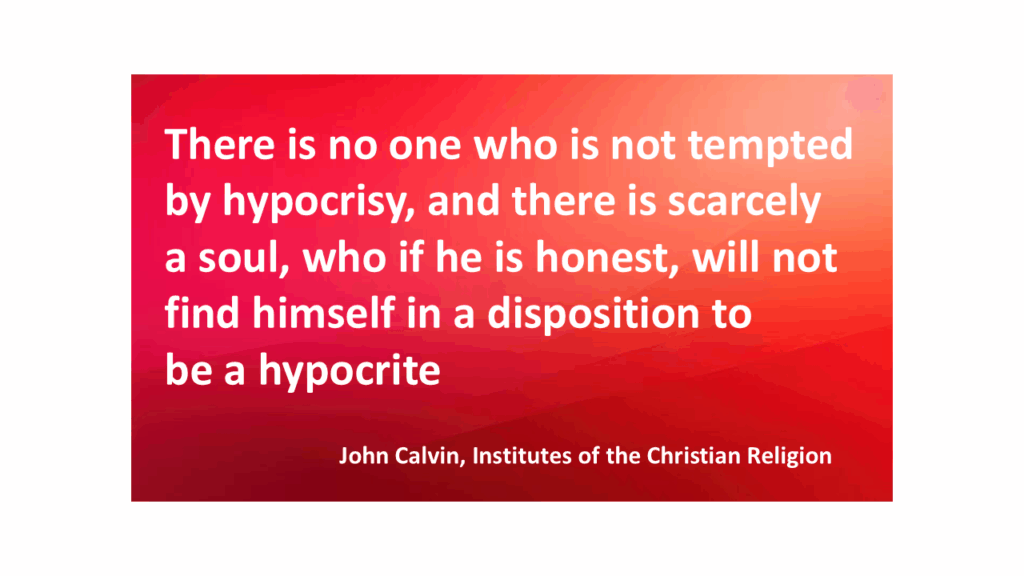
Hypocrisy often arises not out of malice, but from the gap between what we believe is right and how we actually live. Christians are not exempt from this struggle. Even the apostle Paul wrote about his battle with doing the very things he wished he wouldn’t (Romans 7:15–25).
For I do not understand my own actions. For I do not do what I want, but I do the very thing I hate.
Romans 7:15-19
Now if I do what I do not want, I agree with the law, that it is good. So now it is no longer I who do it, but sin that dwells within me. For I know that nothing good dwells in me, that is, in my flesh. For I have the desire to do what is right, but not the ability to carry it out. For I do not do the good I want, but the evil I do not want is what I keep on doing.
The Apostle Paul—who wrote this passage and much of the New Testament, who planted churches across the Roman world, and ultimately died a martyr—openly admitted to moments when his actions, words, or thoughts failed to align with what he knew to be right. Genuine Christianity does not attempt to conceal human weakness; it brings it into the open. It calls flawed people to walk together in honesty, supporting one another toward greater faithfulness, while resting in the assurance that forgiveness is secured not by their perfection, but by the One who gave His life for their failures.
The Christian journey involves gradually closing that gap through humility, repentance, and dependence on God—not pretending it doesn’t exist. So, to become a Christian is not to claim moral superiority, but to confess ongoing need. It means striving to live with authenticity, knowing that hypocrisy is a persistent temptation—but grace, not perfection, is the foundation of our faith.
Contrary to the common stereotype, Christianity isn’t about a bunch of self-righteous people wagging their fingers at the world saying, “Try harder—God’s watching!” That completely misses the point. Real Christianity is about recognizing our need for help. True Christians aren’t pretending they have it all together—they’re the first to admit they don’t. They know they can be selfish, prideful, and even hurtful. They know they fall short, and that they can’t meet God’s standards on their own. Being a Christian means honestly saying, “I mess up. I’m broken. I’ve turned away from God, and I need His grace.” It’s not about excusing failure, but facing reality—and finding the freedom to grow and live as God’s people in a world that’s far from perfect.
Hypocrisy is just one of many sins that Christians, like all people, struggle with and must regularly repent of. Christians are not immune to the ongoing temptations of selfishness, pride, lust, or hypocrisy. They will stumble, sometimes repeatedly, and at times those failures happen publicly—causing real harm and disappointment. But these moments are not a reflection of Christian perfection—they are reminders of human weakness and the continual need for God’s grace, forgiveness, and transformation.
Challenge Question: If everyone struggles with inconsistency between their values and actions, is it fair—or even hypocritical—to single out Christians for moral failure? Why do you think their failures are often more harshly judged?
ThinkCube Truth Veracity Grid
- Have I considered the facts carefully and with an open mind?
- Is my conclusion the result of a careful examination of the facts, or is it a conclusion made in spite of the facts?
- Is my conclusion the one that makes the most sense of the evidence?