
Premise 1: Nature Provides Unmistakable Testimony Of God’s Power
For the wrath of god is revealed from heaven against all ungodliness and unrighteousness of men, who by their unrighteousness suppress the truth. For what can be known about God is plain to them, because God has shown it to them. For His invisible attributes, namely His eternal power and divine nature, have been clearly perceived, ever since the creation of the world, in the things that have been made. So that they are without excuse.
Romans 1:18-20
Romans 1:18–20 is a powerful passage where Paul argues that God’s existence and divine nature are evident in the created world—so much so that humanity is “without excuse” for failing to recognize Him. The Apostle Paul uses the phrase “ever since the creation of the world” to emphasize that even long before modern science, when human understanding was limited to simple observation, the incredible creativity, diversity, and intelligence woven into the natural order would have been staggering—even to the simplest minds.
Paul is making the case that long before the microscope or telescope, before Darwin or Newton, even in the most primitive human settings, the natural world offered overwhelming evidence of a Creator’s power, wisdom, and presence. Let’s expand on that idea:
Observational Simplicity, Profound Impact
Even the earliest humans—shepherds, farmers, nomads—were surrounded by phenomena that defied randomness:
- The regularity of the seasons, the rising and setting of the sun, the cycles of the moon.
- The complexity of animal behavior, the design of the human body, and the reliability of natural laws.
- The beauty of a flower, the immensity of the stars, and the symphony of ecosystems.
Without modern scientific terminology, early people still saw the fingerprints of intelligence and intentionality. A simple man looking up at the night sky, with no knowledge of astrophysics, might still intuitively grasp that such order, beauty, and immensity couldn’t be the product of chaos.
Intuitive Recognition of Design
Paul argues that the evidence is so apparent it transcends intellectual sophistication. Even those with no formal education or religious training have an innate sense that:
- There is purpose behind nature.
- There is a moral law within, prompting questions of right and wrong.
- Life is not merely random but seems to have meaning.
This is the natural theology that Paul is pointing to—the idea that creation itself is a kind of universal revelation, accessible to all, regardless of time, culture, or education.
The Diversity and Creativity of Creation
Imagine being an ancient observer, surrounded by:
- The dazzling diversity of animal species—from elephants to eagles to ants.
- The amazing range of plant life, each with its own function and beauty.
- The miracle of birth, the mystery of the mind, and the resilience of life through droughts and storms.
Paul is essentially saying: Even without understanding DNA, quantum mechanics, or the fine-tuned constants of the universe, the average person in any age could observe the sheer creativity and intelligence behind it all.
Accountability and Awareness
Because this revelation is so universal and unmistakable, Paul concludes: “So they are without excuse.”
- No one can genuinely claim ignorance of God’s presence.
- Even if people didn’t know everything about God, they knew enough to seek, to honor, and to worship.
Romans 1:18–20 invites us to imagine the world as it would appear to any human at any time—through the eyes of wonder rather than scientific precision. And in that wonder, Paul says, the glory, power, and divinity of God have always been clear. The testimony of creation has never been silent. It speaks every day and to every soul. This is what theologians refer to as God’s general revelation to anyone who has ever lived modern, ancient, civilized or aboriginal.
General Revelation Consists of What God Has Revealed of Himself Through Nature
The heavens proclaim the glory of God.
Psalm 19:1-4
The skies display his craftsmanship.
Day after day they continue to speak;
night after night they make him known.
They speak without a sound or word;
their voice is never heard.
Yet their message has gone throughout the earth,
and their words to all the world.
This passage—Psalm 19:1–4—is one of the most vivid declarations in Scripture about general revelation, the idea that creation itself proclaims the reality of God. King David, the author of this psalm, poetically describes how the natural world serves as a continuous, wordless testimony to God’s glory and divine craftsmanship.
“The heavens proclaim the glory of God; the skies display his craftsmanship…”
David begins by focusing on the heavens—the sun, moon, stars, and sky—as a visual manifestation of God’s majesty. The word “proclaim” suggests an active, intentional communication. Creation is not silent in its message; it proclaims, displays, and reveals. The universe is not neutral—it is a canvas filled with divine brushstrokes, pointing to a Creator who is powerful, intelligent, and glorious.
“Day after day they continue to speak; night after night they make him known.”
The revelation of God through nature is constant and unrelenting. There is never a moment when creation is not declaring something about God. Whether it’s the radiant sunrise, the cycle of the seasons, or the silent expanse of stars overhead, creation teaches us—persistently and faithfully—about the God who made it.
“They speak without a sound or word; their voice is never heard. Yet their message has gone throughout the earth, and their words to all the world.”
Though creation doesn’t communicate in human language, its message transcends all barriers. It doesn’t need a spoken word. Its nonverbal witness is universal—reaching every culture, language, and era. There’s no corner of the globe untouched by this divine broadcast. It’s as if the sky is a global sermon declaring: There is a Creator. He is glorious. He is wise. He is worthy of awe.
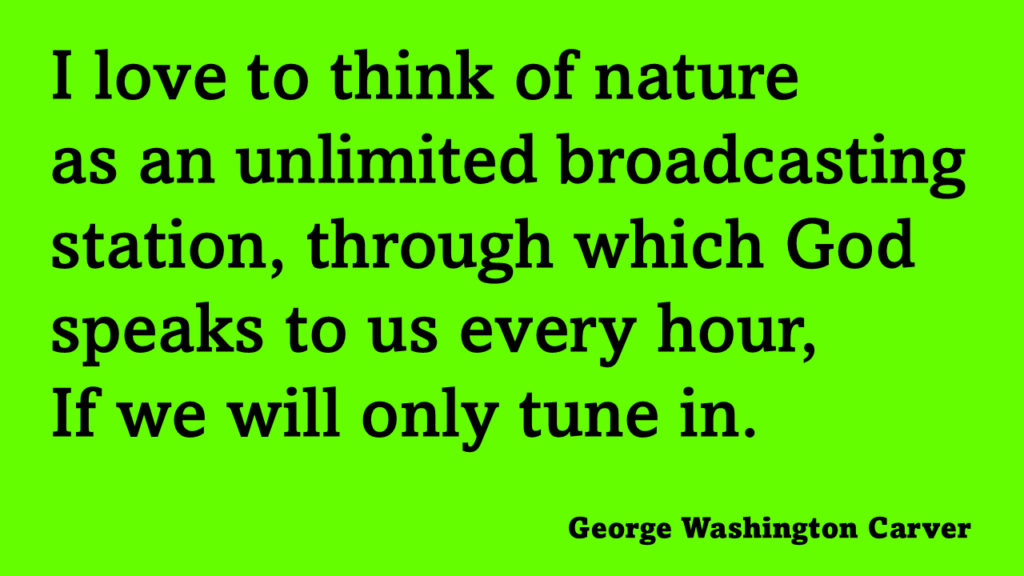
Though this declaration is nonverbal, its message is universal. Creation communicates without sound or speech, yet its voice reaches every corner of the globe. The rising of the sun, the shimmering stars, the order of seasons, and the vastness of the cosmos all point to a Creator who is both majestic and intentional. This is not abstract theology; it is concrete, observable reality. Nature is a divine broadcast that transcends language and culture, making known the eternal power and divine nature of God.
Psalm 19 is declaring that creation is not random or meaningless—it is concrete revelation of God’s divinity. Just as an artist’s skill is revealed in a painting or a composer’s genius is revealed in a symphony, the Creator’s attributes are on display in the intricacies, beauty, and order of the universe. This is exactly what Paul echoes in Romans 1:20 when he says:
For since the creation of the world God’s invisible qualities—
Romans 1:20
his eternal power and divine nature—have been clearly seen
This psalm closely parallels Paul’s words in Romans 1:20, where he affirms that “God’s invisible attributes…have been clearly perceived…in the things that have been made.” Together, these passages affirm that the created order is not random or meaningless—it is a continuous testimony to the glory of God, leaving no one without evidence of His existence.
Every human being, regardless of time, culture, or background, has had a front-row seat to the divinity, power, and intelligence of God. The Creator’s fingerprints are evident throughout everything He has made. Anyone can look at the natural world and clearly perceive what God is like. Creation testifies that God is awesome, powerful, intentional, and perfect in His design.
Challenge Question: If people in every culture and time have had access to the evidence of God through creation, as Psalm 19 and Romans 1 suggest, what does this imply about humanity’s ability to recognize God’s existence—even without hearing the gospel—and how might that shape their moral responsibility before God?
Premise 2: Global Religions Reflect a Recognition Of God Through Nature’s Testimony
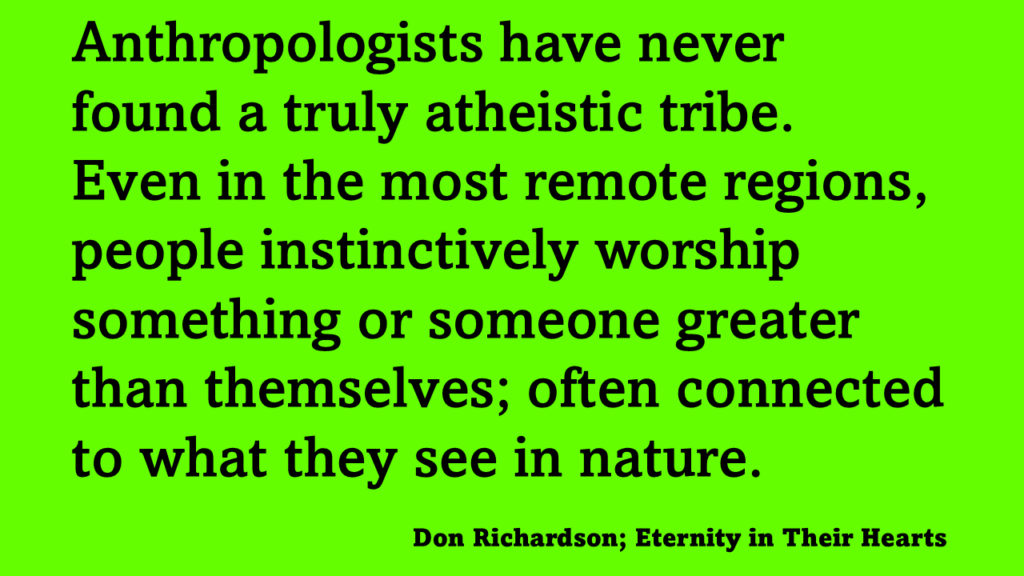
Anthropologists estimate that there have been over 10,000 distinct human cultures throughout recorded and prehistoric history, and every one studied shows evidence of religious belief or supernatural worldview.Religious belief is a near-universal human phenomenon—so widespread that even secular anthropologists have acknowledged its consistent presence across every known culture and civilization.
One of the clearest reasons for this global pattern is what people have always seen in nature. The majesty of the skies, the power of storms, the complexity of life, and the rhythm of seasons have compelled humanity to recognize that there must be something—or someone—greater behind it all. Across time and geography, people have responded to the natural world not with indifference, but with awe, reverence, and worship. The chart below highlights how this instinctive response to creation has led nearly all cultures to develop some form of spiritual or religious belief.
Estimated Global Percentage of Cultures with Religious or Spiritual Belief
| Category | Estimated % | Notes |
|---|---|---|
| Cultures with belief in a god/gods or spiritual forces | 99%+ | Anthropologists have found virtually no culture that is entirely atheist or without spiritual practice. |
| Cultures with nature-based spirituality (animism, earth-worship, etc.) | ca. 70–80% (historically) | Especially common among indigenous tribes, ancient civilizations, and early religious systems. |
| Cultures with belief in a Creator deity | ca. 80–90% | Even among animist cultures, many have a “high god” or “sky god” who created the world but is distant or uninvolved. |
| Uncontacted tribes with documented spiritual practice | ca. 100% (of known cases) | Every known uncontacted or recently contacted tribe has demonstrated belief in spirits, taboos, rituals, or deities. |
| Fully non-religious cultures in history | 0% | No anthropologist has confirmed the existence of a culture or civilization that was completely devoid of religious thought or worship practice. |
The witness of nature—testifying to a powerful Creator—is so strong and universally evident that no anthropologist has ever confirmed the existence of a culture or civilization completely devoid of religious thought or worship practice. In fact, when anthropologists encounter previously unreached or unstudied societies—whether ancient or modern—they consistently find religious systems already in place, centered around a deity, a pantheon of gods, or the forces of nature itself. This aligns perfectly with what the Apostle Paul declares in Romans 1: that ever since the creation of the world, all people have perceived God’s existence through the majesty, power, and wisdom evident in nature. The natural world speaks so loudly and clearly of a divine origin that humanity’s instinctive response has been to worship—often by attributing divinity to nature or by creating deities that reflect the power they see in the created order. Anthropological findings fully support Paul’s claim: the testimony of creation is unmistakable, and people everywhere have responded to it in worship.
Nature is God’s faithful and continual witness of Himself to every person He has ever created. While this general revelation does not provide the full picture of who God is or explain His ultimate purposes in detail, it offers a clear and compelling glimpse of His power, wisdom, and divine nature. This witness is not limited to scholars or theologians—it is accessible even to the simplest of minds. The beauty, order, and majesty of creation serve as an invitation for every human heart to ask deeper questions, to seek meaning, and to reach out for the One behind it all. Nature stirs within us a longing for the transcendent, and that longing can lead people to ask God to reveal Himself more personally—a prayer that Scripture assures He is willing to answer.
Challenge Question : If the Bible says that nature is God’s universal witness, could it be that the very purpose of that witness is to stir the human heart to seek more—to reach, question, and ultimately grope for a deeper knowledge of the One behind it all?
Premise 3: Nature Is God’s Invitation To Seek Him
If you were to walk into a once-vacant building and discover a single room now overflowing with countless baked confections—cupcakes, macaroons, pies, turnovers, donuts, tarts—displayed from floor to ceiling, your mind would immediately begin racing with questions. Every surface is covered with vibrant, varied, intricately decorated pastries, each with different textures, fillings, icings, and fruit toppings. The scene is bursting with color, precision, and creativity.
No rational person would assume these items simply appeared by chance or came from nowhere. Instinctively, you would ask: Who made all this? How did they do it without a kitchen? And what is the purpose of it all? The presence of intentional design demands an explanation. The arrangement, diversity, and artistry provoke inquiry.
This is precisely what nature does to the thoughtful mind. Nature’s beauty, complexity, and power—its ecosystems, its patterns, its awe-inspiring scale—are not random clutter. They are an intelligent display of power and imagination, pointing toward an origin beyond themselves. Just as a room filled with pastries demands a baker, the world filled with design, order, and life demands a Creator.
This natural provocation—Who made this? How did it come to be? And why?—is what has stirred every culture, primitive or modern, to form religious frameworks. Whether through mythology, philosophy, or theology, humanity has always sought to answer the deep and universal questions that creation itself seems to whisper: Who, how, and what for?
Nature As God’s Universal Witness and Invitation
Nature is often referred to as God’s first book — a living, breathing testament to His power, wisdom, and presence. From the vastness of the galaxies to the intricate detail of a single leaf, creation speaks with a silent but profound voice. It declares the majesty of its Maker and draws the attentive heart toward something — or rather Someone — greater than itself.
1. Nature as a Witness of God’s Glory
Psalm 19:1 says, “The heavens declare the glory of God; the skies proclaim the work of his hands.” Nature doesn’t need words to speak. Its beauty, order, and power all bear witness to a divine intelligence. The symmetry of a flower, the rhythm of the seasons, the laws that govern gravity and motion — none of these are random. They are echoes of a Creator who is both powerful and purposeful.
Even those who do not know the Scriptures can sense the divine through creation. This is why Paul writes in Romans 1:20 that “since the creation of the world God’s invisible qualities — his eternal power and divine nature — have been clearly seen, being understood from what has been made, so that people are without excuse.” Nature itself leaves a spiritual footprint that points back to its source.
2. Nature as an Invitation to Seek
But nature doesn’t just testify to God’s existence — it also invites us to seek Him. The awe we feel when standing before a mountain, watching a thunderstorm, or staring at the night sky is not just emotional — it’s spiritual. These experiences stir within us a longing for meaning, transcendence, and connection. They awaken questions: Who made this? What does it say about the Creator? What is my place in this vast world?
In this sense, nature becomes a doorway. It’s not the destination — it’s the invitation. Just as a piece of art leads us to consider the artist, nature is designed to lead us beyond itself to the One who imagined and formed it all.
3. A Universal Language
One of the most beautiful aspects of nature is its universality. It speaks to everyone — across cultures, languages, and religions. You don’t have to be educated or wealthy to be moved by a sunset or inspired by the ocean. Nature offers a common ground for divine encounter. It levels the field and offers everyone — no matter their background — the opportunity to perceive something greater than themselves.
4. A Call to Wonder and Worship
Ultimately, nature leads us not just to knowledge of God, but to worship. When we pause long enough to notice the intricacy and majesty of creation, our natural response is reverence. We are reminded of how small we are — and how great God is. Nature doesn’t demand worship for itself; it humbly redirects our awe toward its Maker.
Nature is both a witness and an invitation—a witness to the glory, power, and divine craftsmanship of God, and an open invitation for the human heart to seek deeper truth. It is a universal sermon, always preaching—not with words, but with wonder—to any who are willing to see, listen, and respond.
Though nature’s testimony is not the Gospel itself, it is no less powerful in its role. It tells every human being, regardless of time, culture, or language, that there is a God who is worthy of reverence. It reveals that He is a lawgiver, evident in the moral intuition written on the human conscience. And most of all, it subtly but unmistakably declares that He is perfect—and that we are not.
This is why Paul writes in Romans 1:20 that God’s “eternal power and divine nature” have been clearly seen, being understood from what has been made, so that people are “without excuse.” Nature strips away the illusion of ignorance. Its beauty awakens awe. Its order reveals intelligence. Its vastness instills humility. And its brokenness, too—storms, decay, death—testifies that something is not right in the world or within us.
To the one who responds positively to this testimony—who humbly acknowledges, There must be a Creator… I want to know Him—God is faithful. He will provide further light. Whether through the Gospel proclaimed by missionaries, the Scripture brought through divine providence, or a supernatural encounter like a dream or vision, God ensures that the seeking heart does not remain in the dark. As Hebrews 11:6 says, “He is a rewarder of those who diligently seek Him.” God will make known the essential truth: that salvation comes through faith in Him, and that He alone can rescue us from sin and reconcile us to Himself.
Challenge Question: If nature is truly a universal witness to God’s existence and character, what does a person’s response to that witness reveal about their willingness to know the truth—and how might that shape God’s response to them?
ThinkCube Truth Veracity Grid
- Have I considered the facts carefully and with an open mind?
- Is my conclusion the result of a careful examination of the facts, or is it a conclusion made in spite of the facts?
- Is my conclusion the one that makes the most sense of the evidence?