Premise 1: Humans Are Made In The Image Of God
Then God said,
“Let us make man in our image,
after our likeness.And let them have dominion
over the fish of the sea
and over the birds of the heavens
and over the livestock
and over all the earth
and over every creeping thing
that creeps on the earth.”So God created man in his own image,
Genesis 1:26-27
in the image of God he created him;
male and female he created them.
The meaning of the image of God is that He intended to make a creature similar to himself. The Hebrew words for both “image” (tselem) and “likeness” (demut) refer to something similar but not identical to the thing it represents or is an “image” of. It simply would have meant to the original readers—”Let us make mankind to be like us and to represent us”.
Simply put, it means that human beings were created to reflect God’s nature, value, and character in the world.
Key Aspects of Being Made in God’s Image
- Inherent Value & Dignity: Every person—regardless of age, ability, background, or social status—has infinite, unearned worth. Value isn’t based on what you produce or achieve; it is woven into your very existence because you carry God’s likeness.
- Capacity to Love & Relate: Because God is relational, humans are hardwired for deep Connection, empathy, community, and unconditional love.
- Creative & Rational Mind: Human creativity, intelligence, problem-solving, and appreciation for beauty (art, music, science) mirror the ultimate Creator’s own mind.
- Moral Awareness: We have a conscience—an intrinsic sense of justice, right and wrong, and a desire to see good triumph over evil.
- Caregivers of Creation: Historically, a king would put up a statue (an “image”) in a distant land to represent his authority. Similarly, humans are designated as God’s representatives or stewards to care for the Earth and look after one another.
This implies that humans are unique in creation, possessing a special connection or reflection of God’s nature, suggesting a divine source for this uniqueness. The concept of being made in God’s image has significant theological implications, including the inherent dignity and value of human life, as well as our capacity for reason, morality, and relationship with the divine.
The Distinctiveness Of Mankind Points To God’s Existence
The image of God (Latin, imago dei) refers to the immaterial part of humanity. It sets human beings apart from the animal world, fits them for the dominion God intended them to have over the earth (Genesis 1:28), and enables them to commune with their Maker. One of the broader examples of human distinctiveness is cognition.
The idea of humanity being created in God’s image, as stated in Genesis 1:27, doesn’t directly prove God’s existence, but it’s a theological concept that, within a faith-based framework, suggests a divine origin and purpose for humanity, implying a creator. The logical progression would be like this:
- Mankind is the only cognitive species able to observe and study the universe, engage in abstract thought, and possess a sense of morality—qualities that reflect the image and nature of God.
- God made mankind the only species with these qualities so it could observe, learn, be moral like Him.
- The distinctiveness of man from any other creature defies evolution and proves special creation by a Creator.
Evolutionist and atheists often share the view that humans are simply another species, having evolved through natural processes, rather than being created separately or having a unique, non-biological soul.
We are just an advanced breed of monkeys on a minor planet of a very average star. But we can understand the Universe. That makes us something very special
Stephen Hawking
Stephen Hawking while obviously trying to advance evolutionist theory inadvertently highlights “human cognizance”.
cog·ni·tion
/ˌkäɡˈniSH(ə)n/
the mental action or process of acquiring knowledge and understanding through thought, experience, and the senses.
Hawking said the only thing that makes humans special is that we can understand the Universe which begs the question: Of the 8.7 million ancestor species on earth why are humans the only species that can understand the universe and contemplate their own existence?
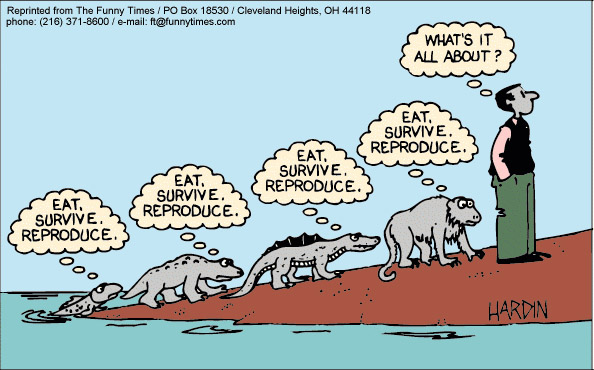
Cognitive Distinctions that No Other Species Have
| Distinctions Lacking In Other Species | |
| Complex Language and Communication | Unlike other animals, humans possess the ability to communicate through complex symbolic language, allowing for the sharing of abstract ideas and knowledge. |
| Advanced Cognitive Abilities | Humans are the only species capable of complex, sometimes mathematical planning, problem-solving, and abstract reasoning. |
| Self-Awareness and Morality | Humans are capable of introspection and self-reflection, which leads to a sense of self and a capacity for moral judgment and ethical reasoning |
| Conscience | Humans have an inherent ability to perceive what is right and what is wrong and, on the strength of this perception, to control, monitor, evaluate and execute their actions |
| Tool Use and Technology | Humans have a natural inclination to create and use tools, which has led to the development of complex technologies that have transformed our world |
| Creativity and Artistic Expression | Humans possess a unique capacity for creativity and artistic expression, which manifests in various forms such as music, art, literature, and dance |
| Contemplation of metaphysical | Humans contemplate existence, purpose, death and eternity |
The gift of mental power comes from God, and if we concentrate our minds on that truth we become in tune with this great power.
Nikola Tesla
Mankind bears the image of God in that we are rational, volitional beings—capable of reasoning, choosing, contemplating, and creating. We are the only species able to write, study, observe, and explore in a conscious effort to understand the universe and reflect on our own existence. Evolutionists often attribute the vast difference between humans and our nearest evolutionary relative, the chimpanzee, to a matter of biological chance—but the gap in capacity suggests something far more profound.
The difference between humans and our nearest evolutionary relatives—primarily chimpanzees and bonobos—is extraordinarily vast when it comes to the higher-order faculties of reasoning, choosing freely, contemplating meaning, and creating intentionally. While genetic similarity between humans and chimpanzees is often cited as approximately 98–99%, this number can be misleading when it comes to functional and cognitive capabilities. That small percentage difference in DNA results in a profound divergence in mental, moral, and creative capacities.
Evolutionists are quick to point to the biological and genetic similarities between humans and primates as evidence of common ancestry. Yet when it comes to the extraordinary divide in intellectual capacity, abstract reasoning, creativity, and self-awareness, the differences are far more difficult to explain. Physical similarities may be readily identified and measured, but the vast gulf between human intelligence and that of our closest animal relatives raises profound questions about what truly makes mankind unique.
Comparative Data and Insights
| Capability | Humans | Chimpanzees / Other Apes |
|---|---|---|
| Abstract Reasoning | Advanced logical, mathematical, and philosophical thought | Limited to simple problem-solving |
| Moral Reasoning | Ability to distinguish good/evil; sense of justice | Lacks moral abstraction; operates via instinct/social cues |
| Language | Complex, symbolic language; past/future tense, imagination | Use of basic gestures or vocalizations; no true language |
| Self-Awareness | Deep self-reflection; understanding of mortality and purpose | Basic mirror recognition; no existential self-awareness |
| Tool Use & Innovation | Advanced tools, architecture, and technologies | Limited tool use; no innovation or progress |
| Artistic and Creative Expression | Art, music, literature, symbolic meaning | No known aesthetic or symbolic creation |
| Spiritual Awareness | Religious belief, worship, and contemplation of the divine | No known spiritual or transcendent awareness |
| Choice and Free Will | Complex ethical decision-making and long-term planning | Decisions driven largely by instinct and immediate needs |
The human capacity for language, symbolic thought, and culture is not an incremental development—it is a cognitive leap
Stephen Pinker; Cognitive Phycologist
The human capacity for language, symbolic thought, and culture is not the product of slow, incremental change, but a sudden and profound cognitive leap that sets humanity apart from all other life. No other species communicates abstract ideas, creates art, records history, or contemplates its own existence. This leap is not easily explained by natural processes alone—it points to something beyond biology, suggesting a purposeful design behind the human mind.
From a Christian perspective, the biological similarities between humans and primates are not necessarily evidence of common ancestry, but can also be understood as evidence of a common Designer. Engineers routinely incorporate proven design principles across entirely different creations because those principles are functional, efficient, and reliable. Consider a lawnmower and a Ferrari. Both have engines, wheels, fuel systems, and many of the same basic mechanical principles, yet their similarities do not make them the same kind of machine or diminish their vastly different capabilities and purposes. Likewise, Christians argue that shared biological features may reflect God’s consistent use of effective design principles across different species, while the extraordinary intellectual, moral, and spiritual capacities of mankind reveal a distinction that extends far beyond physical similarities.
Challenge Question: do you think that man’s ability to reason, choose, contemplate, and create is the result of blind natural processes? if so the why is the intellectual gulf so enormous between mankind and his nearest evolutionary ancestor?
Premise 2: The Human Conscience Cannot Be Explained Naturally
soul
/sōl/
1.the spiritual or immaterial part of a human being
According to evolutionary theory, the primary distinction between humans and other species is a larger, more developed brain. The Bible, however, teaches that what truly sets mankind apart from the animal kingdom is the immaterial aspect of human nature—spiritual consciousness or the soul. This dimension of human existence cannot be measured biologically but must be understood philosophically. Throughout history, this spiritual awareness has been universally expressed across cultures and civilizations in profound and consistent ways.
Here are some ways this spiritual consciousness has been demonstrated across all cultures in all times:
1. Religious Instinct
A general term that refers to the innate human inclination toward religious belief, including belief in God, the afterlife, and the spiritual realm.
2. Transcendental Impulse
This phrase captures humanity’s deep-seated yearning for meaning beyond the material world — for God, heaven, or eternal life.
3. Sense of the Divine *(Latin: sensus divinitatis)
Coined by theologian John Calvin, this refers to the built-in awareness or perception of God that all humans possess, leading them to seek a higher power or ultimate reality.
4. Spiritual Inclination
A broader term describing humanity’s natural tendency to seek spiritual truths, higher purposes, and metaphysical realities.
5. Religious Cognition / Cognitive Science of Religion
In academic terms, this refers to the study of why human minds are predisposed to religious belief, suggesting that belief in the supernatural may arise from our cognitive architecture.
6. Eschatological Belief
This specifically refers to belief in the afterlife, final judgment, and heaven/hell—ideas related to what happens after death.
The profound difference between humanity and all other species lies not merely in the evolution of a larger or more specialized brain. Rather, being made in the image of God refers to the immaterial aspect of human nature—expressed through philosophical reasoning, moral judgment, abstract thinking, and creative capacities such as art and music.

Genesis 1:26–27 declares that God created man and woman in His image and likeness. Since God is spirit (John 4:24), this cannot refer to a physical resemblance. Therefore, being made in His image must point to the spiritual dimension of our nature—the soul. It is this immaterial part of us that reflects God’s nature, and it is given to each person by God.
And the dust returns to the ground it came from, and the spirit returns to God who gave it.
Ecclesiastes 12:7
A number of prominent neuroscientists have challenged the idea that the human mind is merely a product of the physical brain. While the brain processes information through electrical signals and chemical reactions, how physical matter produces conscious awareness, rational thought, free will, and our sense of personal identity remains one of science’s greatest mysteries. Neuroscientists such as Dr. Michael Egnor, Dr. Mario Beauregard, and Nobel Prize winner Sir John Eccles have argued that the mind cannot be fully explained by brain activity alone. They point to the remarkable distinction between the physical workings of the brain and our ability to think abstractly, reason logically, make conscious choices, and reflect upon our own existence. Their research and arguments raise a profound question: Is the human mind simply the product of biological machinery, or is there something about human consciousness that transcends the physical brain?
Neuroscientists Who Challenge the Mind-Brain Equation
| Neuroscientist & Credentials | Book | Central Premise or Argument |
|---|---|---|
| Dr. Michael Egnor, MD — Professor of Neurosurgery and Pediatrics, Stony Brook University; medical degree from Columbia University. | The Immortal Mind (2025) | Human reasoning, free will, and consciousness cannot be adequately explained by physical brain activity alone. Egnor argues that the mind possesses nonmaterial capacities pointing to the existence of a soul. |
| Dr. Mario Beauregard, PhD — Doctorate in Neuroscience, University of Montreal; postdoctoral training at McGill University; former researcher at the University of Arizona. | The Spiritual Brain (2007) | Spiritual experiences, conscious thought, and free will challenge the belief that the mind is merely a product of brain chemistry. |
| Sir John Eccles, DPhil — 1963 Nobel Prize in Physiology or Medicine; doctorate from Oxford University; former Professor of Physiology, Australian National University. | The Self and Its Brain (1977) | The conscious self is distinct from the physical brain and interacts with it. Eccles argued that brain activity alone cannot fully explain human self-awareness and voluntary thought. |
| Dr. Jeffrey M. Schwartz, MD — Research Psychiatrist, UCLA School of Medicine; medical degree from SUNY Downstate Medical Center; researcher specializing in neuroplasticity. | You Are Not Your Brain (2011) | Conscious attention and deliberate choices can physically reshape the brain through neuroplasticity. Schwartz argues that the mind plays an active role in changing the brain rather than merely being a passive product of brain activity. |
If human reason is ultimately the product of mindless, unguided natural processes, we are left with a profound question: How did something incapable of thought, reason, or understanding give rise to beings capable of all three? Matter possesses no intelligence, molecules exercise no judgment, and the laws of physics have no conscious understanding of the universe they govern. Yet mankind possesses the remarkable ability to reason logically, contemplate his own existence, distinguish truth from falsehood, and investigate the very laws that govern creation. Which is more reasonable—that intelligence ultimately arose from something entirely devoid of intelligence, or that human reason reflects the wisdom of an intelligent Creator who made mankind in His own image?
When animals die, their bodies decay, and there is no part of them that continues to exist. Animals do not possess souls. In contrast, when humans die, although the body returns to dust, the soul lives on eternally. To describe being made in the image of God in metaphysical terms is to recognize that humanity bears a spiritual imprint from God—a kind of ‘spiritual DNA’—that reflects His likeness, not something derived from biological ancestry.
As John 4:24 states, ‘God is spirit, and those who worship Him must worship in spirit and truth.’ The greatest distinction of mankind is not merely a larger brain, but the unique gift of a spiritual soul, created to commune with God.
Challenge Question: Do you find it more plausible that humanity’s unique cognitive abilities—expressed daily through philosophy, architecture, art, worship, music, and science—are the product of mere chance among Earth’s 8.7 million species? Or do you believe these mental and creative capacities are a divine gift, uniquely entrusted to mankind by God?
Premise 3: Human Language Cannot Be Explained Naturally
The emergence of symbolic language, first spoken, then written represents the sharpest break between animal and man.
Arthur Koestler—The Ghost in The Machine
When the Bible says that God made mankind in His own image, it also implies that He endowed humanity with certain divine attributes, setting humans apart from the animal kingdom. One such attribute is the ability for language and complex, compositional communication—a reflection of God’s own communicative nature.
According to the World Atlas of Languages there are around 8324 languages spoken around the world not including the thousands of different dialects. For example— Hindi which is one of the three major languages spoken in India has over 48 dialects.
What makes human language unique? Unlike any known form of animal communication, human language is compositional. It enables speakers to construct complex sentences with subjects, verbs, and objects—such as ‘I kicked the ball’—and to convey ideas across past, present, and future tenses. This structure allows for the expression of abstract thought, intention, and nuanced meaning.
Human language is distinct from all other known animal forms of communication in being compositional. Human language allows speakers to express thoughts in sentences comprising subjects, verbs and objects—such as ‘I kicked the ball’—and recognizing past, present and future tenses. Compositionality gives human language an endless capacity for generating new sentences as speakers combine and recombine sets of words into their subject, verb and object roles. For instance, with just 25 different words for each role, it is already possible to generate over 15,000 distinct sentences. Human language is also referential, meaning speakers use it to exchange specific information with each other about people or objects and their locations or actions.
BMC Biology

Animal ‘language’ is nothing like human language. Among primates, vervet monkeys (Chlorocebus pygerythrus) produce three distinct alarm calls in response to the presence of snakes, leopards and eagles. These forms of animal communication are symbolic in the sense of using a sound to stand in for an object or action, but there is no evidence for compositionality, or that they are creative forms of communication in which speakers and listeners exchange information. Instead non-human animal communication is principally limited to repetitive instrumental acts directed towards a specific end.
It is widely known that human DNA shares approximately 96% similarity with that of chimpanzees. What many people don’t realize is that human DNA is also about 90% similar to cats and 85% similar to mice. Yet none of these animals have ever written or spoken even a simple sentence like, ‘See the cat chase the mouse.’ How, then, can this colossal leap in human cognition and linguistic ability be explained purely through natural processes?
The acquisition of language is the most brilliant achievement of the human brain,” according to Dennis Fry in his book, Homo Loquens, Man the Talking Animal.” To utter a word, the infant has to coordinate breathing with delicate movements of palate, tips and tongue. Displacement by a fraction of a millimeter gives a different sound. In order to communicate he has to amass information concerning vocabulary, syntax, the phonetic system, grammar, rhythm patterns and intonation—yet…this phenomenon is considered universal for the human infant.
Dennis Fry; Man the Talking Animal
By the age of three, most human children can speak in fully compositional sentences. In contrast, apes, cats, mice, and other vocalizing animals have continued to produce the same basic sounds—grunts, chirps, and calls—since their existence began, with no observable progression or evolution in their communication.
Christians believe this clear distinction is not merely a matter of brain size. For example, the sperm whale has the largest brain of any animal, yet its communication remains limited to clicks, whistles, and pulsed calls. A key feature that reflects humanity being made in the image of God is the unique ability to speak, write, and transmit knowledge—especially concerning God, morality, and the nature of the universe.
Challenge Question: Do you find it more plausible that every human civilization has developed language, alphabets, and the ability to communicate compositionally simply because of a larger brain and a fortunate arrangement of synapses? Or does the vast cognitive chasm between humans and their closest genetic relatives—particularly in the ability to compose, speak, and write language—point to a unique gift endowed by God?
Premise 4: Human Ingenuity Cannot Be Explained Naturally
So God created human beings in his own image. In the image of God he created them; male and female he created them. Then God blessed them and said, “Be fruitful and multiply. Fill the earth and govern it.
Genesis 1:27-28
God’s command to govern the earth as described in Genesis, demonstrates humanity’s role as God’s representatives, reflecting His image, as humans are given dominion and responsibility to care for and cultivate the earth. The concept of stewardship, or “dominion” as it’s sometimes referred to, highlights that humans are not simply part of creation but are entrusted with a special responsibility to care for and manage the earth.
By caring for the earth and its resources, humans are acting in a way that mirrors God’s own creative and nurturing nature. God therefore equipped man with resourcefulness, creativity, and capacity for innovation, along with his ability to reason and understand. All of these attributes can be seen as reflections of God’s image, demonstrating the unique qualities that set humans apart from other creatures.
tech·nol·o·gy
/tekˈnäləjē/
a manner of accomplishing a task especially using technical processes, methods, or knowledge
Human technology, from basic tools to complex innovations, and the ability to manipulate environments and solve complex problems provides a another “colossal leap” from any other species. Mankind’s capacity for abstract thought, problem-solving, and innovation is evident in the creation and refinement of technology, from early tools to modern devices.
| Examples of Technological Advancement | |
| Tools and Weapons | Early tools like stone axes and spears, and later, complex machinery and weapons, demonstrate our ability to manipulate materials and solve practical problems. |
| Agriculture and water procurement | Using tools and logic man has consistently improved the ability to grow food, find and purify water and distribute both. |
| Transportation | From simple carts to airplanes and spacecraft, transportation technology showcases our ability to overcome geographical barriers and explore the world. |
| Communication | The development of writing, printing, and electronic communication technologies highlights our ability to share information and connect with others across vast distances |
| Medicine and Healthcare | Medical advancements, from basic treatments to complex surgeries and pharmaceuticals, demonstrate our ability to understand and combat disease, extending lifespans and improving quality of life. |
| Science and Technology | The development of scientific knowledge and technological applications, such as space exploration and genetic engineering, showcases our capacity for scientific inquiry and innovation. |
Technology has allowed mankind to adapt to diverse environments and overcome limitations imposed by nature. The rapid pace of technological development, from the invention of the wheel to the development of the internet, highlights our capacity for continuous improvement and adaptation. Christians believe this “colossal leap” of advanced problem solving and technological innovation is the result of “special creation” not blind random natural processes that incidentally gave man a bigger brain.
Evolutionists postulate that man’s brain evolved the the advanced capabilities it has over time. The question is—why haven’t animals shown even the slightest advancement over time?
Animals have neither acquired new innovative skills nor developed advanced instincts over time; they consistently reproduce fixed, stereotyped behaviors. A particular species of spider weaves its web in the same patterned design, birds sing species-specific songs or mimic sounds, and beavers build the same style of dams as they have for thousands of generations. As beautiful and fascinating as these behaviors are, they show no progression in innovation or technology. In contrast, humans have continually advanced in skill, knowledge, and creativity—developing ever greater complexity in technology, agriculture, science, and virtually every field of endeavor. Here are the cognitive abilities of a two year old human child:
Key Cognitive Milestones:
- Object Permanence: Understanding that objects continue to exist even when out of sight.
- Causality: Recognizing that actions lead to specific outcomes.
- Symbolic Thought: Beginning to use symbols (like words) to represent objects and ideas.
- Problem-Solving: Starting to solve simple problems, often through trial and error.
- Language Development: Expanding vocabulary, using two-word phrases, and understanding simple instructions.
- Imitation: Imitating actions and language of adults and other children.
- Sorting and Categorization: Starting to sort objects by shape and color.
- Understanding of Time: Beginning to grasp simple time concepts like “now” and “later”.
- Make-Believe Play: Engaging in simple make-believe or pretend play.
en·dow
/inˈdou,enˈdou/
provide with a quality, ability, or asset.
Evolutionists explain the cognitive and technological advantages of humans over apes or chimpanzees through a combination of gradual evolutionary processes that emphasize adaptation, brain development, and environmental pressures. In essence—
Natural Processes + Time → Larger Brain = High Order Functions
If the evolutionary timeline places the first primates at 60–65 million years ago—which was enough time for primates to evolve into humans with more technologically advanced brains—why wasn’t that same span of time sufficient for primates themselves to evolve comparable cognitive or technological abilities?
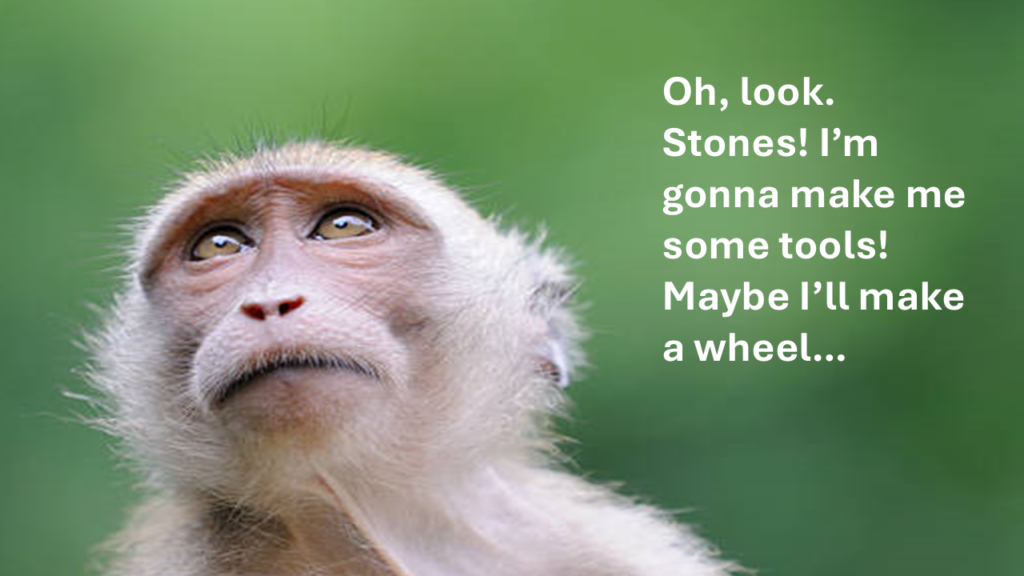
Given the vast amount of time and observable history, there should have been sufficient opportunity for primates to evolve cognitively—if evolution were true. Christians believe that the DNA God endowed to primates purposely limits such advancement, while the DNA God has given to humans purposely enables higher cognition, abstract thought, and innovation.
The often-cited claim that humans share 97% of their DNA with primates is frequently used to argue for common ancestry. However, a significant portion of this genetic similarity can be attributed to shared functional design features—such as hands, feet, skeletal structure, and binocular vision—which are essential for survival and mobility in both species. These similarities do not necessarily point to a common evolutionary origin, but rather reflect a common blueprint or design logic suited to life in a physical environment.
Just as engineers reuse effective designs across different machines, these recurring biological traits may indicate intentional design rather than random divergence. From this perspective, genetic similarity reflects a shared purpose in function, not necessarily shared ancestry.
The 4–5% difference between human and chimpanzee DNA may seem small, but it accounts for profound biological and cognitive differences. These differences are not just in the raw genetic code (the sequence), but also in gene regulation, structure, and expression, which significantly impact development and function. Here is a breakdown of how the 4-5% difference represents a huge amount of biological information:
Total Size of the Human Genome:
- Approximately 3.2 billion base pairs (bp)
4–5% of 3.2 billion base pairs:
- 4% difference = 0.04 × 3.2 billion = 128 million base pairs
- 5% difference = 0.05 × 3.2 billion = 160 million base pairs
So the genetic difference between humans and chimpanzees represents 128–160 million base pairs.
How Much Data is That in Storage Terms?
1 byte = 1 character (roughly equivalent to 1 base pair in text form)
- 128 million base pairs ≈ 128 megabytes (MB)
- 160 million base pairs ≈ 160 megabytes (MB)
What Does This Amount of Data Represent?
That 128–160 MB of differing DNA:
- Encodes the differences in brain size, function, and cognition
- Includes key regulatory genes affecting speech, upright posture, immune response, and more
- Represents the key biological instructions responsible for the cognitive chasm between humans and chimps
To put it in perspective:
- The difference represents the full range of uniquely human traits, including language, abstract reasoning, moral capacity, and spirituality.
There is a profound gap between humans and chimpanzees in terms of cognitive abilities. While chimpanzees are intelligent among animals, humans possess mental faculties that are orders of magnitude more advanced in both complexity and expression.
And God blessed them. And God said to them, “Be fruitful and multiply and fill the earth and subdue it, and have dominion over the fish of the sea and over the birds of the heavens and over every living thing that moves on the earth.”
Genesis 1:28
According to the Bible, abilities such as language, abstract thinking, imagination, creativity, technological innovation, planning, moral reasoning, and conscience are not merely the result of genetics or ancestry, but are the result of divine endowment whereby He creates man in His own image which these traits signify and help distinguish mankind from any other species on earth.
Challenge Question: If chimpanzees are considered our closest genetic relatives, why do humans alone possess advanced cognitive abilities such as language, abstract thinking, creativity, moral reasoning, and technological innovation? Could this profound difference be explained purely by genetics, or does it point to a special endowment beyond biological ancestry?
ThinkCube Truth Veracity Grid
- Have I considered the facts carefully and with an open mind?
- Is my conclusion the result of a careful examination of the facts, or is it a conclusion made in spite of the facts?
- Is my conclusion the one that makes the most sense of the evidence?