With the truth, all given facts harmonize; but with what is false, the truth soon hits a wrong note
Aristototle
Premise 1: Matter Is Not Eternal And Requires A First Cause
The Law Of Cause And Effect is a universal law which specifically states:
- Every single action in the universe produces a reaction no matter what.
- Every single effect within our world and upon the earth has a cause and an original starting point.
If you search “Formation and Evolution of the Solar System” on Wikipedia it states:
“The solar system began 4.5 billion years ago with the gravitational collapse of a giant molecular cloud. Most of the collapsing mass collected in the center, forming the sun, while the rest flattened…of which the planets, moons, asteroids, and other small bodies formed.”
Wikipedia describes the Big Bang but it doesn’t provide the “cause ” of any of the components within their description of the event such as:
- The gravitational collapse
- The giant molecular cloud
- The collapsing mass
??? = Molecular Cloud = Universe = Everything
The Law of First Cause implies by extension that :That if there is matter and energy it had to originate from somewhere, it had to be caused by something.
Any explanation for the origin of the universe must be consistent with the Law of Causation, which istates that every effect must have a sufficient cause. It is the very basis of scientific inquiry—science seeks causes for observed effects.
Science has developed verifiable explanations for many of the universe’s most complex phenomena—such as gravity, photosynthesis, black holes, and radio waves. These explanations are supported by a combination of direct observation, repeatable experimentation, and rigorous mathematical modeling. In many cases, the underlying mechanisms or causes of these phenomena have been validated through empirical data or predictive mathematical frameworks.
By contrast, if evolutionists—or more broadly, proponents of naturalistic origins—are scientifically honest, they must acknowledge a significant gap: there is currently no verified scientific explanation for what caused the Big Bang or for the origin of any of its fundamental components. Even leading scientific resources such as NASA openly admit that a scientifically verifiable cause of the Big Bang, as well as the origin of space, time, matter, and energy, remains unknown.
The Big Bang theory does not provide an explanation for the initial condition of the universe—
NASA
it describes and models what happened afterward.
This admission by NASA exposes a tension. On the one hand, the Big Bang is presented in classrooms and public science communication as established fact. Yet, on the other hand, NASA concedes that the theory cannot explain the very cause or initiatory component of the universe.
This brings us to a logical sequence based on the Kalam Cosmological Argument, which applies the law of causality to the universe itself:
- Everything that begins to exist has a cause.
- The universe began to exist.
- Therefore, the universe must have a cause.
What Is Not Known or Proven
- The origin of the Big Bang itself is not explained by the theory.
- Where the matter, energy, space, and time came from is unknown.
- The cause of the Big Bang is beyond the reach of current science—it’s not observable, repeatable, or testable.
The Big Bang theory, at best, describes what happened after the universe began to exist—but not why it began to exist or what caused it. That cause, by definition, must be something beyond the physical universe—immaterial, timeless, spaceless, and powerful.
This leads many to conclude that the origin of the universe points not away from a Creator, but toward a First Cause that transcends the natural order—a cause that the scientific method alone cannot reach, but that philosophical reasoning and theology can meaningfully explore.
Challenge Question: If the Big Bang theory only explains what happened after the universe began, and not what caused it, is it more reasonable to conclude that the universe had a First Cause beyond space, time, and matter—and if so, what kind of cause could meet those requirements?
Premise 2: Chance Cannot Be The Cause Of The Universe
chance
/CHans/
a: the possibility of a particular outcome in an uncertain situation
(What chance has he of pulling through?)
b: the degree or likelihood of such an outcome (The project had a small chance of success.)
c: how something happens unpredictably without discernible human intention or observable cause
Evolutionist fully realize that the law of cause and effect has to be adhered to in order for the theory to be seen as legitimate science but in the absence of being able to find a provable cause that can be observed, tested and verified they have developed theories within the theory. In the absence of a scientifically verifiable “Cause Agent” for the Big Bang modern science has defaulted to “chance” as the primary cause of the Big Bang and the commencement of evolution.
Let’s break down each of the three dictionary meanings of “chance” and evaluate what it says about what chance is—and what it is not capable of doing.
a. “The possibility of a particular outcome in an uncertain situation”
Example: “What chance has he of pulling through?”
What it means:
This definition uses “chance” as a measure of uncertainty. It doesn’t refer to a cause, but to a description of our lack of certainty in knowing what will happen. It reflects the range of possible outcomes in a situation—not what brings about those outcomes.
Implication:
- Chance here is not a force; it’s a statistical expression.
- It cannot cause anything—it only describes the likelihood that something might occur.
- It assumes there are real causes or conditions involved, even if we don’t fully know or understand them.
b. “The degree or likelihood of such an outcome”
Example: “The project had a small chance of success.”
What it means:
This refers specifically to probability—a numerical or qualitative measure of how likely a certain result is. Again, this is not a force or agent, but a mathematical description of possible outcomes based on known variables.
Implication:
- This is the realm of probability theory, not causality.
- Chance here is a tool of measurement, not a mechanism of change.
- It relies on existing laws, patterns, or known variables, and does not create outcomes by itself.
c. “How something happens unpredictably without discernible human intention or observable cause”
Example: “It happened by chance.”
What it means:
This is the most philosophically loaded definition. It treats chance as a stand-in for unknown or unpredictable causation, and is often used in colloquial or metaphysical discussions.
Implication:
- This suggests absence of knowledge about a cause, not the absence of a cause itself.
- If taken literally (i.e., “without any cause at all”), it implies something can come into being without any explanation or mechanism, which violates the Law of Causality.
- In scientific or metaphysical terms, “chance” in this sense is a label for ignorance, not an actual explanation.
Bottom Line:
None of these definitions of chance describe it as an actual force, agent, or cause. It has no will, no power, and no creative capacity. It is a concept, not a cause. When evolutionists, cosmologists, or philosophers refer to “chance” as the root cause of the universe or life, they are either:
- Referring to statistical probability based on natural laws (which assumes the existence of those laws in the first place), or
- Using “chance” as a placeholder for ignorance, which explains nothing and cannot substitute for a real, causative explanation.
Evolutionary biology since Darwin has seen a dramatic entrenchment and elaboration of the role of chance in evolution. It is nearly impossible to discuss contemporary evolutionary theory in any depth at all without making reference to at least some concept of “chance” or “randomness.”
Grant Ramsey and Charles H. Pence, University Press Scholarship Online
If chance is actually defined as something without an observable cause how can “chance” be a cause? Chance means to happen by luck or fortune. It doesn’t have any scientific standing to be declared the cause of anything. Evolutionist count on people gliding over the fact that they are ascribing power and force to a word that should only be used to describe probability—in doing so they have felt free use it as a vague, unprovable, fill in the blank cause agent for the formation of the universe and evolution on earth.
Ways Evolutionist Inject the Word Chance with Creative Power
Chance aloneis the source of every innovation. Chance alone is the source of all creation in the biosphere
Jacques Monod; Nobel Prize winning Biologist
Nature, according to Darwin, was the product of blind chance and a blind struggle, and man, a lonely intelligent mutation, scrambling with the brutes for his sustenance
J.W. Burrow; Historian Cambridge University, Introduction to The Origin of Species
“One has only to wait: time itself performs the miracles. Given so much time the impossible becomes possible, the possible probable, and the probable actually certain.”
Gerald Wald; Nobel Prize winning Physiologist
Two Reasons Why Evolutionists Appeal To “Chance” As The Cause
- Scientific principles require that every effect must have a cause, yet the cause of the Big Bang remains unproven and beyond the reach of empirical science. Since no verifiable cause has been identified, many have resorted to invoking “chance”—an unprovable and impersonal placeholder—to fill the explanatory gap. In doing so, they treat chance not merely as a measure of probability, but as if it has causal power, despite the fact that chance, by definition, is not a force or agent capable of producing anything.
- Chance also serves as a convenient stopgap for another difficult question: If the entire universe came from the same event—the Big Bang—and all planets were formed from the same fundamental matter, then why has life only emerged on Earth? Is the answer simply that Earth “got lucky”? That “chance” favored one planet and not the others? By attributing life’s emergence to chance, the explanation avoids deeper questions about the precise conditions, fine-tuning, and informational complexity required for life to exist—none of which chance, as a non-causal concept, can actually explain.
Three Reasons “Chance” Cannot Be the Cause of the Universe
1. Chance Is Not a Force, Substance, or Entity
For something to be a cause, it must possess actual power—it must be something that can bring about an effect. But chance is not a force, nor is it matter, energy, time, or space. It has no mass, no properties, and no causal power. It is simply a term we use to describe mathematical probabilities or our lack of knowledge about causes. To speak of “chance” as the cause of the universe is to attribute creative power to a concept that has no physical or metaphysical substance.
2. Chance Cannot Be Measured, Tested, or Verified as a Causal Agent
Scientific explanations rely on observable, repeatable, and testable mechanisms. But chance, especially when used to explain the origin of everything from nothing, cannot be measured or tested as a cause. It offers no mechanism, no predictive power, and no explanatory detail. To say that “chance + nothing = everything” is not a scientific equation—it’s a philosophical assertion that bypasses causality and stretches credibility. It replaces cause-and-effect with randomness-and-mystery, which is incompatible with the scientific method.
3. The Probability of Complex Life Arising by Chance Is Astronomically Low
The odds of even a single functional protein forming by random chance are staggeringly small—let alone an entire self-replicating cell. For example, the probability of a simple functional protein forming by chance has been estimated at 1 in 10⁷⁷ (or worse), and the odds of assembling the genetic code for even the simplest life form exceed 1 in 10⁴⁰,⁰⁰⁰. These numbers are so far beyond what is considered statistically possible that chance is not a rational explanation. The complexity, information content, and interdependence of biological systems point to design—not randomness.
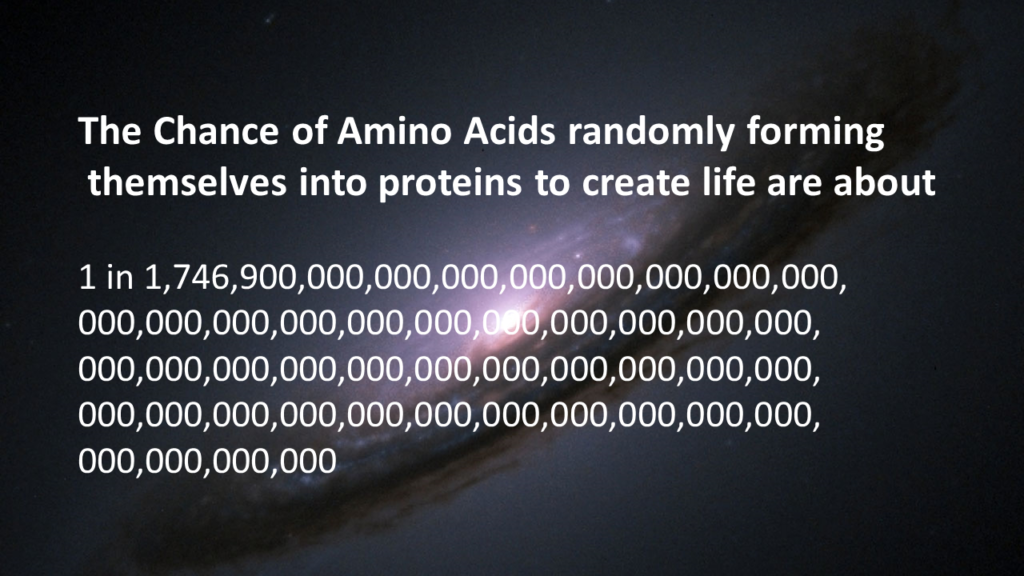
The chance of obtaining a single functioning protein by chance is comparable to a star system full of blind men solving Rubik’s Cubes simultaneously
Sir Fred Hoyle; Formulated the theory of Stellar Nucleosysynthesis
Big Bang and Evolution are the Only Scientific Theories that Gives Chance Such A “Chance”
Big Bang cosmology and evolutionary theory stand out as the only scientific frameworks in which “chance” is widely accepted—not just as a factor, but often as a primary causal agent. In virtually every other branch of science, explanations must be grounded in observable, measurable, and testable causes. Randomness or probability may be used to describe uncertainty within a system, but they are never treated as forces that can produce effects on their own.
So why has this exception been made? Why is “chance”—which has no power, substance, or agency—granted a privileged role in explaining the origin of the universe and the development of life? If chance cannot be tested, observed, or quantified as a causal force, then appealing to it as a scientific explanation stretches beyond the bounds of empirical science and into the realm of speculation.
With the failure of these many efforts, science has been left in the somewhat embarrassing position of having to postulate theories of living organisms which it could not demonstrate. After having chided the theologian for his reliance on myth and miracle, science found itself in the inevitable position of having to create mythology of it’s own that somehow something they cannot prove can take place today had, in truth, taken place in the primeval past.
Loren Eisley; Anthropologist, The Immense Journey p. 199There can be no doubt that after a century of intensive efforts biologists have failed to validate it in any significant sense. The fact remains that nature has not been reduced to the continuum that the Darwinian model demands, nor has the credibility of chance as the creative agency of life been secured.
Michael Denton; Theory In Crisis, PhD Biochemistry
Chance is not a cause; it is a description of uncertainty. It has no creative power, cannot be tested as a force, and offers no plausible explanation for the origin or fine-tuning of the universe. To invoke chance as the cause of all things is to abandon scientific and philosophical reasoning in favor of speculation without substance.
Challenge Question: Given the true nature and definition of “chance,” should scientists present it as the definitive cause of the Big Bang and the origin of life on Earth?
Premise 3: Diversity In Nature Points To A Designer
The theory of evolution asserts that chance, matter, and energy alone are responsible for the origin and development of all things, including highly complex biological systems. If this theory is true, then all of the information encoded in DNA, the laws of physics, and the mathematical precision observed throughout the universe must have arisen spontaneously through the unguided, blind interactions of matter and energy—with no intelligent direction or purpose.
When Charles Darwin formulated his theory, he had no knowledge of DNA or its essential role in life. He was unaware that DNA serves as the instructional blueprint for the development, growth, reproduction, and functionality of every living organism. In fact, not only does every living thing possess DNA, but every single cell within those organisms carries its own complete set.
This explains why we observe not only vast diversity between species, but also tremendous genetic variation within species. The complexity and specificity of this genetic information raises critical questions about whether chance alone is a sufficient explanation—or whether it points instead to purposeful design.
8.7 Million Species Have Their Own Biologically Exclusive Blueprints
Biodiversity refers to the vast variety of life forms found on Earth, encompassing every living organism—including plants, animals, bacteria, fungi, and humans. According to estimates by scientists, there are approximately 8.7 million species of plants and animals on the planet. However, only about 1.2 million species have been formally identified and described to date, the majority of which are insects. This means that millions of organisms remain completely unknown and unexplored, as noted by National Geographic.
Each of these species possesses unique DNA coding, which determines their physical characteristics, reproductive systems, behavioral instincts, and countless other traits. This incredible variety is so extensive that living organisms must be classified and organized into distinct groups—a process known as taxonomy.
There are 8 super systems of taxonomy that include countless biologically and genetically distinct subsystems to numerous to list. Below is a basic taxonomical chart that is by no means comprehensive:
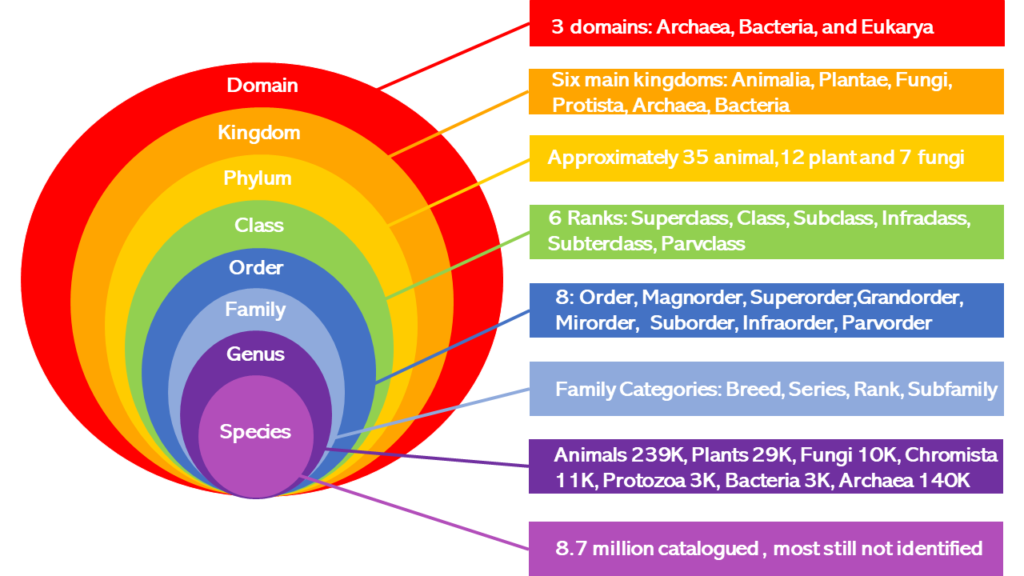
The theory of evolution maintains that all of Earth’s vast and systematic biodiversity arose through random processes—unguided mutations, natural selection, and chance events. It further claims that all species are ultimately evolutionary descendants of a common ancestor.
Yet the sheer number of distinct biological classifications—across kingdoms, phyla, classes, orders, genera, and species—presents a major challenge to this view. Many of these groups display irreducible genetic differences and highly specialized traits that cannot be plausibly traced through gradual ancestral lineages. In fact, numerous species appear in the fossil record fully formed and genetically isolated, with no clear transitional links connecting them to supposed evolutionary predecessors. This raises serious questions about whether biodiversity can be adequately explained by random processes alone, or whether a more intentional cause is required to account for such complex and organized variation. The genetic diversity in nature is so enormous that global databases categorize them.
Global Taxonomic Databases
| Names Of International Taxonomic Information Organizations and Systems |
| International Committee on Taxonomy of Viruses |
| International Institute for Species Exploration |
| International Botanical Congress |
| All Species Foundation |
| World Register of Marine Species |
| Global Biodiversity Information Facility |
| Barcode of Life Data System |
| Integrated Taxonomic Information System |
| International Code of Nomenclature for algae, fungi, and plants |
| Consortium of European Taxonomic Facilities |
| International Association for Plant Taxonomy |
| International Commission on Zoological Nomenclature |
| Intergovernmental Oceanographic Commission |
| World Register of Marine Species |
The earth’s biodiversity is so vast that these listed Taxonomical Organizations and science as a whole have not been able to keep up with classifying species. Biologist believe that 86 percent of the worlds species are still waiting to be found and classified.
It is a remarkable testament to humanity’s narcissism that we know the number of books in the US Library of Congress is 22,194,656, but cannot tell you – to within an order of magnitude – how many distinct species of plants and animals we share our world with
Lord Robert May: Royal Society President PLOS Biology
Biologist and Taxonomist believe there are still over 7 million more species that need to be taxonomically classified genetically. That means the remaining 7 million will be:
- Genetically distinct from each other
- Have different physical and morphological attributes from each other
- All be reproductively isolated
- Have different communal behaviors and instincts
The extraordinary complexity, order, and diversity found in nature point not to random chance, but to intentional design by an intelligent Creator. The biblical worldview affirms that life did not arise by accident, but by the deliberate act of a sovereign God who created all living things “according to their kinds” (Genesis 1). The fact that species appear with distinct genetic boundaries, without clear evolutionary transitions, supports the idea that life was designed with purpose, not shaped by randomness.
The systematic diversity and irreducible complexity we observe in creation reflect the wisdom and creativity of God, not the blind forces of chance. In this light, biodiversity is not a product of evolutionary chaos, but a testimony to the glory, power, and intentionality of the Creator.
Challenge Question: Given the vast, highly ordered, and still largely unclassified biodiversity on Earth—along with the fossil record’s lack of clear transitional forms—does the evidence better support the idea of life arising through random evolutionary processes or through intentional creation by an intelligent Designer?
Premise 4: Complexity And Biological Machinery Point To Intelligent Design
spec·i·fied com·plex·i·ty
/ˈspesəˌfīed/ /kəmˈpleksədē/
the presence of a highly improbable pattern that also serves a meaningful or functional purpose—indicating design rather than chance.
Specified complexity describes patterns or structures that are both highly ordered and highly improbable—making them unlikely to have arisen by chance. A structure exhibits complexity when it is not simple or repetitive and cannot be easily produced by random processes. It exhibits specification when it matches an independently recognizable pattern or serves a clear function.
For example, a DNA molecule contains an intricate sequence of nucleotides that not only defies randomness but also carries precise instructions for building proteins essential to life. This makes DNA both complex (due to the enormous number of possible sequences) and specified (because it performs a meaningful biological role).
Specified complexity is not limited to the molecular or cellular scale—it is also clearly demonstrated in biological systems and organisms at higher levels of organization. For example, consider the human eye: it is composed of numerous specialized parts—lens, retina, cornea, optic nerve, and muscles—that must all work together for vision to occur. Each component is complex on its own, but the system as a whole is specified because it fulfills the precise function of sight. Similarly, the respiratory system, circulatory system, and nervous system in animals involve layers of interdependent organs, pathways, and feedback mechanisms that are not only intricate but serve clearly defined biological purposes. These systems meet the criteria of specified complexity because they are highly improbable to have formed by random chance and yet are functionally ordered to perform tasks vital to survival.
Biological specificity is the set of characteristics of living organisms or constituents of living organisms of being special or doing something special. Each animal or plant species is special. It differs in some way from all other species… biological specificity is the major problem about understanding life.“
Linus Pauling, Nobel Laureate in Chemistry
Specified Complexity Illustrated With A Airplane Analogy
Imagine coming across a fully functioning airplane in the middle of a desert.
- It has thousands of interdependent parts—wings, engines, control systems, landing gear—all precisely arranged to work together.
- It follows a clear blueprint or design that enables flight, communication, navigation, and transport.
- The parts are not random or chaotic; they are highly ordered, and every component serves a specific function.
This airplane exhibits:
- Complexity – It’s not simple or repetitive; the arrangement of its parts is highly intricate.
- Specification – It performs a specific, meaningful function: flight.
You instantly recognize that it did not come into existence by random forces of wind, sand, and time. The presence of both complexity and purpose (specification) points undeniably to an intelligent designer.
Just as no one believes a 747 could assemble itself from a junkyard explosion, it is equally unreasonable to believe that millions of genetically distinct, highly complex living systems—each far more intricate and functionally advanced than any human invention—came together by random, purposeless processes.
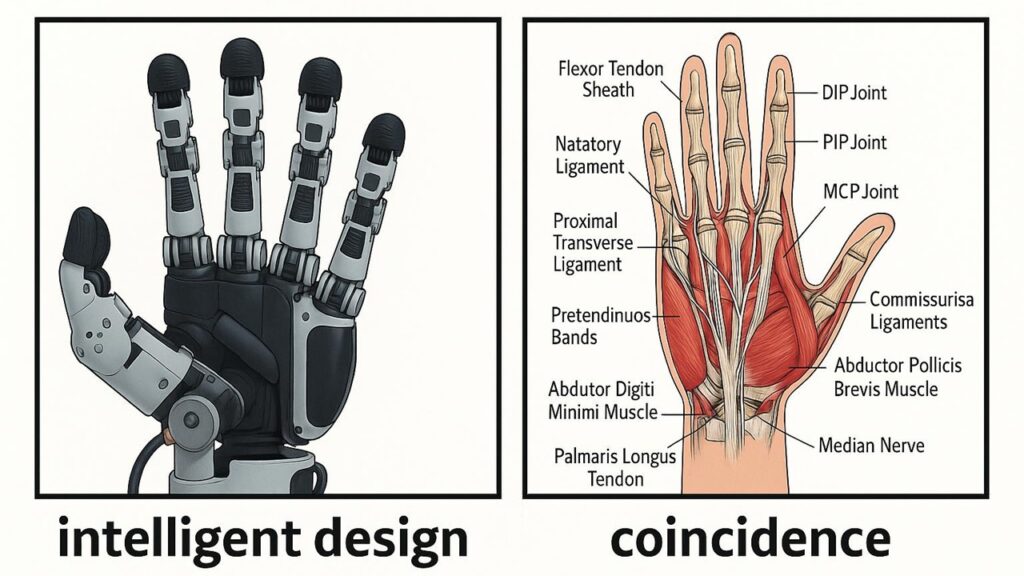
The fundamental claim of intelligent design is straightforward and easily intelligible: namely, there are natural systems that cannot be adequately explained in terms of undirected natural forces and that exhibit features which in any other circumstance we would attribute to intelligence
William Dembski—Mathmatician and Philosopher; (The Design Revolution)
Specified Complexity is Illustrated in Each of the 8.7 Million Distinct Species on Earth
Every species displays a unique combination of physical traits, behavioral instincts, reproductive systems, sensory abilities, and environmental adaptations that are both highly complex and precisely suited to its survival and ecological role. These traits are encoded in each species’ DNA, which serves as a set of specialized instructions for building and maintaining that organism. The complexity of these biological features, combined with their targeted functionality, exemplifies specified complexity—traits that are too coordinated to be random, and too purposeful to arise without intelligent input.
Biology is the study of complicated things that give the appearance of having been designed for a purpose.
Richard Dawkins; The Blind Watchmaker
Examples of Specified Complexity in Biological Species
| Species & Specialized System | Complexity | Specification (Functionality) |
|---|---|---|
| Bat — Sonar Navigation (Echolocation) | Requires coordination of sound emission, echo detection, and neural interpretation | Enables precise navigation and prey detection in total darkness |
| Bird — Aerodynamic Wing Structure | Involves feather arrangement, hollow bones, and muscular control | Allows efficient flight, lift, and maneuverability |
| Deep-Sea Fish — Bioluminescence | Utilizes specialized cells and chemical reactions under extreme pressure | Used for communication, camouflage, and attracting prey in dark environments |
| Spider — Web-Spinning Mechanism | Produces multiple silk types and exhibits encoded behavioral patterns | Constructs webs for prey capture, shelter, and reproduction |
| Woodpecker — Shock-Absorbing Skull Design | Features a reinforced beak and specialized cranial structure | Allows repeated pecking without brain damage |
| Electric Eel — Electrical Discharge System | Composed of modified muscle cells generating electric fields | Used for hunting, navigation, and self-defense |
| Chameleon — Color-Changing Skin | Involves nanocrystal layers and hormone-driven responses | Provides camouflage, communication, and temperature regulation |
| Bombardier Beetle — Chemical Defense Spray | Combines and stores reactive chemicals with controlled ignition | Delivers explosive, high-temperature spray for predator deterrence |
| Gecko — Adhesive Toe Pads | Features microscopic hair-like structures with van der Waals force mechanics | Enables climbing smooth vertical surfaces and ceilings |
| Giraffe — High-Pressure Circulatory System | Requires strong heart, valves, and blood pressure regulation | Maintains brain oxygenation despite long neck and gravity challenges |
| Platypus — Electroreception in Bill | Contains specialized receptors that detect electric signals in water | Helps locate prey underwater while eyes, ears, and nose are closed |
| Human — Language and Vocalization System | Involves complex brain processing, vocal tract, and coordination with hearing | Enables abstract communication, expression, learning, and cultural development |
Why Biological Specificity Points to Intelligent Design
- Uniquely Encoded Information
Each species possesses a distinct DNA code—like a software program—tailored to its form and function. From an ID perspective, such specified information strongly suggests an intelligent source, not random mutation. - Irreducible Complexity in Functional Systems
Many biological systems (e.g., the blood clotting cascade, the eye, flagella) only function when all parts are present and operational. These are best explained by purposeful design, not gradual evolution. - Non-Overlapping Genetic and Functional Traits
The sharp distinctions between species at the genetic and functional level defy the idea of smooth, gradual transitions and instead point to unique acts of design. - Environmentally Optimized Design
Species are finely tuned to thrive in specific ecosystems, often with traits perfectly suited to survival—such as arctic camouflage, desert water retention, or sonar navigation in bats. This level of adaptation reflects foresight and planning. - Limits of Comparative Biology
The uniqueness of species often limits what can be learned from one organism about another—supporting the idea that life was designed according to distinct “blueprints” rather than being modified copies of a universal template. - Appearance of Novel Traits Without Evolutionary Precursors
Traits like bioluminescence, flight, and regenerative capabilities appear suddenly in the fossil record or biology without traceable evolutionary steps—an anomaly better explained by intelligent input than by random processes. - Programmed Development
Embryonic development follows a highly orchestrated, information-rich sequence that unfolds with precision. This step-by-step execution of complex instructions echoes engineered systems, not chance-based assembly. - Overwhelming Biodiversity
With over 8 million distinct species—each showcasing unique combinations of traits, instincts, and reproductive strategies—the scale and order of biodiversity point to a creative intelligence behind life, not a blind, unguided process.
The fact that organisms are distinctly classified into kingdoms, phyla, classes, orders, families, genera, and species is compelling evidence that each exhibits unique biological specifications—often marked by non-overlapping genetic codes and specialized functional traits. This precise and purposeful organization is not random; it reflects a level of intentionality that defies purely naturalistic explanations.
Across all 8.7 million estimated species, the consistent presence of specialized, information-rich, and functionally integrated designs does not point to blind, undirected evolution—but unmistakably to the handiwork of a creative intelligence behind the rich tapestry of life on Earth.
Challenge Question: Does the highly ordered classification of life—marked by distinct genetic codes and specialized functions across millions of species—suggest random evolutionary processes, or does it more reasonably point to the work of an intelligent designer?
ThinkCube Truth Veracity Grid
- Have I considered the facts carefully and with an open mind?
- Is my conclusion the result of a careful examination of the facts, or is it a conclusion made in spite of the facts?
- Is my conclusion the one that makes the most sense of the evidence?