Premise 1: The JWST Is Challenging The Big Bang Theory
The James Webb Space Telescope (JWST) is the most powerful and advanced observatory ever built, designed to look deeper into the universe than any instrument before it. With a massive 21-foot gold-coated mirror and cutting-edge infrared sensors, Webb can capture faint light from the earliest galaxies formed just after proposed Big Bang—over 13 billion years ago. It operates a million miles from Earth in deep space, shielded by a tennis-court–sized sunshield to keep it cold and stable. Its sensitivity is so great that it could detect the heat of a bumblebee from the distance of the Moon. By peering through cosmic dust and unveiling hidden details of planets, stars, and galaxies, JWST is revolutionizing our understanding of the universe.

The James Webb Telescope has studied and documented all of the 8 planets in our solar system dozens of individual stars, moons, and 5,000 exoplanets (planets that orbit a star instead of a sun) using the most advanced tools in astronomy—primarily through infrared imaging and spectroscopy.
1. Infrared Imaging
- JWST sees in infrared light, which allows it to:
- See through dust clouds (e.g., in star-forming regions)
- Detect heat signatures from cool objects like distant planets, moons, and exoplanets
- View early galaxies and stars that are too faint or red-shifted for other telescopes
2. Spectroscopy (Its Most Powerful Tool)
- JWST breaks light into its component wavelengths, creating a spectrum.
- By analyzing these spectra, it can:
- Identify chemical elements and molecules (like water, methane, carbon dioxide)
- Study atmospheres of exoplanets by watching how starlight passes through them during transits
- Detect temperatures, compositions, and pressure levels on planets and moons
How JWST Studies Each Object Type
| Object | How JWST Studies It |
|---|---|
| Planets (Solar System) | High-res infrared images of surfaces and atmospheres (e.g., Mars, Jupiter, Saturn) |
| Moons | Surface chemistry, heat emissions, and cloud layers (e.g., Titan, Europa) |
| Stars | Tracks their life cycle, detects star-forming regions, analyzes stellar composition |
| Exoplanets | Observes transits (planet passing in front of star) and analyzes atmospheric spectra |
The seven lunar rovers, seven Mars rovers, three asteroid rovers, along with the Hubble and James Webb space telescopes, numerous satellites, and decades of manned space exploration have all revealed one consistent truth: the major differences between celestial bodies—not their similarities.
Far from showing that all planets formed through the same simple natural process, these powerful telescopes have revealed an astonishing variety of worlds. Planets, moons, and other celestial bodies differ dramatically in their atmospheres, compositions, temperatures, landscapes, and geological features. Rather than looking like mass-produced objects that formed by chance, each appears uniquely crafted, leading many to see evidence of purpose and design rather than randomness.
Instead of Confirming The Big Bang Theory The JWST Has Raised Significant Questions
When the James Webb Space Telescope (JWST) was launched, many scientists thought it would simply confirm what we already believed about the Big Bang and how galaxies formed. But instead, it’s been like opening a history book and finding whole chapters out of order.
Instead of confirming the Big Bang theory, the James Webb Space Telescope has raised profound new questions. It’s showing us a universe that seems to have “hit the ground running,” far more complex, developed, and diverse than naturalistic models predicted.
- Galaxies that are “too big, too soon— Webb has spotted massive galaxies that appear only a few hundred million years after the supposed Big Bang. That’s like walking into a kindergarten class and finding full-grown adults with college degrees. According to the standard model, there just shouldn’t have been enough time for these galaxies to grow that fast.
- Black holes that grew impossibly quickly— Webb has also found enormous black holes in the early universe—so soon after the beginning that, under current theories, they couldn’t have had enough “time to eat” and grow so large. It’s like seeing a newborn baby that already weighs 300 pounds.
- The chemical “head start”— Heavy elements like carbon, oxygen, and even complex dust particles are showing up far earlier than expected. According to the story we’ve been told, these elements had to be cooked inside multiple generations of stars, over long ages. But Webb sees them already in place—like walking into a bakery at dawn and finding loaves of bread on the shelf even though the ovens haven’t been turned on yet.
- Galaxies that look too bright and too mature— Some galaxies Webb is seeing are brighter, larger, and more developed than scientists thought possible at such early times. Imagine visiting a town only a few months after its founding, and instead of a handful of tents, you find skyscrapers, highways, and shopping malls.
- The timing doesn’t add up—According to the Big Bang timeline, certain steps—like the first stars forming, dying, and spreading heavy elements—were supposed to take hundreds of millions of years. But Webb shows evidence of these steps already completed in what seems like the blink of an eye. It’s like being told it takes an oak tree 50 years to grow, then seeing one fully grown in your backyard a week later.
By faith we understand that the universe was formed at God’s command, so that what is seen was not made out of what was visible.
Hebrews 11:3
The Bible says God created the heavens and the earth fully formed and ready for life, not slowly assembled over billions of years. The James Webb Telescope’s discoveries of galaxies, stars, and elements appearing “too early” fit perfectly with the idea of intentional design. Rather than pointing to random chance and endless time, the heavens declare the handiwork of a Creator who made the universe with purpose, order, and beauty from the very beginning.
Challenge Question: If the James Webb Space Telescope is finding galaxies that appear “too big, too soon,” what does that suggest about the idea that everything slowly built up over billions of years?
Premise 2: All Planets From The Same Bang—Why So Different?
If the Big Bang theory claims that all matter and energy were once compressed into a tiny singular point that expanded rapidly, then logically everything in the universe—planets, stars, galaxies, and exoplanets—should be made from the same original material that expanded outward, right?
Evolutionary theory proposes that our solar system formed from a cloud of swirling gas, dust, and particles. This concept, known as the nebular hypothesis, suggests that gravity gradually pulled these materials together, forming a spinning disk. Over millions of years, the center of this disk became dense and hot enough to ignite nuclear fusion, giving birth to the sun, while the remaining material coalesced into planets, moons, and other celestial bodies.
An extremely dense point exploded with unimaginable force, creating matter and propelling it outward to make the billions of galaxies of our vast universe. Astrophysicists dubbed this titanic explosion the Big Bang.
Exploratorium.edu
According to the Big Bang theory, as described by sources like Exploratorium.edu, all celestial bodies in the universe—stars, planets, moons, and galaxies—originated from the same cosmic explosion and the same pool of matter, at the same time, and under the same conditions. If that were true, we should expect a certain level of uniformity in their chemical and mineral composition. Yet what we observe is the opposite: planets, stars, and moons often have vastly different elements, densities, atmospheres, and structures. Some are gas giants, others are rocky; some contain water or carbon, while others are made almost entirely of iron or frozen gases.
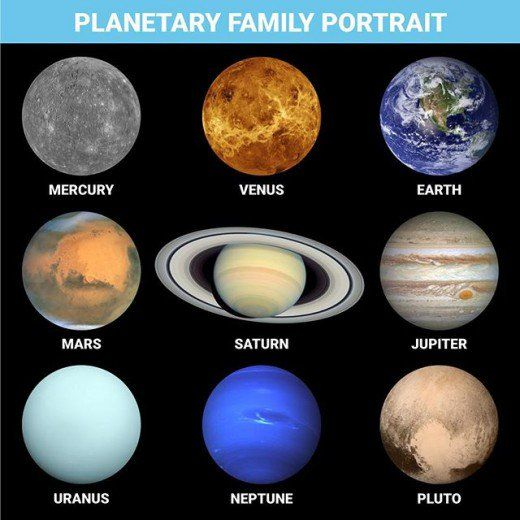
This raises a critical question: If all these bodies supposedly came from the material source, why are they made of such different materials? The diversity in composition challenges the idea of a purely naturalistic, uniform origin and suggests that something more purposeful or intelligently directed may be behind the design of the universe.
Planetary Composition Comparison
| Planet | Dominant Elements / Materials | What Makes It Different? |
|---|---|---|
| Mercury | Iron-rich core, silicate rock crust | More like a giant iron ball than any other planet. Its core makes up about 70% of its mass. |
| Venus | Carbon dioxide atmosphere, silicate surface, sulfuric acid clouds | Similar in size to Earth, yet transformed into a scorching, toxic world hot enough to melt lead. |
| Earth | Iron core, silicate mantle, nitrogen-oxygen atmosphere, abundant liquid water | The only known planet with stable liquid water and the precise combination of conditions needed for complex life. |
| Mars | Iron oxide surface, thin carbon dioxide atmosphere, silicate rock | A cold desert world covered in rust-colored dust with only a fraction of Earth’s atmosphere. |
| Jupiter | About 90% hydrogen, 10% helium, small rocky/icy core | So different from Earth that it has no solid surface at all—essentially a massive ball of gas. |
| Saturn | Mostly hydrogen and helium, ammonia and water ice | Famous for its spectacular ring system and so low in density it would theoretically float in water. |
| Uranus | Hydrogen, helium, methane, icy mantle and core | Rotates on its side unlike the other planets and owes its blue-green color to methane. |
| Neptune | Hydrogen, helium, methane, ammonia, icy-rocky interior | The most distant major planet, with the strongest winds ever measured in the solar system. |
This chart strongly supports the conclusion that the planets in our solar system have highly varied chemical and material compositions, making it scientifically difficult to maintain the assumption that they all:
- Originated at the exact same time,
- From the same matter,
- Under identical physical conditions,
- As a result of a single explosion (i.e., the Big Bang or solar nebula model).
Here’s why:
- Dramatic Variation in Elemental Makeup
- Atmospheric Differences
- Venus has a thick carbon dioxide atmosphere (~96.5%) with sulfuric acid clouds.
- Earth has a balanced atmosphere of nitrogen and oxygen that sustains life.
- Mars, though similar in some surface materials, has a thin, cold atmosphere also dominated by CO₂.
- Structural Composition
- Some planets have solid rocky surfaces; others have no surface at all.
- Core densities, magnetic fields, and geologic activity differ radically.
Scientific Implication:
If all the planets came from the same primordial explosion or solar disk, we should expect far more chemical uniformity, especially given their shared proximity and supposed origin from a single rotating cloud of gas and dust. The stark differences in composition, atmosphere, and structure point not to randomness or uniform processes, but to individual fine-tuning or design-like features.
The moon landings have permitted man to actually study lunar composition and structure. Enough has been found now to permit the firm conclusion that the earth and its moon are of vastly different structure and therefore could not have the same celestial evolutionary “ancestor”. To the surprise of scientists, the chemical makeup of the moon rocks is distinctly different from that of rocks on earth. This difference implies that the moon formed under different conditions…and means that any theory on the origin of the planets will have to create the earth and the moon in different ways.
Jerry E. Bishop—”New Theories of Creation” Science Digest
Many scientists past and present have voiced concerns or expressed surprise at observations that don’t fit its straightforward expectations. In particular, the striking diversity in the chemical makeup of planets, stars, and gas clouds challenges the notion of a uniform, predictable cosmic evolution.
Problems with Big Bang Expectations
| Name | Credentials / Context | Quote |
|---|---|---|
| Eric J. Lerner | Plasma physicist, author of The Big Bang Never Happened | “Not only does the big bang fail to predict the properties of the universe, it cannot even explain the universe that we see.” |
| Halton Arp | Astronomer, researcher of peculiar galaxies, critic of Big Bang cosmology | “There is a fashionable set of beliefs regarding the workings of the universe (the Big Bang) which I believe is wildly incorrect.” |
| Geoffrey Burbidge | Astrophysicist, co-author of the B²FH nucleosynthesis paper | “Big bang cosmology is probably as widely believed as has been any theory of the universe … It rests, however, on many untested, and in some cases, untestable assumptions.” |
| Jacob Bean | Astronomer, University of Chicago, JWST exoplanet atmospheres team | “The atmospheric compositions of giant extrasolar planets do not follow the same trend that is so clear in the solar system planets.” |
| Jonathan Lunine | Planetary scientist, Cornell University, JWST exoplanet studies | “It appears that every giant planet is different, and we’re starting to see those differences thanks to JWST.” |
In 2011, astrophysicist Michel Fumagalli and his team made a fascinating discovery using the Keck Telescope in Hawaii. They detected two extremely distant gas clouds that contained only hydrogen and its isotope, deuterium—without a trace of the heavier elements like carbon, oxygen, nitrogen, or silicon that are common on Earth and in the sun. These clouds are thought to be leftovers from the very early universe, just after the Big Bang, before stars had time to create heavier elements.
What’s striking about this discovery is how it highlights the uniqueness of Earth’s chemistry. If everything truly began from one uniform explosion of matter and energy, then you would expect the elements to be spread out more evenly across the universe—and at least for the planets in our own solar system to look more like “siblings,” sharing the same basic ingredients. But that’s not what we see. Instead, vast stretches of space remain filled with only the simplest gases, while Earth alone is packed with the rich elements required for life. Even our neighboring planets, though formed in the same system, differ dramatically in their chemical makeup. Rather than showing a natural progression from simplicity to life, discoveries like Fumagalli’s emphasize how rare, fine-tuned, and special Earth truly is.
We’ve searched carefully for oxygen, carbon, nitrogen, and silicon—the things that are found on Earth and the sun in abundance, We don’t find a trace of anything other than hydrogen and deuterium.
Michel Fumagalli—Astronomer; University of California
In the end, the picture that emerges is not of a universe where life springs inevitably from matter, but of a cosmos marked by striking unevenness—where most of existence remains barren and simple, and yet one small world overflows with the complexity needed for life. The discovery of pristine, element-poor gas clouds serves as a stark reminder that the raw materials for life are neither evenly distributed nor guaranteed. Instead, Earth’s unique chemistry appears as a rare oasis in a desert of hydrogen and helium.
Far from being an ordinary planet among billions, our world stands out as extraordinary, finely balanced, and singularly suited for life—a reality that points us beyond blind chance and invites us to consider a deeper purpose behind the universe’s design.
Challenge Questions:
- If all the planets and stars that exist in the known universe exploded into existence at the same time as the earth, why are the chemical, physical and environmental makeups radically different?
- If all the planets in the universe share the same evolutionary birthday and complex life has had the same amount of time to develop there— why hasn’t evolution been detected or reproduced on other planets?
Premise 3: What the James Webb Telescope Has Not Found
The James Webb Space Telescope (JWST) is one of the most remarkable scientific instruments ever built, representing decades of innovation and international collaboration. Orbiting nearly a million miles from Earth, Webb’s massive gold-coated mirror and advanced infrared sensors allow it to peer deeper into space—and further back in time—than any telescope before it. With a clarity a hundred times greater than Hubble in the infrared, it has already revealed newborn stars shrouded in dust, the faint light of some of the earliest galaxies, and the complex chemistry of distant exoplanets.
What makes the James Webb Telescope especially powerful is its ability to look back in time almost to the very beginning of the universe. Because light from distant galaxies takes billions of years to reach us, Webb is essentially a cosmic time machine, capturing snapshots of the universe as it was just a few hundred million years after the Big Bang. With this reach, Webb doesn’t just show us more stars—it shows us the earliest structures of the cosmos, allowing scientists to study how galaxies, planets, and even the ingredients for life first emerged.
By early 2025, the James Webb Space Telescope had studied just over 111 exoplanets outside our solar system, using both direct imaging and a method called transit spectroscopy. With these tools, Webb can observe distant worlds, determine their sizes and temperatures, calculate the composition of their atmospheres, and ultimately document which planets might hold the conditions for life — or even resemble new Earths waiting to be discovered. Yet despite its unprecedented power as the most advanced scientific observatory ever built, Webb has not uncovered many of the key ingredients that make Earth uniquely habitable.
Life’s Essentials vs. JWST Discoveries
| What Has Not Been Found | JWST Findings |
|---|---|
| Liquid Water on the Surface | Detected water vapor in atmospheres of some exoplanets, but no confirmed liquid water oceans on any rocky planet. |
| Breathable Atmosphere (O₂/N₂ mix) | Oxygen has not been detected in exoplanet atmospheres; most studied worlds show thick hydrogen/helium, CO₂, or methane envelopes. |
| Stable Climate & Moderate Temperatures | Many rocky exoplanets studied are either too hot (close to stars) or too cold (far away); no Earth-like balance observed yet. |
| Protective Magnetic Field | No exoplanet magnetic fields have been confirmed — crucial for shielding life from harmful radiation. |
| Plate Tectonics / Recycling of Elements | No evidence found; Earth remains the only known planet with tectonic activity supporting long-term habitability. |
| Complex Chemistry (Carbon-based molecules) | Some simple molecules (like CO₂, methane, water vapor) observed, but no complex organics tied to life processes. |
Modern cosmology has revealed that even the so-called “sister planets” of our own solar system are anything but alike, each possessing a distinctly different chemical and elemental makeup. What’s even more striking is that none of the essential, life-sustaining features that make Earth unique—liquid water, a breathable atmosphere, a protective magnetic field, and a stable climate—have been found anywhere else. Even with the extraordinary reach of the James Webb Space Telescope, which can peer back nearly to the dawn of the universe, no other world has shown the full recipe for life.The JWST has uncovered an astonishing 717 young galaxies, most never before seen and these discoveries have only amplified rarity of Earth’s life-friendly design.
The chemicals, elements, atmospheres, and surface conditions we observe across the cosmos are not uniform at all but radically different. Gas giants choke with hydrogen and methane, rocky worlds are scorched or frozen, and stars themselves are built from wildly varying mixtures of elements. Yet in all of this vast variety, the greatest absence is life—and with it, the delicate balance of conditions that make life possible: liquid water, breathable air, protective fields, and stable climates.
If every planet, star, and galaxy truly sprang from the same cosmic eruption called the Big Bang, why is the universe marked not by sameness, but by such staggering disparity? And why, among countless worlds, does only Earth appear to hold the full recipe for life? Far from confirming neat evolutionary progress, the evidence raises profound questions about whether blind cosmic accidents can explain the precision, rarity, and fine-tuning we see written into our planet’s story.
Even among planets supposedly formed from the same stellar dust cloud, there are stark differences in chemical makeup, temperature, magnetic fields, and ability to support life. Rather than pointing to a chaotic but uniform explosion, the fine-tuned complexity and diversity observed across the cosmos suggests that more than randomness is at play—it points to order, precision, and possibly intelligent design.
Challenge Question: If the Big Bang produced the same matter and energy everywhere, why do planets, stars, and galaxies display such radical differences in composition—and why has life only been found on Earth?
Premise 4: The Fine-Tuning of The Earth Points To Design
The conditions that allow life to thrive on Earth are not broad, flexible, or easily met. They are astonishingly narrow—balanced at precise levels that must remain within tight boundaries for life to exist at all. Far from being a cosmic coincidence, the Earth displays a convergence of finely adjusted factors that appear deliberately coordinated, not accidentally assembled. These aren’t general “nice-to-haves,” but exacting parameters that must all align simultaneously. Even minor deviations would render life impossible.
- Precise Distance From The Sun: Earth orbits in the narrow “habitable zone,” where water remains liquid. A shift of only a few percent closer or farther would either boil or freeze the planet’s oceans.
- Stable, Circular Orbit: Earth’s orbit is nearly circular, preventing extreme temperature swings that would destabilize climate and ecosystems.
- Fine-Tuned Atmosphere: The mix of nitrogen, oxygen, carbon dioxide, and trace gases must be held in exact proportions—too much or too little of any component would poison life, suffocate it, or prevent essential biological processes.
- Magnetic Shielding: Earth’s magnetic field protects life from solar radiation that would otherwise strip away the atmosphere and irradiate the surface.
- Plate Tectonics: Far from being a destructive nuisance, tectonics regulate climate, recycle nutrients, and stabilize carbon levels necessary for long-term habitability.
Fine-Tuning of Earth and the Universe
| Constant / Balance | What It Is Now | If It Changed Even a Little… | Impact on Life |
|---|---|---|---|
| Gravity | Keeps stars burning at the right pace | Stronger → stars burn out in seconds; Weaker → stars never ignite | No stars, no planets, no life |
| Cosmological Constant | Controls universe’s expansion | Larger → universe blows apart too fast; Smaller → universe collapses instantly | No galaxies, no Earth, no life |
| Strong Nuclear Force | Holds atomic nuclei together | 2% stronger → only hydrogen exists; 5% weaker → no carbon, oxygen, or chemistry | No atoms for life |
| Weak Nuclear Force | Powers the Sun’s energy process | Much weaker → no heavy elements form; Stronger → stars burn up too fast | No sunlight, no life |
| Earth’s Tilt (23.5°) | Gives us seasons & stable climate | Without the Moon’s pull, tilt wobbles wildly | Climate chaos, floods, freezing, deserts |
| Earth’s Rotation (24 hrs) | Balances day & night temps | Much slower → half planet scorched, half frozen; Much faster → hurricane-force winds daily | Uninhabitable surface |
| Distance from Sun | “Goldilocks zone” — not too hot or cold | 5% closer → runaway greenhouse (like Venus); 20% farther → deep freeze (like Mars) | Earth becomes a dead world |
| Oxygen in Air (21%) | Just right for breathing & fire | Below 15% → we suffocate; Above 25% → forests explode into fire | Humans & animals perish |
| Carbon Dioxide (0.04%) | Plants breathe it; climate balance | Too little → Earth ices over; Too much → scorching greenhouse | No crops, no climate stability |
| Earth’s Crust Thickness | Thin enough to recycle nutrients | Too thin → mega-volcanoes, poison gases; Too thick → no oxygen left for us | No stable biosphere |
| The Moon’s Size & Distance | Stabilizes Earth’s tilt & drives tides | Without it → tilt shifts chaotically; no tides → stagnant oceans | Ocean life dies, climates collapse |
| Jupiter’s Position | Giant planet “shield” against asteroids | Without Jupiter → asteroid bombardment sterilizes Earth repeatedly | No long-term survival of life |
These factors—and many others—are not independent coincidences. Each one requires prior conditions, and each interacts with the others. Change any part of the system, and the entire biosphere collapses. The more we study Earth’s properties, the clearer it becomes that habitability is the result of an extraordinarily coordinated suite of parameters, not the arbitrary byproduct of blind natural processes.
Imagine standing before an enormous control panel containing dozens of precision dials. Each dial controls one of the essential conditions necessary for life on Earth—gravity, atmospheric oxygen, Earth’s distance from the Sun, the strength of nuclear forces, and many others.
Every dial has a narrow range of settings that allows life to exist. Turn certain dials too far in either direction, and the conditions necessary for life disappear.
But here’s the remarkable part: It’s not enough for just one or two dials to be set correctly. All of them must work together to create and maintain a life-supporting environment.
Imagine finding this control panel with every dial already positioned within its life-permitting range. Would you conclude that the settings were the result of blind chance, or would you recognize evidence of intelligent design?
The fine-tuning argument points to a universe whose fundamental conditions appear remarkably suited for life—just as we would expect from an intelligent Creator.
In this sense, fine-tuning is not an argument from ignorance but an argument from specificity. Physicists and planetary scientists consistently emphasize how improbable Earth’s life-permitting configuration truly is. The delicate balance of temperature, chemistry, radiation levels, orbital dynamics, planetary size, and atmospheric composition cannot be chalked up to random chance when the overwhelming majority of cosmic environments are utterly hostile to life.
The Chance of Earth Being The Only Planet With Life Enabling Features Is 1 In 800 Trillion
Naturalistic explanations fail to account for this convergence of life-permitting conditions. Random cosmic processes do not “aim” at life, nor do they possess any mechanism for preserving the narrow tolerances needed to sustain it. Yet Earth not only meets those tolerances—it maintains them over billions of years in a universe trending relentlessly toward instability and entropy. This persistence suggests intentional calibration, not accidental alignment.
Scientist’ Comments On Fine Tuning of Earth
| Name / Source | Credentials | Quote |
|---|---|---|
| American Museum of Natural History | Science Institution | “What makes the Earth habitable? It is the right distance from the Sun, it is protected from harmful solar radiation by its magnetic field, it is kept warm by an insulating atmosphere, and it has the right chemical ingredients for life… no other planet does.” |
| Freeman Dyson | Theoretical Physicist, Princeton Institute for Advanced Study | “As we look out into the universe and identify the many accidents of physics and astronomy that have worked together for our benefit, it almost seems as if the universe must in some sense have known that we were coming.” |
| John Polkinghorne | Physicist & Anglican Priest, University of Cambridge | “Anthropic fine-tuning is too remarkable to be dismissed as just a happy accident. It cries out for an explanation.” |
| Michael Denton | Biochemist, University of Otago (NZ) | “The fitness of the cosmos for life is no mere accident. Every aspect of the natural world is uniquely and intricately suited for life’s existence on Earth.” |
| George Greenstein | Astronomer, Amherst College | “As we survey all the evidence, the thought insistently arises that some supernatural agency—or, rather, Agency—must be involved. Is it possible that suddenly, without intending it, we have stumbled upon scientific proof of the existence of a Supreme Being?” (The Symbiotic Universe, 1988) |
| Paul Davies | Physicist | “The impression of design is overwhelming.” |
| Tim Folger | Science Writer, Discover Magazine | “Life, it seems, is not an incidental component of the universe, burped up out of a random chemical brew on a lonely planet to endure for a few fleeting ticks of the cosmic clock. In some strange sense, it appears that we are not adapted to the universe, the universe is adapted to us.” |
| George Ellis | Astrophysicist | “Amazing fine tuning occurs in the laws that make this [complexity] possible. Realization of the complexity of what is accomplished makes it very difficult not to use the word ‘miraculous’ without taking a stand as to the ontological status of the word.” |
| Dana Valencia | Earth & Planetary Scientist, Harvard University | “Many details as to why Earth is the only planet with liquid water in our solar system needs to be worked out.” |
| NASA | Space Agency | “Earth is the only place we know of inhabited by living things… most notably, Earth is unique in that most of our planet is covered in liquid water.” |
| Stephen Hawking | Theoretical Physicist, Cambridge University | “The remarkable fact is that the values of these numbers seem to have been very finely adjusted to make possible the development of life.” |
| James F. Kasting | Astrobiologist, Penn State University | “Even if we search the cosmos and come up with a negative result, if we see a bunch of Earth-like planets and none of them have life, we know we hold a very special place in the universe.” |
| Charles H. Langmuir | Geochemist, Harvard University | “Earth is the only known habitable planet in the solar system. Understanding how Earth developed its unique habitability has been the frontier of Earth sciences.” |
| Tim Folger | Discover Magazine | “There are many such examples of the universe’s life-friendly properties, so many, in fact, that physicists can’t dismiss them as all mere accidents.” |
| Peter Ward & Donald Brownlee | University of Washington, Authors of Rare Earth | “While simple life might be common in the universe, complex life is exceedingly rare. Earth’s unique geological and chemical history has provided the exact conditions necessary for higher organisms to exist.” |
| Guillermo Gonzalez & Jay W. Richards | Astrophysicist & Philosopher of Science | “The very same narrow circumstances that allow us to exist also provide the best overall setting for making scientific discoveries. The Earth is not only fine-tuned for life; it is fine-tuned for discovery.” |
| Brandon Carter | Astrophysicist, Originator of the Anthropic Principle | “Our location in the universe is not typical but privileged. Earth has a rare chemical and cosmic history that makes observers like ourselves possible.” |
The dramatic differences between Earth and all other known celestial bodies are far too specific and coordinated to be dismissed as coincidence. From its stable climate and protective magnetic field to its oxygen-rich atmosphere and abundant liquid water, Earth possesses a delicate balance of chemical, physical, and biological features that make life not only possible—but richly abundant.
For the Lord is God,
Isaiah 45:18
and He created heavens and earth,
and put everything in place.
He made the world to be lived in,
not to be a place of empty chaos.
“I am the Lord” He says, and there is no other.
This remarkable fine-tuning aligns precisely with what Scripture declares in Isaiah 45:18: “God… formed the earth and made it; he established it; he did not create it empty, he formed it to be inhabited.” Earth is not just another planet among billions—it was uniquely crafted with intention and care.
Such precision points unmistakably to the hand of an intelligent and purposeful Designer. Random chance and undirected natural processes cannot account for the sheer complexity and coordination needed to sustain life on Earth. The evidence in nature overwhelmingly affirms what the Bible has proclaimed all along: that Earth is the designed dwelling place for life, created by a God who intended it to be so.
If the constants, conditions, and planetary features required for life must all exist within razor-thin boundaries—and if the universe overwhelmingly produces environments outside those boundaries—then the most reasonable conclusion is that Earth’s fine-tuning reflects purposeful design, not undirected chance.
Challenge Question: If Earth’s life-permitting conditions depend on dozens of precise, interlocking factors that must all align simultaneously and stay stable over vast periods of time, what is the more rational explanation: blind cosmic accident or intentional design?
ThinkCube Truth Veracity Grid
- Have I considered the facts carefully and with an open mind?
- Is my conclusion the result of careful examination of the facts, or is it a conclusion made in spite of the facts?
- Is my conclusion the one that makes the most sense of the evidence?