
Premise 1 : Israelite Slavery Was Not What You Think
When we hear the word “slavery,” we typically think of the brutal, dehumanizing institution that marked much of recent history—particularly the transatlantic slave trade. But the form of servitude described in Old Testament Israelite law was markedly different. In fact, Israelite “slavery” was, in many cases, voluntary and functioned more like indentured servitude or a social safety net. In Israelite law, many servitude arrangements were entered into voluntarily—often to repay debt or secure basic provision—not through force or coercion.
There were three primary scenarios in which a person might become a servant to another in ancient Israel:
- As a foreigner or citizen of a conquered nation
- As a debtor working off what they owed
- As a voluntary servant seeking a more stable life or out of genuine attachment to a household
Most significantly, Exodus 21:16 strictly forbade any form of involuntary servitude based on kidnapping or slave trading:
“Whoever steals a man and sells him, and anyone found in possession of him, shall be put to death.”
Exodus 21:16
This early biblical law directly targets human trafficking and makes participation in the slave trade a capital offense. The message is unmistakable: slavery in ancient Israel was never meant to resemble the coercive, dehumanizing chattel slavery associated with more recent history.
Chattel Slavery
Chattel slavery is defined as a form of slavery in which a person is owned as property, treated as a commodity, and stripped of all legal rights—having no control over their own life or family. None of these conditions applied to Israelite servitude. Servants were not owned as property, retained legal personhood, could not be kidnapped or sold, were protected by law, and were released after a fixed term or upon mistreatment.
Unfortunately, many who criticize the Bible for mentioning slavery fail to investigate the historical and cultural context. They often impose modern assumptions onto ancient texts, presuming that all forms of servitude are identical to the racialized, lifelong slavery they’ve read about elsewhere. Such comparisons are not only inaccurate—they are unjustified. A closer examination reveals that Israelite servitude was carefully regulated, often voluntary, and embedded with protections for the dignity and welfare of the individual.
Approximately 90-95% of the known ancient world practiced some form of chattel slavery. Israel was in the 5% of nations who did not.
To evaluate biblical references to servitude fairly, it is essential to compare Israel’s laws with the broader realities of the ancient world in which they emerged. Slavery was not a marginal or isolated practice—it was a near-universal institution across ancient civilizations, embedded into economic, military, and social structures from Egypt to Rome. The crucial question, therefore, is not whether Israel existed in a world where servitude was practiced, but whether its legal framework merely reflected the norms of its time or meaningfully diverged from them. When Israel’s laws are examined alongside those of surrounding nations, a striking contrast emerges—one that reveals a system markedly restrained, regulated, and oriented toward human dignity in ways virtually unparalleled in the ancient world.
Israelite Servitude vs. Modern And Ancient Chattel Slavery
| Category | Israelite Servitude (Biblical Law) | Modern Chattel Slavery |
|---|---|---|
| Legal status | Person with legal standing | Property with no legal personhood |
| Basis | Economic debt, poverty, or restitution | Racialized ownership and conquest |
| Ownership | Not owned as property | Fully owned as chattel |
| Duration | Time-limited; release required | Lifelong and hereditary |
| Buying & selling | Kidnapping and slave-trading forbidden | Buying and selling central to system |
| Family rights | Marriage and family legally protected | Families routinely separated |
| Legal protection | Abuse punished; injury required release | Abuse largely permitted or ignored |
| Escape | Runaways protected from return | Runaways hunted and punished |
| Inheritance | Status not inherited by children | Status inherited by offspring |
| Goal of system | Economic recovery and social stability | Forced labor and profit extraction |
This comparison makes one thing unmistakably clear: what the Bible describes in Israelite law is not the same as the cruel, racialized, and permanent slavery seen in later history. Israelite servitude was limited, often voluntary, and protected by moral and legal boundaries rooted in human dignity. Recognizing these differences is essential to understanding the justice and compassion embedded within the Mosaic Law—and to dispelling modern misconceptions about what biblical “slavery” truly entailed.
Slavery in the Ancient World — A Comparative Overview
| Civilization | Nature of Slavery | Legal Status & Rights |
|---|---|---|
| Ancient Israel | Primarily debt-based or voluntary servitude; kidnapping forbidden (Exod 21:16); time-limited release | Servants retained legal personhood; Sabbath rest; abuse punished; mandatory release and restoration |
| Ancient Egypt | War capture, birth, purchase; permanent | Slaves treated as property; no legal personhood |
| Mesopotamia | Debt and war slavery; often permanent | Unequal legal status; branding and harsh penalties permitted |
| Ancient Greece | War, piracy, birth; lifelong | No citizenship; testimony permitted only under torture |
| Ancient Rome | War, trade, birth; lifelong | Classified as property (res); masters held power of life and death |
| Assyrian Empire | Mass deportation through conquest | Extreme brutality; mutilation used as policy |
| Persian Empire | War capture and tribute | Slightly milder administration; still property |
| Phoenicia | Commercial slave trade hubs | Human trafficking institutionalized |
| Carthage | War capture and trade | No meaningful legal protections |
| Ancient China | Penal and hereditary slavery | State or private property |
| Pre-Columbian Empires | War captives | Ritual sacrifice; no protections |
In contrast to the permanent, coercive chattel slavery practiced throughout nearly the entire ancient world, Israel’s system uniquely restricted servitude, prohibited human trafficking, mandated release, and preserved the servant’s legal personhood.
Israelite Slavery was Defined by Voluntary Commitment
Israelite slavery was distinct from every other ancient defined by voluntary commitment, not coercion. Unlike the brutal and involuntary systems of slavery seen throughout much of history, servitude under the Mosaic Law was often entered into willingly—typically as a means of repaying debt, securing economic stability, or aligning oneself with a household. This system included legal safeguards, humane treatment, and the right to release after a set period. The foundation of this servitude rested not on force, but on personal choice within a regulated framework—making it fundamentally different from the oppressive forms of slavery commonly assumed today.
Based on the biblical text and historical context, scholars widely agree that the majority of Israelite servitude was economically motivated. Rather than being driven by conquest, race, or involuntary capture—as seen in many other ancient and modern systems—Israelite servitude primarily functioned as a form of debt repayment or economic survival. Individuals who had fallen into poverty could “sell themselves” into service to avoid starvation, provide for their families, or pay off what they owed (Leviticus 25:39–40; Deuteronomy 15:12). This arrangement was often temporary, voluntary, and regulated by law, with clear protections for dignity, humane treatment, and eventual release. Far from being exploitative, this form of servitude was designed as a social safety net within a covenant community, rooted in justice and compassion.
Biblical Evidence for Economic-Based Servitude
“If your brother becomes poor beside you and sells himself to you…”
This implies poverty—not captivity or coercion—as the primary cause of servitude.
“If your brother, a Hebrew man or a Hebrew woman, is sold to you… in the seventh year you shall let him go free…”
The broader passage focuses on debt relief and humane treatment, not punishment or conquest.
A widow’s sons are at risk of being taken as debt-servants due to an unpaid loan—again showing that debt repayment was a common cause.
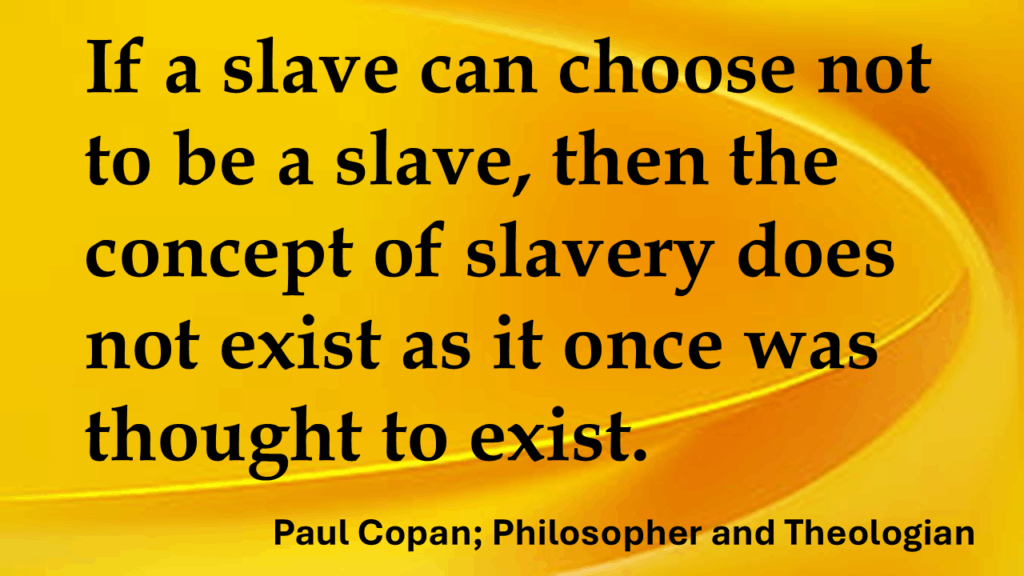
In most historical examples—such as chattel slavery in the transatlantic slave trade—slavery was rooted in coercion, racial superiority, and lifelong ownership. A slave had no say in their condition, no legal recourse, and no hope for freedom. It was an institution of total domination and dehumanization.
But in ancient Israel, the Mosaic Law introduced a radically different model. Israelite “slavery” often functioned more like indentured servitude—a structured, temporary arrangement entered into voluntarily, usually as a way to repay debt or escape poverty. The law even made provisions for release after six years, and explicitly prohibited returning runaway slaves (Deut. 23:15–16). In some cases, a servant could even choose to remain with their master out of love and loyalty (Ex. 21:5–6), a choice that redefines the relationship not as one of oppression, but of mutual respect and security.
When the option to leave is protected by law—and when entering service is voluntary and time-bound—the institution loses its defining elements of force, ownership, and permanence. In such a system, the term slavery becomes more of a legal or economic status than a moral condemnation. That’s why applying the modern connotation of slavery to biblical servitude results in deep misunderstanding. A system where freedom is always within reach is fundamentally incompatible with the brutal, coercive systems most commonly associated with the term slavery today.
Challenge Question: If the Old Testament allowed servants to enter and leave their roles voluntarily, and even forbade the return of runaway slaves, can we honestly equate Israelite servitude with the coercive, dehumanizing slavery of later history—or does this require a reevaluation of our assumptions about biblical “slavery”?
Premise 2 : Israelite Slaves Were Not Deprived Of Freedom And Basic Human Rights
Regardless of the reason a person became an ‘ebed—the Hebrew word often translated as “servant” or “slave”—the Mosaic Law established strict, divinely mandated regulations to preserve the human dignity, welfare, and rights of those in servitude. Whether a person entered service due to poverty, debt, foreign status, or voluntary commitment, they were never to be treated as property or abused without consequence. Israel’s legal system stood in stark contrast to the surrounding cultures, where slaves were often viewed as disposable commodities.
In the Old Testament, while servitude existed as a social and economic reality, it was governed by a legal framework that emphasized justice, compassion, and human dignity. Far from being treated as mere property, Israelite servants were granted meaningful legal rights: they could not be kidnapped or sold (Exodus 21:16), were to be released after six years of service (Exodus 21:2), and were protected from abuse—with permanent injury granting immediate freedom (Exodus 21:26–27). Runaway slaves were not to be returned to their masters but allowed to live freely where they chose (Deuteronomy 23:15–16). These laws ensured that servitude in Israel operated more as a temporary, restorative measure than as a system of oppression, reflecting a God who valued mercy and upheld the dignity of every person.
Legal Protections Rooted in Human Worth
The laws governing servitude in ancient Israel were not arbitrary; they were grounded in the theological truth that every person bore the image of God (Genesis 1:27) and that the Israelites themselves had once been slaves in Egypt (Deuteronomy 5:15). As a result, they were commanded to treat others with compassion, fairness, and restraint.
“You shall not rule over him ruthlessly, but shall fear your God.”
— Leviticus 25:43
This fear of God was the moral anchor that safeguarded against exploitation. Harsh treatment was not just discouraged—it was punishable by law. For instance, if a master permanently injured a servant, the servant was to be granted immediate freedom (Exodus 21:26–27). Such laws acknowledged the bodily integrity and legal personhood of the servant.
Time Limits and Economic Restoration
Servitude was never intended to be a lifelong sentence. Hebrew servants were to be released after six years of service (Exodus 21:2), and during the Year of Jubilee, all Israelite servants were freed and their ancestral lands returned (Leviticus 25:10). This ensured that no family line was trapped in poverty or perpetual servitude across generations.
Moreover, release was to be accompanied by generous provision from the master:
“You shall furnish him liberally out of your flock, out of your threshing floor, and out of your winepress.”
— Deuteronomy 15:14
This law ensured that a former servant could reenter society with resources to rebuild—a far cry from systems where former slaves were abandoned or marginalized.
Freedom to Flee Without Reprisal
Perhaps most telling is the command found in Deuteronomy 23:15–16, which forbade the return of runaway slaves and even required Israelites to give them the freedom to settle wherever they pleased. This law implies that if conditions became unjust or abusive, the servant had the right to escape and find refuge—legal protection that undermines the very notion of forced servitude.
Voluntary Lifelong Service by Choice
In some cases, a servant could voluntarily choose to remain with their master out of love and loyalty. Exodus 21:5–6 describes a ritual where a servant who freely desired to stay would have his ear pierced as a public sign of permanent affiliation. This option was not compelled but invited—a relational dynamic far removed from coercive slavery.
The institution of servitude in ancient Israel was carefully regulated by laws that reflected justice, mercy, and human value. While it still functioned within the economic and social structures of the ancient Near East, Israelite “slavery” was uniquely shaped by God’s moral law. It was voluntary, temporary, protected, and redeemable—a far cry from the racialized, violent systems of slavery seen throughout later history. The Mosaic law sought not to exploit the vulnerable, but to protect them with dignity, ensuring that no one—regardless of their status—was ever beyond the reach of justice.
Scriptural Laws and Protections for Servants in Ancient Israel
| Scripture Reference | Law or Protection Provided | Scripture Text |
|---|---|---|
| Exodus 21:2 | Hebrew servants must be freed after six years of service. | “When you buy a Hebrew slave, he shall serve six years, and in the seventh he shall go out free, for nothing.” |
| Exodus 21:26–27 | If a master injures a servant (eye or tooth), the servant must be set free. | “When a man strikes the eye of his slave, male or female, and destroys it, he shall let the slave go free because of his eye. If he knocks out the tooth of his slave… he shall let the slave go free because of his tooth.” |
| Exodus 21:16 | Kidnapping and selling a person is a capital offense; slave trade forbidden. | “Whoever steals a man and sells him, and anyone found in possession of him, shall be put to death.” |
| Leviticus 25:39–43 | Israelite servants are to be treated as hired workers; not ruled over ruthlessly. | “If your brother becomes poor beside you and sells himself to you, you shall not make him serve as a slave. He shall be with you as a hired worker… You shall not rule over him ruthlessly.” |
| Leviticus 25:47–49 | A relative has the legal right to redeem a family member sold into servitude. | “Then after he is sold he may be redeemed. One of his brothers may redeem him… or if he grows rich he may redeem himself.” |
| Deuteronomy 15:12–15 | Upon release, servants must be generously provided for to reenter society with dignity. | “If your brother, a Hebrew man or a Hebrew woman, is sold to you, he shall serve you six years, and in the seventh year you shall let him go free. And when you let him go free, you shall not let him go empty-handed…” |
| Deuteronomy 23:15–16 | Runaway slaves must not be returned; they are free to settle where they choose. | “You shall not give up to his master a slave who has escaped… He shall dwell with you, in your midst… You shall not wrong him.” |
| Exodus 21:5–6 | A servant may voluntarily choose to remain in service out of love and commitment. | “If the slave plainly says, ‘I love my master… I will not go out free,’ then his master shall bring him to God… and he shall be his slave forever.” |
These laws emphasized that servants were not property but people under God’s protection, and any abuse of power was treated as a serious offense before both man and God. The Fourth Commandment also required that slaves enjoy the Sabbath along with their masters.
Remember the Sabbath day by keeping it holy. Six days you shall labor and do all your work, but the seventh day is a sabbath to the Lord your God. On it you shall not do any work, neither you, nor your son or daughter, nor your male or female servant, nor your animals, nor any foreigner residing in your towns.
Exodus 20:8-11
These laws were not arbitrary—they reflected a divine standard of justice and carried strict penalties for violations. Servants were not without recourse; they could report mistreatment, and if proven, the consequences for the master were severe. For example, if a master caused permanent injury—such as the loss of an eye or tooth—the servant was granted immediate freedom (Exodus 21:26–27). If a master was found guilty of kidnapping and selling a person into slavery, or even possessing such a person, the penalty was death (Exodus 21:16).
Their Was a Maximum Term for Debt Repayment then Guaranteed Freedom
There were also legal time limits and guarantees of economic restoration guaranteed to slaves. If a servant repaid his debt early, he was released, but even if the debt wasn’t repaid in full, he was guaranteed his release in six years. Servitude was never intended to be a lifelong sentence. Hebrew servants were to be released after six years of service (Exodus 21:2), and during the Year of Jubilee, all Israelite servants were freed and their ancestral lands returned (Leviticus 25:10). This ensured that no family line was trapped in poverty or perpetual servitude across generations.
Moreover, release was to be accompanied by generous provision from the master. Once released the Israelite slave was not expected to start over from scratch. Rather, his now former master, who had benefited from his labor, was to provide him with “liberal” amounts of livestock, grain, and wine, in order to get him back on his feet.
If your brother, a Hebrew man or a Hebrew woman, sells himself to you, he shall serve you six years, and in the seventh year you shall let him go free from you. And when you let him go free from you, you shall not let him go empty-handed. You shall furnish him liberally out of your flock, out of your threshing floor, and out of your winepress. As the LORD your God has blessed you, you shall give to him.
Deuteronomy 15:12-14
Servitude in ancient Israel was never intended to be a lifelong sentence. Hebrew servants were to be released after six years of service (Exodus 21:2), and in the Year of Jubilee, all Israelite servants were set free and their ancestral lands restored (Leviticus 25:10). These provisions ensured that no family remained trapped in poverty or generational servitude. In many cases, servants voluntarily chose to remain with their masters out of love and loyalty, especially after their debts had been repaid—often receiving fair wages in the process. To equate Israelite servitude with the harsh, dehumanizing slavery practiced by surrounding nations or the racialized chattel slavery of recent centuries is both historically inaccurate and a misrepresentation of Israel’s legal system, moral framework, and regard for human dignity.
Challenge Question : If Israelite slavery was truly oppressive and inhumane, why do the biblical laws surrounding it include time limits, strict protections against abuse, voluntary lifelong service out of affection, and even the freedom for runaways to resettle without punishment—features completely absent in the slavery systems most critics assume the Bible endorses?
Premise 3 : New Testament Christians Did Not Have The Power To Change Mandatory Roman Laws On Slavery
In the ancient world, slavery was the foundation of nearly every major society, deeply embedded into the social, economic, and legal systems of the time. Roughly half the population of the Roman Empire were slaves, and in Athens, estimates suggest that up to three-fourths of the population lived in bondage. Within Rome itself, some scholars believe as much as 90 percent of the city’s residents may have been slaves at one point, especially during its height in the first century.
The condition of these slaves was often inhuman and brutal. A slave’s life could be extinguished at the whim of a master, with little or no legal consequence. Human rights, as we understand them today, simply did not apply. Among the many dehumanizing practices:
- Slave testimony in court was only admissible under torture, while free citizens testified under oath.
- If a Roman master was murdered, all his household slaves were automatically executed, regardless of guilt, simply as a precaution and punishment.
- It was considered a standard act of hospitality to assign a female slave to a male guest for the night—effectively legal sexual exploitation.
For millions upon millions of enslaved people in past centuries, and even down to the present day in outlying pockets of civilization, survival has been a matter of supreme indifference because of their condition of bondage. The warrior who preferred death to capture was not necessarily being brave or noble; he was being realistic. Even in sophisticated Athens and Rome, where household slaves received humane treatment and were accorded special privileges, their lives were never out of jeopardy. Four hundred slaves belonging to the Roman Pedanius Secundus were ordered put to death because they were under their master’s roof when he was murdered.
Sherwood Wirt: The Social Conscience of the Evangelical p. 10
This was the world into which Christianity was born—a world ruled by an authoritarian Roman empire and upheld by entrenched systems of violence and inequality. The early Christians had no political power or social capital. In fact, they were often viewed with suspicion, hostility, and contempt. Their gatherings were misunderstood, their values ridiculed, and their allegiance to a crucified Lord deemed subversive. If the Christians would have had the power to change Roman slavery laws they absolutely would have.
In such a hostile context, had any New Testament writer openly called for slaves to rebel or for masters to release all their slaves, it would have been a death sentence—not only for the writers, but for Christian slaves and congregations throughout the empire. The Roman state had already demonstrated its merciless response to slave revolts: when Spartacus led a rebellion around 73 B.C., Rome crucified 6,000 captured slaves along the Appian Way. The message was clear: revolt would be met with unimaginable cruelty.
Moreover, ordering Christians to free their slaves outright would have been legally ineffective. Roman law did not recognize slaves as autonomous persons. Even if a Christian freed a slave, that person would still be considered the property of the state unless formally manumitted according to Roman procedure. Thus, most freed slaves would not have enjoyed true freedom in any legal or social sense.
Christianity Changed The Way Slaves Were Treated With Love: The Only Power They Were Free to Exercise
Despite these severe limitations, Christianity began to sow the seeds of a revolution—not through law, but through love. The Gospel called believers to treat others as they would treat Christ Himself, and to love one another as Christ had loved them (John 13:34). This transformed the way Christians related to one another, including in the master-slave relationship.
The apostle Paul wrote to Christian masters and slaves alike, not to incite rebellion, but to transform the relationship from within:
“There is neither Jew nor Greek, slave nor free, male nor female, for you are all one in Christ Jesus.“ (Galatians 3:28)
“Masters, provide your slaves with what is right and fair, because you know that you also have a Master in heaven.” (Colossians 4:1)
“Each of you should look not only to your own interests, but also to the interests of others.” (Philippians 2:4)
In the New Testament book of Philemon is primarily written about a runaway slave. Paul writes a personal letter to a Christian master to receive his runaway slave Onesimus back “no longer as a slave, but better than a slave, as a dear brother” (Philemon 16). This wasn’t a legal abolition—it was a heart-level revolution.
Though early Christians lacked the political means to dismantle slavery institutionally, they planted the theological and moral foundations for its eventual collapse. Over time, as Christian values spread, the idea that every human being is made in the image of God and worthy of dignity slowly began to challenge and erode the legitimacy of slavery. The early church’s countercultural ethic of love, equality, and mercy ultimately proved more subversive than a sword.
Christians were commanded to love others as Christ loved them—a love marked by humility, sacrifice, and the lifting up of the lowly. This command redefined human relationships at every level. It meant that no person could be viewed as mere property or utility, but as a fellow image-bearer of God, worthy of dignity and compassion.
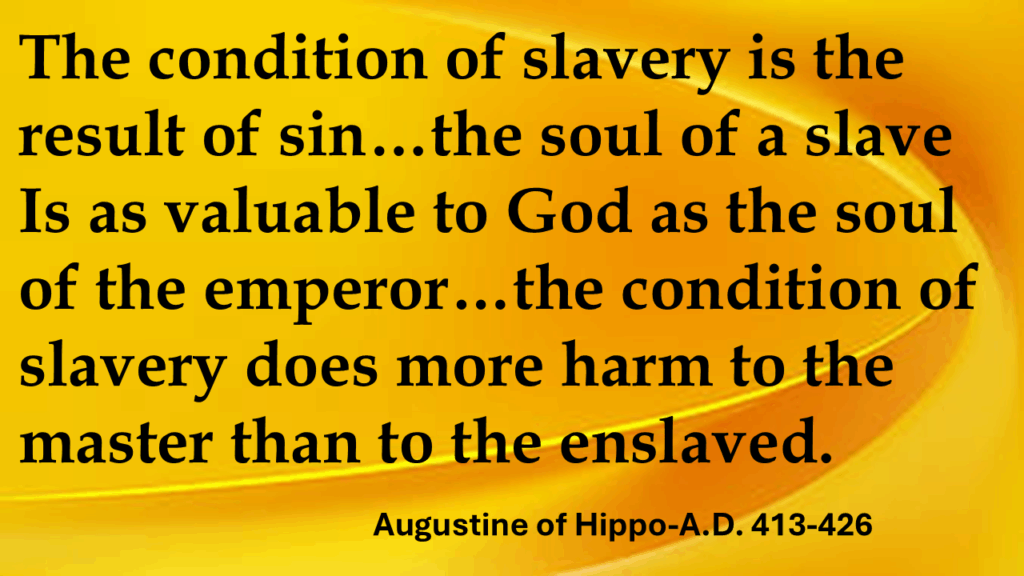
In a world where slavery was normalized, the Gospel introduced a radical new ethic: one in which love, not status, defined worth—and where even the least were to be treated as brothers and sisters in Christ. This vision dismantled the hierarchy of human value by declaring that all are equal at the foot of the cross, and that true greatness is found in serving others, not in ruling over them.
Challenge Question : If the New Testament writers accepted slavery as it existed, why do they consistently undermine its foundations—emphasizing the equal worth of all people in Christ, commanding masters to treat servants justly, and urging believers to love others as Christ loved them—even at a time when openly opposing the institution would have meant certain death for many Christians?
Premise 4: The Abolition Of Slavery Was Led Primarily By Christians
When slavery finally came under sustained moral assault in the Western world, it was not driven first by economic theory, political revolution, or secular humanism, but by explicitly Christian moral convictions. For centuries, slavery had existed largely unquestioned across civilizations. What changed in the West was not merely law, but conscience—and that shift was rooted in Christian theology.
The early abolition movement arose almost entirely from Christian communities who believed that Scripture demanded the recognition of every human being as an image-bearer of God. Abolitionists repeatedly appealed to biblical principles: the equal worth of all souls before God, the command to love one’s neighbor, and the conviction that no person could rightly own another for whom Christ died. These were not peripheral arguments; they were the moral foundation of the movement.
In Britain and the United States, the most persistent and organized opposition to slavery came from devout Christians—evangelicals, Quakers, and other church-centered reformers—who labored for decades against overwhelming political and economic resistance. They petitioned legislatures, published tracts, mobilized churches, and endured ridicule, threats, and violence. Their opposition to slavery was not incidental to their faith; it flowed directly from it.
Key Christian Leaders in the Western Abolition of Slavery
| Person | Role in Abolition | Explicit Christian Motivation |
|---|---|---|
| William Wilberforce (Britain) | Led parliamentary campaign to abolish the British slave trade (1807) and slavery itself (1833) | Evangelical Christian; viewed abolition as a moral duty before God |
| John Newton (Britain) | Former slave trader turned abolition advocate; influenced public opinion | Anglican clergyman; repentance and theology drove his opposition |
| Granville Sharp (Britain) | Early legal architect of British abolition; court cases defending enslaved Africans | Evangelical Christian; appealed to biblical justice and human dignity |
| Thomas Clarkson (Britain) | Organized grassroots abolition movement; gathered eyewitness evidence | Motivated by Christian conscience and moral accountability |
| Quakers (Religious Society of Friends) | First group to formally condemn slavery and organize abolition efforts | Belief in the equal worth of every soul before God |
| Frederick Douglass (U.S.) | Escaped slave; leading abolitionist orator and writer | Appealed to biblical justice; distinguished Christianity from slaveholding hypocrisy |
| Harriet Beecher Stowe (U.S.) | Author of Uncle Tom’s Cabin, shaping public conscience | Evangelical Christian; wrote as a moral appeal grounded in Scripture |
| Charles Finney (U.S.) | Revivalist who tied abolition to Christian repentance | Taught slavery was incompatible with Christian faith |
| William Lloyd Garrison (U.S.) | Founder of The Liberator; radical abolition voice | Christian moral absolutism; appealed to divine law over human law |
| John Woolman (Colonial America) | Early anti-slavery reformer influencing Quaker abolition | Christian pacifism and belief in universal human dignity |
Slavery did not end simply when it became inconvenient or inefficient. In many cases, abolition worked against economic self-interest, particularly in societies deeply dependent on slave labor. What sustained the movement over generations was a moral vision strong enough to confront entrenched power—a vision grounded in the Christian belief that justice is accountable to God, not merely to the state.
This does not mean that all Christians opposed slavery, nor that non-Christians played no role. History is more complex than slogans. But it does mean that the decisive moral engine behind Western abolition was Christian, and that no comparable, sustained abolitionist movement arose from purely secular foundations at the time.
Christian Ethics Provided The Moral Force That Destroyed Slavery In The West
Slavery in the Western world did not collapse merely because it became economically inefficient or politically inconvenient. It collapsed because it became morally indefensible. That moral judgment emerged primarily from Christian ethics, which asserted that every human being bears the image of God, possesses inherent dignity, and stands equally accountable before divine law. As these convictions spread, slavery was no longer seen as a regrettable necessity but as a profound moral contradiction—an offense not only against humanity, but against God Himself. Once slavery was framed in these terms, its eventual abolition was unavoidable.
Secular Historians On Christian Leadership In The Abolition Of Slavery
| Name | Credentials | Quote |
|---|---|---|
| David Brion Davis | Sterling Professor of History (emeritus), Yale University; widely regarded as the leading historian of slavery and abolition | “The abolitionist impulse derived much of its strength from Christian belief and Christian institutions. Without the religious framework that defined slavery as a sin, abolition could not have become a mass movement.” |
| Christopher Leslie Brown | Professor of History, Columbia University; specialist in British abolition | “British abolitionism was not simply compatible with Christianity; it was overwhelmingly shaped and sustained by it. Evangelical religion supplied both the moral energy and organizational structure of the movement.” |
| Niall Ferguson | Senior Fellow, Hoover Institution (Stanford); historian of Western institutions | “It is a historical fact that the first sustained movement to abolish slavery was rooted in Christian moral reform, particularly among evangelical Protestants.” |
| Tom Holland | British historian and author of Dominion; specialist in the moral legacy of Christianity | “The idea that slavery was morally intolerable did not come from the ancient world but from a Christian revolution in moral thinking.” |
| Seymour Drescher | Professor of History, University of Pittsburgh; authority on British abolition | “The decisive thrust toward abolition in Britain came from religious mobilization, particularly evangelical Christianity, which turned antislavery into a mass moral cause.” |
| Mark Noll | Professor emeritus, University of Notre Dame; leading historian of American Christianity | “The most powerful arguments against slavery in Britain and America arose from Christian theology, especially biblical claims about human equality before God.” |
| Hugh Thomas | Regius Professor of Modern History (Cambridge); author of major works on slavery | “The abolition of the slave trade was achieved largely through the moral pressure exerted by Christian reformers, rather than economic necessity.” |
| Adam Hochschild | Historian; author of Bury the Chains, the definitive narrative history of British abolition | “At the heart of Britain’s abolitionist movement was a religiously inspired moral passion, driven above all by evangelical Christians who believed slavery was a sin.” |
Taken together, the historical record makes one conclusion difficult to avoid: the Western abolition of slavery did not emerge from moral neutrality or secular inevitability, but from a sustained Christian moral vision that judged slavery to be incompatible with divine justice and human dignity. This does not deny the failures, compromises, or hypocrisies of many who identified as Christian. It does, however, recognize that the decisive moral language, organizational energy, and perseverance required to dismantle slavery arose primarily from Christian conviction. Slavery fell in the West not because Christianity was discarded, but because its ethical demands were finally taken seriously—and once slavery was exposed as a sin before God, its days were numbered.
Challenge Question: If Christianity truly endorsed slavery, why were its most consistent and influential critics—across generations, nations, and institutions—explicitly Christian
ThinkCube Truth Veracity Grid
- Have I considered the facts carefully and with an open mind?
- Is my conclusion the result of a careful examination of the facts, or is it a conclusion made in spite of the facts?
- Is my conclusion the one that makes the most sense of the evidence?