Premise 1: Evil Is Not A “Thing” Iself
Why is there evil in the world? If God is all-powerful and all-good, why does He allow suffering, injustice, and cruelty? For centuries, thinkers have wrestled with this question. One of the most insightful answers comes from Augustine of Hippo—a fourth-century Christian philosopher and theologian—who offered a radical and surprising view:
Evil is not a thing. It is the absence of something.
At first, this sounds odd. After all, evil feels very real. But Augustine’s insight helps us shift our understanding of evil from something mystical or material to something far more philosophical and theological.
Augustine taught that everything God created is good (Genesis 1:31). Since God is perfectly good, He could not create something that is evil by nature. So where does evil come from?
According to Augustine, evil is not a substance or force. It’s not a thing that God created. Instead, evil is a privation—a lack or corruption of good. Just as darkness is the absence of light, or a shadow is the absence of direct sun, evil is what happens when something good is missing or twisted.
Examples to Understand This Concept:
- Darkness: Darkness isn’t a “thing” you can bottle up or weigh. It exists only where light is absent.
- Cavities in teeth: A cavity isn’t a new substance—it’s the loss of healthy tooth material.
- Rotten apple: Rot isn’t a thing added to the apple—it’s the breakdown or decay of the good parts.
Evil, then, is what happens when something good (like love, order, life, or integrity) is damaged, missing, or used wrongly.
Evil Was Not Created by God
The Bible teaches that everything God made was good:
“God saw all that He had made, and it was very good.” — Genesis 1:31
God is not the author of evil. He is holy, just, and incapable of wrongdoing.
Let no one say when he is tempted, “I am being tempted by God,”
James 1:13
for God cannot be tempted with evil, and he himself tempts no one.
Evil, therefore, is not something He created—it is not a substance, force, or object that God unleashed into the world.
Instead, evil entered creation when God’s creatures—angels and humans—chose to turn away from His goodness.
Evil Is the Absence or Corruption of Good
Just as darkness is not a “thing” in itself but the absence of light, evil is the absence or distortion of good.
- You can’t measure darkness—it’s simply what remains when light is removed.
- Likewise, evil is what remains when good is abandoned, corrupted, or misused.
In Romans 1, Paul describes how humanity “exchanged the truth of God for a lie” and “did not see fit to acknowledge God,” resulting in all kinds of moral decay (Romans 1:21–32). Evil didn’t come from a substance God made—it came from the rejection of the truth and goodness He had revealed.
Evil Is What Happens When Good Is Misused
In Scripture, the problem of sin is often described as using good things in the wrong way:
- Sexuality is a good gift—but becomes destructive when twisted into lust or exploitation.
- Speech is a gift—but becomes sinful when used for lying or slander.
- Desire itself is not evil—but when we desire things more than God, it becomes idolatry.
“Each person is tempted when they are dragged away by their own evil desire and enticed.” — James 1:14
Evil doesn’t need to be a created thing—it arises when good things are used wrongly, or when the good is missing from a person’s heart or actions.
Evil Enters Through Free Will, Not Divine Defect
God gave humans the dignity and responsibility of free will. He made us in His image—with the ability to choose, love, reason, and obey.
But with that freedom came the possibility of rebellion. The first sin in Genesis 3 was not God’s failure—it was man’s choice to turn away from good, seeking independence from the very source of life.
“By one man sin entered the world, and death through sin.” — Romans 5:12
Evil, then, is not something God injected into creation. It is what results when His creatures choose the absence of good over the presence of God.
Why Properly Defining Evil Matters
If evil were a “thing”—a force or substance like gravity or energy—it would imply that evil has independent existence. It might even suggest that evil is eternal or somehow necessary.
But the biblical view is far more hopeful:
- Evil is not equal to good.
- Evil is not co-eternal with God.
- Evil is temporary and parasitic—it feeds off what is good but has no life of its own.
Just as you defeat darkness by turning on the light, evil is defeated by the return and restoration of what is good. Evil is not a created force—it is a tear in the fabric of goodness, a wound in what was made perfect, and a rejection of the One who is good.
The problem of evil remains the most common reason skeptics give for rejecting belief in God. Tragically, many are willing to dismiss God as indifferent—or even evil—without ever examining Scripture, which is filled with God’s attitude toward and response to evil. He neither creates, nor condones evil, but is constantly trying to reach sinful mankind with the Gospel which is the antidote for the presence of evil in the human heart. He is constantly trying to change the hearts and values of mankind to eliminate evil without prohibiting human freedom. Evil is the absence or distortion of all the good things that God created and provide.
Why God allows evil may be difficult to fully understand, but Scripture—and especially the cruel cross of Christ—reveal that God is utterly opposed to all forms of evil and is making every effort, through the transforming power of the Gospel, to eradicate it one heart at a time.
Challenge Question: If evil is its own thing—like a force or power that exists on its own—where did it come from, and why does it always seem to depend on something good to twist or destroy? Could it be that evil isn’t a thing by itself, but the damage or absence of something good?
Premise 2: The Suffering By Natural Causes And Human Error Should Not Be Categorized With Evil
One of the most emotionally charged objections to belief in God goes something like this:
“If a good and all-powerful God exists, why is there so much suffering in the world?”
It’s a question that cuts across philosophical, emotional, and personal lines. But built into it is a hidden assumption—that all suffering is evil. While suffering and evil often overlap, they are not the same thing. In fact, not all suffering is the result of evil, and not all evil necessarily involves suffering, at least not immediately.
This distinction may seem small at first, but it’s actually key to understanding how a good God can exist in a world filled with pain.
Suffering Is Broader Than We Think
Suffering is the experience of pain, distress, or loss. It can be physical, emotional, mental, or even spiritual. We suffer when we lose a loved one, break a bone, endure natural disasters, or feel isolated. Suffering is real, and no serious worldview denies it.
But suffering is not always moral in nature. For example, if someone falls ill due to a virus, the suffering is real—but the virus didn’t sin. When a tornado strikes a town, people may be injured or killed, but the tornado wasn’t “evil” in the moral sense. The wind isn’t morally responsible.
This shows us that suffering can occur without anyone doing anything morally wrong. It’s part of living in a physical world with forces, systems, and vulnerabilities that often lie beyond our control.
Evil Is Not Just About Pain
Evil, on the other hand, is more specific. It involves intentional wrongdoing, moral failure, or corruption of what is good. Acts of theft, abuse, murder, betrayal, oppression, and injustice all fall into this category. These are not simply unfortunate—they are wrong, because they violate a moral standard.
What makes something evil is not just that it causes pain, but that it is unjustified, intentional, and morally corrupt. Evil always implies a value judgment—it’s a way of saying, “This should not be.”
Interestingly, evil doesn’t always involve suffering right away. Someone can commit fraud or manipulation and seem to get away with it, at least temporarily. Likewise, not all pain is evil—athletes endure physical pain to achieve growth, and people suffer emotionally in order to help others.
So while evil and suffering are connected, they are not identical. That distinction matters when assessing whether the existence of suffering disproves a good God.
Why the Distinction Matters
If we lump all suffering under the label of “evil,” we risk oversimplifying a complex issue. A broken arm from a bike fall is not morally evil, even though it hurts. Grieving after a loss isn’t evil—it’s a natural and even healthy response to love and mortality.
This distinction helps us avoid holding God responsible for every unpleasant or painful experience. Many aspects of suffering are tied to the natural order—the fact that we live in a world of gravity, biology, and physical vulnerability. Others come from human error—mistakes, limitations, or ignorance, none of which are necessarily evil.
Understanding this nuance allows us to ask better questions—not just why do bad things happen, but what kind of suffering are we talking about, and what is its cause?
The subject of evil in the world is complex enough without the added confusion of classifying suffering from natural causes as evil. Evil, properly understood, is the absence or corruption of goodness and morality—not merely the presence of pain or hardship. While suffering may be deeply painful, it does not always carry moral weight. Recognizing this distinction helps us approach the problem of evil more clearly and avoid misjudging God’s character based on misunderstood categories.
Suffering Due to Human Error Should Not Be Categorized as Evil
In everyday life, much of the suffering we experience results not from malicious intent but from simple human error—mistakes, miscalculations, oversights, or ignorance. A surgeon makes an error during a procedure. A driver falls asleep at the wheel. A building collapses due to a design flaw. These events may cause real pain, loss, or even death, but they are not always the result of evil in the moral sense.
To classify all such suffering as “evil” is to misunderstand what evil truly is. Evil, properly defined, involves willful moral corruption—intended harm, injustice, or rebellion against what is good. It is an active distortion of goodness, not just the result of imperfection. When a person acts carelessly or without full knowledge, it may be tragic, but it is not necessarily evil. There is a moral difference between failing and intending to harm.
Human beings are finite, fallible creatures. We lack total knowledge, perfect foresight, and complete control over outcomes. As such, mistakes are an inevitable part of human experience. A student failing a test, a mechanic overlooking a part, or a parent making a poor judgment call does not make those people morally evil. Rather, it reminds us that we are limited and in constant need of grace, growth, and humility.
Recognizing this difference is important when asking larger questions about God and the existence of suffering. If every instance of pain caused by human failure is lumped into the category of “evil,” it not only distorts the concept of evil, but it also unfairly attributes moral blame where there may be none. It clouds the discussion and places unnecessary doubt on the goodness of God, who created free beings capable of growth, learning, and responsibility.
Challenge Question: If someone suffers because of a mistake—like a misdiagnosis, an accident, or a poor decision—should that be considered evil? Or is there a meaningful difference between moral evil and the unintended consequences of human imperfection? How might recognizing that distinction change the way we think about suffering and the character of God?
Premise 3: Evil Is Not Just A Problem For Christians
One of the most common objections skeptics raise against the existence of God is the presence of evil and suffering in the world. How, they ask, could a loving and all-powerful God allow things like war, disease, genocide, abuse, and injustice? These are difficult and emotionally weighty questions. Christians don’t shy away from them—because the Bible itself doesn’t shy away from them. Scripture is filled with laments, cries for justice, and deep reflections on human pain.
But as Oxford mathematician and Christian thinker John Lennox points out, the problem of evil is not just a problem for Christians. It’s a universal human problem that transcends belief systems. Everyone—believer and skeptic alike—must wrestle with the reality of evil, and not just what causes it, but what it means.
“If you take God out of the picture, you still have suffering—
John Lennox—Professor Emeritus Oxford
you just don’t have any hope, justice, or meaning behind it.”
This simple yet profound observation gets to the heart of a much deeper issue. The existence of suffering may be emotionally troubling for Christians, but it’s philosophically devastating for atheism if it can’t offer any grounding for calling something “evil” in the first place.
What Is Evil Without God?
In a naturalistic or atheistic worldview—where everything is the result of blind, purposeless processes—moral judgments are reduced to personal preference or social conditioning. In such a view, concepts like “good” and “evil” don’t refer to any fixed or objective standard. They’re just evolutionary byproducts—useful illusions developed for survival.
Morality is a biological adaptation no less than the hands and feet and teeth…
Michael Ruse—Atheist Philosopher of Biology
But if that’s true, then what do we really mean when we call something “evil”? Are we saying it violates some kind of universal moral law—or just that we don’t like it? And if morality is only subjective, why do we react so strongly to acts of injustice, cruelty, or betrayal—things that seem universally wrong?
Moral Outrage Requires a Moral Standard
When we say something like “The Holocaust was evil,” we don’t simply mean it was unpleasant or socially frowned upon. We mean it was objectively wrong—a violation of what should be. That’s a moral claim, not a biological one.
When we react to evil, we’re appealing to something beyond ourselves. We are reaching for a standard that doesn’t shift with opinion or culture. And where does such a standard come from?
According to Lennox and many other Christian thinkers, the very fact that we recognize evil as evil points to the existence of a moral law—and therefore, a Moral Lawgiver. You can’t call something crooked unless you have a sense of what straight is. Likewise, you can’t call something evil unless you have a concept of what goodness is.
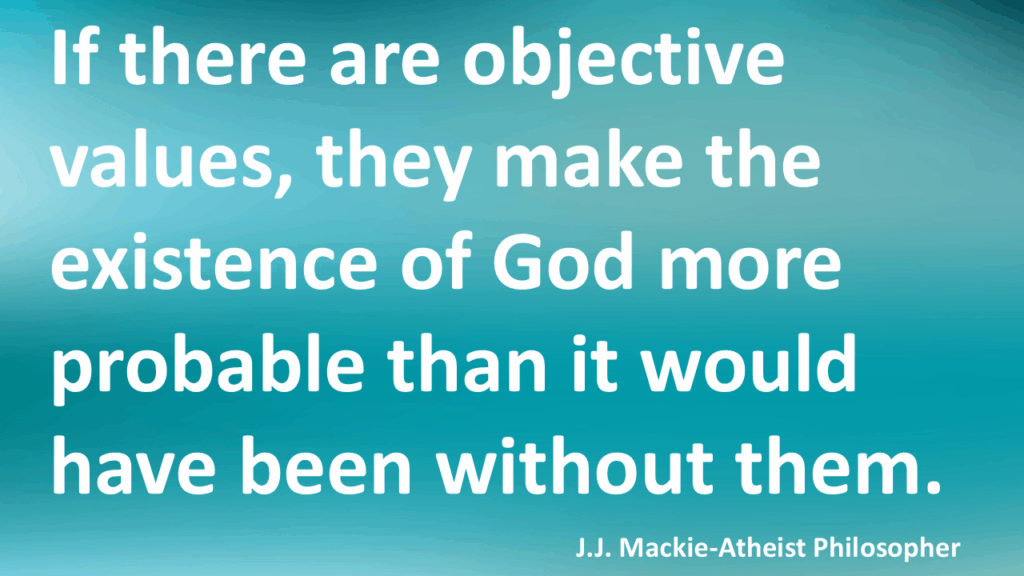
Our outrage at injustice, cruelty, and oppression isn’t just emotional—it’s moral. It testifies to something we instinctively know: that some things are not just unfortunate, but truly wrong. That deep conviction cannot be explained by biology alone or reduced to cultural preference. It points us toward a standard that transcends individuals, societies, and time. Even those who deny God live as if moral truths exist—they condemn wrongdoing, seek justice, and demand fairness. But in a universe without God, these values have no grounding; they’re just opinions floating in a void. The moment we say, “That’s not right,” we’re revealing that we believe there is such a thing as right—and that belief makes more sense in a universe created by a moral God than in one shaped by blind, indifferent forces.
This doesn’t make the pain of suffering disappear, but it does offer something crucial: a foundation for calling evil “evil” in the first place. Without that foundation, we’re left in a world where moral outrage is just emotional noise—where “right” and “wrong” are reduced to social preferences or evolutionary survival tools.
If good and evil are not illusions, then neither is the One who defines them. Far from disproving God, our recognition of evil may be one of the clearest signs that He exists—and that we were made in His moral image.
Evil Without God Leaves Us with Hopelessness
Removing God from the equation doesn’t remove suffering—it only removes hope that there’s any meaning in it or justice for it.
- If there is no God, then there is no ultimate justice. Tyrants who escape punishment in this life are never held accountable.
- If there is no God, then love, dignity, and sacrifice are ultimately meaningless—they are just passing illusions in a meaningless universe.
- If there is no God, then the suffering of the innocent is just bad luck, and cries for justice are just noise in the void.
By contrast, the Christian worldview acknowledges the full weight of evil—and then says that God is not indifferent. He sees it, He hates it, and He will ultimately judge it. That doesn’t remove all mystery, but it grounds our hope that evil will not have the final word.
Skeptics are right to ask hard questions about evil and suffering. But here’s the challenge : if you feel that something in the world is truly, deeply wrong—where does that feeling come from? What are you appealing to when you say something is unjust or unfair?
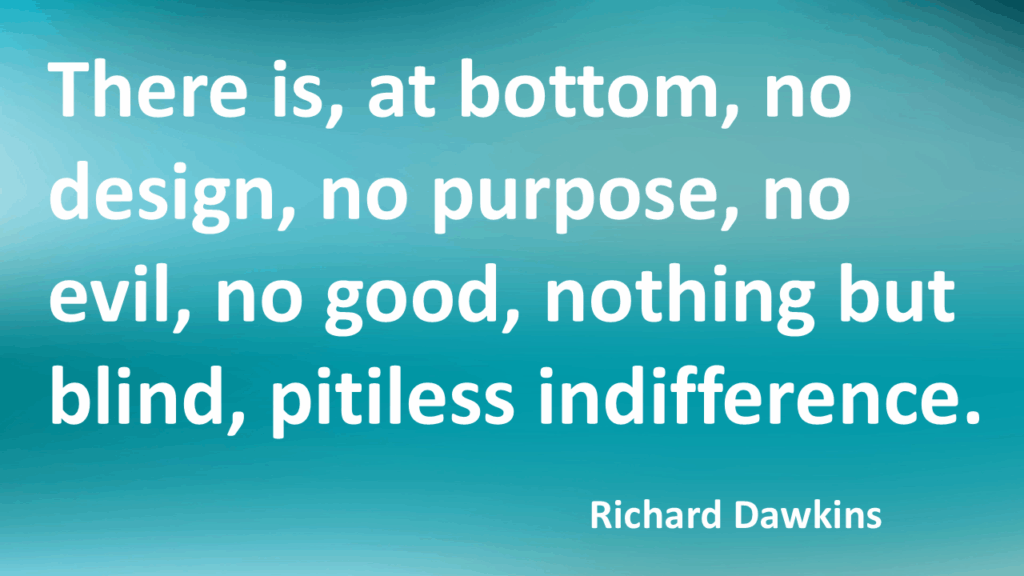
It may be emotionally satisfying to reject God on account of evil—but philosophically, it leaves you in an even darker place. You’re left with the reality of suffering but no reason, no hope, and no ultimate standard by which to call it unjust.
Paradoxically, then, our outrage at evil may be the strongest evidence not against God, but for Him.
Challenge Question: If atheism teaches that we are the product of blind, purposeless processes, and that moral values are just human inventions or evolutionary instincts, then on what basis can we call anything truly evil—or unjust? If there is no objective moral standard, isn’t the outrage we feel toward evil acts just a matter of personal or cultural opinion?
ThinkCube Truth Veracity Grid
- Have I considered the facts carefully and with an open mind?
- Is my conclusion the result of a careful examination of the facts, or is it a conclusion made in spite of the facts?
- Is my conclusion the one that makes the most sense of the evidence?