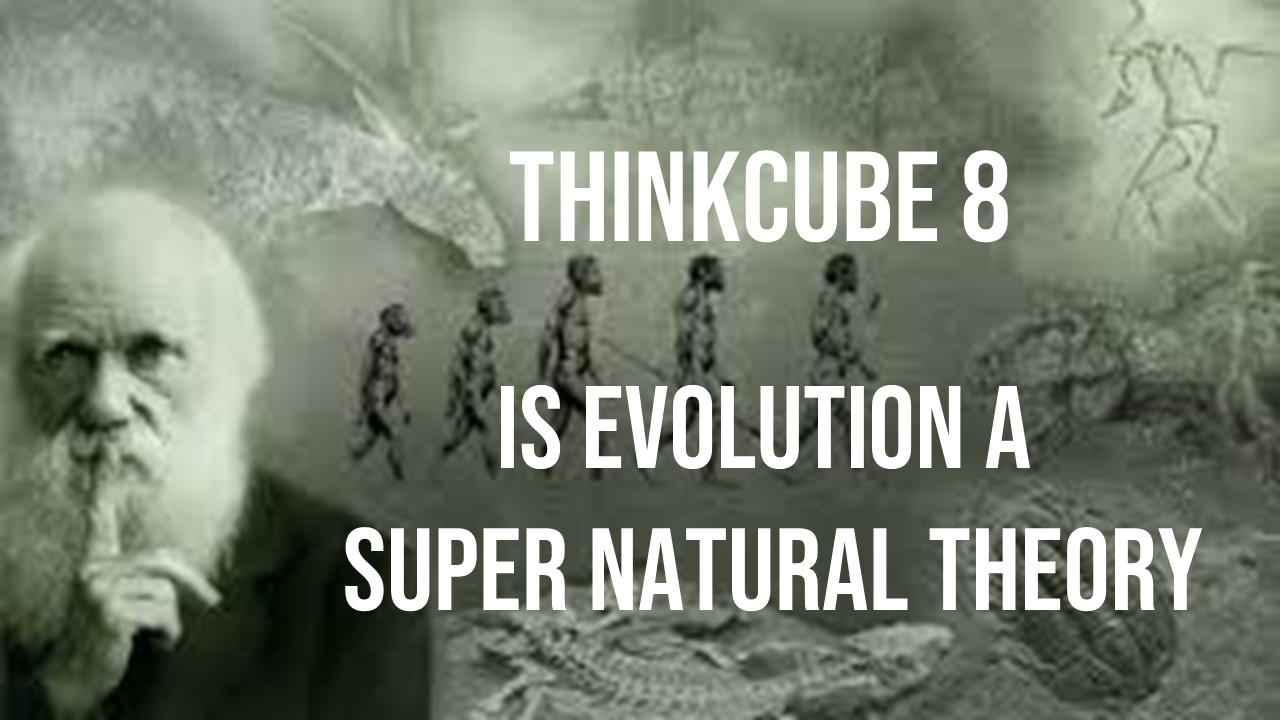
Nothing has to be true, but everything has to sound true.
Isaac Asimov
Premise 1: Evolutionist Default To Non-Natural Explanations
The National Academy of Sciences, and the National Association of Biology Teachers both firmly maintain that reliance on naturalistic explanations is the most fundamental hallmark of science. According to both organization’s mission statements, for any theory to be considered genuinely scientific, it must account for all observed phenomena exclusively through physical or material causes and processes. This commitment to methodological naturalism is supposed to ensure that scientific inquiry remains grounded in empirical observation, testability, and repeatability—key principles that are supposed to distinguish science from other ways of understanding the world, such as philosophy, theology, or metaphysics.
Evolutionary biology rests on the same scientific methodologies the rest of science uses, appealing only to natural events and processes to describe and explain phenomena in the natural world. Science teachers must reject calls to account for the diversity of life or describe the mechanisms of evolution by invoking non-naturalistic or supernatural notions...Ideas such as these are outside the scope of science.
NABT
The NABT statement explicitly mandates that biology teachers “not allow or tolerate any theories of life’s origins that invoke non-naturalistic or supernatural notions.” Modern advances in molecular biology, genetics, biophysics, and paleontology have revealed significant scientific gaps in the theory of evolution. As a result, evolutionists now find themselves blurring the line between natural and non-natural explanations in an effort to resolve questions that purely naturalistic science has thus far been unable to answer.
Every major component of Evolutionary Theory is now supported by what many call “pseudo scientific explanations’ which means that they have the following corollaries:
- They are not scientifically testable, repeatable or verifiable.
- They contradict or violate at least one established law of physics.
These Two Corollaries Perfectly Describe What A Miracle Is.
Miracle
Wikipedia
An event that is inexplicable by natural or scientific laws and accordingly gets attributed to some supernatural cause
Evolutionists often denounce creationist scientists for inferring that an eternal God created the universe from nothing and brought life forth from inanimate matter. Yet, upon closer examination, evolutionary theory offers a strikingly similar framework—only with different terminology. In this view, chance takes the place of God, matter is treated as eternal, and life is said to emerge spontaneously from non-living substances, as if by a kind of naturalistic magic. The difference lies not in the logical challenges, but in the philosophical assumptions behind each explanation.
How Certain Evolutionary Claims Cross from Science into Philosophy or Metaphysics
- Claiming Matter and Energy Are Eternal
- Why it’s metaphysical: Science shows that everything in the observable universe had a beginning (e.g., the Big Bang). To say matter or energy existed eternally without cause is an untestable philosophical assumption, not a scientific conclusion.
- Invoking a Self-Caused Big Bang
- Why it’s metaphysical: The idea that the universe caused itself to exist violates the Law of Causality (nothing can cause itself). This is logically incoherent and not scientifically demonstrable.
- Ignoring the Law of First Cause
- Why it’s metaphysical: Scientific reasoning typically depends on cause-and-effect relationships. Denying the need for a first uncaused cause for the universe places the explanation outside the bounds of empirical science.
- Assuming Laws of Physics Pre-Existed the Universe
- Why it’s metaphysical: The laws of physics are properties of the universe itself. Claiming they existed “before” the universe is a metaphysical speculation, since there is no space, time, or matter in which laws can operate.
- Appealing to ‘Chance’ as a Causal Force
- Why it’s metaphysical: Chance is not a force or entity; it is a mathematical description of probability. Saying that “chance caused life” is not a scientific explanation but a philosophical evasion of causality.
- Describing the Origin of Life as an Accidental Product of Time and Matter
- Why it’s metaphysical: No empirical evidence shows life emerging spontaneously from non-living matter. Claiming this happened despite massive improbabilities is a faith-based assertion, not repeatable science.
- Treating Information-Rich Systems (e.g., DNA) as Products of Blind Processes
- Why it’s metaphysical: Information, as seen in DNA, implies intent, order, and direction. No known natural process generates meaningful code without a sender. Attributing it to unguided processes bypasses scientific logic.
- Assuming Natural Laws Can Create Themselves
- Why it’s metaphysical: Natural laws are descriptions of how matter behaves. They don’t “do” anything or “create” things. To say they brought the universe into existence is a category mistake—a philosophical confusion, not science.
- Excluding Supernatural Causation A Priori
- Why it’s philosophical: To say, before any investigation, that only natural causes are allowed is a philosophical position called methodological naturalism. It is not a conclusion of science but a limiting assumption.
These examples demonstrate that many foundational claims of evolutionary cosmology and origin-of-life theories are not grounded in repeatable, observable science, but rather rest on philosophical or metaphysical premises. This ironically places such theories in the very category that the National Academy of Sciences warns science must avoid—speculative belief systems not supported by the scientific method.
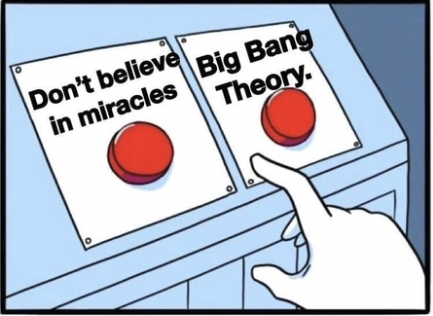
It is absurd for the Evolutionist to complain that it is unthinkable for an admittedly unthinkable God to make everything out of nothing and then pretend that it is more thinkable that nothing should turn itself into everything.
G.K. Chesterton
It is not surprising that naturalists would have to circumvent scientific limitations and support their theories with mechanisms and events that cannot be fully explained by science, because creation is described in Genesis as an unfathomable miracle. The Bible makes it clear that creation cannot be fully explained and can only be partially observed and studied.
The issue is one of consistency. If naturalists object to and reject any reference to the supernatural, then their claims about the origins of the universe and life should be held to those same standards.
Challenge Question: If key claims in evolutionary cosmology and origin-of-life theories rely on unobservable, untestable assumptions, should they be considered scientific explanations—or are they better classified as philosophical or metaphysical beliefs? How does this align or conflict with the standards set by the National Academy of Sciences?”
Premise 2: Evolution Attributes Eternality To Matter
Historic Science: Law of Conservation and Mass: Matter can neither be created or destroyed
Georges Lemaître, a Belgian physicist and Catholic priest often referred to as the “Father of the Big Bang Theory,” first proposed in 1927 that the observable expansion of the universe could be mathematically traced back to a single originating point. He called this point the “primeval atom”—a highly dense and compact state from which the universe emerged.
In essence, the Big Bang hypothesis posits that all matter, energy, space, and time were once concentrated into an unimaginably small, hot, and dense state known as a singularity. Then, in a sudden and mysterious event, this singularity began to rapidly expand, giving rise to the universe we observe today.
However, this explanation raises profound philosophical and scientific questions. It effectively attributes either a non-scientific origin or a kind of eternality to the singularity itself—the “primeval atom” or energy that preceded the Big Bang. Since the singularity lies outside the scope of known physical laws, its origin remains unexplained by science, pointing to a boundary where scientific inquiry gives way to metaphysical speculation.
Evolutionary Scientists believe that matter, energy, and/or the laws of physics are the entities from which everything else came and that those entities have existed from eternity past as the uncreated foundation of all that exists. Matter, energy, and physical laws are, therefore, viewed by materialists as self-existent.
Steven C. Meyer; Geophysicist; Co-founder Center for Science and Culture Discovery Institute
Evolutionists are willing to abandon one of the foundational principles of empirical science— The Law of First Causes—when they claim that energy, matter, and the laws of physics are without origin or cause. By attributing eternal and uncaused characteristics to these fundamental elements, they effectively shift from the domain of physics into the realm of metaphysics.
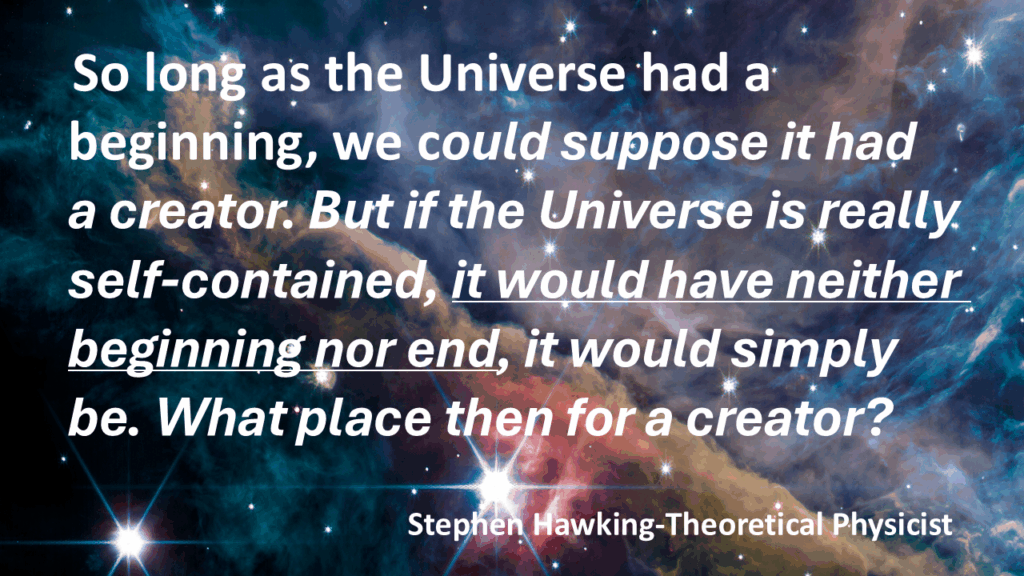
If one claims that the Big Bang caused itself, or that the matter and energy that led to the Big Bang have always existed, then this explanation moves beyond the boundaries of the scientific method. It ceases to be a purely scientific account and instead enters the territory of philosophy—or even religious belief—by positing unprovable assumptions about the nature of reality.
Ironically, this is precisely what the National Academy of Sciences warns against. It states that in order for science to remain true to its purpose, it must avoid explanations that rely on non-empirical or non-naturalistic causes. By departing from causality and embracing eternal matter or self-caused events, such theories risk contradicting the very scientific principles they claim to uphold.
If matter is not eternal, its first emergence into being is a miracle beside which all other miracles dwindle into absolute insignificance.
William Knight; Roman Philosopher
The National Academy of Science has restricted itself from what pure science initially set out to be. Observe, Test, Explore, and follow the evidence whereever it leads. The evidence is showing that naturalism cannot account for the spontaneous appearance of matter, energy, space, and time from absolute nothingness. The very fact that anything exists at all, rather than nothing, demands an explanation that lies beyond the reach of natural processes.
The problem of what happened before the Big Bang is a profound one, and it is hard to see how it can ever be answered by science.
Paul Davies—Theoretical Physicist; Winnter of Templeton, Kelvin, and Faraday Prizes.
If we are intellectually honest, we must recognize that the first cause of matter is not merely a scientific question but a deeply philosophical and theological one. And in facing that question, we are confronted not with the elimination of miracles—but with the undeniable necessity of one.
Challenge Question: If science claims that the universe emerged from eternal, uncaused matter or that it caused itself into existence, does this not mirror a form of faith—only without God? How does this compare with the biblical claim that ‘In the beginning, God created’? Which worldview offers a more coherent and consistent explanation for the origin of all things?”
Premise 3: The Miracle Of Chance, Time, and Self Organizing Matter
Historic Science: The Law of Causality states that every effect must have a cause. There is no beginning or change of existence without a cause.
Evolutionists frequently appeal to concepts such as spontaneous generation, the emergence of life from non-living matter (abiogenesis), and the creative power of time and chance. Yet none of these ideas have ever been empirically demonstrated or granted scientific standing through repeatable observation or experimentation. Despite this, they are often presented as plausible explanations within evolutionary frameworks. Ironically, these speculative claims remain outside the bounds of the scientific method, relying instead on unproven assumptions that resemble philosophical beliefs more than established science. As such, they highlight a significant departure from evidence-based reasoning in favor of naturalistic conjecture.
How Evolution Attributes Creative Power to Non-Personal Forces in Unscientific Ways
- Matter as Self-Organizing and Self-Generating
- Assumes that lifeless chemicals arranged themselves into living cells without guidance or design.
- Ignores the scientific principle that complex, information-rich systems (like DNA) do not arise from raw matter alone without a directing force.
- Time as a Substitute for Causality
- Treats immense spans of time as if they have inherent creative power to generate complexity.
- In reality, time alone does not produce change—it must be combined with a mechanism or cause.
- Chance as a Creative Agent
- Attributes the development of new functions, organs, and species to random mutations filtered by natural selection.
- Yet “chance” is not a force or entity; it is a statistical concept, incapable of intentionally producing order, structure, or purpose.
- Energy as a Life-Giving Force
- Suggests that environmental energy (like sunlight or heat) acting on matter led to the spontaneous emergence of life.
- However, raw energy without a directing code or system typically leads to disorder (entropy), not life or complexity.
How Evolutionist Default To Super-natural Terms to Describe It and it’s Processes
One has only to contemplate the magnitude of this task to concede that spontaneous generation of a living organism is impossible. yet here we are as a result, I believe, of spontaneous generation.
George Wald; Nobel Prize In Biology
An honest man, armed with all the knowledge available to us now, could only state that in some sense, the origin of life appears at the moment to be almost a miracle, so many are the conditions which would have had to have been satisfied to get it going.
Francis Crick – Nobel Laureate in Physiology
Time is the hero of the plot…Given so much time, the impossible becomes possible, the possible becomes probable, the probable becomes virtually certain. One only has to wait; time itself performs miracles
George Wald; Noble Prize winning Physiologist on Evolution
It necessarily follows that chance alone is the source of every innovation, and of all creation in the biosphere. Pure chance, absolutely free but blind, at the very root of the stupendous edifice of evolution.
Jacques Monod; Chance and Necessity: An Essay on the Natural Philosophy of Modern Biology
These quotes demonstrate that some scientists, while advocating for evolutionary theory, employ language and concepts that attribute creative power to chance, time, and spontaneous processes—elements that are inherently non-empirical and philosophical in nature. This approach mirrors aspects of religious belief systems, where faith is placed in unseen and untestable forces. The reliance on such concepts raises questions about the scientific rigor of these explanations and suggests that, in some respects, evolutionary theory incorporates a faith-based component akin to that found in religion.
When scientist attribute instrumental power to chance—they have left the domain of reason, they have left the domain of science; they have turned to pulling rabbits out of hats.
John MacArthur—Creation Believe it or Not
Are These Science Nobel Laureates “Pulling Rabbits Out of Hats?”
1. Chance as a Creative Force – “Pulling Rabbits Out of Hats”
Why it’s problematic:
Chance is not a thing—it has no mind, no power, no agency. It is merely a mathematical expression of probability. When scientists say that chance caused something—like the origin of life or the formation of genetic information—they are treating an abstract concept as a literal force. This is irrational and unscientific.
Why it’s like pulling rabbits out of hats:
It pretends that something came from nothing without an explanation. It gives the illusion of an explanation while offering none—like magic masquerading as science.
2. Time as the Hero of the Story
Why it’s problematic:
Time by itself does nothing. It allows for processes to unfold, but it is not a force. If a process is impossible or implausible in the short term, time does not make it more reasonable unless there is a mechanism that works across that time.
Why it’s like pulling rabbits out of hats:
Claiming that given enough time, anything can happen ignores actual probability limits. It’s the scientific equivalent of saying, “Just wait long enough and the impossible becomes inevitable,” which is not a rational explanation—it’s wishful thinking cloaked in pseudo-scientific language.
3. Spontaneous Generation from Non-Living Matter (Abiogenesis)
Why it’s problematic:
Spontaneous generation was debunked centuries ago by Louis Pasteur. There is no observable mechanism whereby life arises from non-life. Laboratory experiments attempting to simulate early Earth conditions have produced amino acids—but never anything close to a self-replicating, information-driven living cell.
Why it’s like pulling rabbits out of hats:
Asserting that inanimate matter randomly organized itself into a living cell with DNA, metabolism, and reproduction is like claiming a dictionary assembled itself from spilled ink. It’s an imaginative leap—not a scientific conclusion based on evidence.
4. Energy as a Life-Giving Force
Why it’s problematic:
Energy can power systems, but it cannot organize information or direct chemical processes toward life. Without pre-existing coded instructions (like DNA), energy tends to increase disorder (entropy), not produce life.
Why it’s like pulling rabbits out of hats:
Attributing the origin of life to “energy” without explaining the mechanism is like saying electricity created a computer program. It’s hand-waving—replacing explanatory rigor with a mystical placeholder.
The chance that higher life forms might have emerged in this way is comparable with the chance that a tornado sweeping through a junkyard might assemble a Boeing 747 from the materials therein.
Sir Fred Hoyle (Astronomer, Mathematician)
When scientists appeal to chance, time, spontaneous generation, or energy as the causal engines behind life and complexity, they are not offering testable, observable mechanisms. They are invoking unseen, unexplained, and unrepeatable events that stretch credibility—while often criticizing others for doing the same with supernatural explanations.
Challenge Question: When scientists attribute creative power to chance, time, or spontaneous generation—concepts with no observable mechanism or causal agency—are they engaging in genuine science, or are they relying on philosophical speculation that mirrors the very ‘faith-based’ reasoning they often reject in others?
Premise 4: Evolution And The Miracle Of Abiogenesis
Historic Science: Law of Biogenesis states that life can only come from a pre-existing life or other living things and not from non life.
On one planet (Earth), and possibly only one planet in the entire universe, molecules that would normally make nothing more complicated than a chunk of rock, gather themselves together into chunks of rock-sized matter of such staggering complexity that they are capable of running, jumping, swimming, flying, seeing, hearing —
Richard Dawkins; Author of the Blind Watchmaker
Mary Shelley’s Frankenstein is a classic illustration of fantasy—the idea that lifeless material can be reassembled and reanimated into a living being. Similar fables like Pinocchio and Frosty the Snowman entertain the same notion: that inanimate material can, by some magical or mysterious force, become conscious, mobile, and intelligent. These are universally recognized as fiction.
Yet remarkably, the foundational claims of abiogenesis—a core assumption in evolutionary theory and Big Bang cosmology—propose something strikingly similar: that life spontaneously emerged from non-living chemicals and energy, without design, direction, or intelligence.
Here’s how this idea bears all the hallmarks of what we would otherwise call a miracle:
1. It Violates Known Scientific Laws
- The Law of Biogenesis (established by Pasteur and others) states that life comes only from life. No exception has ever been observed in nature or the laboratory.
- Abiogenesis claims the opposite—that life came from non-life at least once. This would require a suspension of the most consistent biological principle known.
▶ Miracle Trait: It contradicts natural law.
2. It Has Never Been Observed or Reproduced
- Despite decades of research and sophisticated laboratory conditions, no experiment has ever produced a living cell from non-living chemicals.
- The conditions required are so complex, so information-rich, and so precise that even deliberate attempts with human intelligence have failed.
▶ Miracle Trait: It is unrepeatable and unobservable—outside the realm of science.
3. It Asserts That Complexity Assembled Itself Without Guidance
- The first living cell contains thousands of precisely arranged molecules, a functioning membrane, DNA/RNA encoding systems, and replication machinery.
- Random chemical reactions, even over billions of years, are incapable of producing such a system without direction.
▶ Miracle Trait: It attributes intelligent outcomes to blind, purposeless forces.
4. It Assigns Creative Power to Inanimate Forces
- Evolutionary materialism holds that dust, gases, and radiation somehow generated genetic code, logic circuits in cells, and metabolic systems.
- That’s the equivalent of saying that time and heat can turn rocks into robots—without a builder.
▶ Miracle Trait: It requires attributing agency to non-agents (e.g., chance, time, energy).
5. It Has a “Just-So” Quality
- Much like folklore, abiogenesis is filled with unseen, unprovable events: the right chemicals, the right environment, the right conditions—all aligning perfectly once.
- The odds of this happening are astronomically low—making belief in it a matter of faith, not evidence.
▶ Miracle Trait: It relies on faith in unseen causes and a one-time event.
Scientist have spared no expense in time or money trying to harness technology in order to replicate life emerging non-living chemicals, matter, and energy to no avail. Not once in the history of science has life coming from non-life ever been observed. Wouldn’t saying it happened only once in history and just in the case of the Big Bang deem it a miraculous occurrence?
Abiogenesis as a Scientific Miracle: A Critical Analysis
The scientific community has invested heavily in trying to understand and replicate the origin of life—abiogenesis—using advanced technology, high-powered simulations, and even particle physics. Despite this, no experiment has ever successfully produced life from non-life. Below are major examples of scientific efforts and technologies used in this pursuit, along with the results:
1. The Miller-Urey Experiment (1953) – The Pioneer Attempt
- Goal: Simulate early Earth’s atmosphere and see if organic molecules would form.
- Method: Combined water, methane, ammonia, and hydrogen, then introduced electrical sparks to mimic lightning.
- Result: Produced some amino acids (building blocks of proteins), but no cells or functional biological systems.
- Limitations: The experiment did not produce DNA, RNA, or self-replicating molecules, and the early Earth atmosphere is now believed to have been different from the one modeled.
2. The Large Hadron Collider (LHC) – CERN, Switzerland
- Purpose: While not built specifically for abiogenesis, the LHC smashes subatomic particles together at near light speed to study the fundamental structure of matter.
- Relevance: Some physicists hoped to recreate conditions similar to the early universe to gain insight into how complexity might arise from energy and matter.
- Outcome: Despite high-energy collisions and extensive data, no pathway to life from non-life has emerged. The LHC explores particle behavior, not the organization of biological systems.
3. NASA’s Astrobiology Programs
- Goal: Understand how life might arise on other planets and simulate early Earth or extraterrestrial environments.
- Method: Conducts experiments under extreme conditions (temperature, pressure, radiation) to test how prebiotic chemistry might behave.
- Result: While some organic compounds (e.g., amino acids, nucleobases) can be synthesized under laboratory or simulated space conditions, no living or replicating system has ever emerged.
4. The Scripps Research Institute – RNA World Hypothesis
- Goal: Attempt to demonstrate that RNA could form spontaneously and catalyze its own replication (a precursor to life).
- Method: Synthetic chemistry and simulation of plausible early-Earth environments.
- Result: Partial successes in forming RNA-like strands, but no self-replicating RNA molecule has yet emerged without significant human intervention and intelligent design.
5. The J. Craig Venter Institute – Synthetic Biology
- Goal: Construct artificial cells by assembling genomes and injecting them into empty bacterial shells.
- Result: Venter’s team successfully created synthetic life by copying existing DNA and placing it into a cell—but this was not abiogenesis. It was life from life, using pre-existing biological templates.
6. Origin of Life Studies Using Supercomputers and AI
- Goal: Model how simple molecules could form complex biological structures over time.
- Method: Use of computational simulations to test thousands of hypothetical chemical pathways.
- Result: Many theoretical models exist, but none have produced a real-world mechanism for life’s spontaneous emergence. Simulations still require highly controlled parameters—i.e., intelligent input.
Despite decades of effort, billions of dollars in research funding, and the best minds in physics, chemistry, and biology:
- Not one experiment has successfully demonstrated life arising from non-life.
- Every effort confirms the immense complexity of even the “simplest” living systems.
- The inability to observe or replicate abiogenesis in a lab—with intelligent guidance and ideal conditions—makes it scientifically unreasonable to believe it happened accidentally in a hostile, uncontrolled early Earth.
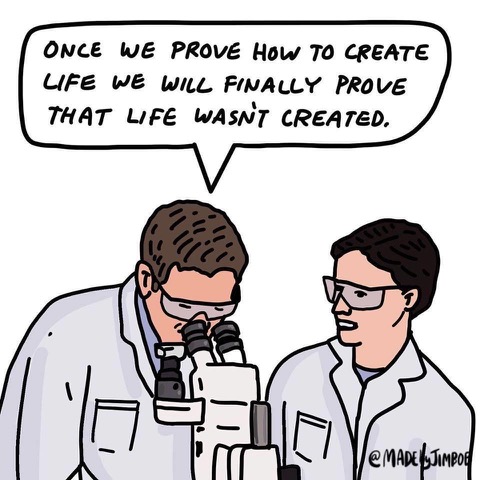
This ongoing failure strongly suggests that life’s origin lies beyond purely materialistic processes, and any honest evaluation must at least acknowledge the possibility of intelligent causation.
Once we see, however, that the probability of life originating at random is so utterly miniscule as to make it absurd, it becomes sensible to think that the favorable properties of physics on which life depends are in every respect deliberate … . It is therefore almost inevitable that our own measure of intelligence must reflect … higher intelligences … even to the limit of God … such a theory is so obvious that one wonders why it is not widely accepted as being self-evident.
Sir Fred Hoyle—Astrophysicist
If a scientist claimed that a wooden puppet came to life by random lightning strikes, or that snow spontaneously developed a consciousness, we’d rightly call it a fairy tale. Yet abiogenesis suggests that chemicals with no mind, intention, or code somehow generated information-rich, self-replicating systems capable of running, seeing, flying, and thinking.
By every standard, that’s a miracle—an event that defies natural explanation, occurs only once, and cannot be repeated. Ironically, the very thing secular science seeks to avoid—supernatural causation—it unwittingly mirrors by appealing to a naturalistic miracle. In this way, evolutionary theory becomes a religion of its own, with its own origin story, articles of faith, and explanatory miracles.
Challenge Question: If science—with all its intelligence, precision, and resources—cannot produce life from non-living matter, is it more reasonable to conclude that the origin of life points to a supernatural Creator rather than to unguided natural processes? Does the continued reliance on abiogenesis reflect scientific inquiry or a rejection of the theological implications of creation?
Premise 5: The Miracle Of Self Assembling Information
Historic Science: Law of Information that states information can only be produced by an intelligent sender.
Nature is saturated with systems that display specified, functional, and often encoded information—the hallmark of intelligence. From molecular biology to cosmic architecture, these examples suggest that the universe is not a random accident but reflects deep rationality and intentional structure.
This information is more sophisticated than anything else known to man, including the information used to assemble nuclear weapons, supercomputers, and space stations. Never in the history of mankind to modern day has instructional information used in the assembly of functional and complex systems been observed to originate mindlessly.
10 Complex Information Systems That Could Not Be The Product Of Random Chance
1. Genetic Regulatory Networks
DNA operates within a complex system of regulatory codes, on/off switches, and feedback loops—functioning like a multi-layered operating system. Evolution attributes these networks to unguided mutations and selection.
2. Protein Folding and Molecular Machines
Proteins fold into exact 3D shapes, and cellular machines like ATP synthase and the bacterial flagellum perform mechanical functions with precision. These are viewed as products of accumulated chance mutations filtered by selection.
3. The Fine-Tuning of the Universe
Physical constants and the fundamental forces are so precisely calibrated that even slight deviations would prevent life. Evolutionary cosmology attributes this to chance within a multiverse or anthropic principle framework.
4. The Cell’s Information Processing System
A single cell contains coordinated systems for data storage, transcription, translation, error correction, and energy management—yet evolution claims these systems arose through stepwise chemical evolution.
5. Photosynthesis
This intricate, multi-step process converts solar energy into usable chemical energy with near-perfect efficiency. Evolution holds that this system gradually formed by random variation and natural selection.
6. Neural Networks and the Brain
The human brain’s 86 billion neurons and trillions of synapses handle vast amounts of information instantly. Evolution posits that such systems developed gradually without foresight or intent.
7. The Genetic Code
The universal code that translates DNA into proteins functions like a digital programming language. Evolution asserts that this symbolic system emerged spontaneously from early chemical interactions.
8. Embryonic Development
A fertilized egg transforms into a complete organism through a tightly regulated and timed process. Evolutionary theory attributes this orchestration to genetic changes accumulated over time.
9. Planetary Systems and Orbital Mechanics
The Earth’s position, orbit, tilt, and rotation are finely tuned for life. These cosmic conditions are seen as the outcome of random events in planetary formation.
10. Ecosystem Interdependence
Complex networks of life—such as pollinators, food chains, and nutrient cycles—interact in delicate balance. Evolution attributes this coordination to co-evolution and adaptation over time.
There is no scientifically responsible way to attribute the origin of highly complex, specified information—such as that found in DNA, cellular systems, or the fine-tuned laws of physics—to random, blind natural processes. Random mutations, natural selection, and unguided chemical reactions have never been observed to produce meaningful, functional information or intricate systems of interdependent parts.
Information theory, empirical observation, and experience consistently show that complex information originates from intelligence, not chance. To claim otherwise departs from testable science and enters the realm of philosophical speculation.
There is no known law of nature, no known process, and no known sequence of events which can cause information to originate by itself in matter.
Werner Gitt— In the Beginning Was Information
While evolutionary theory often asserts that random mutations and natural selection can produce complexity over time, there is no empirical evidence that complex, specified information—like that found in DNA—can originate purely from unguided natural processes. Here’s why:
- Random Mutations as the Source of Innovation
- Claim: Mutations occur by chance and occasionally lead to beneficial traits that accumulate over time.
- Problem: Most mutations are neutral or harmful, and there’s no known mechanism for random copying errors to generate new, functional genetic code with the precision required for biological systems.
- Natural Selection as a Designer Substitute
- Claim: Natural selection “chooses” or “optimizes” traits for survival, mimicking the effect of intelligent design.
- Problem: Natural selection can only work on existing, functional genetic material—it cannot generate new functional information. Moreover, the language used (“selects,” “favors,” “designs”) falsely implies intent in what is actually a blind, undirected process.
- Cumulative Change Over Time (Time as a Creative Force)
- Claim: Over millions of years, small changes can accumulate into complex systems and structures.
- Problem: Time alone does not produce order. Without a guiding mechanism, increasing complexity over time is not inevitable. Many biological systems (e.g., the eye) require all parts to function together, making gradual development implausible.
- Information Arising from Chaos
- Claim: DNA and the complex genetic code originated from random chemical reactions in the prebiotic world.
- Problem: According to information theory, meaningful, functional information (like code or language) always arises from an intelligent source. There is no scientific evidence that random chemical interactions produce ordered, encoded information.
- Energy and Environment as Life-Giving Agents
- Claim: Life arose when energy (e.g., lightning, heat, or radiation) acted on simple molecules to form complex organic compounds.
- Problem: Energy alone does not organize matter into life—it tends to cause breakdown and disorder (entropy), not complexity or function. Without a guiding blueprint, energy disperses rather than constructs.
- Biological Innovation without Precedent
- Claim: Major evolutionary leaps—such as flight, vision, or consciousness—occurred gradually through micromutations and natural selection.
- Problem: These innovations require multiple interdependent parts functioning together, a concept known as “irreducible complexity.” Such leaps lack fossil intermediates and conflict with observed genetic limitations and entropy in real-time biology.
- Self-Organization from Matter
- Claim: Under certain conditions, matter naturally organizes into complex patterns (e.g., crystals or chemical cycles).
- Problem: These examples involve simple repetition, not the specified, hierarchical, and digital information like that found in DNA. Self-organization in physics is not equivalent to the formation of purposeful biological systems.
- Chance as a Creative Agent
- Claim: Given enough time, chance alone can account for the emergence of complexity in life.
- Problem: “Chance” is not a force; it’s a mathematical description of probability. Invoking chance as a cause is equivalent to saying “it just happened”—a non-explanation that avoids the need for evidence-based causation.
While science can describe how biological systems operate and adapt, it has never demonstrated that highly ordered, information-rich systems can originate through purely random, natural processes. To claim otherwise requires a level of faith in the improbable—something more akin to philosophical speculation than demonstrable science.

When traditional science and information theory have demonstrated that meaningful, purposeful information always originates from an intelligent source, yet naturalists insist that the terabytes upon terabytes of highly ordered, specifically coded information found throughout the living world arose spontaneously, randomly, and without intelligent direction, they contradict what empirical observation consistently reveals about the origin of information. To reject intelligent causation while insisting that such extraordinary biological information arose through unguided processes is the height of intellectual inconsistency.
The vast amount of complex genetic information, intricate design, and precisely ordered physical laws necessary for life to exist—all coming together in a fully operational system—is nothing short of miraculous. To suggest that nature somehow assembled these extraordinary elements through random, unguided processes is to propose something equally miraculous, even if naturalists refuse to call it a miracle.
Challenge Question: Given that information theory and empirical science consistently show that complex, functional information arises from intelligence—not random processes—should evolutionary explanations for the origin of DNA, cellular systems, and physical laws be reconsidered as philosophical speculation rather than scientific fact?
Premise 6: Evolution Requires “Faith” In The Unprovable
If evolutionist cannot use science and it’s laws to bring about the Universe, then he has , in reality given up on naturalism and become a believer in supernaturalism.
Jeff Miller; PhD Biomechanical Engineering, Auburn University
Naturalism is the belief that the existence of the Universe can be explained solely through some sort of natural evolutionary process. Creationism is the belief that God is the cause of the complexity, laws, design and diversity seen in science and nature.
Whereas Creationist do not apologize for invoking the words “faith” or “super-natural” in explaining the origin of the Universe—Evolutionists and modern science forbids invoking faith or the supernatural when explaining creation or the origin of the Universe—they have even litigated before the Supreme Court to make sure it doesn’t happen in the public square.
Careful analysis of the major tenets of the Theory of Evolution are not provable nor have they been observed.
This raises the question—Are they fact based or are they faith based?
Faith
Merriam Webster
Firm belief in something for which there is no proof
To fully embrace the evolutionary worldview, one must place faith in several key assumptions—none of which have been directly observed or scientifically demonstrated. The core beliefs one must accept to be an evolutionist:
- Faith that the intricate design observed in nature requires no Designer
- Faith that the universe came from nothing, by nothing, for nothing
- Faith that matter is either eternal or self-created
- Faith that the laws of physics arose without a Lawgiver
- Faith that the extraordinary fine-tuning of the universe needs no Fine-Tuner
- Faith that non-living matter can spontaneously generate life (abiogenesis)
- Faith that complex, information-rich genetic codes emerged through random processes
- Faith that functional instructional information came about by chance alone
- Faith that molecular machines within cells self-assembled unaided
- Faith that consciousness arose from non-conscious matter
- Faith that human beings evolved from bacteria through a series of unguided steps
- Faith that plants and animals all share common ancestry
If any of these claims did not occur, then the entire naturalistic evolutionary framework begins to unravel. Ironically, while critics often accuse creationists of blind faith, these evolutionary tenets require just as much—if not more—faith in the unseen, the unproven, and the unexplained.
Does The Theory Of Evolution Require Faith In Concepts For Which There Is Not Proof ?
It is increasingly common for prominent evolutionary scientists to give lectures, publish books, or produce documentaries in which sweeping, unprovable claims are presented as settled science. These explanations often rely on assumptions that have never been observed, cannot be tested, and in some cases, directly conflict with well-established laws of physics—such as the law of biogenesis or the second law of thermodynamics.
Yet, those in the audience—whether readers, listeners, or viewers—are frequently pressured to accept these claims without question. Any skepticism is often dismissed as unscientific or intellectually inferior. Ironically, this approach demands a kind of blind faith in naturalistic explanations, even when they lack empirical support or contradict observable reality.
We have no evidence about what the first step in making life was, but we do know the kind of step it must have been. It must have been whatever it took to get natural selection started…by some process as yet unknown
Richard Dawkins
Because there is a law like gravity, the universe can and will create itself from nothing in the manner described in Chapter 6. Spontaneous creation is the reason there is something rather than nothing, why the universe exists, why we exist.
Stephen Hawking; The Grand Design
The fact that life evolved out of nearly nothing, some 10 billion years after the universe evolved out of literally nothing, is a fact so staggering that I would be mad to attempt words to do it justice
Richard Dawkins; Author of The Blind Watchmaker
While often presented as a purely scientific framework, the theory of evolution actually requires a substantial degree of faith—akin to religious belief. This is because many of its core claims rely on events and processes that not only remain unproven but also violate established scientific principles and have never been observed to occur in nature.
Despite the absence of direct empirical evidence for these foundational claims—such as life arising from non-living matter or complex information emerging by chance—evolutionists continue to assert their validity. This commitment is rooted in philosophical naturalism: the belief that nature is all that exists, and that every phenomenon must be explained exclusively through material causes, even when the evidence may suggest otherwise.
All of us who study the origin of life find that the more we look into it, the more we feel that it is too complex to have evolved anywhere. We believe as an article of faith that life evolved from dead matter on this planet. It is just that its complexity is so great, it is hard for us to imagine that it did.
Harold Urey—Nobel Laureate in Chemistry
This kind of belief, based on non-observable, non-repeatable, and often contradictory claims, mirrors the structure of religious faith. Yet unlike theistic faith—which openly acknowledges its metaphysical foundation—evolution often masks its assumptions in scientific language while bypassing the very scientific standards it claims to uphold.
Evolution vs. Creation: A Faith-Based Comparison
| Core Tenets | Evolutionary Explanation (Naturalism) | Creationist Explanation (Theism) |
|---|---|---|
| Origin of the Universe | Universe came from nothing via unknown natural processes | Universe was created by an intelligent, eternal Cause (God) |
| Origin of Life | Life emerged spontaneously from non-living matter (Abiogenesis) | Life was created by a living Creator, consistent with biogenesis |
| Origin of Complex Information | Genetic information arose through random mutations and natural selection | Genetic information was encoded by a Designer with purpose |
| Origin of Consciousness | Consciousness emerged from non-conscious matter through gradual evolution | Consciousness is the result of being made in the image of a conscious God |
| Origin of Species | All species evolved from a common ancestor through unguided mechanisms | Species were created according to kinds with built-in boundaries |
| Unobservable Events in the Past | Relies on historical assumptions that cannot be directly tested or repeated | Affirms historical acts of creation based on divine revelation |
| Requires Faith in Unseen Processes | Must trust in undirected processes never observed to produce complexity | Belief in unseen creation acts based on faith in the Creator |
| Violates Known Scientific Laws | Contradicts the law of biogenesis and the second law of thermodynamics | Acknowledges miracles that transcend physical laws, consistent with theolog |
Similarities of Evolution to Religion is Not Going Unnoticed
With the failure of these many efforts to explain the origin of life, science was left in the somewhat embarrassing position of having to postulate theories of living origins which it could not demonstrate. After having chided the theologian for his reliance on myth and miracle, science has found itself in the unenviable position of having to create a mythology of its own.
Loren Eisely, The Immense Journey (New York; Random House)
The fact of evolution is the backbone of biology, and biology is thus in the peculiar position of being a science founded on an unproved theory—is it then a science or a faith? Belief in the theory of evolution is thus exactly parallel to belief in special creation—both are concepts which believers know to be true but neither, up to the present, has been capable of proof.
Matthews L. Harrison; British biologist and Fellow of the Royal Society
Unfortunately many scientists and non-scientists have made Evolution into a religion, something to be defended against infidels. In my experience, many students of biology—professors and textbook writers included—have been so carried away with the arguments for Evolution that they neglect to question it. They preach it…
George Kocan; Evolution Isn’t Faith But theory, Chicago Tribune
As scientific knowledge advances—particularly in fields like genetics, molecular biology, and information theory—the foundational assumptions of the Theory of Evolution are coming under growing scrutiny. Key claims, such as the spontaneous origin of life, the rise of complex information through random mutations, and the gradual development of intricate biological systems, remain unobserved, unrepeatable, and often contradict known scientific laws.
Because these critical components rely on unproven assumptions about events in the distant, unobservable past, many now recognize that evolutionary theory functions less like a testable scientific model and more like a philosophical worldview or secular faith system. It requires belief in things that have never been witnessed, and trust in mechanisms that are speculative at best.
Faith in infrequent events and luck is not science. The origin of life is unsolved by chemistry and physics.
Hubert P. Yockey, Information Theory and Molecular Biology
Ironically, in its effort to exclude supernatural explanations, evolution has adopted its own kind of dogma—complete with unchallenged doctrines, blind faith in material causes, and an intolerance for dissenting views. In this light, evolution is increasingly seen not as a purely scientific theory, but as a naturalistic belief system that mirrors many aspects of religion: it answers ultimate questions, demands allegiance to a particular narrative of origins, and depends on faith in what cannot be empirically verified.
Thus, the more science advances, the more it becomes clear that the Theory of Evolution—far from being a neutral, objective explanation—is deeply rooted in metaphysical assumptions. It is not science in its purest form, but a belief about science shaped by philosophical commitments, and in that sense, it bears a striking resemblance to religion.
Challenge Question: The Theory of Evolution is built upon unobservable events, unproven assumptions, and a commitment to philosophical naturalism—the very reasons often cited for excluding Creationism from the classroom. Is this a fair standard? Or, in the interest of intellectual honesty and critical thinking, should both perspectives allowed to be presented and examined side by side?
Premise 7: Science Is Pointing To A Supernatural Cause
su·per·nat·u·ral
/ˌso͞opərˈnaCH(ə)rəl/
attributed to some force beyond scientific understanding or the laws of nature.
Over the past half-century, major scientific advances—particularly in fields like genetics, cosmology, and information theory—have led to a significant re-evaluation of the Theory of Evolution among young scientists around the world. This growing reassessment is not limited to long-time evolutionists seeking to address the increasing number of gaps in the theory, but also includes a rising generation of researchers who are beginning to question whether the origins of the universe and life can truly be explained by natural processes alone.
In his book Science at the Doorstep to God, physicist and philosopher Robert Spitzer highlights this shift. He documents how modern scientific discoveries are no longer driving young minds away from belief in God; rather, they are drawing many toward the conclusion that a transcendent, intelligent cause is the most reasonable explanation for the existence and fine-tuning of the universe. More and more, science is pointing not away from faith, but toward God as the ultimate source of life and the cosmos.
Although a biologist, I must confess I do not understand how life came about…I consider that life only starts at the level of a functional cell. The most primitive cells may require at least several hundred different specific biological macro-molecules. How such already quite complex structures may have come together, remains a mystery to me. The possibility of the existence of a creator, of God represents to me a satisfactory solution to this problem.
Werner Arber Ph.D; Microbiologist and Geneticist; Nobel Prize Physiology
2 Reasons A New Generation Of Scientists Are Increasingly Open To Belief In God
- Among young physicists there is considerable awareness of the need for something like transcendent intelligence to explain the occurrence of the finely-tuned initial conditions and constants being perfectly in place when life first developed
- Quantum physics, the correlation of physical laws and other non-reduction evidence imply that a “mindlike” dimension of our universe is fundamental than strictly physical processes in structure.
2 Reasons A New Generation Of Scientists Are Less Confident In Evolution
- They do not like the way evolutionist scientist continually default to pseudo-scientific explanations to explain things that the pure Laws of Science do not support
- Resistance to peer pressure that forces them to agree and promote pseudo-scientific explanations to explain things that the pure Laws of Science do not support
Any suppression which undermines and destroys that very foundation on which scientific methodology and research was erected, evolutionist or otherwise, cannot and must not be allowed to flourish … It is a confrontation between scientific objectivity and ingrained prejudice – between logic and emotion – between fact and fiction … In the final analysis, objective scientific logic has to prevail – no matter what the final result is – no matter how many time-honoured idols have to be discarded in the process …
I L Cohen; New York Academy of Sciences and Officer of the Archaeological Institute of America
After all, it is not the duty of science to defend the theory of evolution and stick by it to the bitter end -no matter what illogical and unsupported conclusions it offers …If in the process of impartial scientific logic, they find that creation by outside intelligence is the solution to our quandary, then Let’s cut the umbilical cord that ties us down to Darwin for such a long time.It is choking us and holding us back … Every single concept advanced by the theory of evolution (and amended thereafter) is imaginary as it is not supported by the scientifically established probability concepts.
Darwin was wrong… The theory of evolution may be the worst mistake made in science.”
Historically Science Was Viewed as a Path Toward God
Most people are unaware that many of the most renowned scientists in the history of modern discovery were not only deeply religious but also outspoken theists. These pioneers of science—including figures like Isaac Newton, Johannes Kepler, Blaise Pascal, Robert Boyle, and James Clerk Maxwell—believed that the universe and life itself were the result of a higher, intelligent power. Far from seeing science and faith as opposites, they viewed their scientific work as a means of uncovering the order, design, and rationality embedded in creation by its divine Author.
Great are the works of the Lord…studied by all who delight in them
Psalm 111:2For these great minds, scientific exploration was an act of worship—an effort to understand the laws of nature precisely because they believed those laws were established by a Creator. They saw no conflict between faith and reason; rather, their belief in an orderly, rational God gave them the confidence that the universe itself was orderly and intelligible. Studying nature was, in their view, a way to think God’s thoughts after Him—deciphering the intricate patterns and principles He had woven into creation. Their spiritual conviction was not a hindrance to science, but a powerful motivation behind it.
He who thinks half-heartedly will not believe in God; but he who really thinks has to believe in God
Sir Isaac Newton
Seventeen of the “Top 20 Scientist of All Time” are self-proclaimed theist that believed God created the universe. Seventy-Five percent of all the Noble Prize Winners in science have been self-proclaimed theist that also believe that God created the Universe. Every founder of every major discipline of science believed in God as creator.
| Scientist | Founder Of: | About Science and God |
| Isaac Newton | Father of Theoretical Physics | “The universe could only have come from the plan of an omniscient being” |
| Carl Linnaeus | Father of Systematic Botany | “God created, Linnaeus ordered them” |
| Robert Boyle | Father of Modern Chemistry | “God is the author of the Universe” |
| Johannes Kepler | Father of Laws of Motion | “The rational order and harmony has been revealed by God in the language of mathematics” |
| Albert Einstein | Father of Modern Physics | “In all the laws of the universe manifest a spirit vastly superior to man” |
| Max Planck | Father of Quantum Physics | “For the believer God stands at the beginning of their speeches; for the physicist at the end” |
| Robert Mayer | Father of Law of Conservation | “True science can not be anything but an introduction to the Christian religion” |
| Louis Pasteur | Father of Pasteurization | “Too little science leads away from God, while much science leads back to them” |
| Gregor Mendel | Founder of Genetics | |
| Gottfried Leibniz | Father of Calculus | The knowledge of God is no less the beginning of Science |
Nobel Prize–Winning Theists on God and Science
Based on available data, a significant majority of Nobel Prize winners in the sciences have identified as theists, particularly within the Christian tradition. According to Baruch Shalev’s comprehensive study 100 Years of Nobel Prizes, covering the period from 1901 to 2000, the distribution of religious affiliations among Nobel laureates in scientific fields is as follows:
- Chemistry: Approximately 72.5% identified as Christians.
- Physics: Around 65.3% had a Christian background.
- Medicine (Physiology or Medicine): About 62% were Christians.
In contrast, atheists, agnostics, and freethinkers comprised a smaller percentage of laureates in these scientific disciplines:
- Chemistry: Approximately 7.1%
- Physics: Around 4.7%
- Medicine: About 8.9%
These figures suggest that belief in a higher power was not only common but well represented among Nobel laureates in the sciences throughout the 20th century. Far from being an obstacle to scientific achievement, theistic belief—particularly within the Judeo-Christian tradition—has often inspired and guided some of the most brilliant scientific minds in modern history.
Despite this, evolutionists and secular critics have frequently portrayed creationists as “unscientific” or “anti-intellectual.” However, this characterization is a misleading stereotype, not grounded in historical fact. Many of the greatest scientific pioneers were committed theists who saw no conflict between their faith in God and their pursuit of scientific knowledge. The idea that belief in a Creator disqualifies one from serious scientific inquiry is not only false—it ignores the legacy of centuries of theist scientists who laid the very foundations of modern science.
| Name | Nobel Prize and Year | Quote |
|---|---|---|
| Albert Einstein | Physics, 1928 | “Science without religion is lame, religion without science is blind” |
| Arthur Compton | Physics, 1927 | “For myself, faith begins with the realization that a supreme intelligence brought the universe into being and created man. It is not difficult for me to have this faith, for an orderly, intelligent universe testifies to the greatest statement ever uttered: ‘In the beginning God…’” |
| Anthony Hewish | Physics, 1978 | “The ghostly presence of virtual particles defies rational common sense and is non-intuitive for those unacquainted with physics. Religious belief in God, and Christian belief that God became man around two thousand years ago, may seem strange to common-sense thinking. But when the most elementary physical things behave in this way, we should be prepared to accept that the deepest aspects of our existence go beyond our common-sense understanding.” |
| Max Planck | Physics, 1918 | “Both religion and science require a belief in God. For believers, God is in the beginning, and for physicists He is at the end of all considerations… To the former He is the foundation, to the latter, the crown of the edifice of every generalized world view.” |
| Werner Heisenberg | Physics, 1932 | “The first gulp from the glass of natural sciences will turn you into an atheist, but at the bottom of the glass God is waiting for you.” |
| Charles Townes | Physics, 1964 | “As a religious person, I strongly sense the presence and actions of a creative being far beyond myself and yet always personal and close by… I believe science is consistent with—and often enhances—faith in a Creator.” |
| Joseph Murray | Medicine, 1990 | “My faith is a part of me. I see the design in the universe and the beauty of it, and it’s clear to me that this is God’s work.” |
| Sir John Eccles | Medicine, 1963 | “Science and religion are not antagonists, but complementary fields of inquiry. I am a believer in the primacy of the spiritual self and in a Divine Being who created the universe and gave purpose to life.” |
| William D. Phillips | Physics, 1997 | “I believe in God. In fact, I believe in a personal God who acts in and interacts with the creation… I believe that the observations about the orderliness of the physical universe… suggest that an intelligent Creator is responsible.” |
| Arthur Schawlow | Physics, 1981 | “It seems to me that when confronted with the marvels of life and the universe, one must ask why and not just how. The only possible answers are religious… The context of religion is a great background for doing science.” |
| Robert Millikan | Physics, 1923 | “I can assert most definitely that the denial of faith lacks any scientific basis. In my view, there will never be a true contradiction between faith and science.” |
| Ernest Walton | Physics, 1951 | “One way to learn more about God is to study His works. It is evident that an orderly, intelligent being has created the universe and our own existence.” |
| Werner Arber | Medicine, 1978 | “The possibility of the existence of a Creator, of God, represents to me a satisfactory solution to this problem [of the origin of complex biological structures].” |
| Ernst Boris Chain | Medicine, 1945 | “I have said for years that speculations about the origin of life lead to no useful purpose as even the simplest living system is far too complex to be explained by evolution. I am convinced that life is far too complex to have originated from chance.” |
These world-changing scientists did not see a conflict between their faith in God and their scientific work—in fact, they believed that the order and intelligibility of the universe pointed toward an intelligent Creator. These were all brilliant rigorous scientist that rejected the idea that life could be explained solely by material processes and openly affirmed belief in a purposeful Creator.
Science may explain the world, but we still have to explain science. The laws which enable the universe to come into being spontaneously seem themselves to be the product of exceedingly ingenious design. If physics is the product of design, the universe must have a purpose, and the evidence of modern physics suggests strongly to me that the purpose includes us.
Paul Davies—Physicist, Winner of Templeton, Kelvin, and Faraday Prizes
As scientific understanding deepens, it is becoming increasingly clear that some of the most fundamental questions—such as the origin of physical laws, consciousness, and meaning—may remain unanswerable by science alone because their answers lie beyond the boundaries of the natural world. These enduring mysteries suggest that science, rather than disproving the need for a Creator, may actually point toward one.
Challenge Question: Are the advancements of science revealing that the reason the following questions can’t be answered or proven scientifically is because the answers lie outside of nature?
- How did the universe burst into existence on it’s own and where did the matter that caused the Big Bang come from?
- Why does life only exists on earth- Even though other celestial bodies were created out of the same energy and matter of the Big Bang
- How can their be precision without a precisionist-The universe shows fine tuning and obeys fixed laws which do not orginate through random processes
- How can the programmed information in DNA organize itself randomly?
- How could the first complex cell assemble itself randomly from a prebiotic soup?
- Why do the world’s major fossil beds reveal the sudden appearance of every type of animal on the taxonomic tree all together?
- How did the fixed Laws of Physics and the 26 essential constants required for life on earth just occur randomly and precisely the moment the Universe came into existence?
ThinkCube Truth Veracity Grid
- Have I considered the facts carefully and with an open mind?
- Is my conclusion the result of a careful examination of the facts, or is it a conclusion made in spite of the facts?
- Is my conclusion the one that makes the most sense of the evidence?