Premise 1: The Old Testament Is The The Best Preserved Text From Antiquity
Historians evaluate the reliability of ancient documents using three primary factors: the number of surviving manuscripts, the age of those manuscripts, and the consistency of the text across copies. By all three measures, the Old Testament stands in a class of its own.
First, the Bible is supported by an extraordinary number of manuscripts and textual witnesses. While Homer’s Iliad is often considered one of the best-preserved works of classical antiquity with approximately 1,800 manuscripts, the biblical text is supported by tens of thousands of manuscripts, fragments, ancient translations, and quotations preserved across multiple languages and regions.
Second, the manuscripts are remarkably ancient. Some Old Testament fragments date to around 600 B.C., placing them unusually close to the events they record. The discovery of the Dead Sea Scrolls provided approximately 900 manuscripts and fragments, many dating from the third century B.C. In addition, the Cairo Geniza yielded more than 250,000 fragments of biblical and Jewish writings, providing scholars with an unparalleled body of textual evidence.
Third, the biblical text demonstrates exceptional consistency across centuries of transmission. Many ancient works survive only through copies produced 500 to 1,500 years after their originals. By contrast, the Old Testament can be compared against thousands of manuscripts spanning centuries, allowing scholars to identify copying variations and confirm the remarkable stability of the text.
The contrast with other ancient literature is striking. Plato’s Tetralogies, for example, survive in only about 210 manuscripts, with the earliest complete copies appearing more than 1,200 years after Plato’s lifetime. No other work from antiquity possesses the combination of manuscript quantity, antiquity, and textual consistency found in the Hebrew Scriptures.
For this reason, many scholars regard the Old Testament as the most thoroughly preserved and textually verified body of literature from the ancient world. Before asking whether the Bible’s message is true, it is important to recognize that few ancient documents are supported by evidence of preservation that even approaches that of Scripture.
Evidence for the Old Testament’s Exceptional Textual Reliability
| Factor | Details |
|---|---|
| Manuscript Quantity | Thousands of Hebrew manuscripts, plus ancient translations (Greek Septuagint, Aramaic Targums, Latin, Syriac). Far more than any other pre-Christian text. |
| Manuscript Age | The Dead Sea Scrolls (dated ~250 BC to 70 AD) include portions of every Old Testament book except Esther. These are 1,000 years older than previously known Hebrew manuscripts and show remarkable consistency. |
| Geographic Spread | Texts and fragments found across Israel, Egypt, Qumran, and Mesopotamia, showing broad transmission and preservation. |
| Scribal Tradition | The Jewish Masoretes (6th–10th century AD) preserved the Hebrew text with extreme precision, verifying consonants, vowel points, word counts, and middle letters. |
| Historical Citations | Quoted extensively in ancient Jewish writings, early Christian writings, and inscriptions. Jesus and the New Testament writers quote from nearly every Old Testament book. |
Comparison to Other Ancient Writings
| Work | Earliest Copy | Time Gap from Original | # of Copies |
|---|---|---|---|
| Homer’s Iliad | ~400 BC | ~500 years | ~1,800 |
| Herodotus’ Histories | ~900 AD | ~1,300 years | ~100 |
| Plato’s writings | ~900 AD | ~1,200 years | ~7 |
| Old Testament (e.g., Isaiah) | ~125 BC (Dead Sea Scrolls) | ~700 years | Thousands (Hebrew + Versions) |
No other pre-Christian document compares in terms of transmission reliability and textual support. This is due to the exceptional care with which the Hebrew Scriptures were copied, preserved, and transmitted over the centuries. Ancient Jewish scribes, especially the Masoretes, developed intricate methods to ensure textual accuracy—including counting verses, words, and even individual letters. The discovery of the Dead Sea Scrolls—containing Old Testament manuscripts over a thousand years older than previously known copies—confirmed the remarkable consistency of the text across centuries. In contrast, other ancient works often have fewer surviving manuscripts, longer gaps between original composition and earliest copies, and greater textual variation. The Old Testament stands alone as a uniquely preserved and faithfully transmitted document, providing an unparalleled level of textual confidence among ancient writings.
Old Testament Manuscripts that Have Been Discovered And Used to Compose Modern Bible Translations
| Name | Date Of Copies | Bible Books |
| Dead Sea Scrolls | 250 BC-AD 68 | 900 biblical manuscripts from every book of the Old Testament except Esther |
| Isaiah Scroll A | 150-100 B.C | Complete Copy of the book of Isaiah |
| Rylands Papyrus 458 | 150 BC | Contains Greek portions of Deuteronomy 23-28 |
| Nash Papyrus | 150 BC-AD | Portion of the Decalogue (Exodus 20); Deuteronomy 5:6-21; Shema (Deuteronomy 6:4-9) |
| Peshitta | AD 100-200 | Entire Old Testament in Syriac |
| Codex Vaticanus | AD 325 | Entire Greek Old Testament except portions of Genesis, 2 Kings, Psalms |
| Codex Ephraemi Rescriptus | AD 345 | Contains Job, Proverbs, Ecclesiastes, Song of Solomon |
| Codex Sinaiticus | AD 350 | Half of the Old Testament in Greek |
| Latin Vulgate | AD 390-405 | Entire Old Testament in Latin |
| Codex Alexandrinus | AD 450 | Entire Old testament in Greek |
| Codex Cairensis | AD 850 | Joshua, Judges, Samuel, Kings, Isaiah, Jeremiah, Ezekiel, Hosea, Joel, Amos, Obadiah, Jonah Micah, Nahum, Habakkuk, Zephaniah, Haggai, Zechariah, and Malachi |
| Aleppo Codex | AD 900 | Complete Hebrew Old Testament |
| Codex Leningradensis | AD 1008 | Complete Hebrew Test Of Old Testament |
| Samaritan Pentateuch | 10th-11th Century AD | Genesis, Exodus, Leviticus, Numbers, Deuteronomy |
Remarkable Facts Concerning these Ancient Manuscripts
- They were written in a whole range of nations (Syria, Egypt, Rome, Israel, Africa, Greece, Armenia, Georgia, China)
- They were written in the most common languages of the day such as Greek, Hebrew, Latin, and Syriac, Coptic, Ethiopic, Slavic, and Gothic.
- There are copies from every century since 600 B.C. to 1 A.D
Most astonishingly, the Dead Sea Scrolls and the later Masoretic manuscripts agree with each other in over 90% of their textual content. This remarkable level of agreement serves as powerful verification that they originated from a common textual ancestor and were transmitted with extraordinary faithfulness over the centuries. These manuscripts form the very foundation of nearly all major modern Bible translations, including the New American Standard Bible (NASB), New International Version (NIV), English Standard Version (ESV), and even the King James Version (KJV).
Before the discovery of the Dead Sea Scrolls in 1946, the earliest complete Old Testament manuscripts available were from the Masoretic Text, dated to approximately AD 980–1008. The scrolls unearthed in the Qumran caves—over 15,000 fragments representing more than 900 manuscripts—include portions of every Old Testament book except Esther. When paleographers conducted detailed side-by-side comparisons of these ancient scrolls with the Masoretic Text, they were astonished by the consistency. Despite a millennium of copying and transmission, the biblical text had changed very little, providing strong evidence of its textual integrity across time.
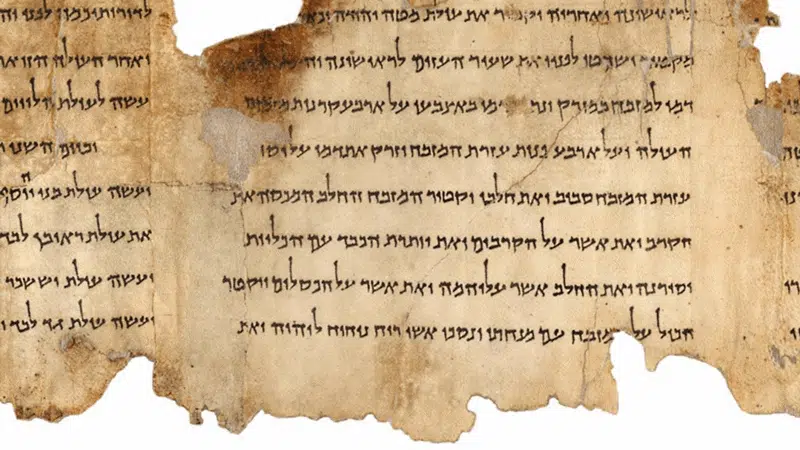
In the Chart below you will find literal translation of Genesis 1:18-20 from the 1Q1 Genesis Scroll that were written in Hebrew then translated to English side by side with the King James Version which is the most read version of the Bible in the world. This side by side comparison is an example of the word for word translation philosophy used by translators to compose most modern Bible translations.
Dead Sea Scroll Fragment Comparison: Genesis 1:19–20
| Dead Sea Scroll Fragment | Date Written | Literal Translation (Hebrew to English) | King James Version |
|---|---|---|---|
| 1Q1 Genesis 1:19–20 | 30 B.C. | 19 There was evening and there was morning, a fourth day. 20 God said, “Let the waters abound with living creatures, and let birds fly above the earth in the open expanse of the sky.” | 19 And the evening and the morning were the fourth day. 20 And God said, Let the waters bring forth abundantly the moving creature that hath life, and fowl that may fly above the earth in the open firmament of heaven. |
It is a matter of wonder that through something like a thousand years the text underwent so little alteration.
FF Bruce: British Biblical Scholar; Cambridge University
The enormous number of surviving biblical manuscripts—far surpassing that of any other ancient text—has enabled scholars to reconstruct the original text of the Bible with extraordinary precision. Through careful comparison of thousands of manuscripts, versions, and fragments across centuries and regions, experts have determined that over 99% of the words in the Bible are textually certain. The remaining less than 1% consists primarily of minor variations in spelling, word order, or scribal slips—none of which affect any core doctrine, historical claim, or theological teaching of the Christian faith. This unparalleled textual integrity underscores the Bible’s reliability and demonstrates that what we hold in our hands today faithfully reflects what was originally written.
Challenge Question : How does the extraordinary textual reliability of the Old Testament influence our confidence in the Bible’s historical and theological claims, especially compared to other ancient writings?
Premise 2: The New Testament Has Been Preserved In More Manuscripts Than Any Other Ancient Work
Paleographers are specialized historians who study ancient handwriting, manuscripts, and textual traditions to determine the age, origin, and authenticity of historical documents. Their work is critical in reconstructing ancient texts, identifying scribal habits, and tracing the transmission of literature across centuries. Paleographers use tools such as ink composition analysis, writing style comparison, parchment dating, and codicology (the study of ancient book structures) to examine ancient writings with great precision.
In addition to biblical manuscripts, paleographers examine a wide array of significant literary, historical, and legal texts, including:
Ancient Texts and Paleographic Evidence
| Work | Date Range (Approx.) | Estimated Manuscript Count |
|---|---|---|
| New Testament | 50–100 AD | 24,000+ total |
| Old Testament (Hebrew Bible) | 1400–400 BC | 10,000+ |
| The Iliad (Homer) | 800 BC | ca. 1,800 |
| The Odyssey (Homer) | 700 BC | ca. 1,000 |
| Beowulf | 700–1000 AD | 1 complete, ca. 30 fragments |
| The Epic of Gilgamesh | 2100–1200 BC | ca. 100 clay tablets/fragments |
| Shakespeare’s Folios & Quartos | 1590–1623 AD | 200+ |
| Plato’s Dialogues | 380–350 BC | ca. 200 |
| Aristotle’s Corpus | 350–322 BC | ca. 200 |
| Julius Caesar’s Gallic Wars | 58–50 BC | ca. 49 |
| Cicero’s Orations & Letters | 80–43 BC | ca. 300 |
| Livy’s History of Rome (Ab Urbe Condita) | 27 BC – 9 AD | ca. 100 |
| Tacitus’s Annals and Histories | 100–120 AD | ca. 20 |
| Tacitus’s Annals of Imperial Rome | 100–120 AD | ca. 20 (included in above count) |
| Suetonius’s The Twelve Caesars | 121 AD | ca. 8 |
| Pliny the Younger’s Letters | 100–113 AD | ca. 7 |
| Thucydides’s History of the Peloponnesian War | 431–400 BC | ca. 96 |
| Sophocles’s Assorted Works | 496–406 BC | ca. 193 |
| Aristophanes’s Assorted Works | 446–386 BC | ca. 46 |
| Corpus Juris Civilis (Justinian Code) | 529–534 AD | ca. 15 |
The classical works listed on the charts are housed in the most respected Libraries and Universities in the world and are accepted as primary sources for the historical events they document even though most have less than a dozen manuscripts to compare and were authored by people who did not live during the times or events they write about.
The New Testament, by contrast, enjoys more manuscript support than any other ancient work—over 24,000 textual witnesses in Greek, Latin, Syriac, Coptic, and other early languages. This is more than ten times the manuscript evidence for its nearest competitor. Moreover, the New Testament was written by eyewitnesses and their close companions, all of whom lived during the lifetime of Jesus and the events they record.
We have more than 1,000 times the manuscript data for the
Dan Wallace; Executive Director Center for the Study of New Testament manuscripts
New Testament than we do for the average Greco-Roman author
Manuscripts Can Be Found In The World’s Most Prominent Museums, Libraries and Universities
The preservation of over 35,000 Old and New Testament manuscripts is one of the most remarkable achievements in textual history. These priceless documents are housed in many of the world’s most prestigious museums, universities, and national libraries, where they are studied, safeguarded, and displayed. The chart below highlights key institutions across the globe that hold significant biblical manuscript collections—ranging from ancient Hebrew scrolls and Greek papyri to medieval codices and early printed Bibles.

The Museum of the Bible in Washington, D.C., spans an impressive 430,000 square feet and stands just three blocks from the U.S. Capitol. Spread across eight floors. Since its opening in 2017, the museum has attracted visitors from around the world with thousands of biblical artifacts, ancient manuscripts, interactive exhibits, and state-of-the-art technology, making it one of the most extensive and engaging religious museums in the world.
Other Global Institutions Housing Old & New Testament Manuscripts
| Institution / Library | Country / Region | Notable Holdings |
|---|---|---|
| The British Library (UK) | United Kingdom | Codex Sinaiticus (partial), extensive NT manuscripts |
| The Vatican Library | Vatican City | Codex Vaticanus, ancient OT/NT manuscripts |
| Israel Museum – Shrine of the Book | Israel | Dead Sea Scrolls, including the complete Isaiah scroll |
| Library of Congress | United States | Biblical manuscript facsimiles and historical collections |
| Bodleian Library, Oxford University | United Kingdom | Biblical papyri, early Old Testament texts |
| Chester Beatty Library | Ireland | Biblical papyri, early Gospel fragments |
| Cambridge University Library | United Kingdom | Cairo Geniza texts, early Hebrew manuscripts |
| National Library of Russia (St. Petersburg) | Russia | Codex Leningrad facsimiles, Greek biblical texts |
| Bibliothèque nationale de France | France | Greek biblical papyri and Old Testament fragments |
| University of Leipzig | Germany | Codex Friderico-Augustanus (part of Codex Sinaiticus) |
| University of Michigan Library | United States | Papyrus fragments of Pauline epistles |
| Princeton University Library | United States | Greek New Testament papyri, Septuagint fragments |
| Duke University – Rubenstein Library | United States | Early New Testament manuscripts and scrolls |
| Yale University – Beinecke Rare Book Library | United States | Rare Old Testament manuscripts and early papyri |
| Harvard University – Houghton Library | United States | Ancient versions of both OT and NT |
| Austrian National Library | Austria | Greek biblical codices, early Latin texts |
| University of Tübingen | Germany | Coptic and Greek New Testament manuscripts |
To be skeptical of the resultant text of the New Testament books is to
John Warwick Montgomery: Lawyer, Professor, Theologian
allow all of classical antiquity to slip into obscurity, for no documents of
the ancient period are as well attested bibliographically as the New Testament.
This vast and well-preserved manuscript tradition not only affirms the Bible’s unparalleled historical reliability but also testifies to God’s providential care in preserving His Word across millennia. The global distribution of these manuscripts—across cultures, languages, and centuries—underscores the enduring significance of Scripture and its impact on human civilization. Far from being lost, altered, or corrupted, the biblical text has been faithfully transmitted, studied, and protected, ensuring that believers today can read the same truths that were inspired, recorded, and passed down through generations.
Challenge Question: What does the global preservation and widespread study of biblical manuscripts reveal about the historical reliability and enduring significance of the Bible?
Premise 3: Textual Experts Conclude the Bible Is 99% Accurate
Paleographers and textual critics use a variety of scientific, historical, and linguistic tools and methods to determine the remarkable accuracy of the biblical text over time. These processes are designed to trace, compare, and reconstruct the original wording of ancient manuscripts with a high degree of confidence. By analyzing everything from handwriting styles and ink composition to the physical structure and geographical distribution of manuscripts, scholars are able to pinpoint scribal changes, detect copyist errors, and restore the most authentic form of the text possible.
Tools and Processes Used by Paleographers and Textual Scholars
| Process / Tool | Purpose |
|---|---|
| Paleography (handwriting analysis) | Dating manuscripts by analyzing script styles, ink flow, and writing materials. |
| Codicology | Studying the physical structure of manuscripts (binding, layout, foliation). |
| Textual Criticism | Comparing multiple manuscripts to identify and eliminate errors or variations. |
| Collation of Manuscripts | Line-by-line comparison of texts across manuscript families to track changes. |
| Carbon-14 Dating | Dating parchment or papyrus scientifically to determine manuscript age. |
| Ink and Material Analysis | Examining ink composition and writing surfaces (papyrus, parchment) to validate authenticity. |
| Internal Evidence Analysis | Evaluating grammar, vocabulary, context, and scribal tendencies. |
| External Evidence Evaluation | Assessing manuscript age, geographic distribution, and textual family lineage. |
| Critical Editions (e.g., Nestle-Aland, Biblia Hebraica Stuttgartensia) | Publishing scientifically reconstructed versions of the original text using all known evidence. |
| Digital Imaging / Multispectral Scanning | Recovering faint or damaged text not visible to the naked eye. |
| Stemmatics (Textual Genealogy) | Creating “family trees” of manuscripts to trace the development of variations. |
These tools enable scholars to:
- Detect and correct scribal errors.
- Distinguish original readings from later additions.
- Reconstruct the earliest attainable text of the Bible.
- Demonstrate consistent transmission accuracy across time and geography.
Claims That Bible Has Been Corrupted Over Time Are Inaccurate
As a result of this rigorous and multi-disciplinary approach, experts have concluded that the Bible has been transmitted with over 99% accuracy. The few remaining textual variants—none of which alter any essential doctrine—are well-documented and continually studied in published critical editions. This meticulous process not only reinforces the integrity of the biblical text but also sets it apart as one of the most reliably preserved works of antiquity.
Scholarly consensus—shared by both conservative theologians and secular textual critics—is that more than 99% of the Bible’s original wording has been reliably preserved through centuries of careful manuscript transmission. This extraordinary level of accuracy is the result of a vast number of manuscripts, meticulous scribal traditions, and centuries of comparative analysis.
The remaining less than 1% of textual variation consists mainly of minor differences in spelling, word order, or scribal errors, none of which affect any central doctrine, historical claim, or theological teaching of the Christian faith. These variants are not hidden or ignored—they are well-documented, openly discussed in footnotes and critical editions of the Bible, and are continually refined through the rigorous discipline of textual criticism. This academic process ensures that modern translations of the Bible are not only transparent about textual uncertainties but also rooted in the best available evidence, making the Bible one of the most textually stable and historically reliable ancient documents in existence.
Breakdown by Testament:
Old Testament
- Based on thousands of Hebrew manuscripts (especially the Masoretic Text) and the Dead Sea Scrolls, scholars conclude that the Hebrew Bible is over 95–98% textually pure.
- The Dead Sea Scrolls (250 BC – 70 AD) confirmed the accuracy of the Masoretic Text, showing virtually no doctrinal changes over 1,000+ years of transmission.
New Testament
- With over 5,800 Greek manuscripts, 10,000 Latin manuscripts, and thousands of early translations, the textual purity of the New Testament is estimated at 99.5% or higher.
- The remaining <0.5% of textual variants involve spelling, word order, or minor omissions—none affecting essential Christian doctrines.
The manuscripts, the versions, citations from early Christian writings…using these tools with discretion,
Neil R. Lightfoot; How We Got The Bible
it is possible to come so near the original autographs that we can all but grasp them in our hand.
The extraordinary preservation of the Bible through centuries of transmission is not merely a testament to human diligence—it is a reflection of divine providence. Scripture declares, “The grass withers, the flower fades, but the word of our God will stand forever” (Isaiah 40:8). Despite the passing of time, the rise and fall of empires, and the imperfections of scribes, God has sovereignly preserved His Word so that every generation might know His truth. The overwhelming manuscript evidence, affirmed by both faith and scholarship, demonstrates that the Bible we hold today is a faithful and trustworthy witness to the revelation of God. Far from being corrupted or lost, the Scriptures continue to fulfill their divine purpose: to reveal the character of God, the redemption found in Christ, and the hope of eternal life for all who believe.
Challenge Question: How does the overwhelming manuscript evidence and historical accuracy of the Bible’s transmission influence your confidence in its authority, reliability, and divine origin?
Premise 4: The Writings of Early Church Fathers Confirm Faithful Transmission Of The Text
The Early Church Fathers are a group of ancient and influential Christian theologians and writers who established the doctrinal foundations of Christianity. The historical period they wrote in was called the “Patristic Period” during the 1st-8th centuries beginning when most of the New Testament books were first published.
The Early Church Fathers wrote extensively about Christianity and quoted directly from the New Testament using older manuscript copies than we have today. Numerous volumes of their writings have been preserved and are filled with direct and literal quotations from the New Testament.
All 27 Books of the New Testament are Quoted, Addressed and Validated by Early Church Fathers
All 27 books of the New Testament are quoted, referenced, or affirmed by the writings of the Early Church Fathers, many of whom wrote in the late 1st through 4th centuries AD. These early Christian leaders—including Clement of Rome, Ignatius of Antioch, Polycarp, Justin Martyr, Irenaeus, Tertullian, Origen, Athanasius, and others—frequently cited the Gospels, Acts, Pauline epistles, general epistles, and Revelation in their sermons, letters, and theological works.
This widespread usage across different regions and generations of the early church demonstrates that the New Testament canon was recognized, circulated, and treated as authoritative Scripture long before any formal church councils codified it. The consistent affirmation of all 27 books by a diverse body of early Christian leaders powerfully confirms both the authenticity and acceptance of the New Testament as the inspired Word of God from the earliest days of the Christian faith.
Direct Quotes from Church Fathers and New Testament Books Directly Quoted From
| Writer | Date | Gospels | Acts | Pauline Epistles | General Epistles | Revelation | Totals |
| Justin Martyr | 100-165 A.D | 268 | 10 | 43 | 6 | 266 | 330 |
| Iraneus | 130 A.D | 1,038 | 194 | 499 | 23 | 65 | 1,819 |
| Clement | 1,017 | 44 | 1,127 | 207 | 11 | 2.406 | |
| Origen | 254 AD | 9.231 | 349 | 7,778 | 399 | 165 | 17,922 |
| Tertullian | 160 A.D | 3,822 | 502 | 2,609 | 120 | 205 | 7,258 |
| Hippolytus | 236 A.D | 734 | 42 | 387 | 27 | 188 | 1,378 |
| Eusebius | 265 A.D | 3,258 | 211 | 1,592 | 88 | 27 | 5,176 |
| Totals | 19,368 | 1,392 | 14,035 | 870 | 664 | 36,289 |
Not only does the New Testament outnumber the total of all other ancient works (932) by over 24,000 manuscripts—we have volumes of the writings of the Early Church Fathers containing over 36,000 direct quotes from every book in the New Testament.
So extensive are these citations that if all other sources for our knowledge of the text of the New Testament were destroyed, they would be sufficient alone for the reconstruction of the entire New Testament.
Bruce Metzger—Bible Translator, Professor Princeton Theological Seminary
Scholars estimate that nearly the entire New Testament could be reconstructed solely from the quotations and allusions found in the writings of the Early Church Fathers. These early Christian leaders, writing between the late 1st and 4th centuries, quoted extensively from all 27 books of the New Testament—often from memory, in sermons, letters, theological treatises, and debates. Their writings provide a powerful, independent witness to the content and authority of the New Testament in the earliest centuries of the church.
By comparing these patristic quotations with the thousands of extant New Testament manuscripts, paleographers and textual critics are able to verify the remarkable consistency of the biblical text over time. This vast, overlapping body of manuscript evidence and early citations demonstrates that the New Testament we read today has been faithfully and accurately transmitted, confirming its historical integrity and theological reliability across nearly two millennia.
Challenge Question : How does the widespread quoting of the New Testament by early Church Fathers strengthen our confidence in the authenticity and accurate transmission of the New Testament text?
Premise 5: The Bible Is The Most Textually Authenticated Work From Antiquity
Virtually all texts that have survived from the ancient world—including works of history, philosophy, science, and literature—have come down to us only through handwritten copies produced centuries after their original composition. In fact, for authors such as Shakespeare, Chaucer, Plato, Homer, Aristotle, and others, the original autographs no longer exist, and our only means of evaluating their accuracy is by comparing the surviving manuscript copies made over time. Here are just a few examples of famous works transmitted by hand before the printing press like the Bible was.
Famous Works Transmitted by Hand Before the Printing Press
| Work/Date | Author | Genre / Significance |
|---|---|---|
| The Iliad-ca. 800 B.C | Homer | Epic poetry; foundatioal to Greek literature |
| The Odyssey-ca. 700 B.C | Homer | Epic poetry; sequel to The Iliad |
| The Histories-ca. 450 B.C | Herodotus | Considered the first major historical work in Western literature |
| The Republic-ca. 380 B.C | Plato | Foundational philosophical dialogue on justice and politics |
| Nicomachean Ethics– ca. 340 B.C | Aristotle | Major ethical treatise of ancient philosophy |
| The Aeneid-ca. 19 B.C | Virgil | Roman epic glorifying the founding of Rome |
| Metamorphoses-ca. 8 A.D | Ovid | Collection of mythological transformations; influential on Western art |
| Lives (Parallel Lives)-ca. 100 A.D | Plutarch | Biographies of Greek and Roman figures; major historical source |
| Annals & Histories– ca. 100 A.D | Tacitus | Key Roman historical records of the early empire |
| On the Nature of Things (De Rerum Natura)-ca. 50 B.C | Lucretius | Epic poem explaining Epicurean philosophy and science |
| The Divine Comedy– ca. 1308-1320 A.D | Dante Alighieri | Italian masterpiece depicting the afterlife; major literary landmark |
| The Canterbury Tales-ca. 1387-1400 A.D | Geoffrey Chaucer | Collection of stories in Middle English; cornerstone of English literature |
| Beowulf-ca. 700-1000 A.D | Unknown | Old English epic poem; earliest known English literary work |
| Confessions-ca. 397-400 A.D. | Augustine of Hippo | Foundational Christian autobiography and theological reflection |
| City of God– ca. 413-426 A.D. | Augustine of Hippo | Christian philosophy and defense against pagan critics |
| Summa Theologica-ca. 1265-1274 A.D | Thomas Aquinas | Central text of medieval Christian theology |
| The Book of the City of Ladies-ca. 1405 A.D | Christine de Pizan | Early feminist text by a prominent medieval female author |
| The Decameron– 1349-1353 A.D | Giovanni Boccaccio | Collection of novellas; major influence on European literature |
These ancient and pre-printing press works are accepted as reliable and worthy of being taught in schools and universities for several key reasons:
Textual Preservation through Manuscripts
- Though original manuscripts are lost, many of these works were preserved through multiple hand-copied versions across centuries and locations.
- Textual criticism allows scholars to compare copies, identify variations, and reconstruct the most accurate form of the original text.
- The more manuscripts available (as with works like Homer or Plato), the greater the confidence in textual integrity.
Paleographers and textual scholars use a consistent, rigorous method known as textual criticism to reconstruct ancient texts—whether biblical, literary, philosophical, or historical. This process involves examining the surviving manuscript copies, many of which were hand-copied over centuries, often with slight variations. Scholars compare these copies side by side, identifying patterns of differences, copyist errors, omissions, and insertions. By analyzing these variants across multiple manuscripts, they can determine which readings are most likely to reflect the original wording. This same method is applied to both sacred texts like the Bible and secular works such as those of Homer, Plato, or Aristotle. Despite the absence of original autographs for any of these ancient works, textual criticism allows scholars to assemble reliable and authoritative reconstructions. The Bible, in fact, benefits from far more manuscript evidence than any other ancient text, making its reconstruction not only possible but extraordinarily well-supported by comparison.
The Bible Exceeds Every Bibliographic Standard
This process of comparison is called the bibliographic test which is the primary method historians use to verify the textual accuracy of ancient documents. The bibliographic test looks at the ancient manuscripts of the Bible and asks whether the text of the Bible we have today is the same as the original.
Textual criticism is a branch of textual scholarship that concerns itself with identifying textual errors, variants or different versions of manuscripts or books. A textual critic searches for the best surviving texts or the earliest readings from multiple sources. The documents are compared and differences noted. In the case of the Bible paleographers have compared the 2.6 million pages to attempt to establish it’s original rendering.
While is seems like a super complicated process—in some ways it is simple. One way of understanding the process is to pretend you have a hundred of the same jigsaw puzzle but each having either a few missing pieces, or the wrong ones. When you lay all 100 mostly completed puzzles alongside each other it becomes easy to see by comparing them which pieces don’t fit. The Bible has 25,000 manuscripts to compare more than 24,000 more than all other accepted ancient works combined. Now translators can use Artificial Intelligence technology to assess the accuracy of a translation.
Yes, paleographers and biblical textual scholars are increasingly using AI and machine learning to compare, analyze, and reconstruct ancient manuscripts of the Bible. These technologies are revolutionizing the field in several key ways:
1. Handwriting Analysis and Script Dating
- AI can be trained to recognize ancient scripts (such as Hebrew, Greek, Aramaic, Syriac, etc.) across thousands of manuscripts.
- This allows paleographers to identify scribes, date manuscripts, and detect regional writing styles with far greater speed and accuracy than manual methods.
2. Digital Collation of Textual Variants
- AI algorithms can automatically collate and compare different manuscript versions to detect:
- Spelling variations
- Copyist errors
- Scribal habits
- Deliberate alterations or harmonizations
- This assists scholars in identifying the most reliable readings and constructing critical editions of the biblical text.
3. Manuscript Reconstruction and Fragment Assembly
- In collections like the Dead Sea Scrolls, many manuscripts are in fragmentary condition.
- AI-powered image recognition helps match fragments based on:
- Ink patterns
- Fiber alignment of parchment or papyrus
- Character shapes and spacing
- Projects like the “Scrollery” at the Israel Antiquities Authority and others have used AI to virtually reconstruct scrolls that would have been impossible to assemble manually.
4. Language Modeling and Translation Support
- Natural Language Processing (NLP) models trained on ancient Hebrew, Koine Greek, and other biblical languages can help scholars:
- Identify rare word usages
- Detect intertextual references
- Assist in producing more accurate translations and understanding semantic shifts over time.
5. Pattern Recognition for Authorship and Scribal Attribution
- AI is being used to analyze stylistic fingerprints in biblical manuscripts—helping scholars determine if two texts were likely written by the same scribe or in the same scriptorium.
Notable Projects Using AI in Biblical Manuscript Studies:
- “Scripta Qumranica Electronica” – Dead Sea Scrolls digitization and AI-powered textual analysis.
- “Vetus Latina” and Greek New Testament projects – AI is aiding in collation and translation tracking.
- Codex Sinaiticus and Vaticanus analysis – AI tools assist in comparing these major codices line-by-line.
Far from undermining the Bible, these technologies are confirming its remarkable consistency over centuries and providing new insights into its transmission history. Advanced imaging, AI-assisted collation, and digital paleography are allowing scholars to analyze manuscripts with a level of precision never before possible—revealing how faithfully the biblical text has been copied and preserved over time. These tools are uncovering patterns of scribal accuracy, detecting minute variations, and even helping to reconstruct damaged or incomplete manuscripts. In doing so, they are reinforcing the reliability of the biblical text and highlighting the care with which it was transmitted across languages, regions, and generations. Rather than exposing flaws, modern technology is helping to demonstrate the Bible’s exceptional textual stability and historical credibility.
No Book has Undergone More Extensive Bibliographic Testing
No ancient book has more copies to compare or more paleographers or historians to apply the bibliographic test. Not even close! Combining both the Old and New Testament, there are more than 66,000 manuscripts and scrolls to compare and authenticate original text and meaning. Of just the 5,800+ Greek New Testament manuscripts there are more than 2.6 million pages.
If you were to stack all of the manuscripts of all the other academically accepted ancient works it would measure 2 feet high. If you stacked all of the manuscripts of the New Testament alone it would measure over 3,937 feet high or 4 1/2 empire state buildings stacked on top of each other.
The importance of the sheer number of manuscripts and early patristic quotations of Scripture cannot be overstated. As with other documents of ancient literature, there are no known extant original manuscripts of the Bible. Fortunately, however, the abundance of manuscript copies makes it possible to reconstruct the original text with virtually complete accuracy.
Norman Geisler and William Nix: A General Introduction To The Bible
3 Factors That Give Scholars Confidence In The Text Of The Bible
- The vast number of manuscripts is hugely advantageous when trying to determine the original reading of the Bible.
- The Bible surpasses the Bibliographic Test far more than other Ancient Works
- Scribal errors or (variants) after systematic analysis by un-competing experts do not overturn any narrative or doctrine of the Bible.
Studies of the thousands of manuscripts show a textual consistency of over 99.5%, with the remaining differences being minor variations that do not affect core doctrines or historical content. No other ancient document has undergone such rigorous testing and emerged with such overwhelming textual integrity.
Challenge Question: Did you realize that paleography and textual criticism are advanced scholarly disciplines used to validate the authenticity of all ancient texts—not just the Bible?
Premise 6: The Bible Has Been More Textually Scrutinized Than Any Other Work
There are several hundred widely accepted and well-known works from the ancient and pre-printing press era—across science, literature, theology, philosophy, history, and law—that were originally transmitted by hand and are now reprinted, translated, and available in libraries across the globe.
The title of “most famous literary author of all time” is widely attributed to William Shakespeare. Most would be surprised to find out that while William Shakespeare (1564–1616) lived after the invention of the printing press (ca. 1450 AD), his works were initially preserved and circulated through a combination of handwritten notes, early printed editions, and posthumous collections, rather than original manuscripts.
How Many of Shakespeare’s Original Manuscripts Survive? Zero!
There are no surviving original manuscripts (autographs) of William Shakespeare’s plays or sonnets in his own handwriting. Not a single full script, draft, or completed play survives in his own pen.
What Do We Have?
| Source Type | Description |
|---|---|
| Early Quartos | Most were not published during his lifetime in definitive form. Many survive through First Folio (1623) and earlier quartos, compiled by actors and associates from memory or theater scripts. Many were unauthorized and error-prone (“bad quartos”). |
| First Folio (1623) | Published 7 years after his death by fellow actors. It collected 36 plays, 18 of which had never been printed before. |
| Secondhand Transcriptions | Based on stage scripts, actors’ recollections, or theater copies—often with inconsistencies. |
| Fragments and Signatures | Only a handful of documents (legal, business) include Shakespeare’s verified signature—none are literary. |
Despite the total absence of any surviving original manuscripts written in William Shakespeare’s own hand, his plays and sonnets are universally accepted as authentic and authoritative. Scholars have painstakingly reconstructed his works from early printed editions, actors’ notes, partial transcriptions, and posthumous collections like the First Folio (1623)—compiled seven years after his death. These reconstructions, though based on fragmentary and indirect sources, are taught in schools, quoted in courtrooms, and celebrated as literary masterpieces. The same goes for the writings of Aristotle, Homer, and Plato which are all studied and revered for their authenticity.
Comparison: Surviving Manuscripts and Fragments
| Author / Work | Approximate Surviving Manuscripts / Fragments | Notes |
|---|---|---|
| The Bible (Old & New Testaments) | 66,000+ (Greek, Hebrew, Aramaic, Latin, and other early translations) | Most well-attested work in ancient literature; includes Dead Sea Scrolls, early papyri, lectionaries, and codices |
| Homer (Iliad & Odyssey) | ca. 1,800 | Iliad has the most of any non-biblical ancient work |
| Plato | ca. 250 | Spans several centuries after original composition |
| Aristotle | ca. 100 | No originals survive—reconstructed from later copies |
| William Shakespeare | 0 original manuscripts; ca. 18 early quartos; 1 First Folio | Reconstructed posthumously; no known original handwritten scripts |
Despite possessing unparalleled manuscript support, the Bible is often subjected to a level of skepticism rarely applied to any other ancient document. Critics frequently question its textual reliability while accepting classical works that survive in far fewer copies and with much larger gaps between the originals and existing manuscripts. If such works are considered trustworthy representations of their authors’ writings, then the evidence for the Bible warrants even greater confidence. By every standard historians use to evaluate ancient texts—quantity, age, and consistency of manuscripts—Scripture stands in a category of its own.
Many assume that the Bible:
- Was passed down like a game of “telephone,”
- Was corrupted by religious authorities,
- Lacks manuscript support.
But in fact:
- The New Testament alone has over 24,0000 Greek manuscripts, with tens of thousands of supporting translations and patristic citations.
- The Old Testament is supported by the Dead Sea Scrolls, the Masoretic Text, and ancient versions like the Septuagint.
These far exceed the manuscript evidence for classical works like Tacitus (20 copies) or Thucydides (96 copies)—yet those works face little doubt. The sheer volume, early dating, and wide geographical distribution of New Testament manuscripts make it the most thoroughly documented work of antiquity.
Digitization, Databases, and Artificial Intelligence Prove The Scrutiny Is Unjustified
No other ancient text in history has received the same level of scholarly attention, academic investment, and technological effort as the Bible. For centuries, thousands of researchers—linguists, paleographers, archaeologists, historians, and theologians—have dedicated their careers to studying its manuscripts, languages, transmission history, and cultural context. Entire institutes, digital libraries, and global collaborations exist solely to preserve, analyze, and compare biblical texts. Cutting-edge technologies such as multispectral imaging, AI-powered collation, and 3D manuscript reconstruction are regularly applied to biblical manuscripts—efforts rarely matched in the study of any other ancient work.
Bible Text And Manuscript Databases Around The World
| Name | Focus | Content & Features |
|---|---|---|
| Center for the Study of New Testament Manuscripts (CSNTM) | Greek New Testament manuscripts | Hosts a digital manuscript collection, high-resolution images, and tools for textual analysis |
| INTF Virtual Manuscript Room | Greek NT (Institut für Neutestamentliche Textforschung) | Offers searchable metadata, digitized images, and cataloging based on the K‑Liste |
| Codex Sinaiticus Website | Major ancient Bible codex | Full online access to images and critical apparatus for Codex Sinaiticus, a 4th‑century Bible |
| Digital Scriptorium | Medieval and Renaissance manuscripts | A union catalog of 8,300+ manuscripts with 47,000+ digitized images, including many biblical texts |
| Digital Bible Library (DBL) | Modern translations and digital Scripture assets | Repository of standardized digital Bible texts across hundreds of languages for licensing and distribution |
| The SWORD Project | Bible software development framework | Open-source library supporting over 200 texts in 50+ languages with search and retrieval APIs |
| Bible Analyzer | Bible study and textual comparison tool | Offers cross-version comparisons, statistical analysis, and tagging features for Bible research |
| BibleServer.com | Multilingual Bible translations | JST-style interface offering 46 translations in 21 languages, side‑by‑side comparison, and search API |
While other classical texts may be studied within narrow academic circles, the Bible continues to be the focus of a uniquely sustained, interdisciplinary, and international pursuit to ensure its accuracy, preserve its history, and understand its transmission. This level of dedication underscores its unmatched significance in the realms of literature, faith, and global culture.
The Bible stands alone in both the scale of manuscript evidence supporting it and the extraordinary scholarly commitment to preserving its textual integrity. No other ancient work comes close to the volume of manuscripts, the breadth of language translations, or the depth of academic effort devoted to its study and verification. Entire institutions, technologies, and global research initiatives exist to ensure the Bible’s accuracy and faithful transmission.
Yet, despite this unparalleled level of textual support, the Bible is often subjected to a level of skepticism and scrutiny that far exceeds that directed at other ancient texts—many of which are accepted as reliable based on only a handful of much later copies. This double standard is not only inconsistent but unfair. If other ancient works are trusted with far less evidence, the Bible, with its overwhelming manuscript support and academic validation, deserves at least equal—if not greater—confidence in its credibility.
Challenge Question : Why do you think the Bible, despite having far more manuscript evidence and scholarly validation than any other ancient text, continues to face greater skepticism and scrutiny than those with far less historical support?
ThinkCube Truth Veracity Grid
- Have I considered the facts carefully and with an open mind?
- Is my conclusion the result of a careful examination of the facts, or is it a conclusion made in spite of the facts?
- Is my conclusion the one that makes the most sense of the evidence?