Premise 1: The Human Conscience Exist Because God Exist
con·science
/ˈkänSHəns/
the sense or consciousness of the moral goodness or blameworthiness of one’s own conduct, intentions, or character together with a feeling of obligation to do right or be good
The conscience is the part of the human psyche that produces feelings of guilt and mental anguish when we violate it, and a sense of peace and well-being when our thoughts, words, and actions align with it. The Bible makes it clear that the human conscience is not a product of genetics or evolution, but a God-given spiritual faculty implanted in every human soul.
Even Gentiles, who do not have God’s written law, show that they know his law when they instinctively obey it, even without having heard it. They demonstrate that God’s law is written in their hearts, for their own conscience and thoughts either accuse them or tell them they are doing right.
Romans 2:14-15
Scripture Says There are 3 Primary Purposes For The “God-given” Conscience
- The conscience acts as a moral compass, guiding individuals towards what they perceive as good and away evil.
- The conscience serves as a God-given capacity for human beings to exercise self-evaluation
- The conscience is God’s provisional safeguard for societies because it allows individuals to discern moral truths and act accordingly, potentially preventing actions that could harm others or society as a whole.
- The conscience is a witness to the presence of the law of God written on our hearts.
The human conscience, with its innate sense of right and wrong is evidence of being made in God’s image reflecting a moral and spiritual dimension that cannot be explained naturally. The human conscience reflects a moral and spiritual dimension that transcends mere earthly existence in the following ways:
| 1. Spiritual Dimension | This capacity for moral judgment is seen as a reflection of God’s own moral nature and a sign of our spiritual connection to the divine. |
| 2. Responsibility and Accountability | The conscience also instills a sense of responsibility and accountability, suggesting that we will be judged for our actions, reinforcing the idea of a higher power and divine justice. |
| 3. Universality | The existence of conscience across cultures and societies, despite varying moral codes, points to an innate human capacity that may be rooted in being made in God’s image. |
Throughout the wide world of creation God has left all sorts of signs that point right back at him. Often these clues tell us more than that a divine being exists; they often tell us what kind of divine being exists. Some of these clues lie right before our nose in the world around us, whereas others lie deep inside of us at the level of immediate subjective experience. Among these interior signs is the conscience, which points not merely toward the existence of God but the existence of a personal God.
Matthew Nelson; Does Conscience Point Towards the Existence of God?
The universal nature of the human conscience is evident in the consistent moral judgments found across cultures and individuals—such as the widespread condemnation of actions like stealing, lying, and causing harm—pointing to an innate sense of right and wrong. While cultural expressions and legal systems may differ, the underlying moral instincts remain remarkably consistent, suggesting a shared moral framework embedded in human nature. This inner law operates independently of formal education or religious training, often prompting guilt, shame, or a desire to make things right, even when no one else is watching. Such moral intuition defies purely evolutionary or social explanations and instead points to a deeper, universal imprint—what many have called the “law written on the heart.”
I have no doubt that our moral code(s) provide survival advantage over many of the alternatives. But this biological benefit does not in itself imply that our ethics developed naturalistically. It may be, for example, that a divine Lawgiver hardwired us with knowledge of moral laws, and one of the benefits of following them is that things will generally go better for us, as well as for others.
Mitch Stokes; Philosopher—How to Be an Atheist; Why Many Skeptics Aren’t Skeptical Enough
Evolutionary theory proposes that the human conscience and universal moral principles emerged from social instincts and advanced brain functions, which enabled humans to cooperate and survive more effectively than their evolutionary ancestors. Here are key challenges and limitations to explaining conscience strictly from an evolutionary perspective:
1. The Universality and Objectivity of Moral Standards
- Across cultures, certain moral principles (e.g., prohibitions against murder, theft, deceit) are universally recognized.
- Evolution favors survival, not objective truth or universal morality. If conscience were purely evolutionary, moral norms would likely vary more significantly between populations based on survival needs, yet they remain strikingly consistent.
- This suggests a transcendent moral law, not just a byproduct of biology.
2. Moral Self-Sacrifice and Altruism
- Humans often act against their own survival interests—risking or even giving up their lives for strangers, moral causes, or principles.
- Such behavior contradicts the principle of natural selection, which should favor actions that maximize personal and genetic survival.
- Evolution struggles to explain why someone would die for a moral ideal that brings no evolutionary advantage.
3. Guilt, Shame, and Inner Conviction
- The emotional weight of guilt, the remorse felt even when no one else knows of a wrongdoing, and the sense of inner accountability point to an internal moral compass, not just social conditioning.
- Evolution can explain external behavior modification due to group pressure, but not internalized guilt based on unseen or abstract violations of conscience.
4. The Language of Obligation (“Ought”)
- Humans experience moral obligation as something they “ought” to do, even when it contradicts personal desire or survival.
- Evolution may explain what humans do, but not why they feel they should do something, especially when it works against their advantage.
- The presence of moral duties implies a source of authority greater than biology—suggesting a moral lawgiver.
5. Lack of Moral Conscience in Other Species
- Despite genetic similarities, animals do not show signs of possessing moral conscience.
- They can be social, empathetic, or even cooperative, but they do not experience guilt, moral reasoning, or abstract ethical conflict.
- This sharp distinction suggests a qualitative leap, not just a quantitative development of intelligence.
6. Spiritual Awareness Tied to Conscience
- The conscience often responds not only to interpersonal ethics but to a sense of divine accountability or higher moral authority.
- This spiritual dimension of conscience goes beyond evolution’s explanatory power, which is limited to material processes.
From a Christian view, these limitations support the belief that conscience is a spiritual faculty—a God-given moral compass written on the human heart. Christians believe that the human conscience, when operating properly, serves as God’s moral compass placed within each person.
No one has to be persuaded that actions such as murder, lying, stealing, and adultery are wrong— It’s already written on their hearts. The Bible says the reason you find these same values even in cultures that have had no exposure to the Bible is because God planted it in all people everywhere.
Challenge Question: Which do you find more plausible: 1. That conscious morality in man is purely a product of natural selection, or 2. That it the human conscience is an innate inner sense planted in mankind by God Himself?
Premise 2: Objective Morality Proves God’s Existence
ob·jec·tive
Merriam Webster Dictionary
/əbˈjektiv/
Phenomenon or condition in the realm of sensible experience independent of individual thought and perceptible by all observers : having reality independent of the mind
Social ethicists who study the value systems of even the most remote civilizations have consistently found that, on average, societies around the world uphold the same positive values and condemn similar negative behaviors. While sociologists recognize cultural variations, they also observe compelling evidence that core moral values—such as bravery, loyalty, marital fidelity, and truthfulness—are present across cultures. This widespread moral consistency reflects a phenomenon that is difficult to fully explain through natural or cultural evolution alone.
Even the smallest obscure civilizations condemn cowardice, murder, selfishness, stealing, lying, and cheating, and adultery. Ironically, these are the same values that comprise most of the Ten Commandments.
- You shall not commit adultery
- You shall not lie or bear false witness
- You shall not steal
- You shall not murder
- Honor your father and mother
- You shall not kill
- You shall not desire your neighbors possessions
Evolution is Cannot Explain The Conscience and Human Morality
“Man is alone in the universe’s unfeeling immensity out of which he emerged by chance.”
Jacques Monod; Nobel Prize Winner “Chance and Necessity
Atheist Richard Dawkins argues in The God Delusion that genes act “selfishly” in order to increase their chances of survival and that this is how evolution produced human morality independent of God or religion. This explanation does not explain how natural selection can produce such moral obligation.
If God does not exist, then as Francis Schaeffer explains, ethics can describe only what is, not what ought to be. Without an objective moral standard, there would be no real difference between kindness and cruelty—terms like ‘kind’ and ‘cruel’ would lose their meaning. If humanity is merely the product of blind natural processes, like any other animal species, then humans should behave accordingly—without conscience, guilt, or selflessness. In short, if evolution alone explains human origins, then moral instincts would be reduced to non-abstract impulses aimed at ‘survival of the fittest,’ not the higher call of conscience or moral responsibility.
Okay. How about this? If Darwinism is true, why should I be good tomorrow? Now, there’s no answer to that. The presumption is—I mean, I could hear the answer in my head—”Oh, because this helps us survive as a group.” But there’s a presumption there that helping us survive as a group is a good thing in itself. What makes it good in itself? The long and short of it is, if Darwinism explains our view of morality, then we have nothing more than relativism because biology cannot make anything bad in itself.
Greg Koukl; Stand To Reason: Is our Morality Just a Product of Evolution?
The materialistic view says: “Man is the product of impersonal time, plus chance, plus matter. As a result, no man has eternal value or dignity nor any meaning other than that which is subjectively derived.”
The materialistic view of morality says: “Morality is defined by every individual according to his own views and interests. Morality is ultimately relative because every person is the final authority for his own views.”
If evolution insists that “Man is different from “other” animals only in degree, not kind— Why then would man’s universal moral instincts be so distinct from the survival instincts of evolutionary cousins which is “eat or be eaten, fight or die”?
God’s Moral Law Is Pre-Wired Into Every Human Conscience
Even Gentiles (greek word ethnos or nations), who do not have God’s written law, show that they know his law when they instinctively obey it, even without having heard it. They demonstrate that God’s law is written in their hearts, for their own conscience and thoughts either accuse them or tell them they are doing right
Romans 2:14-15
In Romans 2, the apostle Paul teaches that people of all ethnicities do not need to read the Bible to know what is moral, because this moral knowledge is already implanted in every human soul. He specifically refers to the ‘Gentiles’—a term that, in Greek, means ‘nations’—highlighting that moral awareness extends beyond the Jewish people. This aligns with the observable reality across cultures, where acts such as murder, lying, stealing, and adultery are universally condemned. Christians believe this affirms that God’s law is not an external imposition, but something woven into the very fabric of the human soul.
The Christian view says: “Man was created by God in His image, and is loved by God. Because of this, all men are endowed with eternal value and dignity. Their value is not derived ultimately from themselves, but from the source transcending themselves which is God Himself.”
The Christian view says: That God has placed in every human the foundational moral principles inherent to human dignity and prosperity and that these principles are immutable because they are rooted in God’s unchanging, holy character.
The Christian view says: That man being created in God’s image with conscience and moral objectivity intact proves that God exists.
The moral argument for God’s existence posits that universal objective moral values necessitate a divine source, and therefore, God’s existence. The argument is as follows:
- Premise 1: Objective moral values exist: The argument starts with the assumption that there are objective moral truths, meaning that certain actions are inherently good or bad, regardless of cultural or individual beliefs.
- Premise 2: God is the necessary foundation for objective morality: The argument suggests that these objective moral values cannot exist without a source external to humanity, and that source is God.
- Conclusion: Therefore, God exists: If objective moral values exist, and God is the only source for them, then God must exist.
In order to say that an action is good or evil, one needs an objective and universal moral standard that transcends individual people and individual societies. It must also be personal in nature. Moral standards deal with right and wrong, what should and should not be done. That implies a choice that requires personality and consciousness. A transcendent moral standard would therefore need to be grounded in a conscious, personal, and transcendent reality. Christians find this in God—the only place where such a standard can be found.
Henry Middleton; Can Morality Be Based in our Evolutionary Past?
The universal human desire for fairness, honesty, fidelity, the protection of property, and equal justice under the law reflects a moral nature unique to mankind—one that sets us apart from all other creatures and points to our being made in the image of God. Humanity’s innate concern for justice is not merely a social construct, but evidence of a deeper moral reality—one that ultimately points to God, the divine arbiter of justice, as our Creator.
Challenge Question: Which is more plausible 1. That man invented morality with his bigger brain to aid cooperation and survival or 2. The reason objective reality is universal is because it is from a source outside of nature, namely God?
Premise 3: Man’s Spirit Tells Him God Exist
tran·scend·ent
/tran(t)ˈsendənt/
beyond or above the range of normal or merely physical human experience.
The feeling that there’s something beyond oneself, a sense of transcendence or purpose, is often attributed to the “inner man” or the spirit, which is a spiritual aspect of a person, distinct from the physical body.
Christians believe that being made in the image of God distinguishes mankind from animals in that they have rationality, language and written communication, abstract thoughts, creativity design capability not linked to survival, and the ability to manage. They believe however, that the most important distinction mankind has compared to animals is the ability to perceive God and eternity.
Yet God has made everything beautiful for its own time. He has planted eternity in the human heart
Ecclesiastes 3:11
The idea that God has placed a sense of eternity in the human heart, a longing for something beyond the temporal world, is the core concept in Ecclesiastes 3:11, suggesting an innate human awareness of a spiritual dimension and purpose. This awareness of eternity points to a spiritual dimension that transcends earthly existence, indicating a divine purpose and destiny.
This concept aligns with the idea of imago Dei, meaning humans are created in God’s image, reflecting a divine nature and purpose. Solomon in Ecclesiastes 3:11 says that this is an instinct God places in mankind at birth that confirms what their cognitive sense is telling revealing to them when they see the beauty, design, and vastness of the universe, and what their conscience affirms to them concerning moral justice.
This innate sense of transcendence has been found in every country, culture, and permeates all of human history. Ecclesiastes 3:11 says that this God given instinct is the reason the two thirds of the world’s population believes in God and that it is metaphysical reality and not just an evolved humanity’s social construct created to help society’s to cooperate and survive.
84 Percent of the World’s Population is Religious and Believes in the Afterlife
Belief in a god, or a supreme being, and some sort of afterlife is strong in many countries around the globe, according to a new Ipsos/Reuters poll. Only 18% of the people across 23 countries who took part in the poll said they don’t believe in God.
It may seem to many that we live in a secular world but this survey shows just how important spiritual life is to so many global citizens.
Bobby Duffy, the London-based managing director of the Social Research Institute at Ipsos.
As of 2024, all fifty U.S. states and the District of Columbia include the teaching of evolution in their public school science standards, while none teach intelligent design and creationism. (Wikipedia) Virtually all American universities teach evolutionary biology as a core part of their biology curricula and research programs. Nonetheless, despite the whole education system in America teaching that the Universe and man were the result of chemical and natural processes and nothing else—the vast majority of Americans believe in God, Life after Death, and Heaven and Hell.
| Center For Public Opinion Research Results | Poll: Americans and the Afterlife |
| Life after Death | 76% of Americans Believe |
| Heaven | 85% of Americans Believe |
| Hell | 66% of Americans Believe |
Another CBS news poll asked more than a thousand adults in America about belief in the afterlife. Three out of four Americans believe in the existence of heaven or hell. When asked where they thought they would spend the afterlife, 82 percent of those polled believed they would spend it in heaven. How can this majority opinion be reconciled when humanism, evolution, and secularism are institutionally mainstream?
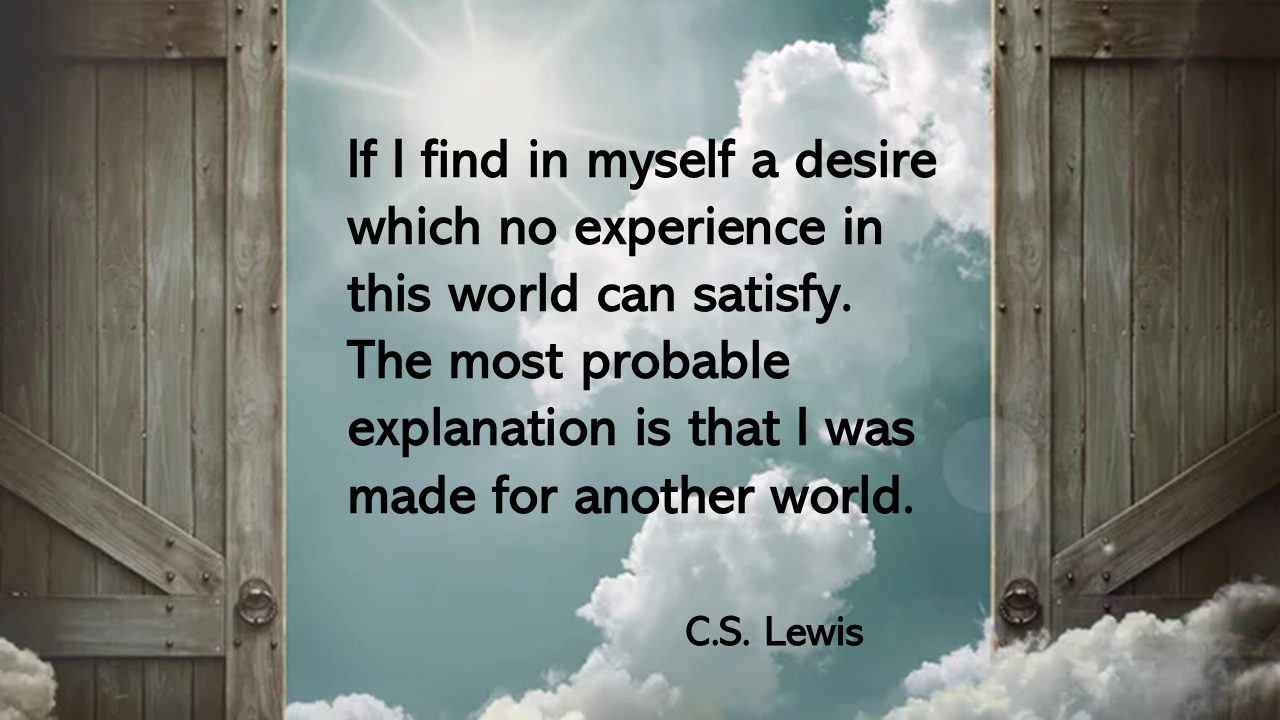
This striking contrast reveals a deep inner tension within modern culture: while secular worldviews dominate education, media, and science, the majority of individuals still hold to a fundamentally spiritual conviction about life after death. This suggests that belief in an afterlife may be less a product of institutional influence and more a reflection of the human conscience—an innate sense that life has meaning beyond the material, and that moral accountability extends beyond the grave. Even in a secular age, the soul seems hardwired for eternity.
The Bible Says That God Is Never Without a Witness
| Things Man has to suppress in order to not believe in God | |
| 1. Special Cognition | Man’s ability to observe, and marvel at the beauty, design, complexity and vastness of the universe which no other species can |
| 2. Moral Conscience | The Universal innate sense of right and wrong that affirms the dictates of the 10 commandments even in cultures where the Bible is not available |
| 3. Transcendent Spirituality | The Universal sense that their is a God, heaven and hell |
Romans 1:18 says that those who refuse to acknowledge God as creator or as deity are “suppressing the truth” in unrighteousness. The Greek word “suppress” is “katecho” which means to restrain, hold back, or push down. It implies that if people refuse to believe after everything that their cognitive reason knows, their moral conscience demonstrates, and their inner spirit tells them that they demonstrate “willful unbelief”.
On the other hand, it implies that all three of the God-given instincts are witnesses that God is not far from any one of us and that if we reach out for Him we can find Him.
“The God who made the world and everything in it is the Lord of heaven and earth and does not live in temples built by human hands. And he is not served by human hands, as if he needed anything. Rather, he himself gives everyone life and breath and everything else. From one man he made all the nations, that they should inhabit the whole earth; and he marked out their appointed times in history and the boundaries of their lands. God did this so that they would seek him and perhaps reach out for him and find him, though he is not far from any one of us.”
Acts 17:24-28
General revelation refers to God’s communication of Himself through nature and the human conscience which God uses to prod mankind to seek Him in faith. Special revelation is God’s specific and supernatural communication, primarily through the Bible and the person of Jesus Christ.
For I know the plans I have for you,” declares the Lord, “plans to prosper you and not to harm you, plans to give you hope and a future. Then you will call on me and come and pray to me, and I will listen to you. You will seek me and find me when you seek me with all your heart. I will be found by you,” declares the Lord,
Jeremiah 29:11-14
Challenge Questions: Regardless of your religious background which is more true for you :
1. Do you think that this life and world is all there is and will be?
2. Do you think their is an afterlife?
3. If you believe there is something beyond this world, and this life, where do you think that intuition came from?
ThinkCube Truth Veracity Grid
- Have I considered the issue carefully with an open mind?
- Is my conclusion the result of a careful examination of the facts, or is it a conclusion made in spite of the facts?
- Is my conclusion the one that makes the most sense of the evidence?