Premise 1: Creation Reveals The Majesty Of God
The heavens proclaim the glory of God.
Psalm 19:1-4
The skies display his craftsmanship.
Day after day they continue to speak;
night after night they make him known.
They speak without a sound or word;
their voice is never heard.
Yet their message has gone throughout the earth,
and their words to all the world.
It is said that an artist creates from the beauty within. Similarly the beauty of the natural world reveals the beauty of the God who created it. The majesty of God is often reflected in creation through its beauty, order, power, and complexity. Here are a few key ways this is commonly understood:
1. Beauty and Grandeur: The splendor of mountains, the vastness of the oceans, the intricacy of a snowflake, or the colors of a sunset are seen as expressions of God’s creative power and glory.
2. Order and Design: The precise laws of nature, the balance of ecosystems, and the structure of the universe suggest an intelligent and majestic designer. This harmony points to a God of wisdom and order.
3. Power and Immensity: The sheer size and force within the universe—from galaxies to thunderstorms—reflect a God of immense power and majesty, evoking awe and reverence.
4. Life and Complexity: The complexity of living organisms, from the human body to the smallest cell, suggests intentionality and creative genius, often viewed as a reflection of God’s majesty and care.
The workman is known by his work. The variety, multitude, order, beauty, harmony, different nature, and excellent contrivance, of the things that are made, the direction of them to certain ends, and the concurrence of all the parts to the good and beauty of the whole, do abundantly prove a Creator and his eternal power and Godhead
Matthew Henry
Everywhere we look, creation reveals an extraordinary harmony of beauty, order, complexity, and purpose. From trees producing the oxygen we breathe to the intricate balance of the food chain, from the remarkable process of photosynthesis to the countless systems that sustain life, everything works together in astonishing harmony. The natural world is not only breathtakingly beautiful but also remarkably functional, intricately interconnected, and wonderfully designed. Earth is a living masterpiece—and it is the crown jewel of the universe.
Let’s Talk About Oceans
Oceans cover an astonishing 71% of Earth’s surface, containing approximately 321 million cubic miles of water. The Pacific Ocean alone is larger than all of Earth’s landmasses combined! Beneath the waves lie towering mountain ranges, enormous underwater volcanoes, and trenches plunging nearly 7 miles deep. Scientists estimate that more than 80% of the ocean remains unmapped, unobserved, or unexplored. From vibrant coral reefs teeming with life to mysterious creatures surviving in total darkness, the sheer size, depth, and diversity of Earth’s oceans are almost beyond comprehension.



The oceans are among the most vast, mysterious, and awe-inspiring features of our planet. Here are some astonishing facts and statistics that highlight their grandeur and immensity:
| Oceans cover 70% of the Earth’s surface about 361 million square kilometers |
| Average Depth 2.3 miles deep enough to submerge Mt. Everest entirely and still have 1.25 miles left |
| Mariana Trench is deepest point at 36,201 feet or 7 miles which is higher than commercial jets fly |
| Home to 2 million marine species—on average 2,000 new ones are discovered and named each year |
| There are far more mountains under the ocean than on land many are taller than land mountains |
| The undersea Mid-Atlantic Ridge stretching 40,000 miles is the longest mountain range on Earth |
| The undersea Monterey Canyon is 11,800 feet deep which is twice the depth of the Grand Canyon |
Some have asked “why would God cover 70 percent of the Earth’s surface with oceans?” perhaps not knowing that vital role oceans play in climate regulation:
- Oceans act as buffer by absorbing 90% of excess atmospheric heat
- Oceans produce over 50% of the world’s oxygen more than all the rainforests combined
- Oceans absorb around 25-30% of the carbon dioxide admitted by human activity each year
- Scientist believe that over 80 percent of the oceans have not been explored yet.
As of 2026 Scientist have confirmed 6,458 planets and none of them have a single ocean.
Let’s Talk About Rivers, Lakes, Aquifers And Waterfalls
Scientists have identified approximately 117 million lakes, millions of rivers and streams, and countless waterfalls cascading over cliffs, mountains, and valleys. Some lakes stretch hundreds of miles, while others shimmer like turquoise jewels nestled among towering peaks. Rivers carve immense canyons, wind through lush rainforests, and nourish entire continents. Waterfalls range from delicate mountain cascades to thundering giants plunging thousands of feet. No two landscapes are exactly alike. The sheer number, variety, beauty, and life-sustaining importance of these natural wonders offer another breathtaking display of God’s creative majesty.
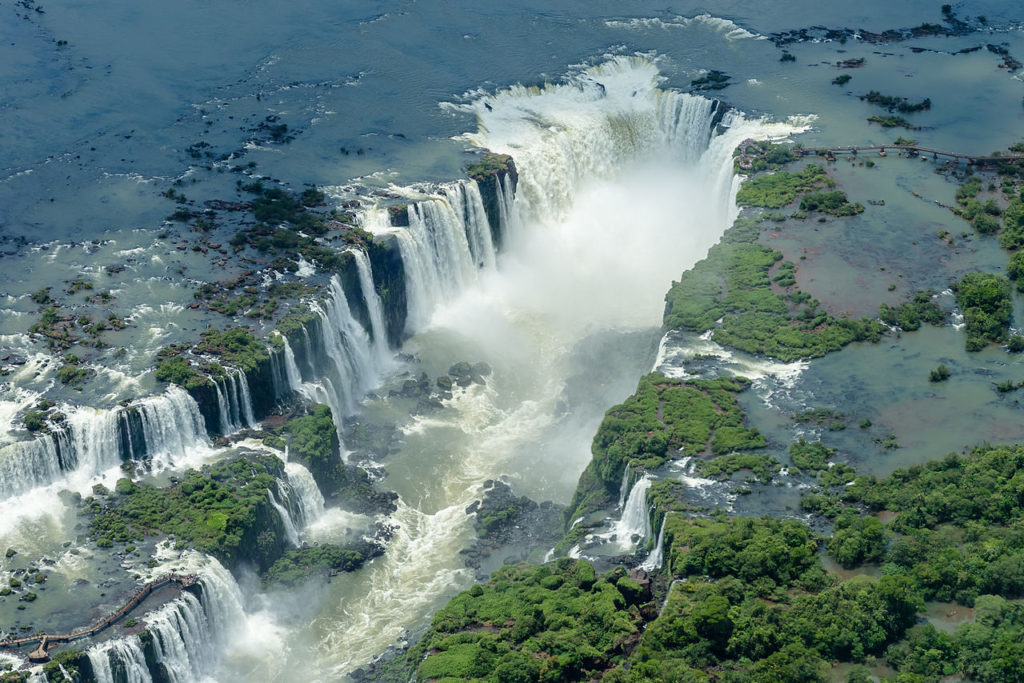
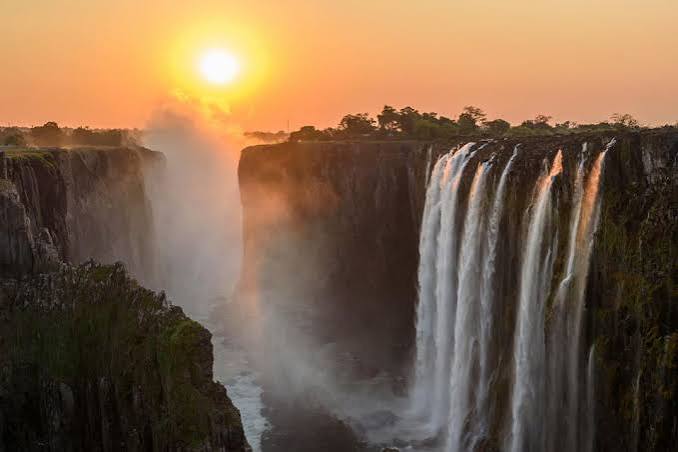

Rivers may seem modest compared to oceans, but they are immensely powerful, life-sustaining, and geographically transformative. Here are some astonishing facts and statistics that showcase the grandeur and immensity of the world’s rivers:
| The Earth’s longest rivers are the Nile (4,130 miles) Amazon (4,100 miles) Yangtze (3,917 miles) |
| Rio de la Plata in Argentina is 137 miles wide at its mouth—wider than some seas |
| The Congo River is deeper than a 70 story building |
| Rivers provide freshwater for 2.7 billion people |
| Rivers provide around 16% of the world’s electricity |
| About 70% of global freshwater used for agriculture is sourced from rivers |
There are estimated to be over 3 million rivers rivers in the world, and tense of thousands of waterfalls with new ones constantly being discovered. Ranging from narrow mountain waterways to enormous rivers stretching across entire continents. The Nile River extends approximately 4,130 miles, while the mighty Amazon carries an astonishing 7 million cubic feet of water every second—enough to fill nearly 80 Olympic-sized swimming pools! Africa’s Congo River plunges to depths exceeding 700 feet, making it one of the deepest rivers on Earth. From turquoise rivers winding through desert canyons to immense waterways cutting through tropical rainforests, their diversity is staggering.
The Earth’s 117 million lakes range from tiny mountain pools to inland seas stretching hundreds of miles. Lake Superior contains enough water to cover all of North and South America under a foot of water, while Russia’s Lake Baikal plunges more than 5,300 feet deep and holds approximately 20% of the world’s unfrozen surface freshwater. From brilliant turquoise alpine lakes to blood-red salt lakes, the staggering size, depth, colors, and diversity of Earth’s lakes are almost beyond imagination.

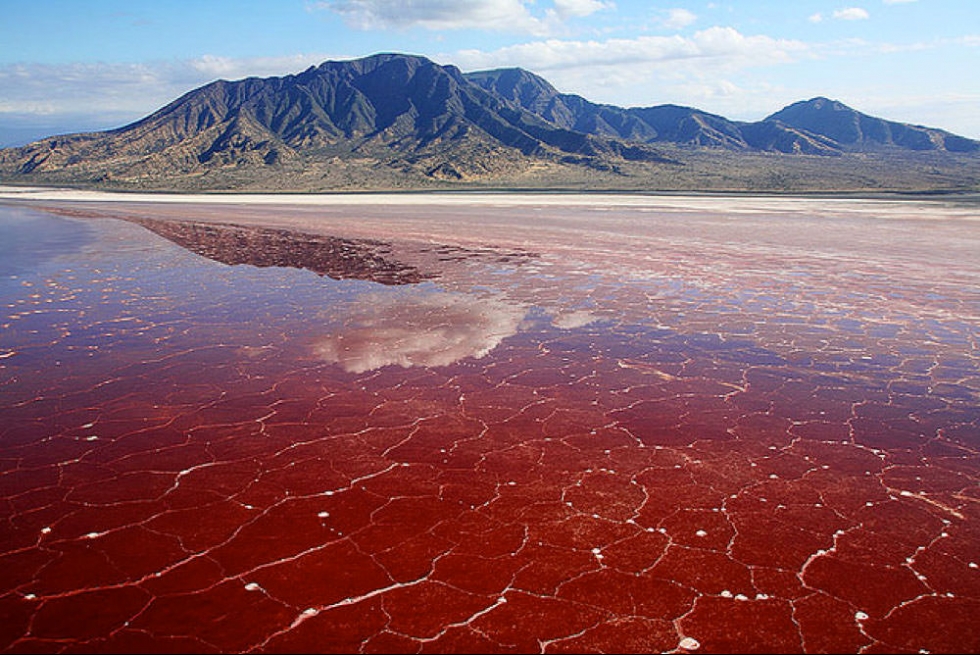
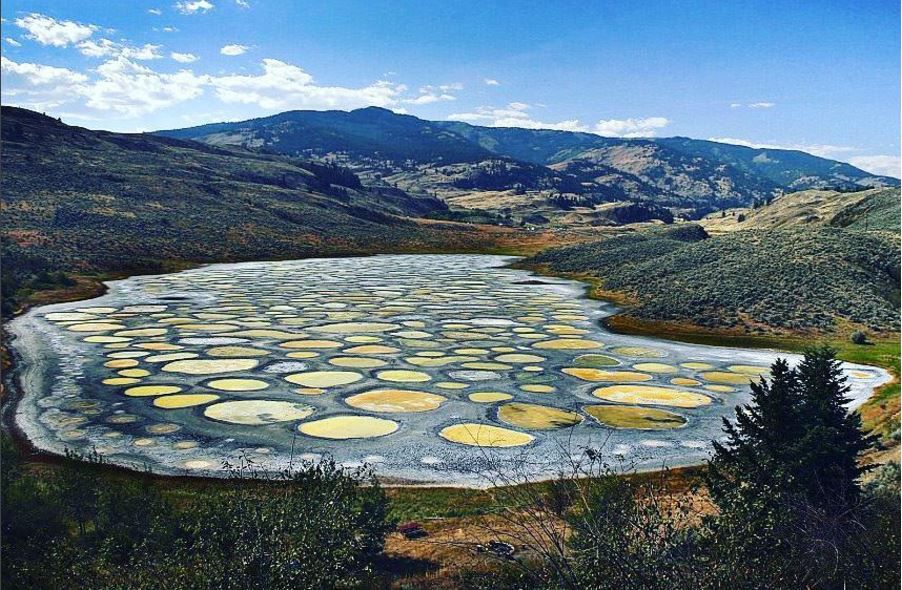
Aquifers are vast underground layers of rock, sand, and gravel that store freshwater. Hidden beneath our feet, these enormous natural reservoirs supply drinking water, irrigate crops, sustain rivers, and keep springs flowing even during dry seasons.The scale is staggering: an estimated 2.5 million cubic miles of freshwater lie underground, more than 30 times the water stored in Earth’s freshwater lakes. Groundwater accounts for approximately 99% of Earth’s liquid freshwater and supplies about half of the water withdrawn for household use worldwide and 25% of irrigation water used to grow crops.
Not a single drop of drinkable water has been found on any other planet.
Let’s Talk About Forest And Trees
Earth is home to an estimated 3 trillion trees representing more than 73,000 species, growing in everything from steamy tropical rainforests to frozen Arctic landscapes. Forests cover approximately 31% of Earth’s land surface, with the Amazon rainforest alone spanning more than 2 million square miles. California’s towering coast redwoods reach heights exceeding 380 feet, while giant sequoias can contain enough wood to build dozens of homes. Some trees live for more than 4,800 years, and scientists estimate that thousands of tree species remain undiscovered. From miniature Arctic willows to towering redwoods, the sheer number, size, age, and diversity of Earth’s trees are staggering.
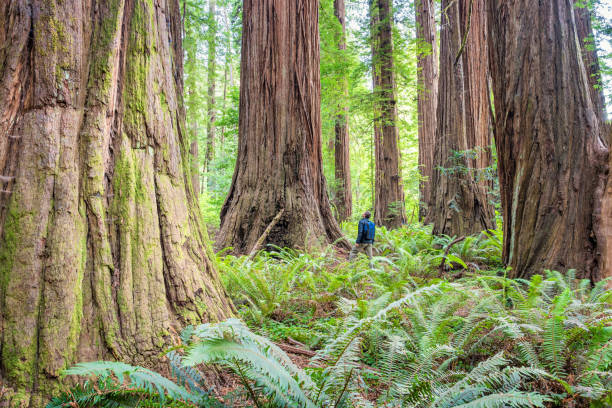
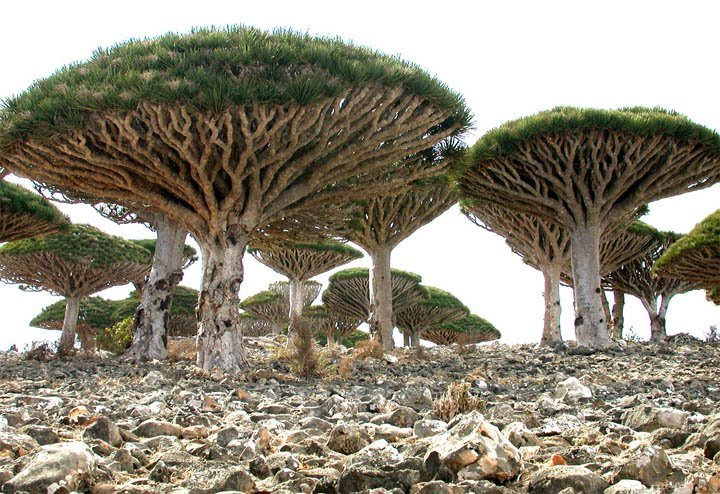

Forests and trees are among the most awe-inspiring and vital components of Earth’s ecosystem. Here are some astonishing facts and statistics that highlight their absolute necessity to life on earth.
| Approximately 75% of the world’s accessible freshwater originates in forested watersheds. |
| Approximately 80% of Earth’s terrestrial biodiversity is found in forests, including countless species of plants, animals, fungi. |
| Every year, the world produces an astonishing 445 million cubic meters of lumber for construction and other uses. |
| Around 2.4 billion people depend on wood-based energy for cooking and other household needs. |
| Forest are home to about 80% of the world’s terrestrial species of animals, plants, fungi, and microbes |
| Forest absorb 650 billion tons of carbon, both above and below ground |
| Trees transpire 40-50 trillion teratonnes of water which is essential to global rainfall patterns |
| Approximately 10% of the global food supply grows on trees |
From towering redwoods to delicate flowering trees, the beauty and diversity of Earth’s forests are breathtaking. Trees provide food, shelter, medicine, building materials, and oxygen while sustaining countless ecosystems and regulating our planet’s climate and water cycles. Their extraordinary beauty, complexity, and usefulness make trees one of the most remarkable features of our natural world.
The James Webb Telescope has observed and studied 111 planets and none of them have a tree, bush, or even a single blade of grass.
Let’s Talk About the Mountains, Canyons and National Parks
There are approximately 4,000–6,000 national parks worldwide, spread across more than 100 countries. Worldwide, there are more than 300,000 protected areas of various kinds, including national parks, nature reserves, marine protected areas, and wildlife sanctuaries.


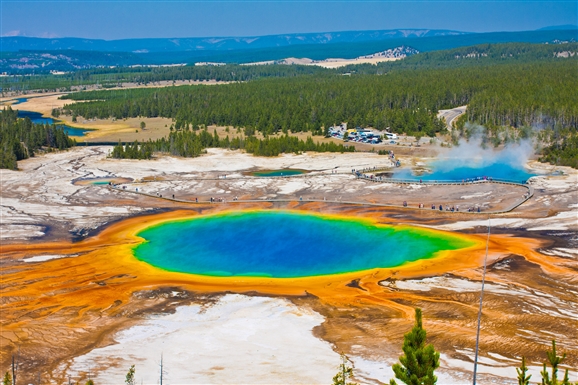
Mountains and Canyons are among the most awe-inspiring natural formations on Earth, embodying grandeur, isolation, and extreme conditions. Here are some astonishing facts and statistics that highlight their grandeur and majesty:
| Mount Everest is called the “Roof of The Word” at a height of 29,031 feet |
| Mauna Kea in Hawaii is 33,500 feet tall from sea floor to summit or ca. 7 miles |
| The Himalayas contain all 14 of the world’s peaks above 26,000 feet |
| Andes Mountains span 7 countries, 4,350 miles making it the longest mountain range in the world |
| Yarlung Tsangpo Grand Canyon in China is deepest in the world at 19,714 feet or 4 miles |
| Grand Canyon is 277 miles long and 6,093 feet deep |
| Colo Canyon in Peru is twice as deep as the Grand Canyon |






Mountains house over 85% of the world’s amphibians, birds, and mammals, and they supply 60-80% of the world’s freshwater. While there are formations on other planets that appear to be mountains or canyons they are not the result of tectonic plates colliding, nor are they sculpted by water and ice like the Earth’s mountains are. No one would want to take a selfie with them in the background!
How many national park worthy sites have been found on the 6,000 plus planets telescopes have observed? None!
The Earth Is the Canvas God Uses to Display His Grandeur
The anthropic principle recognizes that the universe possesses the precise conditions necessary for human life to exist. If certain fundamental laws or constants were different, life as we know it would be impossible. Some argue that Earth’s life-supporting conditions are unsurprising because we could only exist on a planet capable of sustaining us. But this observation does not explain why such extraordinary conditions exist in the first place.
The Bible presents Earth as a remarkable expression of God’s creative power. Just as mankind possesses unique intellectual, moral, and spiritual capacities, we also possess the extraordinary ability to recognize, study, appreciate, and marvel at the beauty, complexity, and grandeur of creation.
Consider What the Earth Contains…
- Approximately 400,000 species of flowering plants
- More than 11,000 species of birds
- Approximately 37,000 species of fish
- More than 350,000 known species of vascular plants
- An estimated 73,000 species of trees
- Millions of animal, plant, and microbial species, with countless others yet to be discovered
The James Webb Telescope has studied the 8 planets in our solar system and 111 outside of it. Zero species of any kind…not even a worm, weed, or weevil.
Could it be that Earth possesses this astonishing abundance and diversity of life because God designed it as a magnificent canvas upon which to display His limitless creativity?
Consider the extraordinary variety of colors, shapes, patterns, behaviors, and intricate biological designs found throughout nature. Every living organism contains remarkable genetic information directing its development and function. From the delicate structure of a flower to the complexity of the human brain, the sheer diversity, beauty, and sophistication of life are almost beyond comprehension.
The purposeful precision, exquisite design, beauty, colors and whimsy found in nature is not God showing off, its God being God. Here are just a few of the over 400,000 moth species scientist believe there are.



Earth possesses an almost incalculable variety of life, yet among the other planets in our solar system, not a single one has accessible liquid water, a breathable atmosphere, or the life-sustaining solar conditions necessary to support life as we know it. Every continent, country, and region of Earth displays its own remarkable diversity of landscapes, ecosystems, climates, plants, and animals. How can such extraordinary abundance and variety be explained as merely the product of chance?
Consider Mars, often regarded as one of the most promising planets for future human colonization. Even there, conditions are so hostile that humans could not survive without extensive technological support. Place Earth and Mars side by side, and the contrast is staggering: one planet overflowing with life, color, beauty, and diversity; the other a barren, frozen desert. The difference is almost beyond comprehension.
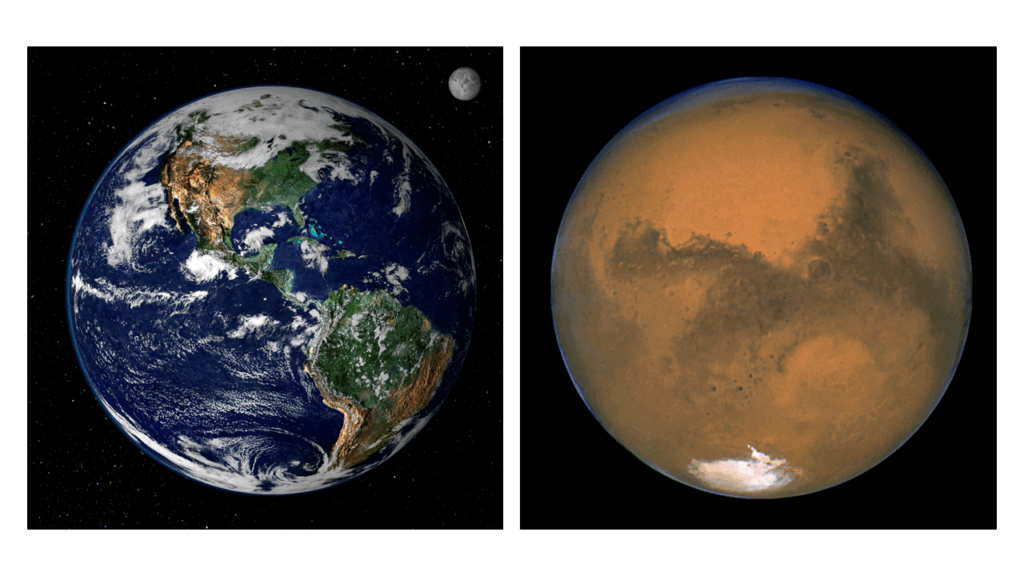
Life on Mars would mean confinement to sealed habitats, no natural weather, no greenery, and no escape from the harshness of an alien world. Compared to Earth’s vibrant wonder, Mars is a bleak and hostile place—inhospitable both physically and emotionally. The stark contrast between Earth and every other celestial body highlights our planet’s extraordinary uniqueness. And when we consider not only the beauty of Earth but the existence of conscious human beings capable of recognizing and appreciating that beauty, it becomes clear: Earth is more than just a planet—it is the stage of God.
Challenge Question: Consider the above side-by-side images of Earth and Mars—one vibrant and teeming with life and beauty, the other barren and lifeless. Evolutionists claim that both planets originated at the same time from the same matter, energy, and chemical processes following the Big Bang. If that were true, why is life so abundant in every forest, field, and meadow on Earth, while not a trace of it exists on any of the planets Earth is supposedly evolutionary siblings to?
Premise 2: Creation Reveals The Infinite Wisdom Of God
Creation reveals the astonishing wisdom, intelligence, and order of God. This is perhaps nowhere more evident than in the vast and ever-expanding fields of science. There are well over 1,000 distinct scientific disciplines and sub-disciplines—ranging from astrophysics to microbiology, quantum chemistry to geology, neuroscience to ecology—each dedicated to studying a particular aspect of the created order. As research continues to advance, even more new branches of inquiry have to emerge. After 500 years of scientific advancement the consensus is that our knowledge of the universe macro and micro is still in it’s infancy.
“We live still in the childhood of mankind. All these horizons are beginning to light up in our day: molecular biology, DNA, cosmology. We’re just children looking for answers.”
John Archibald Wheeler—Theoretical Physicist, winner of Albert Einstein Award
Here are the four major main branches of physical science and their major subfields:
Physics-The study of matter, energy, and motion
Subfields:
- Classical Mechanics – motion of objects and forces.
- Thermodynamics – heat and temperature and their relation to energy and work.
- Electromagnetism – electric and magnetic fields.
- Optics – behavior of light and its interactions with matter.
- Acoustics – sound and its transmission.
- Quantum Mechanics – behavior of particles on the atomic and subatomic scale.
- Relativity – motion at high speeds (special and general relativity).
- Nuclear Physics – structure and behavior of atomic nuclei.
- Particle Physics – fundamental particles and their interactions.
- Condensed Matter Physics – properties of solids and liquids.
Chemistry-The study of substances, properties, and reactions
Subfields:
- Organic Chemistry – chemistry of carbon-based compounds.
- Inorganic Chemistry – chemistry of non-organic (non-carbon) compounds.
- Physical Chemistry – physical principles underlying chemical systems.
- Analytical Chemistry – techniques to analyze substances.
- Biochemistry – chemistry within living organisms.
- Theoretical Chemistry – mathematical modeling and computational chemistry.
Astronomy-The study of celestial objects and phenomena
Subfields:
- Astrophysics – physical properties and behavior of celestial bodies.
- Planetary Science – study of planets, moons, and planetary systems.
- Cosmology – study of the origin and evolution of the universe.
- Stellar Astronomy – stars and their life cycles.
- Galactic Astronomy – structure and components of galaxies.
- Extragalactic Astronomy – objects outside the Milky Way.
- Radio, Optical, and X-ray Astronomy – study of celestial objects using various wavelengths.
Earth Science-The study of the Earth and its components.
Subfields:
- Geology – structure and composition of Earth’s crust, rocks, and minerals.
- Meteorology – study of the atmosphere and weather patterns.
- Oceanography – physical and biological properties of oceans.
- Seismology – study of earthquakes and seismic waves.
- Volcanology – study of volcanoes and related phenomena.
- Hydrology – study of water cycles, rivers, and groundwater.
- Environmental Science – impact of human activity on the Earth.
de·rived knowl·edge
/ˈnäləj/ /dəˈrīv/
Knowledge that is obtained through reasoning, inference,
or interpretation from existing information or evidence
All the knowledge that scientists have gathered to form the physical sciences is derived from discovery, not invention; it reflects truths that existed long before humans uncovered them.
Physical sciences (like physics, chemistry, and geology) aim to understand the natural world. The data, observations, and phenomena studied come from nature—gravity, thermodynamics, atomic interactions, etc., all exist independently of human thought. The organizations in science such as classes, phylum, and species, the knowledge of atomic particles, modern genetics, anatomy, astronomy and physics are all the result of observing, mining, and studying the enormous amount of data already pre-contained in nature. Nature is God’s mind on display!
Wisdom enables us to understand reality. Through wisdom we have discovered a set of scientific laws that elegantly express reality in the language of mathematics. Whenever man learns the logic of the universe, man is (in essence) “thinking God’s thoughts after Him.” A correct “understanding, therefore, is that we humans discover and (implement) wisdom; we do not invent it.
Institute For Creation Research; Nature Reveals God’s Wisdom
Science Has Only Scratched The Surface Of God’s Creation
| Category | What Remains Undiscovered |
|---|---|
| The Universe | 95% of the universe (dark matter + dark energy) is completely unseen and unknown. |
| Galaxies | 99.999% of galaxies have never been observed; likely trillions exist beyond our reach. |
| Planets | The Milky Way may hold 100–400 billion planets; only a few thousand have been confirmed. |
| Earth’s Species (Total) | Scientists believe 80–90% of all species on Earth are still undiscovered. |
| Microbial Life | Less than 1% of microbial species have been identified; millions remain unknown. |
| Deep Ocean | Over 80% of the ocean is unmapped, unobserved, and unexplored. |
| Ocean Floor Life | Deep-sea ecosystems likely contain millions of undiscovered species. |
| Plant Species | Tens of thousands of plant species—especially in rainforests—remain undocumented. |
| Fungal Species | Estimated 2–5 million fungal species exist; only about 150,000 have been classified. |
| Insects | Millions of insect species are unknown to science, particularly in tropical regions. |
| Caves & Underground Ecosystems | Vast cave systems, underground lakes, and deep-earth ecosystems remain unexplored. |
| Ice Worlds (Europa, Enceladus, etc.) | Global subsurface oceans may contain undiscovered life; none have been directly explored. |
| Earth’s Interior | We have drilled only 7.5 miles into a 4,000-mile-deep planet—nearly all is unexplored. |
| Laws of Physics | Scientists believe additional laws and forces may exist beyond our current models. |
Each year, scientists are uncovering, documenting, and cataloging vast amounts of previously hidden information embedded in nature—revealing intricate systems, patterns, and phenomena that had long gone unnoticed. As fast as they discover the more they find they have left to discover to the point it has become bottomless.
1. Research Papers
- Over 2.5 million scientific papers are published globally each year.
- That’s about 6,800+ papers per day—though not all are “discoveries,” many contain novel data or hypotheses.
2. Fields of Discovery
- Biomedicine: New genes, treatments, or disease links are found daily.
- Physics: Regular updates in particle physics, cosmology, quantum mechanics.
- Astronomy: New exoplanets, black hole observations, or supernovae are reported weekly.
- Climate science: New insights into atmospheric patterns or feedback loops emerge constantly.
- Artificial Intelligence: Weekly advances in model capabilities and algorithms.
3. Patents and Technology
- Scientists and engineers file hundreds of thousands of patents annually, many based on new discoveries.
- In 2023, the U.S. Patent Office granted over 320,000 patents—a good chunk involved novel scientific or technical ideas.
The existing scientific concepts cover always only a very limited part of reality, and the other part that has not yet been understood is infinite.
Werner Heisenberg—Nobel Prize Winning Physicist
Our knowledge of the universe remains a mere “drop in the bucket” compared to the vast mysteries that remain unexplored and unexplained.
Human Knowledge vs. the Unknown
Blaise Paschal the brilliant philosopher and mathmatician said that even the most brillant man’s intellect hold the same position in the universe of knowledge as his physical body. Exaggeration? Despite centuries of scientific advancement, the boundaries of human knowledge remain remarkably limited. Each new breakthrough often raises more questions than it answers, revealing previously unknown layers of complexity and opening entirely new fields of investigation. From quantum physics and cosmology to genetics and neuroscience, the more we discover about the universe, the more we realize how much remains unexplored and unexplained.
Scientist Admitting Ignorance in Light of Immeasurable Knowledge
| Scientist | Quote | Context |
|---|---|---|
| Stuart Firestein (Neuroscientist) | “That’s not what we think in the lab. What we think in the lab is, we don’t know bupkis. So I thought, well, we should be talking about what we don’t know, not what we know.” | From his book/lectures on the value of ignorance in science |
| Richard Feynman (Physicist) | “I think it’s much more interesting to live not knowing than to have answers which might be wrong. I have approximate answers and possible beliefs … I am not absolutely sure of anything and there are many things I don’t know anything about…” | Famous reflection on embracing doubt and uncertainty |
| James Tour (Chemist/Nanoscientist) | “Those who think scientists understand the issues of prebiotic chemistry are wholly misinformed. Nobody understands them. Maybe one day we will. But that day is far from today. … It is a mystery.” | Statement on the limits of current knowledge about life’s origins |
| Konrad Lorenz (Zoologist, Nobel Laureate) | “Scientists are people who know more and more about less and less, until they know everything about nothing.” | Humorous critique of overspecialization in science |
| Emil du Bois-Reymond (Physiologist) | “Ignoramus et ignorabimus” (“We do not know and will not know”). | Emphasizing science’s inherent limits — some mysteries may remain unsolvable |
| John Tyndall (Physicist) | “The real mystery of the universe lies unsolved, and, as far as we are concerned, is incapable of solution… Let us… acknowledge our ignorance.” | Advocating humility before unsolved cosmic mysteries |
| Albert Einstein (Physicist) | “The more I learn, the more I realize how much I don’t know.” | Widely quoted, expressing humility before the vastness of knowledge |
| Niels Bohr (Physicist) | “Every sentence I utter must be understood not as an affirmation, but as a question.” | Bohr, father of quantum theory, underscoring the uncertainty and provisional nature of knowledge |
| Max Planck (Physicist, founder of quantum theory) | “Science cannot solve the ultimate mystery of nature. And that is because, in the last analysis, we ourselves are part of nature and therefore part of the mystery that we are trying to solve.” | Highlighting the paradox of studying a universe of which we are inseparably a part |
The cause of our universe coming into being and continuing to operate as it does is a dynamic display of cosmic wisdom. The unfathomable amount of applied knowledge (wisdom) that was used to invent the universe, and to pre-program its interactive workings, is a source of beyond-the-imagination-wonder!
Institute For Creation Research; Nature Reveals God’s Wisdom
Can Such An Infinite Amount Of Complex Information Arise Randomly By Chance?
According to the Law of Conservation of Information, highly ordered and meaningful information cannot emerge from purely natural processes—it must originate from an intelligent source. This principle challenges the idea that structured complexity, such as that found throughout the universe, could arise through random chance alone.
It is estimated that the universe and nature collectively contain around 10⁹⁰ bytes of information—that’s roughly 100 billion billion billion billion billion billion billion gigabytes. This immense reservoir of encoded knowledge, from DNA sequences to cosmic laws, represents just a glimpse of the intelligence of God, as described in the Bible.
Oh, the depth of the riches both of the wisdom and knowledge of God!
Romans 11:33
How unsearchable are His judgments and His ways past finding out!
The deeper science delves into the fabric of reality, the more it reveals—not simplicity, but greater layers of mystery and order. Each new discovery uncovers another level of sophistication and design, pointing not toward randomness, but toward an infinite mind behind the universe. God is omniscient, His intelligence cannot be measured on any human scale. The combined intellectual capacity of every genius who has ever lived would represent only a finite fragment of what an all-knowing Creator understands perfectly and eternally.
Challenge Question: Do you think the beauty, diversity, and knowledge found in nature is the result of a supremely creative intelligence or random and purposeless natural processes?
Premise 3: Creation Reveals God’s Perfect Character
char·ac·ter
/ˈker(ə)ktər/
the mental and moral qualities distinctive to an individual.
Creation not only displays God’s power and infinite intelligence, but it also offers profound insight into His primary moral attributes. The Bible describes God as infinite, meaning there is no limit to His perfections. Therefore, when considering God’s attributes, they must always be understood as infinite in degree. If God is just, loving, and merciful, then He is infinitely and perfectly just, loving, and merciful. The following are some of the infinite character traits that reflect God’s moral perfection.
- Nature reveals God as an ordered lawgiver
- Nature reveals God’s as unchanging
- Nature reveals God as benevolent
Nature Reveals God as a Ordered Lawgiver
Nature reveals God’s orderliness and character through its intricate design, predictable cycles, and the beauty and harmony that permeate all of creation, suggesting a divine creator and sustainer. Pollination, food chains, water cycles—each system is interdependent and self-regulating. The harmony and balance in ecosystems suggest not randomness, but a purpose-driven order.
“According to everything taught by the exact sciences about the immense realm of nature, a certain order prevails—one independent of the human mind …this order can be formulated in terms of purposeful activity. There is evidence of an intelligent order of the universe to which both man and nature are subservient”
Max Planck; Father of Quantum Physics
The universe exhibits a remarkable degree of order and regularity, with phenomena like gravity, planetary motion, and the laws of physics operating with mathematical precision. The laws of physics, chemistry, and biology are uniform and consistent across time and space. This orderliness and the reliability of natural law has historically led thinkers like Newton, Kepler, and Einstein to speak of God as a lawgiver.
Here Are The Fundamental Laws of Physics Which Govern The Universe With Perfect Precision
- Newton’s Laws of Motion: These three laws describe how objects move and interact.
- Law of Universal Gravitation: This law describes the force of attraction between any two objects with mass.
- Maxwell’s Equations: These equations describe the behavior of electromagnetic fields.
- Einstein’s Theory of Relativity: This theory describes gravity and the relationship between space, time, and the universe.
- Quantum Mechanics: This theory describes the behavior of matter and energy at the atomic and subatomic level.
- Laws of Thermodynamics: These laws describe the behavior of heat and energy transfer.
- Laws of Conservation: These laws state that certain quantities, like energy and momentum, remain constant in a closed system.
- Other Important Laws: Coulomb’s law, Gauss’s law, Archimedes’ principle, and Kepler’s Laws are also important.
The Laws of Physics Had to be Perfectly in Place the Instant the Big Bang Happened
Roger Penrose a Nobel Laureate in Physics estimated that the chance of the universe beginning in the extraordinarily low-entropy state necessary for the Second Law of Thermodynamics and the emergence of structure and life is astronomically small.
1 in 10^10^123
That’s a number so large it cannot be written out even if every particle in the universe were a zero—literally. Even if every proton, neutron, and electron were assigned a digit, you wouldn’t come close to writing it down. This number is not just impractically large—it is physically unrepresentable in any known universe. When odds reach this magnitude, they are effectively indistinguishable from impossibility.
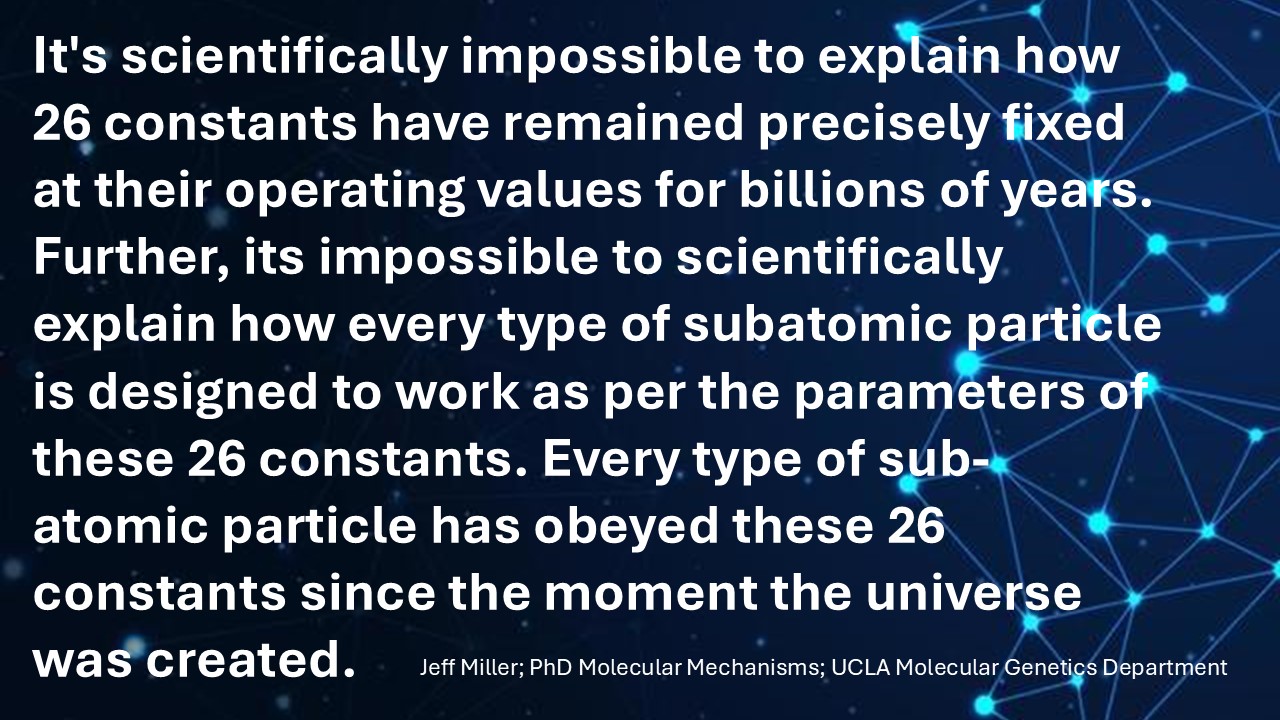
The Bible refers to the fixed laws and constants that govern the universe as the “ordinances, and laws of heaven and earth” and uses terms like law, laws, lawgiver, and ordinances over 576 times. If the probability of all the finely tuned laws and constants necessary for life emerging by chance at the moment of the Big Bang is virtually zero, then how did this astonishing level of complexity and mathematical precision come to be?
Can you direct the movement of the stars—binding the cluster of the Pleiades, or loosening the cords of Orion? Can you direct the constellations through the seasons or guide the Bear with her cubs across the heavens? Do you know the laws of the universe? Can you use them to regulate the earth?
Job 38:33
Does the Bible reveal the Who behind the what, or does the mathematically implausible Theory of Evolution offer a more credible explanation for the mathematical precision for which the universe operates moment by moment?
Every work of art reveals something about the artist, just as every intelligent design offers a glimpse into the mind of its designer. The extraordinary laws, constants, and mathematical precision governing the universe reveal a Creator who values order, consistency, and purpose. And if God established such remarkable order throughout His creation, should we be surprised that He also expects order, purpose, and obedience from the intelligent creatures He placed within it?
Challenge Question: Given that the laws of physics and the 26 fundamental constants exhibit extraordinary precision and order, and that the Law of Information affirms such structured complexity must come from an intelligent source, are these not best understood as the handiwork of a divine Lawgiver? Where, if not from God, did such perfectly calibrated laws and constants originate?
Premise 4: Creation Reveals The Unchangeableness Of God
im·mu·ta·ble
/i(m)ˈmyo͞odəb(ə)
unchanging over time or unable to be changed
Nature’s inherent constancy and the cyclical nature of natural processes, like seasons, tides, and celestial orbits reflect God’s immutability and unchanging nature. These steadfast and predictable patterns reflect the constants of God’s character and and that His faithfulness and promises are reliable and enduring.
Each year, Earth orbits the Sun at an average distance of 92.96 million miles, or approximately 8.317 light minutes. A full orbit takes 365.256 days. In addition to Earth’s orbit, the motion of the entire solar system through the galaxy is also modeled with precision. Using these models, scientists can accurately calculate planetary positions, eclipses, and celestial alignments—even when projecting backward in time.
Using the predictable movements of the Sun, Moon, and stars, astronomers and historians can:
- Study ancient structures: Determine whether ancient buildings and monuments were deliberately positioned to align with the Sun or certain stars.
- Recreate the night sky: Calculate exactly how the stars and planets would have appeared thousands of years ago, including when the Egyptian pyramids were built.
- Investigate historical dates: Use ancient records of eclipses, planetary movements, and other astronomical events to help determine when historical events occurred.
Astronomers, historians, and biblical scholars have used modern astronomical calculations to investigate whether the Star of Bethlehem described in Matthew 2 corresponds to an actual celestial event. Because the movements of planets and stars can be calculated backward thousands of years, researchers can reconstruct the night sky around the time of Jesus’ birth.
Here is an example that actually aligns with a famous account in the Bible in Joshua 10:13
The Israel Times
So the sun stood still,
and the moon stopped,
till the nation avenged itself on its enemies…
The sun stopped in the middle of the sky and delayed going down about a full day
Cambridge researchers announced Monday that they have pinpointed the date of the biblical account of Joshua stopping the sun—which they claim is the day of the oldest eclipse ever recorded to October 30, 1207 BCE, exactly 3,224 years ago
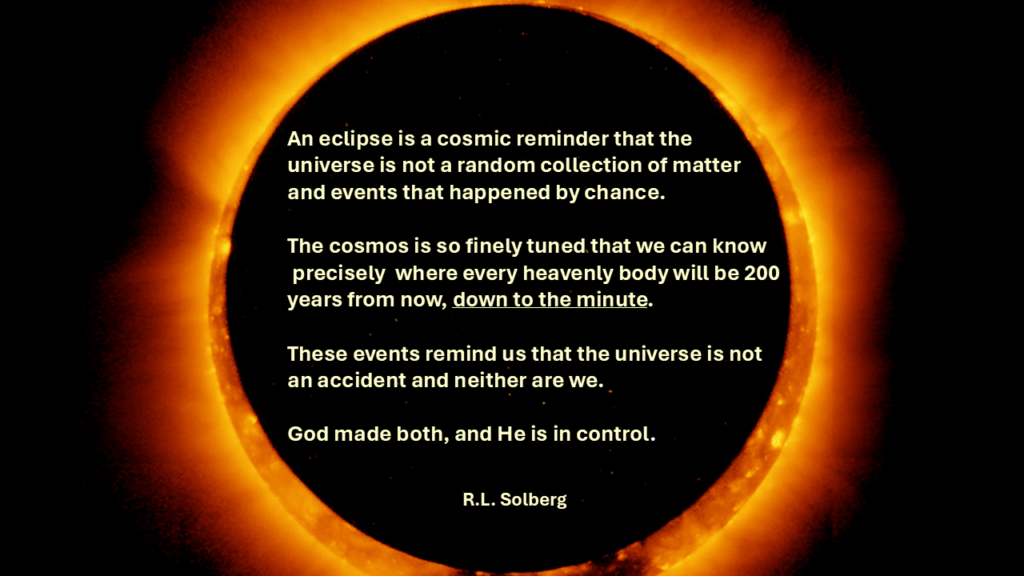
The predictable orbits of celestial bodies are just one example among many natural phenomena and consistent patterns that are essential to the functioning of every conceivable natural and physical system in the universe.
| Things In Nature That Reflect God’s Immutability | Description |
| Laws of Physics and 26 Constants | These laws and constants have been precisely fixed since the first second the Universe was created. |
| Solar Days | The predictable 24 hour time period it takes for the Earth to rotate once on its axis. The Earth’s 365 day, 5-hour, 48 minute and 45.51 second-round-trip is accurate to a thousandth of a second. |
| Seasons | Winter, Spring, Summer and Fall same frequency and duration annually due to earth’s rotation and orbit around sun being consistent |
| Tides | Can be predicted to within the hour globally due to the predictable gravitational forces of the moon and the earths rotation. |
| Hydrological Cycle | The water cycle involves the continuous circulation of water in the Earth-atmosphere system, moving from the ground to the atmosphere and back again. Evaporation-condensation-and precipitation |
| Homeostasis | All living organisms are homeostatic. Homeostasis is the ability to maintain a stable internal environment despite external changes, which is crucial for survival and function. |
The Bible Says That God Is The “Consistency” Behind Nature’s “Constancy”
For by him all things were created,
that are in heaven, and that are in earth,
visible and invisible,
whether they be thrones, or dominions,
or principalities, or powers:
all things were created by him, and for him.And he is before all things,
Colossians 1:16-17
and by him all things consist.
The word “consist” is the root of “consistency,“ which refers to something that remains unchanged in nature, standard, or effect over time. While the exact age of the universe may be debated among both secular and Christian scientists, one truth remains undisputed: if any of the laws of physics, universal constants, or other fundamental mathematical principles were altered—even by the slightest degree—chaos would inevitably follow. The universe depends on this remarkable and delicate consistency to sustain order, structure, and life itself.
Earth-Specific Fine-Tuning Parameters
- Distance from the Sun (The Habitable Zone)
- If Earth were slightly closer: water would evaporate, causing a runaway greenhouse effect (like Venus).
- If Earth were slightly farther: water would freeze, making life impossible (like Mars).
- Orbital Eccentricity
- Earth’s orbit is nearly circular. A more eccentric (oval) orbit would cause extreme seasonal temperature swings, destabilizing ecosystems.
- Axial Tilt (Obliquity)
- Current tilt (~23.5°) provides stable, mild seasons.
- A tilt near 0° or 90° would eliminate or exaggerate seasons, stressing or extinguishing many life forms.
- Rotation Rate (Length of Day)
- A slower rotation would cause extreme day/night temperature swings.
- A much faster rotation could create destructive winds and flatten the planet at the equator due to centrifugal force.
- Magnetic Field Strength
- Shields Earth from solar and cosmic radiation.
- A weaker field would expose life to harmful radiation and strip the atmosphere via solar wind.
- Plate Tectonics
- Regulates carbon dioxide via the carbon-silicate cycle, maintaining climate stability.
- Without it, Earth might become too hot (like Venus) or too cold.
- Atmospheric Composition (Especially Oxygen & CO₂ levels)
- Oxygen too high: fires would rage uncontrollably.
- Oxygen too low: multicellular life couldn’t survive.
- CO₂ too high/low: runaway greenhouse effect or global freezing.
- Presence of the Moon
- Stabilizes Earth’s tilt.
- A smaller or absent Moon could lead to chaotic axial changes, severely affecting climate and seasons.
- Surface Water Distribution
- Enough water to support life, but enough land for diverse ecosystems.
- Too much water: “Waterworld” with no continents.
- Too little: dry desert planet.
Cosmic or Physical Constants Related to Earth’s Habitability
- Gravitational Constant (G)
- Slightly stronger: stars burn faster and die young.
- Slightly weaker: stars can’t form or sustain fusion.
- Electromagnetic Force Strength
- Affects chemical bonding. If different, molecules like DNA wouldn’t form.
- Strong Nuclear Force
- If slightly weaker or stronger, atoms like carbon and oxygen couldn’t form in stars.
- Cosmological Constant
- Controls universe expansion.
- Too large: matter wouldn’t clump to form stars and galaxies.
- Mass Ratio of Protons to Electrons
- Affects chemistry and atomic structure. Small deviations would destroy stable matter.
Because of these constants, laws, and unchanging parameters—many of which are uniquely fine-tuned for Earth—life is not only possible but continually sustained. The consistent, precise, and enduring support of life on this planet serves as a continual reflection of God’s unwavering and intentional care for humanity, inhabiting the only known planet among thousands capable of supporting life.
Who kept the sea inside its boundaries
as it burst from the womb,
and as I clothed it with clouds
and wrapped it in thick darkness?For I locked it behind barred gates,
limiting its shores.I said, “This far and no farther will you come.
Job 38:8-11
Here your proud waves must stop!”
The Constancy and Consistency in Nature Reflect the Unchangeable Character of God
| Faithfulness and Reliability | God’s unchangeable nature means His character, plan and purposes remain constant, offering a sense of security and reliability in a world of uncertainty. |
| Perfection and Stability | God’s immutability is seen as a reflection of His perfect nature, meaning He cannot be subject to change, as change would imply imperfection. |
| Eternal and Unwavering | God’s unchangeableness is tied to His eternal nature, meaning He exists outside of time and therefore is not subject to the limitations and changes that humans experience |
| Consistency in Love and Justice | God’s unchangeable love, justice, and mercy are constant, meaning that His character and ways remain the same, regardless of circumstances or human actions. |
| Security in Times of Need | Knowing that God does not change provides comfort and assurance during times of hardship, as believers can rely on His unchanging nature for strength and guidance. |
The unchangeableness of God—referred to as His immutability—serves as a profound foundation of stability and assurance in a world marked by constant change and uncertainty. While circumstances, cultures, and even people shift over time, God’s character, promises, and purposes remain unwavering.
Those who say that the study of science makes a man an atheist must be rather silly. Something which is against natural laws seems to me rather out of the question because it would be a depressive idea about God. It would make God smaller than He must be assumed. When He stated that these laws hold, then they hold, and he wouldn’t make exceptions. This is too human an idea. Humans do such things, but not God.
Max Born—Nobel Prize Physics; Instrumental in Development of Quantum Mechanics
For believers, this means that the same God who was faithful in the past is faithful today and will remain so forever. His immutability offers a deep sense of security, reminding us that we can fully trust in His Word, rely on His guidance, and rest in the certainty of His eternal nature.
Challenge Question: How can we account for the sudden and perfectly timed emergence of the universe’s mathematically precise laws and constants at the very moment of creation—apart from the intentional act of a divine Creator?
Premise 5: Creation Reflects God’s Infinite Goodness
be·nev·o·lence
/bəˈnevəl(ə)ns/
the quality of being well meaning; kindness
Creation reflects God’s benevolence through its beauty, order, and abundant provision, revealing a loving and intentional Creator who fashioned everything with purpose and care. Scripture affirms this in Genesis 1:31, where it says, “God saw all that He had made, and it was very good.” This declaration underscores that creation is not only the work of a powerful God but also a reflection of His inherent goodness and generous nature.
Creation is a gift from God to humanity in several profound and meaningful ways—both practically and spiritually. Creation is a manifestation of God’s love an goodness, providing a place for humanity to live, learn, and grow, and offering opportunities for experiencing profound beauty and wonder. Here are ways that show this:
1. Provision for Life
Creation supplies everything necessary for human survival and flourishing:
- Air to breathe, water to drink, and food to eat.
- Natural materials for shelter, medicine, and technology.
- A finely tuned Earth with precise conditions that sustain life—gravity, temperature, atmospheric composition, and more.
These provisions reflect God’s generosity and care for human well-being (Psalm 104:10–14; Acts 14:17).
2. Beauty and Enjoyment
Beyond survival, creation is filled with beauty, variety, and wonder:
- Majestic mountains, vibrant flowers, oceans teeming with life, and endless stars.
- These features aren’t strictly necessary—but they enrich human experience, stir awe, and inspire joy.
This suggests that creation is not only functional but also a deliberate expression of love meant to be enjoyed (Psalm 19:1; Ecclesiastes 3:11).
3. A Revelation of God’s Nature
Creation reveals God’s attributes—His power, intelligence, order, and creativity:
- Romans 1:20 says that God’s “invisible attributes, His eternal power and divine nature, have been clearly seen, being understood through what has been made.”
- Creation acts as a kind of universal language, declaring truths about God to every person on Earth.
It is a gift of knowledge and revelation, pointing humanity toward its Creator.
4. A Context for Relationship and Worship
Creation gives humanity a place to know and walk with God:
- The Garden of Eden was more than just a habitat—it was a sacred space for fellowship between God and man.
- Nature still provides a quiet sanctuary for reflection, worship, and spiritual growth.
In this way, creation is a gifted environment for divine relationship (Genesis 2:15; Psalm 8:3–4).
5. A Trust and Responsibility
Creation is also a gift of stewardship:
- God entrusted humanity with the care and cultivation of the earth (Genesis 1:28–30; 2:15).
- This stewardship gives purpose and dignity, inviting people to participate in God’s ongoing work.
God’s Benevolence Is Evident in How He Sustains Life
Yet He has not left Himself without testimony: He has shown kindness by giving you rain from heaven and crops in their seasons; he provides you with plenty of food and fills your hearts with joy.
Acts 14:17
Creation is a gift from God to man because it provides for our needs, inspires our hearts, reveals His nature, offers a space for relationship, and entrusts us with meaningful purpose. It is an expression of both God’s power and His personal care—a living testament to His benevolence and love.
Webster’s Dictionary defines benevolence as the quality of being well-meaning or kind. This concept is echoed in Acts 14:17, which speaks of how nature reflects God’s benevolence toward all humanity—a goodness that Christians refer to as common grace. Common grace is the undeserved favor and kindness of God extended to all of creation, regardless of a person’s faith or righteousness. God’s provision of food, rain, sunlight, natural medicines, and even the ability to find joy in the beauty of nature are vivid expressions of this grace. These blessings serve as daily reminders of His generous and loving care for all people. Here are some of the ways God is generous and caring towards all mankind:
Food
God said, “See, I have given you every plant yielding seed
that is upon the face of all the earth
and every tree with seed in its fruit;
you shall have them for food.And to every beast of the earth
and to every bird of the air
and to everything that creeps on the earth,
everything that has the breath of life,
I have given every green plant for food.”And it was so.
Genesis 1:29–30
The science journal Elementa presented an analysis of global and regional food supply to reveal the flows of calories, protein and the micro-nutrients vitamin A, iron and zinc from production to human consumption. It concluded that the current production of crops is sufficient to provide enough food for the projected global population of 9.7 billion in 2050. All of this food comes from the hundreds of plant species that God genetically designed to be edible and nutritious.
The FAO estimates that approximately 30,000 plant species are edible. Remarkably, these plants possess the ability to reproduce, many through seeds that produce new generations of plants, providing a naturally renewable source of food for humans and animals.
Fruits
The world produces approximately 950 million metric tons of fruit annually, including apples, oranges, bananas, berries, and thousands of other varieties. Rich in essential vitamins, minerals, fiber, and antioxidants, fruits provide vital nutrition for billions of people while supporting wildlife and ecosystems around the world.
- Common: apples, bananas, mangoes, grapes
- Lesser known: durian, mangosteen, sapote, ackee, miracle fruit, jabuticaba
- Thousands of regional/cultural varieties (e.g., 7,500+ apple cultivars alone)
Vegetables:
The world produces more than 1 billion metric tons of vegetables annually, including carrots, broccoli, tomatoes, onions, leafy greens, and countless other varieties. Packed with essential vitamins, minerals, fiber, and antioxidants, vegetables provide vital nourishment for billions of people while offering an extraordinary diversity of colors, flavors, textures, and nutritional benefits.
- Includes leafy greens, roots, tubers, legumes, shoots, flowers
- Examples: kale, taro, amaranth leaves, chayote, sunchoke, fiddleheads
Nuts & Edible Seeds:
The world produces millions of metric tons of nuts and edible seeds annually, including almonds, walnuts, cashews, pistachios, sunflower seeds, and countless other varieties. Rich in protein, healthy fats, essential minerals, and vitamins, these nutrient-dense foods provide vital nourishment for billions of people.
- Common: almonds, walnuts, hazelnuts, sunflower seeds
- Lesser known: pili nuts, monkey puzzle seeds, sacha inchi, water caltrop
Wild & Foraged Plants:
Thousands of species of wild edible plants grow naturally across forests, grasslands, mountains, and wetlands, providing berries, mushrooms, roots, nuts, herbs, and leafy greens. These natural food sources have sustained human populations for thousands of years and continue to provide essential nutrition for people and wildlife around the world.
- Hundreds of thousands more species are locally edible or medicinal, especially in Indigenous diets.
Water
You make springs pour water into the ravines,
so streams gush down from the mountains.They provide water for all the animals,
and the wild donkeys quench their thirst.The birds nest beside the streams
and sing among the branches of the trees.You send rain on the mountains
Psalm 104:10-13
from your heavenly home.
It is estimated that over 2 quadrillion gallons of water are required annually to sustain the global food supply—enough to cover the entire United States in roughly two feet of water. In addition to agricultural needs, the average person consumes about 5,600 gallons of water per year. When multiplied by a global population of approximately 9.7 billion, the total amount of water needed to both feed and hydrate humanity approaches an astonishing 54 trillion gallons annually. This highlights the immense scale of Earth’s water demand and the critical role it plays in sustaining life. Here are the ways God provides this vast amount of water:
Rainfall (Precipitation)
Every year, an estimated 121,000 cubic miles of precipitation fall upon Earth’s surface, replenishing rivers, lakes, aquifers, and forests while sustaining agriculture and ecosystems. This continuous water cycle distributes freshwater across the planet, making life on land possible.
- Ultimate source of all freshwater; replenishes rivers, lakes, aquifers, and soil moisture.
- Directly used in rainfed agriculture (accounts for ~60% of global food production).
- Highly variable by region and season.
Surface Water
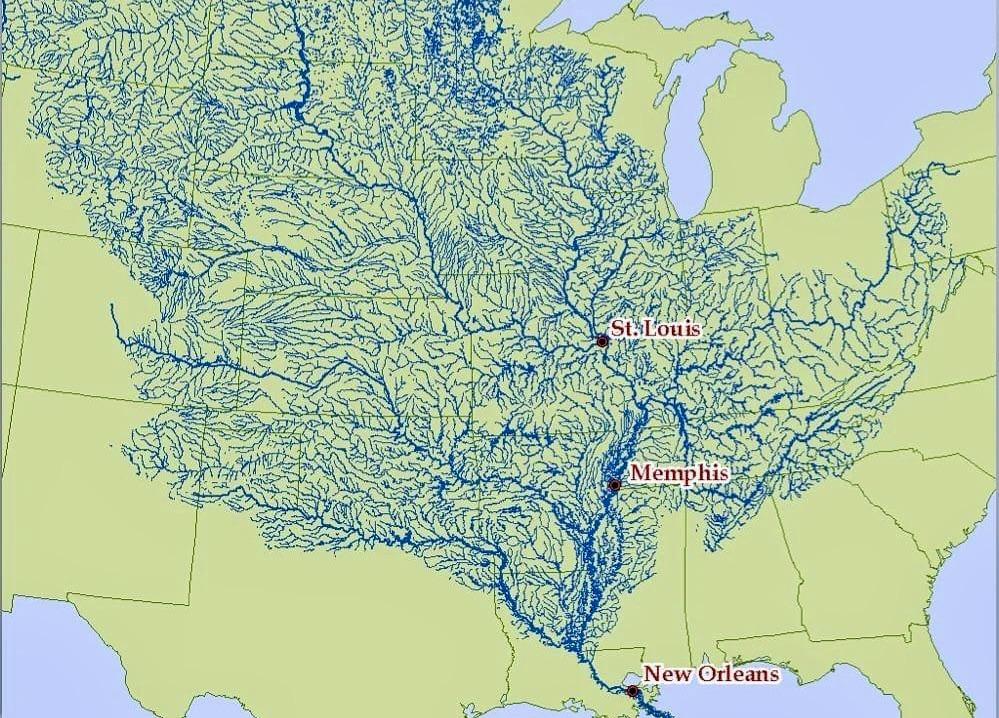
Earth’s rivers, lakes, streams, and reservoirs provide essential freshwater for billions of people, supplying drinking water, irrigating crops, generating hydroelectric power, and sustaining countless ecosystems
- Includes rivers, lakes, and streams.
- Used for irrigation, drinking water, industry, and hydropower.
- Major sources: Nile, Yangtze, Ganges, Mississippi, Amazon, Danube, etc.
Groundwater (Aquifers)
Groundwater accounts for approximately 99% of Earth’s liquid freshwater and supplies about half of the water withdrawn for household use worldwide and 25% of irrigation water used to grow crops.
- Stored in underground layers of rock and soil.
- Provides water for ~2 billion people and ~40% of global irrigation.
- Key aquifers: Ogallala (U.S.), North China Plain, Indo-Gangetic Basin, Arabian Peninsula.
- Often over-extracted—non-renewable in many regions.
Snowpack and Glaciers
Glaciers and ice caps contain approximately 69% of Earth’s freshwater, making them the planet’s largest freshwater reservoirs.
- Natural freshwater storage in mountain regions.
- Meltwater feeds rivers like the Ganges, Indus, and Colorado during dry seasons.
- Climate change is rapidly reducing this source.
Wetlands and Marshes
Wetlands and marshes cover approximately 6% of Earth’s land surface, acting as natural water filters, absorbing floodwaters, replenishing groundwater, and providing habitats for thousands of species. These remarkable ecosystems also store enormous amounts of carbon and help maintain the balance of Earth’s water cycle.
- Act as natural sponges that store, purify, and release water.
- Crucial for ecosystems and seasonal agriculture (e.g., rice paddies).
- Decreasing globally due to urbanization and farming.
The way God uses rain, the hydrological cycle, surface water, groundwater, snowpack, and glaciers to supply water to humanity and animals is a profound demonstration of His goodness, wisdom, and benevolence. Through a perfectly balanced and self-sustaining system, He provides clean, life-giving water to nourish people, animals, and the earth itself. From the steady flow of rivers to the hidden reserves in aquifers and the seasonal melt of snow and glaciers, every part of this system reflects thoughtful design and compassionate provision. It is a daily reminder of God’s faithful care for all creation.
Sun
Matthew 5:45In that way, you will be acting
as true children of your Father in heaven.For he gives his sunlight
to both the evil and the good,and He sends rain
on the just and the unjust alike.
The fine-tuning of the Earth allows us to receive life-sustaining benefits from the Sun in precise and balanced ways. Here are key examples:
1. Optimal Distance from the Sun (“Goldilocks Zone”)
- Earth orbits the Sun at just the right distance—not too hot, not too cold—allowing liquid water to exist, which is essential for all known life.
- If Earth were slightly closer or farther, temperatures would be too extreme for complex life.
2. Atmosphere and Ozone Layer
- Earth’s atmosphere filters harmful ultraviolet (UV) radiation while still allowing beneficial sunlight (visible light and some UV) to reach the surface.
- The ozone layer specifically absorbs the most dangerous UV rays, protecting skin, DNA, and ecosystems.
3. Magnetic Field
- Earth’s magnetic field shields the planet from solar wind and radiation, which could otherwise strip away the atmosphere and expose the surface to harmful energy.
- This protection helps preserve the delicate balance of heat and radiation necessary for life.
4. Axial Tilt and Rotation
- Earth’s 23.5° axial tilt provides seasonal variation that supports biodiversity and agricultural cycles.
- Its 24-hour rotation evenly distributes solar heating, preventing extreme temperatures between day and night.
5. Atmospheric Composition
- The mix of gases—especially carbon dioxide, oxygen, and nitrogen—regulates the greenhouse effect, trapping just enough solar heat to maintain a stable climate.
- Without this balance, Earth would be either a frozen wasteland or a scorched desert.
6. Clouds and Albedo (Reflectivity)
- Earth’s cloud cover and surface reflectivity help regulate how much solar energy is absorbed vs. reflected.
- This fine-tuning helps stabilize temperatures and prevent runaway heating.
7. Photosynthesis Compatibility
- Sunlight on Earth contains the exact range of light wavelengths needed for photosynthesis, enabling plants to convert light into energy, produce oxygen, and form the base of the food chain.
These fine tuning parameters allow the Earth and it’s inhabitants the benefits from the sun that are essential to mankind’s physical and environmental health which are wholly absent on any other planets.
Such as:
- Vitamin D Production – Sunlight triggers the body to produce vitamin D, crucial for bone health, immune function, and mood regulation.
- Mental Health – Exposure to natural light helps regulate serotonin levels, improving mood and reducing the risk of depression.
- Circadian Rhythm Regulation – Sunlight helps maintain the body’s internal clock, promoting healthy sleep patterns.
- Plant Growth – Sunlight is vital for photosynthesis, which sustains the global food supply and oxygen production.
- Disinfection – UV rays from sunlight can naturally kill certain bacteria and pathogens on surfaces and in water.
Natural Medicines
“Their fruit will be for food, and their leaves for healing.”
Ezekiel 47:12
Plants, fungi, and other organic substances have played a foundational role in medicine for centuries—and continue to be essential to modern healthcare. These natural resources contribute to human health in the following key ways:
1. Treatment and Cure of Diseases
- Many life-saving medications are derived directly from plants or fungi, or are modeled after natural compounds.
- Aspirin comes from willow bark.
- Penicillin, the first antibiotic, is derived from Penicillium mold.
- Quinine, used to treat malaria, is extracted from the bark of the cinchona tree.
- These natural compounds have unique chemical structures that target infections, regulate body systems, or destroy harmful cells (like in cancer treatment).
2. Source of Pharmaceuticals
- Over 50% of pharmaceutical drugs have natural origins or are inspired by organic compounds.
- Fungi, bacteria, marine organisms, and plants continue to be mined for new chemical properties in drug discovery and development.
3. Immune Support and Inflammation Control
- Many herbs and plant extracts possess anti-inflammatory, antioxidant, and immune-modulating properties.
- Turmeric, echinacea, and garlic, for example, are widely studied for their healing effects.
4. Wound Care and Healing
- Organic substances aid in wound care through:
- Antibacterial properties (e.g., honey, aloe vera).
- Promoting tissue regeneration (e.g., gotu kola, calendula).
- Pain relief (e.g., clove oil, derived from plants).
5. Chronic Condition Management
- Natural compounds help manage chronic diseases like diabetes, heart disease, and arthritis.
- For example, metformin, a common diabetes drug, was developed from a compound found in the French lilac.
6. Biological Compatibility
- Organic compounds often work better with the human body due to natural compatibility—they are more easily absorbed, recognized, or metabolized by biological systems compared to synthetic-only chemicals.
7. Continued Potential for Discovery
- The vast majority of Earth’s plants, fungi, and microorganisms remain scientifically unexplored.
- Especially in rainforests and oceans, researchers continue to find potential new treatments for cancer, neurological disorders, and antibiotic resistance.
The fact that plants, fungi, and other organic substances contain the very compounds needed to heal, protect, and sustain the human body is a profound example of God’s intentional and benevolent design. Long before the discovery of modern medicine, these natural resources were already embedded in creation—waiting to be found, understood, and applied. This reveals not only God’s foresight but His deep concern for human well-being.
From the bark of trees that reduces pain, to fungi that fight infection, and herbs that strengthen the body, the natural world is filled with life-saving and life-enhancing substances. These are not random coincidences; they are provisions of grace woven into creation, demonstrating that God anticipated human needs and lovingly provided for them.
Building And Clothing Materials
I will plant trees in the barren desert— cedar, acacia, myrtle, olive, cypress, fir, and pine. I am doing this so all who see this miracle will understand what it means—that it is the Lord who has done this, the Holy One of Israel who created it.
Isaiah 41:19-20
There are approximately 2 to 2.5 billion shelters or living structures on Earth. Nature contributes a significant majority of the materials used for sheltering humans—well over 80% globally—either directly or indirectly.
Estimated Global Contribution of Nature to Building Materials
| Material Type | Nature’s Contribution |
|---|---|
| Traditional/vernacular buildings | ca. 100% |
| Modern buildings (urban areas) | ca. 60–90% (natural origins, even if processed) |
| Eco-sustainable buildings | ca. 90–100% |
Even in highly industrialized societies, nature remains the original source of nearly all construction materials. Only a small fraction (mainly synthetic polymers, composites, or recycled materials) is not directly derived from natural sources. There are an estimated 2.2 to 2.6 dwellings (houses, apartments, and other residential units) worldwide—but there is not even enough material to build a single small thatch hut on any other planet.
Nature Provides the Raw Materials for the Worlds Clothes
Nature also plays a foundational role in clothing the world’s 8 billion people by providing the raw materials and ingredients for textiles and garments. Here’s how:
1. Plant-Based Fibers
- Cotton: Grown in over 70 countries, cotton is the most widely used natural fiber. Its soft, breathable properties make it ideal for everything from T-shirts to denim.
- Linen (Flax): Derived from the flax plant, linen is durable and moisture-wicking, used in warm-weather clothing and household textiles.
- Hemp: An ancient crop that requires little water and no pesticides, hemp produces strong, long-lasting fabric.
- Bamboo: Processed into viscose or rayon, bamboo is a renewable source for soft and silky textiles.
2. Animal-Based Fibers
- Wool: Sheared from sheep, wool provides warmth and is used in sweaters, suits, and outerwear.
- Silk: Produced by silkworms feeding on mulberry leaves, silk is prized for its softness and luster.
- Alpaca, Cashmere, and Mohair: These luxurious fibers come from alpacas, goats, and angora goats, offering lightweight warmth.
3. Natural Dyes and Treatments
- Plant-based dyes: Historically and increasingly today, colors are extracted from roots, leaves, flowers, and bark (e.g., indigo from indigofera plants).
- Tannins and resins: Sourced from trees and plants, they are used in leather tanning and textile finishing.
4. Leather and Skins
- Derived from animals like cows, sheep, and goats, leather is used in shoes, jackets, belts, and bags. Ethical and sustainable practices aim to use by-products of the food industry.
5. Rubber and Latex
- Natural rubber from rubber trees is essential for elastic materials, soles of shoes, and waterproof clothing.
From cotton fields and woolly pastures to bamboo forests and silkworm farms, nature provides the essential building blocks for clothing. These organic sources are renewable, biodegradable, and deeply intertwined with human culture and survival, showcasing God’s enduring provision for our most basic needs.
ALMIGHTY King! whose wondrous hand
Supports the weight of sea and land;
Whose grace is such a boundless store,
No heart shall break that sighs for more.Thy providence supplies my food,
And ’tis thy blessing makes it good;
My soul is nourished by thy word:
Let soul and body praise the Lord!— William Cowper, Grace and Providence
The Earth stands uniquely habitable, adorned with exquisite and diverse life in every corner of the globe. None of the food, water, medicine, or building and clothing materials can be found any place in the Universe but Earth. These gifts testify to God’s intentional care and profound regard for humanity.
From the rising of the sun to the falling of the rain, the blessings of everyday life reveal the wonder of common grace—God’s gracious provision for all His creatures. This grace reflects His nature as caring, generous, and kind.
Challenge Question: Do you believe the beauty and abundance found on Earth are merely the result of blind cosmic luck—or are they evidence of God’s intentional care and regard for humanity?
Premise 6: Creation Reveals Immesurable Greateness
in·fin·i·tude
/inˈfinəˌto͞od/
the state or quality of being infinite or having no limit
The infinite nature of God simply means that God exists outside of and is not limited by time or space. Infinite simply means “without limits.”
Creation reflects God’s infiniteness through its sheer scale, complexity, and the boundless beauty and wonder it reveals, suggesting a creator of limitless power and imagination. Creation reveals the existence of a God who presides in majestic, transcendent, sustaining power.
3 Ways God’s Infinitude Are Observed
| Scale and Vastness | The universe, with its billions of galaxies and stars, is a testament to God’s infinite power and scope. The sheer size of the cosmos, and the vastness of space and time, points to a creator who is not bound by limitations. |
| Complexity and Order | The intricate and ordered nature of the universe, from the smallest subatomic particles to the largest galaxies, suggests a brilliant and infinite intelligence at work. The laws of physics and the delicate balance of nature point to a creator who is not only powerful but also wise and creative |
| Transcendent Nature | The beauty and wonder of creation, from the majesty of mountains to the delicate beauty of a flower, speaks to a creator who is not only powerful but also loving and artistic. The sheer diversity of life and the intricate designs within nature point to a creator who is not limited by our understanding of beauty. |
For since the creation of the world
God’s invisible qualities—his eternal power and divine nature—
have been clearly seen,
being understood from what has been made,so that people are without excuse.
Romans 1:20
Ways God’s Infinitude Has Been Revealed In The Physical Sciences
| Space | The James Webb telescope can see 13.5 billion years in the past yet this is just a portion the portion called “observable universe which is still roughly 93 billion light years across. says “He counts the stars and calls them all by name” Psalm 147:4 |
| Biological Diversity | Scientists estimate there are around 8.7 million species of animals on Earth, although only about 1.2 million have been formally described and cataloged. Scientists discover an estimated 15,000 to 18,000 new species each year. ” What is the price of two sparrows—one copper coin? But not a single sparrow can fall to the ground without your Father knowing it.” Matthew 10:29 |
| Botanical Diversity | There are an estimated 380,000 to 435,000 known species of plants on Earth. Scientists discover and name around 2,000 new plant species each year. “Then God said, Let the land sprout with vegetation—every sort of seed bearing plant, and trees that grow seed-bearing fruit.” Genesis 1:11 |
| DNA | DNA’s structure allows for incredibly high data density. Research suggests that a single gram of DNA could hold approximately 215 petabytes of data, which is 100 million times more information per gram than modern disk drives. “But God gives everything a body as he has chosen, and to each kind of seed its own body. 39 For not all flesh is the same, but there is one kind for humans, another for animals, another for birds, and another for fish.” 1 Corinthians 15:38-39 |
| Quantum Physics | In quantum physics, “infinity” manifests in several ways, including infinite energy of point particles, infinities arising in vacuum states, and infinities in light scattering calculations. “By faith we understand that the universe was formed at God’s command, so that what is seen was not made out of what was visible.” Hebrews 11:3 |
Different Ways God’s Infinite Power Is On Display
Omnipotentence
An Agency or force of unlimited power
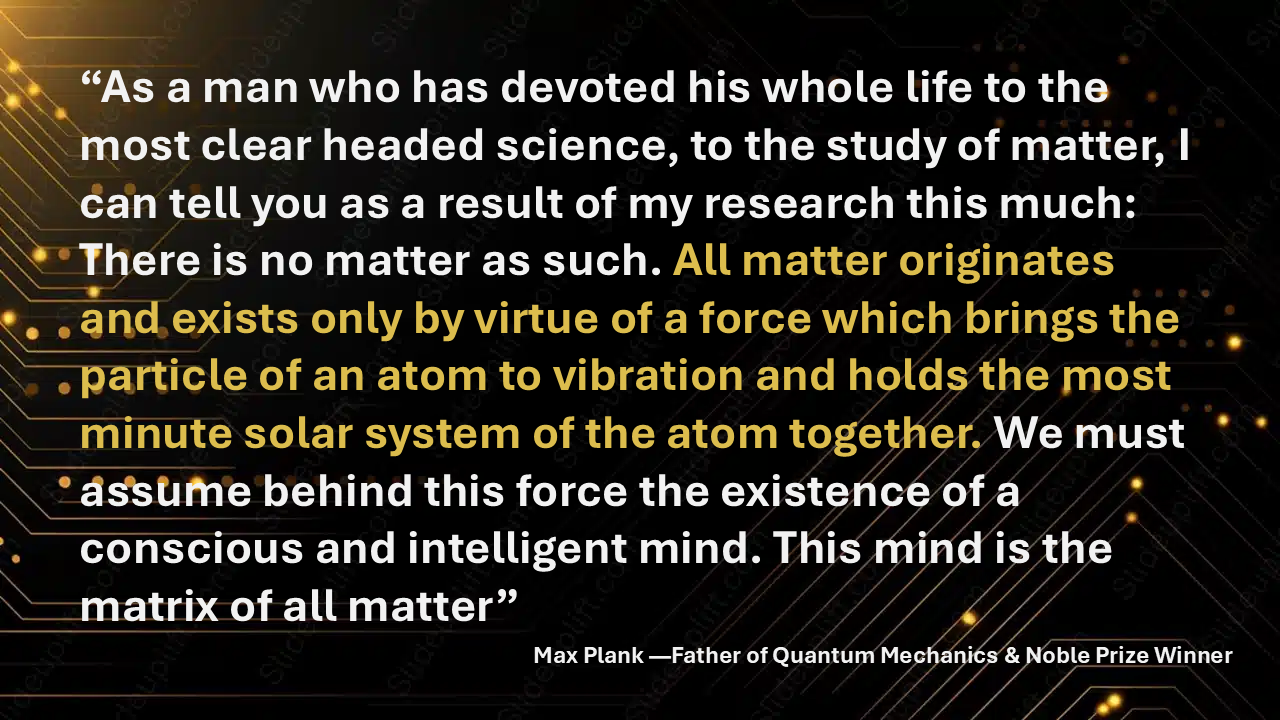
Consider the magnitude of what it means to possess unlimited power. Every force in the universe, from the energy contained within a single atom to the unimaginable power of billions of stars, operates within physical limits. But the God of the Bible is not constrained by those limits. He is the source of all matter, energy, space, and time. His power is not merely greater than anything in creation—it is without limit. Here are ways God’s infinite power is displayed in creation:
Creation from Nothing (Creatio ex nihilo)
- The belief that God created the universe out of nothing shows a power that no other being possesses. Creating without using pre-existing materials points to limitless power.
Order and Complexity in Nature
- The intricate laws of physics, the fine-tuning of the universe, and the complexity of life all point to a creator who is not only powerful but supremely intelligent.
- This suggests a power that not only creates, but sustains and governs all things with absolute control.
Sovereignty over Time and Space
- Creating the universe means God is outside and above time, space, and matter. This transcendent act demonstrates total dominion over everything that exists.
Dependence of Creation on God
- The fact that creation continues to exist is evidence of God’s ongoing sustaining power. Without God’s will, nothing could exist.
Omniscience
Having complete, infinite, and unlimited
knowledge, awareness, and understanding—literally meaning “all-knowing.”
For God to be sovereign over His creation of all things, whether visible or invisible, He has to be all-knowing. Creation reflects God’s omniscience, or all-knowingness, through its intricate order, purpose, and the inherent goodness of all things.
The universe, with its complex systems and laws, points to a creator who understands and orchestrates everything with precision. As Creator, God knows every intimate detail about His creation, demonstrating His all-encompassing knowledge. Here are ways Creation reveals God’s omniscience:
Fine-Tuning of the Universe
Modern physics shows that the universe appears to be finely tuned for life. Constants like the gravitational constant, the strength of the strong nuclear force, and the cosmological constant must fall within very narrow ranges for stars, planets, and life to exist.
- Scientific Observation: If any of these constants were even slightly different, complex life could not form.
- Implication: Some interpret this precision as evidence that a Creator must have had complete knowledge (omniscience) of all physical laws and parameters needed to produce life.
Complexity in Biological Systems
Biological systems, like the human brain, immune system, and genetic code, are incredibly complex and interdependent.
- DNA contains vast amounts of information coded in a language-like structure. The genome reflects not just information, but information management—error correction, replication fidelity, and expression regulation.
- Implication: The informational content and function of biological systems point to a mind that understands not only matter, but abstract systems, such as logic, communication, and self-repair—hallmarks of omniscient design.
Mathematical Foundations of Nature
The universe operates according to elegant, consistent mathematical laws.
- Einstein once said, “The most incomprehensible thing about the universe is that it is comprehensible.”
- Implication: Mathematics appears to be a “language” woven into the fabric of reality. If God is the author of creation, the presence of deep mathematical order could indicate omniscient knowledge of logic, structure, and predictability.
Predictive Power of Natural Laws
The fact that humans can predict celestial events (eclipses, planetary orbits), understand atomic structures, and apply physics across the universe points to a consistent design.
- Implication: A Creator who set such a system in motion must possess exhaustive knowledge of time, cause-effect relationships, and every possible outcome—a core element of omniscience.
Information Theory and the Origin of Information
Information theory, pioneered by Claude Shannon, studies how information is created, transmitted, and preserved.
Implication: The origin of functional information in biology implies a source with complete knowledge of how that information must operate—suggestive of omniscience.
Scientific Insight: Random processes can generate noise but not meaningful information (like a functioning genetic code or language).
Great is our Lord, and mighty in power;
Psalm 147:5
His understanding is infinite.
Mankind is the most intelligent creature in the natural world. Yet despite centuries of scientific discovery, enormous investments, and extraordinary advances in human knowledge, we still cannot create a single living blade of grass, a granule of soil, or a drop of water from absolutely nothing. If all that existed in the universe were a single blade of grass, a granule of soil, or a drop of water, each would be regarded as an extraordinary marvel worthy of scientific reverence. There is something profoundly ironic about mankind, whose very intelligence was given to him by God, so often presuming that he knows more than the One who created him.
Christians and the Bible believe God’s intelligence is infinitely greater than the amount contained in the universe and that the cosmos is only a glimpse of it. Creation reveals the infinite distance between us (creatures) and Him (the Creator). Because God is infinite, He is also transcendent, which means that God is exceedingly far above creation and is both greater than creation and independent of it. Over one hundred billion galaxies—each with hundreds of billions of stars—are proclaiming, in some small measure, the infinite glory of God.
Challenge Question: What do you think the source of the infinite amount of information contained in the Universe known and unknown is?
ThinkCube Truth Veracity Grid
- Have I considered the facts carefully and with an open mind?
- Is my conclusion the result of a careful examination of the facts, or is it a conclusion made in spite of the facts?
- Is my conclusion the one that makes the most sense of the evidence?