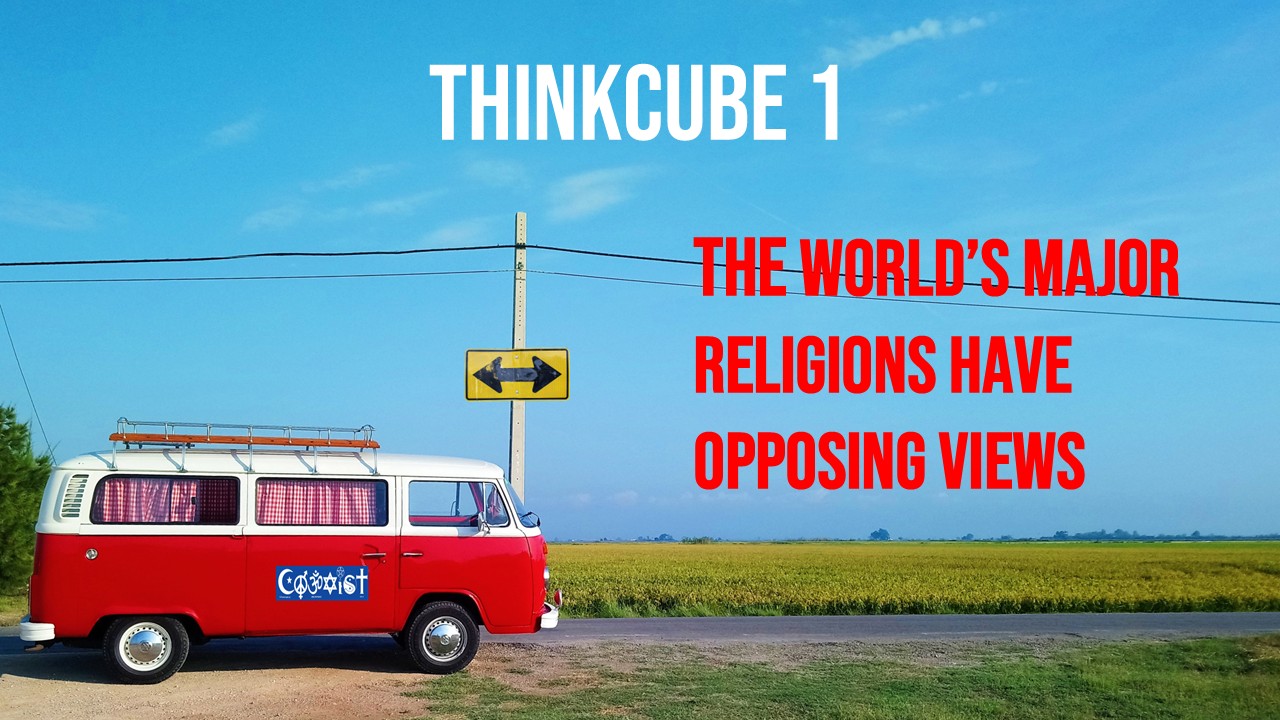
Premise 1: The World’s Major Religions Are Doctrinally Opposed
All of the world’s major religions present fundamentally different—and often conflicting—doctrines about the nature of God, the human condition, salvation, and the afterlife. Despite these contradictions, there have been attempts to harmonize them under a single spiritual umbrella. In his influential work The World’s Religions, scholar Huston Smith references a 19th-century Hindu saint, Ramakrishna, who advocated the idea that all religions are valid paths leading to the same ultimate reality. This belief, sometimes called religious pluralism, suggests that beneath their superficial differences, the world’s religions share a common spiritual core. A more contemporary form of this idea is known as “universalism,” often illustrated by the metaphor of a wheel: the religions of the world are the spokes, each taking a different route, yet all converging on the same divine center.
This metaphor is appealing in its inclusivity, offering a vision of religious harmony and coexistence. However, it raises a crucial and unavoidable question: Can this really be true? Given that the core claims of major religions often contradict each other—such as the nature of God (monotheistic, polytheistic, or non-theistic), the identity and role of Jesus, the path to salvation, and the final destiny of the soul—it is difficult to see how all religions can be equally true in the same sense. The question is not whether all religions contain elements of truth, wisdom, or moral guidance, but whether they all ultimately point to the same divine reality, especially when their central teachings diverge on essential matters. To affirm this, one must either ignore these contradictions or reduce each faith’s claims to symbolic or subjective interpretations—an approach that risks misrepresenting them altogether.
Applying Aristotle’s Law Of Non-contradiction To Universalism
Aristotle’s law of non-contradiction states that two opposite truth claims cannot both be true at the same time and in the same way. In simple terms, something cannot be true and not true at the same time. For example, if one religion says that God is personal and another says that God is impersonal, both statements cannot be fully correct in the same sense. This law is a basic rule of logic and helps us recognize that when different religions make contradictory claims about ultimate reality, they can’t all be equally true.
The reality is that every religion makes exclusive truth claims about God that are not only not the same, but are opposed to each other. Nothing demonstrates this more than the world’s religions fundamental view of God himself.
Contradictory Views of God Across Major World Religions
| Religion–View of God | Nature of God | Exclusive Claim About God |
|---|---|---|
| Christianity—One personal, triune God (Father, Son, Holy Spirit) | Personal, loving, became incarnate in Jesus | Jesus is the only way to God (John 14:6) |
| Islam—One indivisible, transcendent God (Allah) | Personal but utterly singular, not triune | Denies Trinity; Muhammad is Allah’s final prophet |
| Judaism—One personal, covenantal God (YHWH) | Singular, not triune | Rejects Jesus as divine or the promised Messiah |
| Hinduism—Many gods as expressions of one ultimate reality | Varies: personal deities and impersonal Brahman | All is ultimately Brahman; gods are expressions |
| Buddhism—No creator god; emphasis on enlightenment | Ultimate reality is Nirvana, not a deity | God is not central; rejects personal creator God |
| Mormonism—God was once a man; humans can become gods | One of many gods; not eternally divine | Denies historic Christian view of God’s nature |
| New Age—God is an impersonal force within all things | Divine energy or force; pantheistic | Everyone is part of the divine; truth is within |
| Taoism—The Tao is the ultimate reality, there is not a personal god | The Tao is an impersonal, natural cosmic order | Aligning with the Tao is the path to harmony and truth |
| Confucianism—Focus on moral duty and harmony, not centered on God | Ethical and philosophical rather than theistic | Does not claim a personal or revealed deity |
Contrasting Views of Salvation and the Afterlife
| Religion | View of Salvation | View of the Afterlife |
|---|---|---|
| Protestant Christianity | Salvation is by grace through faith alone in the death and resurrection of Jesus Christ. Human effort cannot earn salvation. | Upon death, believers go immediately to heaven. Unbelievers are separated from God in hell. |
| Roman Catholicism | Salvation involves faith in Christ, baptism, and the performance of sacraments and good works to be purified from sin. | The purified go to heaven; those who reject Christ go to hell. Believers who die with unconfessed sins enter purgatory for cleansing. |
| Islam | Salvation is based on submission to Allah and following the Five Pillars. Good deeds must outweigh bad deeds. Martyrdom guarantees paradise. | The faithful enter paradise; those who reject Allah face eternal punishment in hell. |
| Hinduism | Salvation (moksha) is escaping the cycle of reincarnation and becoming one with Brahman. Achieved through devotion, knowledge, or disciplined works. | The soul is reborn in new bodies based on karma until it achieves liberation and is absorbed into the divine essence. |
| Buddhism | Salvation (nirvana) is achieved by extinguishing desire and escaping the cycle of suffering and rebirth through the Eightfold Path. | The soul is reborn repeatedly until enlightenment is reached. After achieving nirvana, the soul ceases to exist in personal form. |
| Taoism | Salvation is harmony with the Tao, the cosmic force of nature. Attained by living simply, virtuously, and in balance with nature and cosmic energy. | Traditional Taoism included immortality quests, but modern Taoism often adopts Buddhist ideas of rebirth and eventual spiritual merging. |
| Jehovah’s Witnesses | The 144,000 “anointed” are saved by Christ’s blood to rule in heaven. Others must earn salvation through obedience and evangelism. | Most will be resurrected to live on a restored Earth under Christ’s rule. The 144,000 reign in heaven. The wicked are annihilated. |
| Baháʼí Faith | Humans are not inherently sinful. Salvation is spiritual growth by recognizing God’s messengers and living morally. | The soul continues progressing toward God after death through spiritual realms, experiencing nearness (heaven) or distance (hell) from God. |
| Mormonism (LDS) | “General salvation” is given to all through Christ’s atonement. “Individual salvation” (exaltation) requires faith, church rituals, obedience, and temple work. | The faithful are assigned to one of three heavens. The highest (Celestial Kingdom) allows believers to become gods and have spirit children. |
These charts reveal a critical truth: the world’s major religions are not simply different expressions of the same reality—they offer fundamentally incompatible views of God, ultimate reality, and the path to salvation or enlightenment. While each religion may contain moral insights or spiritual practices, their core doctrines directly contradict one another. According to basic logic—such as the law of non-contradiction—they cannot all be equally true in the same way. This challenges the popular notion of religious universalism and invites deeper examination into which, if any, offers a true and coherent view of God.
All Of The Worlds Religion Answer Life’s Biggest Questions Differently
- Who or what god is
- How or why you should live concerning salvation of your soul
- What heaven is or how you get there
To say that all religions are essentially the same is like claiming that Mexican, Asian, Italian, and African cuisines are the same—despite using entirely different ingredients, preparation methods, and resulting in completely distinct flavors. Each type of food reflects a unique cultural heritage, underlying philosophy, and culinary logic. Likewise, each religion arises from a particular worldview, defines the nature of God (or gods), humanity, salvation, morality, and the afterlife in fundamentally different—and often contradictory—ways.
“To maintain that all religions are essentially the same and lead to the same conclusion is as absurd as to maintain that all scientific theories lead to the same conclusion”
W.T. Stace—British Philosopher of Religion
For example, Christianity teaches that salvation is by grace through faith in the atoning death and resurrection of Jesus Christ, while Hinduism sees salvation as merging into an impersonal divine essence through cycles of reincarnation. Islam teaches submission to Allah and obedience to his law, while Buddhism denies a personal god altogether and seeks the cessation of desire. These aren’t superficial differences—they are foundational and mutually exclusive.
To suggest that all religions lead to the same spiritual destination is not only logically inconsistent, it also minimizes the deep convictions and doctrines that billions of people around the world hold as central to their faith. Just as it would be inaccurate—and dismissive—to flatten global cuisines into one uniform dish, it is equally flawed to reduce all religions to one indistinguishable path.
In light of the clear and irreconcilable differences between the world’s major religions—especially regarding the nature of God, salvation, and the afterlife—it is intellectually dishonest to claim they are all the same or lead to the same destination. While tolerance and respect are essential, truth by nature is exclusive. If even one religion is true in its ultimate claims, then others that contradict it cannot also be true in the same way.
Challenge Question: How can world religions be deemed equally true and valid if they literally contradict each other?
Premise 2: All Of The World’s Major Religions Believe They Are Exclusive
Timothy Keller, author of “The Reason For God” writes about being the Christian representative in a panel discussion at a college along with a Jewish Rabbi, and a Muslim Imam. The panelists were asked to discuss the differences among religions. Following the discussion they all agreed on the following statement:
If Christians are right about Jesus being God, then Muslims and Jews fail in a serious way to love God as God really is, but if Muslims and Jews are right that Jesus is not God but rather a teacher or prophet, then Christians fail in a serious way to love God as God really is.
Timothy Keller— The Reason for God
Each of the world’s major religions holds to a distinct and exclusive understanding of salvation, the requirements for attaining it, and the nature of the afterlife. As a result, any deviation from their specific teachings is not viewed as a harmless alternative, but as a spiritually catastrophic error. In their view, rejecting or misunderstanding the true path puts a person’s eternal destiny at risk—whether that be separation from God, endless reincarnation, annihilation, or missing out on divine union or exaltation.
For example, Christianity teaches that salvation comes only through faith in Jesus Christ; to reject Him is to forfeit eternal life. Islam warns that denial of Allah and His prophet leads to eternal punishment. Hinduism sees failure to escape the cycle of karma and rebirth as continued bondage to suffering. Buddhism teaches that clinging to desire keeps one trapped in samsara. Even more modern systems like Mormonism and Jehovah’s Witnesses describe dire consequences—spiritual loss or limited access to eternal rewards—for failing to follow their prescribed path.
None of the Major Religions View Salvation as a Multi-lane Highway
None of the religions treat salvation as a flexible, multi-lane highway. Each insists that their path is not only right but essential—and that diverging from it has eternal implications. Leaders of the world’s foremost religions are not vague or ambiguous when it comes to the question of salvation—they are deeply dogmatic. They do not teach that there are many equally valid paths to heaven, enlightenment, or ultimate reality; rather, they assert that there is only one true path, and it is their own. Each religion lays out specific beliefs about God (or the ultimate reality), along with clear doctrinal teachings, moral codes, rituals, and required actions—whether they be commandments, sacraments, pillars, or spiritual disciplines.
Failure to meet these requirements, whether in belief, behavior, or devotion, is not treated lightly. According to each system, a misstep—whether in misunderstanding who God is, neglecting essential duties, or trusting in the wrong savior or philosophy—can result in disqualification from salvation or eternal reward. This exclusivity is not an occasional feature; it is a defining trait of each faith.
Each religion informs its followers that they have “the truth” …Also, each religion tells its followers that they are saved and connected to God by devotedly performing that truth
Timothy Keller-The Reason for God
Despite modern attempts to portray world religions as different routes to the same destination, their actual teachings firmly reject that notion. They do not allow for multiple spiritual finish lines—only one, and each religion claims to know where it is and how to get there.
Challenge Question: Is it at all accurate to say then that all religions are basically the same, and lead to the same destination if the religions founders and leaders wholeheartedly disagree?
Premise 3: All Religions Do Not Lead To The Same Destination
Are all religions basically the same?
Do all religions lead to the same destination?
In a word, “No.”
The world’s religions don’t even agree on what the destination is. For example, Buddhism teaches that your problem is suffering. The solution is the eight-fold path and the goal is nirvana, which means you essentially become extinct with respect to the material world.
Christianity, on the other hand, teaches that your problem is sin, the inborn tendency to go your own way apart from God. The solution is forgiveness, by which God restores the broken relationship, and the goal is a resurrected life in a renewed heaven and earth.
In Hinduism, your problem is a vicious cycle of life, death and rebirth. The solution is discipline in various forms — ritual actions, wisdom or devotion to the god of your choosing, and the goal is not salvation from sin but to escape the cycle of birth, death and rebirth.
In Islam, your problem is self-sufficiency, or acting as if you can get along without God. The solution is submission to Allah by following the five pillars of the faith, and the goal is a paradise of sensual comforts.
In Judaism, the problem is a rhythm of wrongdoing, punishment and exile. The solution is to return to God by remembering the covenant and following the commands of the Torah, the Hebrew Bible. The goal is to repair the world by doing the commandments and restoring righteousness.
Some religions emphasize that life has gone wrong, while others emphasize that life itself is wrong.
There is No Agreement on the Destination, Problem, or Solution
Are all religions basically the same? Do they ultimately lead to the same destination? A careful examination of their core teachings reveals that they are not the same—and they do not lead to the same place.
While many religions may share surface similarities—such as ethical principles, reverence for the divine, or a desire for peace—their foundational beliefs are radically different and often directly opposed. They disagree on who or what God is, what the human problem is, how it is solved, and what awaits us after death. Some teach that God is personal, others impersonal; some say salvation comes through grace, others through works or enlightenment; some promise eternal life, others speak of reincarnation or absorption into a cosmic whole.
These aren’t minor variations—they are essential truths that define the entire structure of each faith. Because these core claims contradict one another, they cannot all be true in the same sense. The idea that all religions are simply different roads up the same mountain may sound appealing, but it collapses under the weight of their actual teachings. Each religion offers a distinct map, with different destinations, and different
All too often, however, people assume that these very different belief systems are just alternate paths up the same mountain, and that fails to do justice to the distinctiveness of what each religion teaches and insists upon.
Reverend John Armstrong—Article in The Republic
In the end, all religions are not saying the same thing, and they are not leading to the same place. Their core claims about truth, God, salvation, and eternity fundamentally contradict each other. They can all be wrong, but they cannot all be right. Truth, by nature, is exclusive.
Challenge Question : Is it condescending to treat all religions as essentially the same, as if their distinct doctrines and foundational teachings are merely secondary to their surface-level similarities?
ThinkCube Truth Veracity Grid
- Have I considered the facts carefully and with an open mind?
- Is my conclusion the result of a careful examination of the facts, or is it a conclusion made in spite of the facts?
- Is my conclusion the one that makes the most sense of the evidence?