Premise 1: Why There Are So Many Religions
The vast majority of humanity—nearly three-quarters of the world—still finds meaning and identity within some form of religious tradition. Religion continues to thrive because it speaks to the deepest human needs: for meaning, morality, belonging, comfort, and transcendence. Rather than being outdated, it remains profoundly relevant in answering the questions every generation continues to ask.
3 Main Reasons The Majority Of The Global Population Is Religious
1. The Search for Ultimate Meaning
Human beings instinctively seek answers to life’s biggest questions: Why are we here? What happens after death? What is my purpose? Religion provides coherent frameworks that speak to these longings, offering narratives that give life direction, value, and hope beyond the material world.
2. Inescapable Sense of the Divine
Across time and geography, people report a deep, intuitive sense that there is something more—a transcendent reality beyond what is seen. C.S. Lewis once noted that “creatures are not born with desires unless satisfaction for those desires exists.” The universal religious impulse suggests this longing is not accidental.
3. Accountability to a higher power
Many religious traditions teach that humans are accountable to a divine being or moral lawgiver. This instills a sense that one’s actions matter not just socially or legally, but eternally. This vertical accountability often encourages integrity, restraint, and purpose in personal conduct.
Human Religiosity Reveals A Universal Spiritual Instinct
Anthropologists have observed that even remote tribes and indigenous groups—those with little or no contact with the outside world—possess structured religious systems. These often include ceremonies, doctrines, songs, rituals, and practices of giving or sacrifice, all serving as expressions of worship.
Both anthropologists and sociologists have consistently found that, while the world’s cultures and indigenous peoples maintain distinct and profound religious traditions, they all exhibit the same underlying spiritual instincts. These universal traits—such as a sense of the divine, moral awareness, reverence, and the impulse to worship—point to something deeply embedded in human nature: a shared spiritual capacity that transcends geography, language, and history.
He has made everything beautiful and appropriate in its time.
Ecclesiastes 3:11
He has also planted eternity in the human heart
From the beginning, Scripture teaches that human beings are made in the image of God (imago Dei), which includes not only moral awareness and reason but also a deep spiritual capacity. This means that God has embedded within every person an instinctive awareness of His existence, a conscience that recognizes right from wrong, and a longing for something beyond the material world.
One of the clearest affirmations of this comes from Ecclesiastes 3:11, which says, “He has made everything beautiful in its time. He has also set eternity in the human heart.” This means that every human being, regardless of culture or background, has an innate sense that life does not end at death and that there is something greater, eternal, and transcendent beyond this world.
wor·ship
Oxford Dictionary
/ˈwərSHəp/
the feeling or expression of worship and adoration for a deity
Even in societies that have never encountered Scripture, people build temples, offer sacrifices, and seek the divine. This universal religious impulse is not random—it is evidence that God has hardwired the human soul to seek Him.
Global Religious Instincts and Biblical Affirmation of Divine Awareness
| Universal Religious Instinct | Biblical Principle | Scriptural Reference |
|---|---|---|
| Belief in a higher power or divine being | Humanity has an innate awareness of God | Romans 1:19–20 – “What may be known about God is plain… God has made it plain to them.” |
| Moral awareness / conscience | God’s law is written on human hearts | Romans 2:14–15 – “The requirements of the law are written on their hearts…” |
| Rituals, sacrifices, and offerings | A natural impulse to seek favor or atone before God | Ecclesiastes 3:11 – “He has set eternity in the human heart…” |
| Communal worship and sacred spaces | People naturally seek fellowship in the presence of the divine | Acts 17:26–27 – “He determined… that they would seek Him and perhaps reach out…” |
| Fear of divine judgment or afterlife | Instinctive sense of accountability to a higher power | Hebrews 9:27 – “It is appointed for men to die once, and after this comes judgment.” |
| Use of music, chants, and symbols in worship | Worship expressed through music and symbolic acts | Psalm 150:6 – “Let everything that has breath praise the Lord.” |
| Desire for meaning, transcendence, and purpose | Deep longing for relationship with the Creator | Psalm 42:1–2 – “As the deer pants for streams of water, so my soul pants for you, O God.” |
The reason religions exist in every nation, state, province, village, and rainforest is because the human soul was made for connection with God—the real and living Creator who made the world and each person in it. These universal spiritual instincts—our longing for eternity, our moral awareness, our drive to worship—are not accidents of culture or evolution; they are fingerprints of the God who designed us to know Him. The Bible speaks of these instincts in profound and consistent terms, revealing that they were placed in us to draw us toward truth, not confusion.
And he made from one man every nation of mankind to live on all the face of the earth, havindetermined allotted periods and the boundaries of their dwelling place, that they should seek God, and perhaps feel their way toward him and find him. Yet he is actually not far from each one of us.
Acts 17:26-27
The phrase “perhaps feel their way toward him and find him” reflects the universal spiritual hunger built into every human heart—a longing to know the One who made us. Though sin has darkened human understanding, this inner longing persists, prompting people to search, build altars, form religions, and reach for transcendence. And yet, as Paul reminds his audience, God is not far from any one of us. He is near—ready to be found—not through endless striving or vague spirituality, but through the truth He has revealed in Christ. This passage affirms both God’s providential ordering of human history and His deep desire for every soul to know Him.
Creatures are not born with desires unless satisfaction for those desires exists. A baby feels hunger: well; there is such a thing as food… If I find in myself a desire which no experience in this world can satisfy,
C.S Lewis—Mere Christianity
the most probable explanation is that I was made for another world
Religious pluralism, in trying to honor all paths, invents a fictional god that no religion actually teaches. But the Bible points us to the true God—the One who made us, who we are ultimately accountable to, and who has made Himself known through His Word and His Son. Only through Him can the deepest instincts of the human heart find their true fulfillment.
Discussion Question: Why do you think even the most remote tribes and cultures—despite having little or no contact with the modern world—contemplate a higher authority, eternity, and moral accountability? Is it, as Sigmund Freud suggested, a form of “wish fulfillment” or a psychological coping mechanism? Or is it because humanity is born with a God-given spiritual instinct, a soul designed to seek its Creator?
Premise 2: Most Religions Are Humanity’s Attempt To Reconstruct God
According to Aristotle’s law of non-contradiction—which states that two opposing truth claims cannot both be true at the same time and in the same way—the existence of over 4,000 religions means that 3,999 are wrong and only one is true.
The fact that logic points to the existence of only one true God and thus only one true religion, yet humanity has produced over 4,000 religions, powerfully illustrates a core tendency in human nature: the desire to create a god in one’s own image rather than submit to the true God as He has revealed Himself.
The vast number of religions is evidence humans have a God-shaped vacuum in our soul. Because of our God-shaped vacuum, humans have consistently sought to fill the void with gods of their own making. In ancient cultures, people created false religions that worshiped stone idols. Today, many still create false religions. All false religions are essentially attempts to fill the void in the human soul.
Romans 1:18-23 speaks directly to why people create gods for themselves and subsequently develop traditions and religions around them:
But God shows his anger from heaven against all sinful, wicked people who suppress the truth by their wickedness. They know the truth about God because he has made it obvious to them. For ever since the world was created, people have seen the earth and sky. Through everything God made, they can clearly see his invisible qualities–his eternal power and divine nature. So they have no excuse for not knowing God. Yes, they knew God but they wouldn’t worship him as God or even give Him thanks.
Romans 1:18-23
And they began to think up foolish ideas of what God was like.
This passage clearly describes how man’s sinfulness, his rejection of God’s power over their lives, and an unwillingness to accept God as He describes himself are why “they began to think up foolish ideas of what God was like”.
People reshape God not because they lack awareness of Him, but because they reject Him. Rather than surrender to the true God, they construct false images that reflect their own values, comforts, and desires. Romans 1 is a diagnosis of the human heart’s tendency to exchange revelation for speculation—leading to spiritual decline and moral corruption.
| Reasons to reject God of Bible | Solution to avoid God of Bible |
| God who demands righteousness and morality | Invent a God who is preoccupied, humanistic, or turns a blind eye to our sinfulness |
| God who says you can’t earn your own way to heaven | Invent a God who if you complete certain steps, follow certain rules or rituals and you get in |
| God is sovereign, all powerful, all knowing demands faithfulness | Invent a God who is more a mystical force and not intimately concerned in the affairs of men |
| God who demands eternal separation from Himself for rebellion and sin or restoration by accepting his son’s sacrifice for our sins by dying on the cross | Invent a God who you can appease with trite confession, sacrifices or acts of benevolence |
Rejecting the True God and Suppressing His Revealed Truth has Dangerous Consequences
The proliferation of false gods and man-made doctrines is a direct manifestation of what the Bible calls the “suppression of the truth” (Romans 1:18). Rather than disproving God’s existence or suggesting that the truth about Him is unclear, the existence of thousands of religions actually affirms Scripture’s diagnosis of the human condition. It reveals not a lack of evidence for God, but a deliberate rejection of the one true God.
For although they knew God, they did not honor him as God
Romans 1:21
Humanity’s natural instinct is to worship—but instead of worshiping the Creator as He has revealed Himself, people often reshape God into an image that reflects their own desires, fears, or cultural values. These alternative religions are not born from sincere pursuit of truth but from a willful resistance to it. As Romans 1 explains, when people refuse to honor God, their thinking becomes futile, and their hearts darkened. The result is the invention of belief systems that allow for autonomy rather than submission—gods who affirm rather than confront, and doctrines that excuse rather than redeem.
Inventing False Ideas About God Leads To Spiritual Darkness
| Step | Description | Why It Happens |
|---|---|---|
| 1. Reject the Truth Romans 1:18–21 | People suppress the knowledge of the true God. | They do not want to be accountable to His moral authority. |
| 2. Darkened Thinking Romans 1:21 | Their reasoning becomes futile, and their understanding is clouded. | Rejection of truth leads to spiritual blindness and confusion. |
| 3. Foolish Speculation Romans 1:21 | “They began to think up foolish ideas of what God was like.” | Instead of submitting to God’s self-revelation, they invent gods that align with their desires. |
| 4. Exchange the Glory Romans 1:23 | They trade the glory of the incorruptible God for images of created things (idolatry). | Humans seek control and familiarity, creating gods they can manipulate or understand. |
| 5. Justify Sinful Desires Romans 1:24-25 | False gods are shaped to affirm human behavior rather than convict it. | People prefer a god who permits rather than one who commands righteousness. |
| 6. Worship the Created, Not the Creator Romans 1:25 | They begin to worship nature, power, self, or idols instead of the true God. | A rejection of God leads to misdirected worship. |
| 7. Hardened Hearts Ephesians 4:18-19 | Continued rebellion leads to a seared conscience and deeper separation from truth. | Without repentance, the heart grows callous, preferring lies over truth. |
God consistently reveals that He must be received, worshiped, and obeyed as He truly is—not as we wish Him to be. Any attempt to remake Him in our own image or preferences is idolatry. Scripture commands truth-based worship rooted in God’s self-revelation, not human invention. Far from being evidence against God, the existence of so many religions is tragic confirmation of mankind’s rebellion—and its deep, persistent longing for meaning apart from surrender to the true and living God.
The most serious sin a person can commit is to distort the character of God
R.C. Sproul
God gives every person the freedom to choose—either to worship Him as He truly is or to follow something false. He extends an open invitation to know Him and experience His truth, but He does not force anyone to accept it. Yet, as Aristotle rightly observed, “there can be no competing truths.” Ultimately, those who reject the one true God will discover the magnitude of their error. And in the end, the greatest tragedy known to man is not hardship, loss, or even death—it is to miss the true and living God.
Challenge Question: If there are estimated 4,000 religions and only one can be true—what happens to the 3,999 that are wrong?
Premise 3: Multiple Religions Are Mans Attempt To Create His Own Entrance To Heaven
According to Aristotle’s Law of Non-Contradiction, two opposing truth claims cannot both be true at the same time and in the same way. This principle has direct implications for the world’s religious systems. With over 4,000 religions in existence—each offering different answers to how to obtain salvation, heaven, or enlightenment—they cannot all be right. At best, only one can represent ultimate truth. The rest, by necessity, are mistaken in some or many of their core claims.
But in nearly every system, the pattern is the same: man is the architect of his salvation. He climbs, works, meditates, sacrifices, or follows rules, hoping to reach paradise or liberation. Whether it’s the Eightfold Path to Nirvana, the Five Pillars of Islam, or the laws of karma and reincarnation, each religion—apart from Christianity—depends on human effort to ascend toward the eternal.
Major World Religions and Their Paths to Heaven or Enlightenment
| Religion-Pathway | Ultimate Goal | Path Prescribed |
|---|---|---|
| Christianity Grace Through Faith | Eternal life with God (Heaven) | Faith in Jesus Christ alone (salvation by grace) — Ephesians 2:8–9. |
| Islam Faith + Works | Paradise (Jannah) | Obedience to Allah through the Five Pillars, good deeds, and Allah’s mercy |
| Judaism Works + Repentance | Right standing with God / Olam Ha-Ba | Obeying the Mosaic Law, repentance, prayer, good deeds |
| Hinduism Spiritual Progression | Moksha (liberation from rebirth) | Following one or more paths: Karma Yoga (action), Jnana Yoga (knowledge), Bhakti Yoga (devotion) |
| Buddhism Self-Discipline-enlightenment | Nirvana (end of suffering) | Eightfold Path, meditation, right conduct, detachment from desire |
| Sikhism Faith + Action | Union with God | Devotion to God, meditation on His name, good deeds, community service |
| Mormonism (LDS) Faith + Works | Exaltation / Eternal progression | Faith in Christ, obedience to all commandments, temple rituals, and good works |
| Jehovah’s Witnesses Faith + Works | Earthly paradise | Faith in Jehovah, good works, evangelism, and loyalty to Watchtower teachings |
| Baha’i Moral & Spiritual effort | Unity with God / eternal soul growth | Obeying Baha’i laws, personal spiritual growth, unity of all religions |
| Taoism Alignment w/Tao | Harmony with the Tao | Living in harmony with nature, simplicity, humility, and detachment |
| Scientology Self-Purification | Spiritual freedom & enlightenment | Auditing, progressing through The Bridge to Total Freedom |
Multiple Paths Are Mankind’s Attempt to Control His Own Destiny
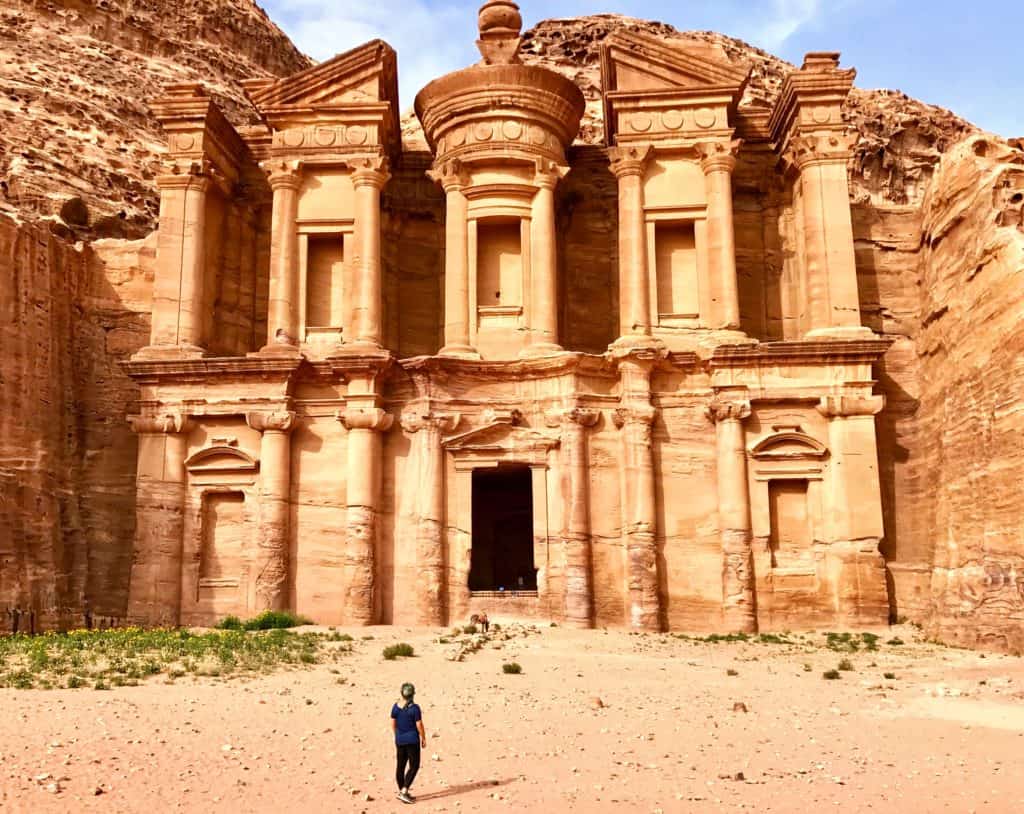
Despite its vast inner courtyards and grand architecture, Petra is accessible by only one main route—a narrow, winding gorge called the Siq, flanked by towering rock walls. All travelers must enter through this single passage; there is no alternate way in. Similarly, no matter how many spiritual paths humanity may attempt to create—no matter how elaborate the rituals or sincere the intentions—there is only one road that leads to heaven, and it is not man-made. All other paths represent man’s attempt to draw his own map, build his own road, and carve his own doorway into paradise.
One aspect of Christianity that even skeptics often find puzzling is its claim that salvation is not earned through human effort, moral achievement, or religious performance. Unlike every other major world religion, Christianity places the decisive work of salvation entirely outside the individual—rooted in what God has done rather than what humans must accomplish. This reversal runs counter to natural human instincts, which gravitate toward systems of merit, self-improvement, and moral credit. If Christianity were a belief system invented by humanity, it would almost certainly reinforce these instincts rather than undermine them. Instead, its central message confronts human pride by removing all grounds for self-boasting, making grace—not effort—the defining feature of salvation.
Just as there is only one true way to be saved, the Bible tells us there is only one road to heaven, and that is through Jesus Christ. He declared, “I am the way, the truth, and the life. No one comes to the Father except through Me” (John 14:6). Think of the Ark Encounter in Kentucky, a life-sized replica of Noah’s Ark. This massive structure, built to biblical dimensions, has only one main door—just like the original ark described in Genesis. God told Noah to build one door, because there was only one way in to escape the coming judgment. In the same way, Jesus is the only door to eternal life.
I am the door. If anyone enters by me, he will be saved
John 10:9
The thousands of religious paths mankind has created represent feeble attempts to draw his own map, build his own road, and carve his own entrance into heaven. But salvation doesn’t come by human invention—it comes by divine invitation. There is one path, one door, and one Savior.
God Does Not Want Anyone To Miss The True Entrance
Salvation is God’s primary agenda, His top priority. He chose 40 men throughout history and inspired them to write the Bible which from Genesis to Revelation they provide clues, drop breadcrumbs on the path, and even provide explicity instruction on how man can be saved from His sins and receive eternal life. 1 Corinthians 14:33 says “God is not the author of confusion” . He does not want anyone to miss the door and He has taken great pains to tell man exactly who the door is and how the door opens. Rather than work for salvation, or wander around looking for it His instructions are clear.
Salvation is God’s primary agenda—His highest priority for humanity. Throughout history, He chose 40 men across different eras, cultures, and backgrounds to write the Bible, and through divine inspiration, they delivered a unified message. From Genesis to Revelation, Scripture offers clues, guidance, and even explicit instructions on how mankind can be saved from sin and receive eternal life. As 1 Corinthians 14:33 reminds us, “God is not the author of confusion.” He does not want anyone to miss the way. In fact, He has taken great care to make the path unmistakably clear—revealing who the Door is and how it opens. Salvation is not something to be earned through striving, nor something to be discovered through wandering. God’s instructions are clear, direct, and full of grace: the way is Jesus Christ.
Scriptures That Declares Jesus Is The Way To Salvation Unequivocally
| Reference | Full Scripture Text (ESV) | Meaning / Emphasis |
|---|---|---|
| John 14:6 | “Jesus said to him, ‘I am the way, and the truth, and the life. No one comes to the Father except through me.’” | Jesus declares He is the only way to God. |
| John 10:9 | “I am the door. If anyone enters by me, he will be saved and will go in and out and find pasture.” | Jesus is the exclusive entrance into salvation. |
| John 11:25–26 | “Jesus said to her, ‘I am the resurrection and the life. Whoever believes in me, though he die, yet shall he live, and everyone who lives and believes in me shall never die. Do you believe this?’” | Jesus offers eternal life to all who believe. |
| Acts 4:12 | “And there is salvation in no one else, for there is no other name under heaven given among men by which we must be saved.” | Salvation is found only in Jesus—no other name saves. |
| 1 Timothy 2:5 | “For there is one God, and there is one mediator between God and men, the man Christ Jesus.” | Jesus is the only mediator between God and man. |
| Matthew 7:13–14 | “Enter by the narrow gate. For the gate is wide and the way is easy that leads to destruction, and those who enter by it are many. For the gate is narrow and the way is hard that leads to life, and those who find it are few.” | Jesus warns that only one narrow way leads to life. |
| Hebrews 10:19–20 | “Therefore, brothers, since we have confidence to enter the holy places by the blood of Jesus, by the new and living way that he opened for us through the curtain, that is, through his flesh.” | Jesus opened a new and living way through His death. |
| Isaiah 45:22 | “Turn to me and be saved, all the ends of the earth! For I am God, and there is no other.” | God alone is the source of salvation—no other gods or systems. |
| Romans 5:1–2 | “Therefore, since we have been justified by faith, we have peace with God through our Lord Jesus Christ. Through him we have also obtained access by faith into this grace in which we stand, and we rejoice in hope of the glory of God.” | Peace and access to God come through Jesus Christ alone. |
| John 3:16–17 | “For God so loved the world, that he gave his only Son, that whoever believes in him should not perish but have eternal life. For God did not send his Son into the world to condemn the world, but in order that the world might be saved through him.” | Eternal life is given to those who believe in Jesus—He is the means of salvation. |
Almost all man made religions are based on human effort and the most tragic consequence of relying on human effort is the false sense of security it brings. People may convince themselves they’ve built a bridge through their own goodness or spiritual activity—only to find, in the end, that what they trusted was a mirage. What seemed solid was never anchored in truth.
These passages on the chart make it unmistakably clear: Jesus is not one of many possible ways—He is the only way. God has not left the path to salvation vague or open to personal interpretation. It is through faith in Jesus Christ alone—the Door, the Way, the Resurrection, and the Life—that we are saved. God never intended for humanity to approach salvation like a shopping mall of religious options, nor to rely on guesswork, intuition, or chance. He does not ask us to throw darts at a board and hope for the best. From beginning to end, Scripture shows that our salvation and eternal destiny have always been at the center of God’s heart and mind—and He has made the way unmistakably clear through His Son.
Challenge Question: With over 4,000 religions in the world offering different paths to salvation or enlightenment, why do you think Jesus made such exclusive claims about being “the way, the truth, and the life”—and what does this tell us about God’s desire for clarity, not confusion, in matters of eternal destiny?
ThinkCube Truth Veracity Grid
- Have I considered the facts carefully and with an open mind?
- Is my conclusion the result of a careful examination of the facts, or is it a conclusion made in spite of the facts?
- Is my conclusion the one that makes the most sense of the evidence?