
Premise 1: The Bible Is A Reliable Source For Near East History
Modern archaeology has helped us realize that the Bible is historically accurate even in the smallest of details. There have been thousands of archaeological discoveries in the past century that support every book of the Bible. Here are just a few examples:
Critics used to believe … the Bible was wrong because they felt that King David was a legendary, mythical character. They pointed to the fact that there was no archaeological evidence that King David was an actual historical figure.
But then in 1994, archaeologists discovered an ancient stone slab in northern Galilee that was inscribed with the references to King David and the “House of David.”
Critics used to believe … the Bible was wrong because there was no evidence (outside of the Bible) that a group of people called the Hittites ever existed. The Hittite civilization is mentioned approximately 40 times in the Old Testament, thus skeptics were convinced that this proved the Bible is a mythical creation of ancient Hebrew writers.
But then … in 1906, a German archaeologist named Hugo Winckler was excavating in Boghaz-Koi, Turkey, and discovered the capital city of the ancient Hittite empire, the entire Hittite library and 10,000 clay tablets documenting the Hittite history. Scholars translated these writings and discovered that everything the Bible said about the Hittite empire was true.
Critics used to believe … that a king named Belshazzar never really existed, thus calling into question the historicity of the book of Daniel, which mentions this Babylonian king.
But then … in 1854, Henry Rawlinson discovered an inscription in Iraq that named Belshazzar as the oldest son and co-regent of King Nebonidus, who would often leave Belshazzar in charge of Babylon while he traveled. This discovery also helped to clarify Daniel 5:29, which states that Daniel was elevated to the “third highest ruler in the kingdom.”
Critics used to believe … the book of Acts was not historically accurate. A man named Sir William Ramsay, who is well known to be one of the greatest historical scholars and archaeologists in history, decided to try to disprove the Bible as the inspired Word of God by showing that the book of Acts was not historically accurate.
But then after 30 years of archaeological research in the Middle East, Ramsay came to the conclusion that:
Luke is a historian of the first rank; not merely are his statements of fact trustworthy.
Sir William Ramsay— Historian widely, considered foremost authority on history of Asia Minor
This author should be placed along with the very greatest historians.
Critics used to believe … the Old Testament simply could not be reliable because they felt that over a long period of time the Old Testament writings would have been changed, altered, edited or corrupted.
But then … in 1947, the Dead Sea Scrolls were discovered. These scrolls contained, among other writings, every book in the Old Testament (except Esther). Until the Dead Sea Scrolls were found, the earliest copy of the complete Old Testament was from A.D. 900. Scholars compared this copy with the Dead Sea Scrolls (produced around 1,000 years earlier) and found that the Old Testament had 95-98% accuracy and had been faithfully transcribed.
Archaeology has consistently affirmed the Bible as a valuable and reliable historical resource. Excavations have uncovered cities, artifacts, inscriptions, and cultural details that align with biblical accounts—such as the existence of ancient Jericho, the Pool of Bethesda, Pontius Pilate’s inscription, and the Hittite civilization, once thought to be mythical. These findings support the Bible’s historical credibility and demonstrate that its authors recorded real people, places, and events with remarkable accuracy.
Archaeologist Confirm Bible’s Historicity
| Author | Quote | Key Point |
|---|---|---|
| Donald J. Wiseman (1918–2010) Professor of Assyriology, University of London; curator, British Museum | “The geography of Bible lands and visible remains of antiquity were gradually recorded until today more than 25,000 sites within this region and dating to Old Testament times in their broadest sense have been located.” | Vast number of archaeological sites confirm biblical context. |
| Nelson Glueck (1900–1971) President of Hebrew Union College; renowned archaeologist of the Negev and Transjordan | “It may be stated categorically that no archaeological discovery has ever contravened a biblical reference. Scores of archaeological findings have been made which confirm in clear outline or exact detail historical statements in the Bible.” | No discovery has disproved Scripture; many have confirmed it. |
| William F. Albright (1891–1971) Professor of Semitic Languages, Johns Hopkins University; “father of modern biblical archaeology” | “The excessive skepticism of many liberal theologians stems not from careful evaluation of the available data but from an enormous underestimation of the value of evidence. In the light of archaeology, the historicity of the patriarchal narratives is no longer in doubt.” | Archaeology confirms patriarchal narratives as historical. |
| Kenneth A. Kitchen (b. 1932) Professor Emeritus of Egyptology, University of Liverpool | “The writings of the Old Testament … in terms of general reliability, are outstandingly better than, for example, the early history of ancient Egypt, Mesopotamia, or Greece, where we are dealing with hundreds of copies or fewer.” | OT texts more reliable than other ancient histories. |
| Joseph P. Free (1911–1974) Professor of Archaeology, Wheaton College; field director of Dothan excavations | “Archaeology has confirmed countless passages which had been rejected by critics as unhistorical or contradictory to known facts.” | Archaeology vindicates passages once doubted. |
| Millar Burrows (1889–1980) Professor of Archaeology, Yale University; authority on the Dead Sea Scrolls | “Archaeology has in many cases refuted the views of modern critics. It has shown in a number of instances that these views rest on false assumptions and untenable hypotheses.” | Criticism often overturned by archaeology. |
| Sir Frederic G. Kenyon (1863–1952) Director of the British Museum; biblical and classical scholar | “The interval between the dates of original composition and the earliest extant evidence becomes so small as to be in fact negligible, and the last foundation for any doubt that the Scriptures have come down to us substantially as they were written has now been removed.” | Archaeology confirms NT transmission reliability. |
| Yohanan Aharoni (1919–1976) Professor of Archaeology, Hebrew University; director at Hazor, Arad, Beersheba | “The overwhelming impression … is that the Bible, in its broad outlines of historical events, is in harmony with the results of archaeology.” | Bible and archaeology agree in historical outline. |
| James B. Pritchard (1909–1997) Professor of Religious Thought, University of Pennsylvania; excavator at Gibeon, Shechem | “Archaeology has greatly illuminated the background of biblical history and in many cases confirmed the accuracy of the details of biblical tradition.” | Archaeology illuminates and confirms biblical details. |
| John Garstang (1876–1956) Professor of Archaeology, University of Liverpool; excavator of Jericho | “As to the main facts, then, we are in agreement: Joshua destroyed Jericho about 1400 B.C. The walls fell down flat. The city was burned with fire.” | Jericho account matches biblical record. |
| E. M. Blaiklock (1903–1983) Professor of Classics, University of Auckland, NZ; NT historian | “Archaeology has not produced anything that is in real conflict with the Bible. On the contrary … it has added confirmation to the substantial historicity of the Old Testament.” | Archaeology confirms OT historicity. |
| Jack Finegan (1908–2000) Professor of NT History and Archaeology, Pacific School of Religion | “The work of archaeology has unquestionably strengthened confidence in the reliability of the Scriptural record.” | Archaeology builds confidence in Scripture. |
| Roland de Vaux (1903–1971) Director, École Biblique (Jerusalem); principal excavator of Qumran | “The biblical tradition is more reliable than the critics have supposed; and often it has been borne out by the results of archaeology.” | Archaeology shows Bible more reliable than critics assumed. |
| Alan Millard (b. 1937) Rankin Professor Emeritus of Hebrew and Ancient Semitic Languages, University of Liverpool | “Nothing discovered by archaeology has shaken the major outlines of Old Testament history.” | No discoveries undermine OT history. |
Over 50 Cities and Towns Mentioned in the Bible Have Been Verified by Archaeologists
As of current archaeological and historical research, over 50 cities and towns mentioned in the Bible have been positively identified and verified through excavations, inscriptions, and ancient records. Some sources cite 70 to 100+ identifiable biblical sites, depending on the criteria used (e.g., precise location, name continuity, and historical consistency).
Sir William Ramsay ultimately wrote a book on the trustworthiness of the Bible based on his discoveries and actually converted to Christianity. Sir Ramsay found no historical or geographical mistakes in the book of Acts. This is amazing when we realize that in the book of Acts, Luke mentions 32 countries, 54 cities, nine Mediterranean islands and 95 people and he did not get one wrong.
Many ancient towns mentioned in the Bible—though no longer existing today—have been discovered by archaeologists in the exact locations the Bible describes. These sites often contain verifiable evidence, including inscriptions bearing the same names found in Scripture. Remarkably, many of these discoveries were made precisely because archaeologists followed biblical references to locate them. In other words, archaeology not only confirms the Bible’s historical accuracy, but the Bible itself has served as a valuable and trusted guide for professional archaeological research.
No archaeological discovery has ever contradicted a single, properly understood Biblical statement
Nelson Glueck—Archaeologist considered to be one of the top 3 archaeologist in history
14 of The 54 Biblical Cities Discovered by Archaeologist
| City | Passage Mentioning City | Discovery |
| Arad | When the Canaanite, the king of Arad…fought against Israel (Numbers 21:1) | 30 km NE of Beersheba excavated from 1962-1974 |
| Bethel | Early the next morning Jacob took the stone he had placed under his head and set it up as a pillar—he called that place Bethel (Genesis 28:18-19) | W. F. Albright made a trial excavation at Bethel in 1927. Full excavation in 1934. Continued the excavation in 1954, 1957, and 1960 |
| Capernaum | And when they had come to Capernaum, those who collected the two-drachma tax … (Matthew 17:24) | Identified since 1856 byTell Hum and sporadically excavated for the past 130 years. |
| Chorazin | “Woe to you, Chorazin! Woe to you, Bethsaida! … (Matthew 11:21) | Excavations 1962-2004 |
| Dan | And they called the name of the city Dan, after the name of Dan their father who was born in Israel; however, the name of the city formerly was Laish (Judges 18:29) | Excavation began 1966 |
| Ephesus | Paul, an apostle of Christ Jesus by the will of God, to the saints who are at Ephesus, and who are faithful in Christ Jesus (Ephesians 1:1) | The 24,000-seat theater and the commercial agora, as well as many other public buildings and streets of the first and second centuries a.d. excavated |
| Gaza | But an angel of the Lord spoke to Philip saying, “Arise and go south to the road that descends from Jerusalem to Gaza (Acts 8:26) | Gaza excavated in 1922 |
| Gezer | But they did not drive out the Canaanites who lived in Gezer…(Joshua 16:10) | Excavated 1902-1909 |
| Hazor | Then it came about, when Jabin king of Hazor heard of it, that he sent to Jobab king of Madon and to the king of Shimron and to the king of Achshaph. (Joshua 11:1) | Excavations 1955-1958, 1968-1970 |
| Hesbon | Sihon king of the Amorites, who lived in Heshbon, and ruled from Aroer, which is on the edge of the valley of the Arnon . . . (Joshua 12:2) | Excavations were undertaken by Andrews University from 1968 to 1976 |
| Jericho | Then the sons of Israel journeyed, and camped in the plains of Moab beyond the Jordan opposite Jericho (Numbers 22:1) | Oldest inhabited and fortified city ever excavated. (1867,1907, 1930-36, 1952-58, 1985 |
| Joppa | And since Lydda was near Joppa, the disciples, having heard that Peter was there, sent two men to him, entreating him (Acts 9:38) | During excavations of the site of ancient Joppa a thirteenth-century b.c. citadel gate was uncovered |
| Nineveh | So Sennacherib king of Assyria departed and returned home, and lived at Nineveh (2 Kings 19:36) | Excavated from 1845-1857 |
| Shechem | And Abram passed through the land as far as the site of Shechem, to the oak of Moreh. Now the Canaanite was then in the land (Genesis 12:6) | Excavated 1913-14, 1926-34, 1956-72 |
With advances in technology—such as ground-penetrating radar, sonar, and laser scanning—archaeologists are continually uncovering new evidence that confirms the people, places, and events described in the Bible. Each year, the Bible Archaeology Report publishes a list of the Top 10 Biblical Archaeology Discoveries , highlighting the most significant findings from that calendar year. Tablets, coins, synagogues, city ruins, walls, monuments, tombs, and other artifacts are regularly unearthed—further verifying the historical accuracy of the biblical record.
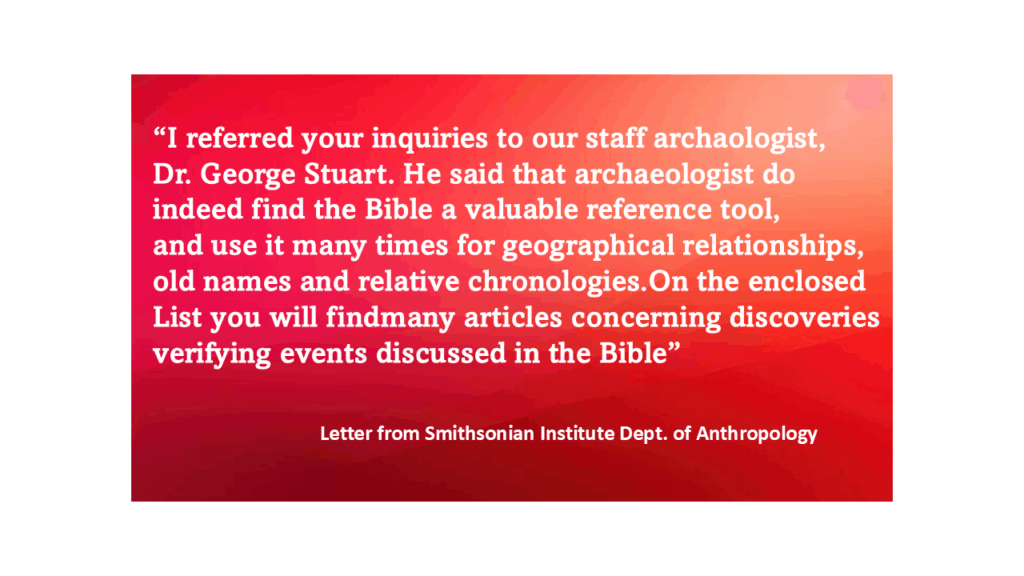
The historical books of the Old Testament are as accurate historical documents as any that we have from antiquity and are in fact more accurate than many of the Egyptian, Mesopotamian, or Greek histories. These Biblical records can be and are used as are other ancient documents in archaeology.
Smithsonian Institute Department of Anthropology
These ongoing discoveries continue to strengthen the Bible’s credibility as a trustworthy historical document. Far from being a book of myth or legend, the Bible is consistently supported by physical evidence—affirming its accuracy and deepening confidence in its message.
Challenge Question: Does the fact that respected secular institutions—such as the Smithsonian Institution—affirm the Bible’s historical accuracy give you greater confidence in the reliability of Scripture?
Premise 2: Many People In The Bible Have Been Historically Confirmed
The Bible has long served as a reliable resource for historians and archaeologists seeking to understand the ancient world. Far from being a mere religious document, it contains detailed records of people, places, and events that consistently align with historical evidence.
At least 60 individuals mentioned in the Bible have been archaeologically confirmed to have truly existed, based on inscriptions, seals, tablets, and other ancient records. These include kings, officials, prophets, and foreign rulers—both from Israel and neighboring nations.
38 Of 60 Archaeologically Verified People in the Bible
| Name | Archaeological Evidence | Source/Notes |
|---|---|---|
| King David King of Israel | Tel Dan Stele | Mentions the “House of David” |
| Hezekiah King of Judah | Royal seal (bulla), Siloam inscription | Found in Jerusalem |
| Uzziah (Azariah) King of Judah | Uzziah tombstone inscription | 1 Chronicles 26:23 |
| Ahaz King of Judah | Assyrian records; seal | Isaiah 7; Tiglath-Pileser III’s annals |
| Manasseh King of Judah | Assyrian Prism inscription | 2 Kings 21 |
| Jehoiachin King of Judah | Babylon ration tablets | 2 Kings 25:27–30 |
| Ahab King of Israel | Assyrian Kurkh Monolith | 1 Kings 16–22 |
| Omri King of Israel | Mesha Stele (Moabite Stone) | 1 Kings 16:16–28 |
| Jehu King of Israel | Black Obelisk of Shalmaneser III | Depicted bowing to Assyrian king |
| Hazael King of Aram | Tel Dan Stele | 2 Kings 8 |
| Ben-Hadad I/II Kings of Aram | Aramean inscriptions | 1 Kings 15:18, 20 |
| Tiglath-Pileser III King of Assyria | Assyria annals, inscriptions | 2 Kings 15:29 |
| Sennacherib King of Assyria | Sennacherib Prism, Lachish reliefs | 2 Kings 18–19 |
| Esarhaddon King of Assyria | Babylonian chronicles | 2 Kings 19:37 |
| Nebuchadnezzar II King of Babylon | Babylonian Chronicles | Book of Daniel, 2 Kings |
| Cyrus the Great King of Persia | Cyrus Cylinder | Ezra 1 |
| Darius I King of Persia | Behistun Inscription | Ezra 5–6 |
| Artaxerxes I King of Persia | Elephantine papyri | Nehemiah 2 |
| Shalmaneser V King of Assyria | Assyrian records | 2 Kings 17:3 |
| Merodach-Baladan King of Babylon | Assyrian and Babylonian texts | Isaiah 39:1 |
| Belshazzar Co-regent Babylon | Nabonidus Cylinder | Daniel 5 |
| Nabonidus King of Babylon, Father of Belshazzar | Cylinder and other inscriptions | Daniel 5 |
| Sanballat Governor Samaria | Elephantine papyri | Nehemiah 2:10 |
| Tobiah Ammonite Official | Seal and references in papyri | Nehemiah 2 |
| Geshem the Arab Opponent of Nehemiah | References in Arabian inscriptions | Nehemiah 2:19 |
| Pontius Pilate Roman Governor Judea | Pilate Stone (Caesarea Maritima) | Matthew 27 |
| Caiaphas High Priest At Jesus Trial | Ossuary bearing his name | Matthew 26 |
| Herod the Great King of Judea Under Rome | Coins, buildings, tomb | Matthew 2 |
| Herod Antipas Son of Herod The Great | Coins, historical texts (Josephus) | Luke 23 |
| Sergius Paulus Roman Proconsul of Cyprus | Inscription in Cyprus and historical texts | Acts 13 |
| Gallio Roman Proconsul of Achaia | Delphi inscription | Acts 18:12–17 |
| Felix Roman Governor | Tacitus, inscriptions | Acts 23–24 |
| Festus Roman Governor | Josephus, Roman records | Acts 25 |
| Quirinius Roman Governor of Syria | Roman census records | Luke 2:2 |
| Baruch Scribe of Jeremiah | Seals bearing name “Baruch son of Neriah” | Jeremiah 36:4 |
| Gemariah Son of Shaphan; official | Seal impressions | Jeremiah 36:10 |
| Gedaliah Governor after Fall of Jerusalem | Babylonian and biblical references | 2 Kings 25:22–25 |
These discoveries confirm that the Bible is not just a religious text, but a historically grounded document. The archaeological verification of dozens of biblical figures adds compelling evidence to the Bible’s reliability and supports its claim to record real events involving real people in real places.
List Of Disciples, Authors and Icons Who have been Historically Verified
| Person | Description | How Verified |
| Isaiah | Prophet, Author of Isaiah | Ophel Bulla |
| Jeremiah | Prophet, Author of Jeremiah, Lamentations | Ishtar Gate Inscription |
| Daniel | Prophet, Author of Daniel | Cylinder of Nabonidus |
| David | King of Israel, Psalms | Mesha Stele, Moabite Stone |
| King Saul | First King of Israel | City of Beth Shan |
| Jacob | Patriarch of 12 Tribes of Israel | The Merneptah Stele |
| James | Brother of Jesus | Ossuary Inscription |
| Herod The Great | Ruler of Judea at Jesus Birth | The Herodium now a National Park |
| Pontius Pilate | Governor of Judea presided over trial of Jesus | The Pilate Stone Inscription |
| John The Baptist | Cousin of Jesus, Preacher | Alabaster Relic Box |
| Philip | Apostle, Disciple of Jesus | St. Philip’s Tomb |
| Caiphas | High Priest of Israel | Caiphas Ossuary |
Some of history’s most powerful Pharaohs, kings, and emperors prominently mentioned in the Bible— have been historically and archaeologically verified. These include Pharaohs Ramses and Necho of Egypt; Cyrus and Darius, kings of Persia; and Sargon, Sennacherib, and Shalmaneser V, kings of Assyria. In the New Testament, Roman rulers such as Herod the Great, Tiberius Caesar, Claudius, and even Nero play significant roles in the biblical narrative, all of whom are well-attested in historical records.
For centuries, historians and archaeologists have turned to the Bible not only as a sacred text but as a valuable historical resource. Its detailed accounts of ancient cities, cultural practices, geographical landmarks, and political figures have repeatedly aligned with archaeological discoveries. Even secular institutions recognize its usefulness.
The names of over 40 different kings of various countries mentioned in the Bible have all been found in contemporary documents and inscriptions outside of the Old Testament, and are always consistent with the times and places associated with them in the Bible. Nothing exists in ancient literature that has been even remotely as well-confirmed in accuracy as has the Bible.
Institute for Creation Research—Biblical Data Is Historically Testable
The Bible is a significant source book for secular archaeologist. Two of the greatest 20th century archaeologists, William F. Albright and Nelson Glueck who were both non-Christians lauded the Bible as being the single most accurate source document from history. Over and over again, the Bible has been found to be accurate in its places, dates, and records of events. No other “religious” document comes even close.
Taken together, the archaeological and historical verification of dozens of biblical figures, places, and events powerfully affirms the Bible’s reliability as a trustworthy record of ancient history. Far from being a collection of myths or legends, the Bible continues to align with discoveries across time, geography, and culture—offering compelling evidence that its accounts are both rooted in reality.
Challenge Question : If archaeology continues to confirm the people, places, and events described in the Bible, what does that suggest about the Bible’s overall reliability—and how should that influence the way we view its spiritual and historical claims?
Premise 3: Locations And Events In The Bible Have Been Confirmed
Because the Scriptures continually refer to historical events, they are verifiable; their accuracy can be checked by external evidence. Tens of thousands of archaeological sites have been excavated in the ancient Near East (e.g., Israel, Egypt, Jordan, Mesopotamia), which intersect with biblical geography and history.
Thousands of discoveries have supported or aligned with biblical details—confirming names, places, customs, and historical events. Scholars (both secular and religious) have used the Bible as a historical reference tool, especially for locations, timelines, and cultural practices. Prominent archaeologists—including William F. Albright, Nelson Glueck, and Kenneth Kitchen—have praised the Bible’s historical reliability in many cases.
The Old and New Testaments make abundant references to nations, kings, battles, cities, mountains, rivers, buildings, treaties, customs, economics, politics, dates, and the like. Because the historical narratives of the Bible are so specific many of its details are open to archaeological investigation. The advancement of archaeology has indeed confirmed geographic locations of events, cities, and structures mentioned in the Bible. Every year more and more discoveries confirm the geographical, political, and cultural details mentioned in the Bible.
Over the past century, numerous archaeological discoveries have confirmed the historical reliability of key places and events described in the Old Testament. From ancient city ruins to inscriptions and artifacts, these findings align remarkably with the biblical record—often in precise detail. The following charts contain some of the most notable examples where archaeology has affirmed the accuracy of Scripture.
| Place or Event | How or Where Discovered |
|---|---|
| Walls of Jericho | Excavations revealed collapsed walls dating to around 1400 BC |
| Siege of Lachish | Lachish Reliefs found in Nineveh and site excavation in Israel |
| Solomon’s City Wall (Jerusalem) | Stone wall sections and gates in Jerusalem dated to 10th century BC |
| Hezekiah’s Tunnel | Tunnel and inscription confirming 8th century BC water project |
| House of David (Tel Dan Stele) | Aramaic stele inscription referencing “House of David” at Tel Dan |
| Siloam Inscription | Inscription describing tunnel completion found near Siloam Pool |
| City of Hazor | Burn layer and destruction debris matched Joshua’s conquest |
| Gibeon | Inscriptions and jar handles bearing the name “Gibeon” |
| Shiloh (Tabernacle site) | Excavation showed long-term worship use; altar structures found |
| Destruction of Sodom (Tall el-Hammam) | City destruction layer aligns with Genesis account; debated |
| King Omri’s reign (Mesha Stele) | Moabite Stone confirms Omri as king of Israel |
| Assyrian invasion (Lachish Reliefs) | Stone carvings in Sennacherib’s palace depict the siege of Lachish |
| Pool of Bethesda | Excavation near St. Anne’s Church in Jerusalem matches John 5 |
| Ebla Tablets (names and customs) | Tablets list Canaanite cities and customs consistent with Genesis |
| Cyrus’s Decree (Cyrus Cylinder) | Cylinder from Babylon describes Persian policy matching Ezra 1 |
| City of Ai | Excavated at Et-Tell and Khirbet el-Maqatir; debate exists but structures align with biblical conquest accounts |
| Babylonian Destruction of Jerusalem | Ash layers, arrowheads, and seals from 586 BC found in Jerusalem |
| Tel Arad Temple | Temple and altar remains with inscriptions matching priestly service |
| Mount Ebal Altar | Large stone altar matching Joshua’s description discovered |
| Ketef Hinnom Silver Scrolls | Oldest biblical text (Numbers 6 blessing); dated to 7th century BC |
| City of Dan | Fortified gate system and cultic remains confirm biblical city |
| Khirbet Qeiyafa | Fortified city dated to Davidic period supports early Kingdom of Judah |
| Samaria Ostraca | Pottery inscriptions with names and locations from biblical Israel |
| Bullae (Seals) of biblical figures | Seals of Hezekiah, Isaiah (possibly), Gemariah, and others found in Jerusalem |
| Lachish Letters | Tablets written before Babylonian siege match Jeremiah’s era and context |
| Gezer Calendar | Ancient Hebrew inscription listing agricultural seasons; supports early Israelite literacy |
| Temple Mount Coin Hoards | Coins from First and Second Temple periods; align with biblical economic references |
| Place or Event | How or Where Discovered |
|---|---|
| Nazareth | 1st-century dwellings and tombs confirm a small village existed at Jesus’s time |
| Capernaum Synagogue | Ruins of a synagogue dated to 1st century discovered in Capernaum |
| Pool of Bethesda | Excavated near St. Anne’s Church; matches John 5 description |
| Pool of Siloam | Rediscovered in Jerusalem; matches John 9 account of healing |
| Pontius Pilate | Inscribed stone in Caesarea Maritima confirms Pilate as governor |
| Caiaphas’s Ossuary | Ossuary inscribed “Joseph son of Caiaphas” found in Jerusalem |
| Herod the Great’s Construction Projects | Remains of the Second Temple, Masada, and Caesarea match biblical descriptions |
| Tiberius Caesar Inscription | Roman inscription at Caesarea names Tiberius Caesar |
| Erastus Inscription (Corinth) | Paving stone in Corinth mentions Erastus, a city official (Romans 16:23) |
| Gallio Inscription (Delphi) | Inscription at Delphi confirms Gallio’s role as proconsul (Acts 18) |
| Acts 27 Shipwreck (Malta) | Artifacts and anchors near Malta align with Paul’s shipwreck in Acts 27 |
| Sergius Paulus (Cyprus) | Inscription and archaeology support existence of Roman proconsul in Cyprus |
| Temple Mount (Second Temple) | Archaeological evidence confirms structure and retaining walls of Second Temple |
| Stone Pavement (Gabbatha) | Stone pavement matching John 19:13 discovered near Antonio Fortress |
| Crucifixion Evidence (Giv’at ha-Mivtar) | Skeletal remains with nail through heel bone confirm Roman crucifixion method |
| James Ossuary | Ossuary reading “James, son of Joseph, brother of Jesus”; debated but likely authentic |
| Tomb of Herod | Herodium excavation uncovered the tomb of Herod the Great |
| City of Philippi | Excavations confirm the Roman colony mentioned in Acts 16 |
| Thessalonica Inscriptions | Inscriptions confirm the city and local leaders mentioned in Acts 17 |
| Early Christian Symbols | 1st–2nd century symbols and inscriptions show spread of early Christianity |
| Synagogue at Magdala | 1st-century synagogue discovered in Mary Magdalene’s hometown |
| Temple Warning Inscription | Greek inscription warning Gentiles not to enter the Temple—matches Acts 21 |
| Nazareth Inscription (Edict of Caesar) | Marble tablet forbidding tomb disturbance—possibly linked to resurrection claims |
| Ossuary of Alexander (son of Simon) | Inscription possibly referencing Simon who carried Jesus’s cross (Mark 15:21) |
| Cornelius Inscription (Caesarea) | Latin inscription referencing centurion Cornelius of Acts 10 (location debated) |
| 1st Century Fishing Boat | Ancient boat from Sea of Galilee dated to Jesus’s time |
| Jericho in the Time of Jesus | Excavations confirm occupation during Herod’s reign; aligns with Gospel accounts |
The New Testament is rooted in real people, real places, and real historical events. Over the past century, archaeology has repeatedly confirmed the accuracy of its geographical details, cultural references, and political figures. Conservatively 200-300 directly relevant discoveries, and hundreds more that confirm the historical backdrop of the New Testament (Roman occupation, Jewish customs, early Christian growth, etc.) have been made that powerfully support the historical reliability of the New Testament record. The following chart highlights 27 archaeological discoveries that affirm the historical reliability of the New Testament—ranging from inscriptions and ossuaries to ancient cities, synagogues, and artifacts—all aligning with the biblical record.
Archaeology is Constantly Confirming the Accuracy of the Bible
Archaeology is constantly confirming the historical accuracy of the Bible. It has verified many ancient sites, civilizations, and biblical characters whose existence was questioned by the academic world and often dismissed as myths. Biblical archaeology has silenced many of these critics as new discoveries support the facts of the Bible.
On the whole, however, archaeological work has unquestionably strengthened confidence in the reliability of the Scriptural record. More than one archaeologist has found his respect for the Bible increased by the experience of excavation in Palestine.
Millar Burrows, Leading Authority on the Dead Sea scrolls, Professor emeritus Yale Divinity School
Archeology is exploding in the middle east. There are dozens of active excavations are currently underway in biblical lands like Israel, Jordan, Egypt, Cyprus, and parts of Turkey and Greece—focusing on sites from eras covering both the Old and New Testament. There are typically 20–50 active, focused projects directly related to biblical history at any given time, with more such projects planned each year. Every year more and more people, places and events in the Bible are confirmed archaeologically and each new discovery fuels momentum for further investment and strategic exploration.
Top 10 discoveries of 2022
| 1. Mt. Ebal Curse Tablet | Text older than any other known Hebrew inscription from ancient Israel about Yahweh. |
| 2. Shiloh Tabernacle Architecture | Norther gate entrance of Shilo where the tabernacle sat during the period of Judges in the Bible |
| 3. Lachish Comb Inscription | Earliest known alphabetic text ever found in Israel which demonstrates that there was an active alphabetic Semitic language in place prior to when Torah was written |
| 4. Hezekiah’s Monument Inscription | Translated “Hezekiah’s Pool” is inscribed in stone which is the same mentioned in 2 Kings 20:20 “Now the rest of the acts of Hezekiah, and all his might and how he made the pool, and the conduit, and brought water into the city” |
| 5. City of David Ivories | 1,500 fragments of finely decorated ivory dated to the First Temple Period in the City of David show signs of having been crushed and burned in the Babylonian destruction of 586 B.C. mentioned in 2 Kings 25:1-8 |
| 6. Vanilla-Laced Vessels from time of Jeremiah | Vessels date to the years before Babylonian destruction of Jerusalem which revealed wine enriched with vanilla which was not known to have existed before the arrival of Columbus, but showed that the “spiced wine” the Bible mentioned was an accurate description |
| 7.Hezekiah’s Sluice Gate | For decade, scientist have puzzled over how Hezekiah’s Tunnel mentioned in the Old Testament could have redirected water to the Pool of Siloam mentioned in Isaiah 8:6 and John 9:7. The discovery of this sluice gate shows how. |
| 8. The Ishmael Papyrus | Dead Sea Scroll Fragment rediscovered Mentioning Ismael the son of the first governor of Babylon mentioned in Jeremiah 40 |
| 9. Judges-Era Lead Trade | Isotope analysis of Lead found in shipwreck correlated with a previous shipwreck found off coast of Israel that verified the seaports and trade mentioned in Judges 5:17 |
| 10. Rameside-Era Tomb | Tomb found that dates to period of Ramesses II |
Taken together, the growing body of archaeological evidence—spanning both the Old and New Testaments—powerfully reinforces the Bible’s credibility as a historical document. From inscriptions and city ruins to coins, ossuaries, and ancient artifacts, these discoveries continue to affirm that the people, places, and events described in Scripture were real and rooted in verifiable history. Far from being a collection of myths or moral fables, the Bible stands as a remarkably reliable account of ancient life, culture, and faith. The more the ground is uncovered, the more the record of Scripture is confirmed—reminding us that faith is not built on fiction, but on a foundation that withstands the test of time.
Challenge Question: If archaeology continues to confirm the historical accuracy of the Bible’s people, places, and events, what implications does that have for how we view its spiritual claims and overall reliability?
ThinkCubed Truth Veracity Grid:
- Have I considered the facts carefully and with an open mind?
- Is my conclusion the result of careful examination of the facts, or is it a conclusion made in spite of the facts?
- Is my conclusion the one that makes the most sense of the evidence?