Premise 1 : Religion Has Not Been The Largest Contributor To Violence In History
The claim that faith and religion are the primary sources of violence and war throughout human history is both misleading and historically inaccurate. Atheists and secular humanists often repeat this assertion—perhaps most famously by Sam Harris, who wrote in The End of Faith that religion is “the most prolific source of violence in our history.” While such statements are rhetorically powerful, they collapse under the weight of historical evidence.
To be clear, no one should deny or excuse the religiously motivated atrocities that have occurred, such as the Crusades or the Thirty Years’ War. These events were devastating, and they serve as sobering reminders of how religion can be misused for power and conquest. However, acknowledging these abuses does not justify the broader claim that religion is the dominant cause of warfare across history.
A valuable corrective to this narrative comes from The Encyclopedia of Wars by Charles Phillips and Alan Axelrod—a comprehensive three-volume work that catalogs 1,763 wars throughout recorded human history. Of those, only 123 are classified as being religious in nature. This represents just 6.98% of all wars. Moreover, if we subtract those fought in the name of Islam (66), the percentage drops to a mere 3.23%.
Most Wars Are Because of Territorial Ambition, Politics, Ethnic Rivalry, Resources, and Personal Power
This data reveals an important truth: the overwhelming majority of human conflicts have been driven not by theological disputes, but by territorial ambition, political ideology, ethnic rivalry, resource competition, and personal power struggles. Secular ideologies have also proven deadly. The regimes of Stalin, Mao, and Pol Pot—explicitly atheistic and hostile to religion—were responsible for tens of millions of deaths in the 20th century alone. The biggest conflicts in history were all caused by non-religious motives.
| Conflict & Casualties | Dates | Primary Motive |
|---|---|---|
| Peloponnesian War ca. 200,000 victims | 431–404 BC | Territorial & Hegemonic Ambition |
| Punic Wars ca. 250,000 victims | 264–146 BC | Territorial Expansion and Trade |
| Hundred Years’ War ca. 3 million | 1337–1453 | Dynastic Claims and Territorial Disputes |
| Napoleonic Wars ca. 3.5 million | 1803–1815 | Expansionism & European Domination |
| Franco-Prussian War ca. 180,000 | 1870–1871 | National Unification and Territory |
| World War I ca. 20 million | 1914–1918 | Imperial Rivalries and Military Alliances |
| Thirty Years’ War ca. 8 million | 1618–1648 | Religious & Political Power |
| American Civil War ca. 750,000 | 1861–1865 | State Rights vs. Federal Authority |
| War of the Roses ca. 105,000 | 1455–1487 | Dynastic Rivalry |
| Russo-Japanese War ca. 130,000 | 1904–1905 | Imperial Expansion |
| World War II ca. 70 million | 1939–1945 | Territorial Expansion and Resource Acquisition |
In short, while religion has at times been used as a justification for violence, it is far from being the principal cause of war. Blaming religion for the world’s bloodshed is not only an oversimplification—it obscures the far more complex and often secular roots of human conflict.
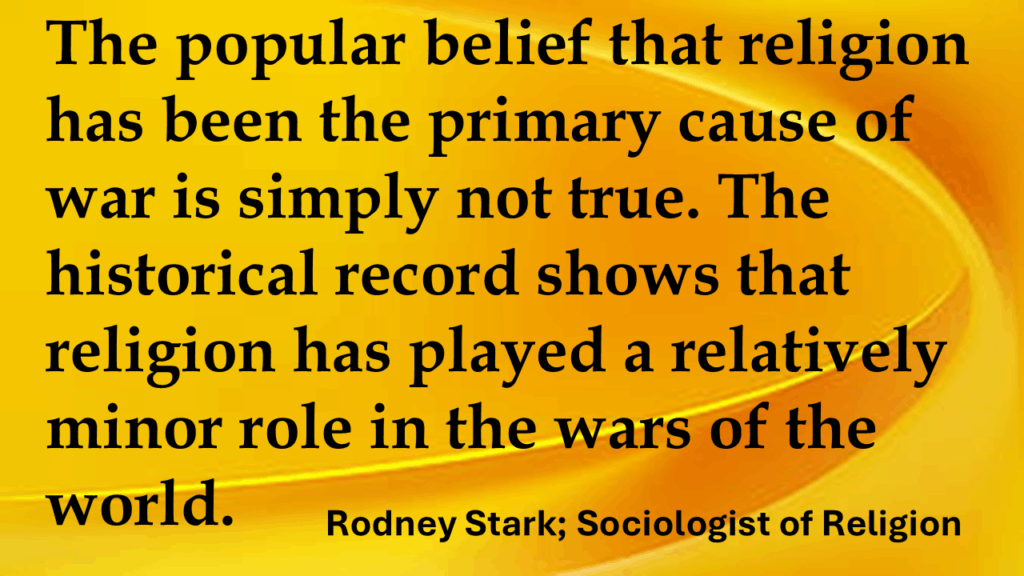
Ninety percent of the estimated 225 million war-related deaths throughout history were caused by non-religious conflicts. This staggering figure underscores a vital truth: while religion has undeniably been misused at times to justify violence, the overwhelming majority of human bloodshed has been driven by secular motives—territorial conquest, political power, ethnic rivalry, nationalism, and economic gain. To single out religion as the chief cause of war not only distorts history but also ignores the far more pervasive role that human ambition, greed, and ideology have played in shaping the world’s most devastating conflicts.
Challenge Question: If religion is truly the leading cause of violence in history, how do you account for the fact that over 90% of the 225 million war-related deaths were caused by conflicts rooted in secular ambitions—such as power, territory, nationalism, and resources—rather than religious belief?
Premise 2 : Non-Religious Ideologies Have Fueled The World’s Deadliest Wars
In the modern critique of religion, a common refrain is that religious belief has been the primary driver of human violence. Popular authors like Christopher Hitchens and Sam Harris have argued that religion is inherently divisive and dangerous—”the root of all evil.” However, a sober look at the historical record reveals a far different story. In fact, many of the **bloodiest and most destructive wars in human history were not driven by religious belief, but by non-religious ideologies—secular worldviews that replaced divine authority with human ambition, political utopianism, and raw power.
Far from being a mere counterpoint to religious conflict, secular ideologies have not only rivaled but far outstripped religion in terms of the scale of devastation wrought upon humanity.
Mass Deaths Under 20th-Century Non-Religious Dictatorships
| Dictator / Regime Leader | Estimated Deaths | Regime & Ideology |
|---|---|---|
| Joseph Stalin | 42,672,000 (ca. 43 million) | Soviet Communism — Atheistic Communism |
| Mao Zedong | 37,828,000 (ca. 38 million) | Maoist China — Atheistic Communism |
| Adolf Hitler | 20,946,000 (ca. 21 million) | Nazi Germany — Fascist Nationalism / Anti-Religious |
| Chiang Kai-shek | 10,214,000 (ca. 10 million) | Nationalist China — Nationalism / Anti-Communism |
| Vladimir Lenin | 4,017,000 (ca. 4 million) | Soviet Communism — Atheistic Communism |
| Hideki Tojo | 3,990,000 (ca. 4 million) | Imperial Japan — Militaristic Nationalism |
| Pol Pot | 2,397,000 (ca. 2.5 million) | Khmer Rouge (Cambodia) — Agrarian Communism / Atheistic |
| Kim Regime (North Korea) | ~1–3 million | North Korea — Atheistic Totalitarianism |
The number of lives lost during religious conflicts pales in comparison to the staggering death tolls caused by atheistic regimes. While religion has undoubtedly been associated with certain wars throughout history, the scale of violence unleashed by Godless political ideologies far exceeds anything done in the name of faith.
Historians estimate that approximately 90% of all war-related casualties in recorded history have resulted not from religious crusades or sectarian disputes, but from secular and anti-theistic regimes—many of which actively criminalized, suppressed, and persecuted Christianity and other faiths.
Totalitarian systems built on atheistic philosophies, such as Soviet Communism, Maoist China, and the Khmer Rouge, treated human life as expendable in pursuit of political purity or revolutionary ideals. In these regimes, where there was no moral accountability to a higher power, the state became the supreme authority—justifying mass murder, forced famines, and brutal purges in the name of progress.
This sobering reality challenges the popular narrative that religion is the chief cause of violence. In truth, history reveals that the absence of God in public life—and the dehumanization that often follows—has led to some of the darkest chapters in human history.
Almost 170 million men, women and children have been shot, beaten, tortured, knifed, burned, starved, frozen, crushed or worked to death; buried alive, drowned, hung, bombed or killed in any other of a myriad of ways governments have inflicted death on unarmed, helpless citizens and foreigners. The dead could conceivably be nearly 360 million people. It is as though our species has been devastated by a modern Black Plague. And indeed it has, but a plague of Power, not germs.
R.J. Rummel: Lethal Politics and Death by Government
Atheism Gave Birth To Modern War
While religion is often blamed for history’s bloodshed, the 20th century tells a far more disturbing story: atheism—particularly in the form of materialist, evolutionary ideologies—has fathered the most catastrophic wars and genocides the world has ever seen. Many of the regimes responsible for mass atrocities were founded not on religious belief, but on Marxist, neo-Darwinian, and anti-theistic philosophies that denied the intrinsic value of human life and replaced divine accountability with raw political power.
At the core of these regimes was the belief that man is nothing more than a product of evolutionary struggle—a cosmic accident engaged in a perpetual battle for survival. Darwin’s doctrine of “survival of the fittest,” though originally scientific in scope, became a guiding principle in the geopolitical and social ideologies of tyrants like Adolf Hitler, Joseph Stalin, Mao Zedong, and Pol Pot.
No one embodied the deadly implications of this worldview more than Adolf Hitler. In his manifesto, Mein Kampf (“My Struggle”), Hitler articulated a political philosophy rooted explicitly in evolutionary theory. He described history as a biological struggle between superior and inferior races and saw the extermination of the weak as a necessary step in the evolution of a master race. For Hitler, “natural selection” was not just a scientific observation—it was a political mandate.
“He who would live must fight. He who does not wish to fight in this world, where permanent struggle is the law of life, has not the right to exist.”
— Adolf Hitler, Mein Kampf
He justified mass murder and eugenics with chilling naturalistic logic:
“I do not see why man should not be just as cruel as nature. Nature doesn’t like bastards.”
And ultimately:
“All that is not of pure race in this world is trash.”
This was evolution applied politically—nature’s brutality, codified into law and policy. Hitler’s actions were not an aberration but the horrific outworking of a worldview that denied moral absolutes, eternal accountability, and the sacredness of human life. Stalin and Mao, who also embraced materialist and atheistic ideologies, followed similar patterns—mass purges, engineered famines, forced labor camps—all justified by the belief that the ends (political power, class equality, or racial purity) justified any means.
The religion of social Darwinism belongs to the most dangerous elements within the thoughts of the last century. It aids the propagation of ruthless national and racial egoism by establishing it as a moral norm. If Hitler believed in anything at all, then it was in the laws of evolution which justified and sanctified his actions and especially his cruelties.
Erich Fromm : Sociologist, Psychoanlyst, Philosopher
Most of the regimes that initiated the 20th century’s deadliest conflicts adhered to Marxist and neo-evolutionary philosophies, where Darwin’s doctrine of survival of the fittest was not only accepted scientifically but also deeply influenced geopolitical doctrine. Common traits of these ideologies include:
- Moral relativism: Ethics are defined by the needs of the revolution, the party, or the leader.
- Dehumanization: Groups labeled as “enemies” (e.g., kulaks, Jews, bourgeoisie) are treated as obstacles to progress, not persons.
- State worship: The state or ideology replaces God as the object of loyalty and source of authority.
- Suppression of dissent: Because the system is seen as infallible, opposition is viewed as treason or heresy.
The most lethal regimes in history did not arise from religious zeal but from the deliberate rejection of God and the elevation of man as his own master. When human beings are seen as mere animals—products of blind evolution and material forces—there is no moral foundation to protect the weak, no sanctity to restrain violence, and no judgment to fear.
Geopolitical Ideologies and Their Connections to Darwinism
| Ideology | Core Beliefs | Connection to Darwinism |
|---|---|---|
| Marxism | Class struggle drives history; eventual rise of a classless society | Marx saw Darwin’s theory as a natural basis for historical materialism |
| Communism | State ownership of means of production; elimination of private property | Built on Marxist principles which aligned with Darwin’s view of progress through struggle |
| Socialism | Redistribution of wealth; strong state involvement in economy | Shared roots with Marxism; implicitly influenced by evolutionary progress ideals |
| Fascism | National strength through authoritarian rule and suppression of dissent | Adopted survival-of-the-fittest mentality for state competition and expansion |
| Nazism (National Socialism) | Racial hierarchy and purity; use of state to enforce racial policy | Explicitly used Darwinian language to justify racial policies and genocide |
| Leninism | Revolutionary vanguard leads proletariat to seize control | Applied Marxist evolution of class struggle with militant revolutionary adaptation |
| Maoism | Peasant-led revolution; permanent revolution in rural settings | Adapted Marxism to agrarian context, viewed societal change as evolutionary necessity |
| Social Darwinism | Survival of the fittest applied to society and politics | Directly derived from Darwinism; justified inequality and imperialism as natural law |
Far from being the primary cause of war, religion—particularly Christianity—has often stood as a check on human depravity, affirming the dignity of every person as made in the image of God. In contrast, atheistic and evolutionary ideologies have stripped away that moral restraint, resulting in ideologically justified slaughter on a scale unmatched in human history.
History bears witness: when man dethrones God, he does not become free—he becomes dangerous.
Challenge Question : Given that all seven political leaders in the chart were either atheists, secularists, or adherents to Darwin’s theory of survival of the fittest, doesn’t history demonstrate that atheism and secular ideologies have played the dominant role in the world’s most devastating conflicts?
Premise 3: The Wars Fought In The Name Of Christianity Did Not Represent Orthodox Christianity
One of the most common objections raised against Christianity is the violence associated with its history—particularly the Crusades, the Inquisition, and the religious wars of early modern Europe. Critics argue that such events expose Christianity as a force for oppression, conflict, and bloodshed. However, this line of reasoning fails to distinguish between Christianity as taught by Christ and the New Testament, and the political misuse of Christianity by individuals or institutions for personal or national gain.
The wars fought in the name of Christianity—while often tragic and horrific—did not represent the teachings or spirit of orthodox Christianity. Rather, they represent distortions and misappropriations of the faith for political, economic, or territorial ambitions. A closer look at both history and Scripture reveals that these conflicts were more about power than principle, and more about kings than Christ.
What Is Orthodox Christianity?
Orthodox Christianity refers to the core, biblically grounded teachings of the Christian faith, as affirmed by Jesus Christ and His apostles. At its heart, Christianity teaches:
- Love for enemies (Matthew 5:44)
- Peacemaking over violence (Matthew 5:9)
- The sanctity of life (Genesis 1:27; Psalm 139)
- Voluntary faith, not forced conversion (John 18:36; 2 Corinthians 10:4)
- Humility, not coercive power (Philippians 2:3–8)
These principles are not merely moral ideals—they are central to the message and mission of Jesus, who explicitly rejected violence as a means of advancing His kingdom.
“My kingdom is not of this world. If it were, My servants would fight…”
— Jesus, John 18:36
A Closer Look at So-Called “Christian Wars”
1. The Crusades (11th–13th centuries)
While launched in response to Islamic aggression and the call to protect Eastern Christians and pilgrims, the Crusades quickly devolved into politically driven campaigns often marred by greed, vengeance, and brutal excess. Many Crusaders had little to no knowledge of the gospel and often acted in contradiction to Christ’s teachings. Their actions represent the medieval synthesis of church and state, not the gospel of peace.
2. The Inquisitions
The Inquisitions, particularly the Spanish Inquisition, are infamous for their abuses. Yet, they were highly political instruments used by monarchs and church-state alliances to consolidate control. Torture and forced conversions stand in direct contradiction to Jesus’ model of free invitation to follow Him.
3. The Thirty Years’ War (1618–1648)
This war is often labeled a religious conflict between Protestants and Catholics, but it was just as much about dynastic ambition and territorial control. Catholic France even sided with Protestant forces when it suited their national interest, revealing the underlying political motivations cloaked in religious language.
False Christianity vs. True Discipleship
Throughout history, many have worn the name of Christ while denying His way. This is not surprising, as Jesus Himself warned that many would claim His name while living in defiance of His will:
“Not everyone who says to me, ‘Lord, Lord,’ will enter the kingdom of heaven… I will tell them plainly, ‘I never knew you.’”
— Matthew 7:21–23
In other words, not all who act in the name of Christianity truly represent Christ.
Orthodox Christianity rejects the idea of conquering by the sword. The early church, composed of the apostles and their disciples, was marked by nonviolence, martyrdom, and compassion. The spread of Christianity in the first three centuries came not through warfare but through the sacrificial love and moral conviction of its followers.
Orthodox Christianity Advocates for Separation of Church and State
Political abuse is the reason orthodox Christianity advocates for the separation of church and state. Historically, whenever the church has been entangled with political power, the gospel has suffered. The temptation for rulers to use religion as a tool for control—and for religious institutions to seek worldly influence—has repeatedly led to corruption, coercion, and compromise. Orthodox Christianity, rooted in the teachings of Jesus and the New Testament, maintains that faith must be voluntary, not enforced by the state, and that the church’s power lies not in legislation or military force, but in the spiritual transformation of hearts. Jesus Himself rejected political revolution and clarified that His kingdom is “not of this world” (John 18:36). When the church wields the sword of the state, it often ceases to be a witness of grace and truth. True Christianity thrives not in alliance with empires, but often in resistance to them—calling both rulers and citizens to accountability before God, rather than serving as a branch of political authority.
The reason no major wars have been fought in the name of Christianity in the modern era is largely due to the widespread adoption of the separation of church and state—a principle deeply aligned with the teachings of orthodox Christianity. In earlier centuries, particularly during the Middle Ages and early modern period, this separation was virtually nonexistent. Kings and popes often served as both political and religious authorities, wielding immense power over civil and ecclesiastical life alike.
In medieval and Renaissance Europe, it was not uncommon for monarchs to claim divine authority, acting as both the sovereign of the land and the protector—or even enforcer—of the faith. During this time, nearly every major European state was governed by rulers who held both political and religious legitimacy, blurring the line between national interest and spiritual authority. Today, that number is essentially zero. Modern Europe has undergone a profound political transformation: absolute monarchies and theocratic models have given way to democratic or parliamentary governments, which maintain a clear constitutional divide between religious institutions and state power.
It is no coincidence that, since this shift, no major war has been waged in the name of Christianity. The decline of religiously sanctioned political power has corresponded directly with the decline of religiously motivated conflict in the West. Critics of Christianity often point to the Crusades, the Inquisition, or the Thirty Years’ War as evidence of religion’s violent nature. But these conflicts were confined to a specific historical and geographical context—medieval and early modern Europe—during a time when the church and state were deeply entangled.
The religious wars so often cited to indict Christianity represent only 3.75% of all recorded wars in history, and no major war has been fought in the name of Christianity since 1648—nearly 400 years ago. To hold global Christianity accountable for these historical abuses is to overlook the vastly different political and cultural context in which they occurred. It is a historical fallacy to project the feudal, church-state entanglements of medieval Europe onto modern Christianity, particularly in its orthodox, biblical form, which explicitly rejects coercion and upholds the moral and institutional independence of the church from the state.
The fact that Christian nations no longer wage wars in the name of their faith is not evidence that Christianity has changed, but rather that political systems have finally come into closer alignment with Christianity’s original vision: a spiritual kingdom, not a political empire; voluntary faith, not forced conversion; and a church that influences society through truth and compassion, not through swords and thrones.
Challenge Question: If religious wars represent less than 4% of all recorded conflicts—and no major war has been fought in the name of Christianity for nearly 400 years—on what basis can Christianity still be blamed as a primary cause of violence in history, especially when its orthodox teachings explicitly reject coercion and uphold the separation of church and state?
Premise 4 : The Sinful Human Condition Is The Root Cause of All War And Violence
In the ongoing discussion about religion and violence, a common accusation is that faith—particularly Christianity—is the root cause of war. From the Crusades to the Inquisition, critics often point to historical events in which religion was associated with bloodshed. But when viewed in the broader context of human history, the evidence tells a very different story: Religion, including Christianity, is not the primary cause of war—**the sinful human condition is.
What causes quarrels and what causes fights among you? Is it not this, that your passions are at war within you? You desire and do not have, so you murder. You covet and cannot obtain, so you fight and quarrel.”
James 4:1-2
James 4:1–2 speaks not only to interpersonal disputes but also offers a profound lens through which to understand global and regional conflict. Nations, like individuals, are driven by desires—for power, territory, resources, security, or prestige. When these desires go unfulfilled, they can escalate into aggression, conquest, and war. Coveting what another nation possesses—whether land, oil, influence, or wealth—often lies at the root of international conflict.
Just as James says, “You desire and do not have, so you murder,” history repeatedly shows that wars are frequently fueled not by necessity or justice, but by greed, envy, and ambition. The passions warring within leaders and their people spill out onto battlefields. This biblical insight reminds us that the true battlefield is first in the human heart—and lasting peace can never be achieved without addressing the deeper spiritual and moral causes of conflict.
What Does the Historical Record Show?
According to The Encyclopedia of Wars by Charles Phillips and Alan Axelrod, only 123 of the 1,763 recorded wars in history—less than 7%—were religious in nature. Of those, just 66 were associated with Christianity, representing only 3.75% of all documented conflicts.
Furthermore, no major war has been fought in the name of Christianity since the Thirty Years’ War ended in 1648, nearly 400 years ago. This means the vast majority of wars—both in number and in death toll—have been rooted in non-religious causes, such as nationalism, ethnic rivalry, political ideology, and economic greed.
What Does Jesus Say? The Source of Conflict Lies Within
If religion is not to blame for most violence, then what is?
Jesus answers this question directly in Mark 7:21–23, identifying the true source of evil:
“For from within, out of the heart of man, come evil thoughts, sexual immorality, theft, murder, adultery, coveting, wickedness, deceit, sensuality, envy, slander, pride, foolishness. All these evil things come from within, and they defile a person.”
According to Jesus, the real problem is not external institutions but the internal corruption of the human heart. The impulses that lead to violence—envy, pride, greed, hatred, and foolishness—are rooted in every individual. These are not religious issues; they are human issues. Wars and atrocities are merely the outward manifestations of inward sin.
The Role of Greed, Pride, and Coveting in Warfare
The New Testament continues this diagnosis. In James 4:1–2, the apostle James writes:
“Those conflicts and disputes among you, where do they come from? Do they not come from your cravings that are at war within you? You want something and do not have it, so you commit murder. And you covet something and cannot obtain it; so you engage in disputes and conflicts.”
This passage is strikingly accurate in its description of geopolitical history. So many wars—both ancient and modern—have been sparked not by religious zeal, but by desire for land, resources, wealth, or power. Whether it was the imperial expansions of Rome, the colonial conquests of European powers, or modern wars over oil and territory, the driving force has often been covetousness—a sin of the heart.
The Sinful Leader and the Cost of Human Ego
Jesus also mentioned “foolishness” and “wickedness” in His list of heart-born evils. These traits have often defined some of the most destructive leaders in history. Many wars have been started or prolonged simply because of the ego, pride, or delusions of a single individual:
- Adolf Hitler’s racial ideology and lust for dominance led to World War II.
- Joseph Stalin’s paranoia and brutal policies caused mass purges and famine.
- Pol Pot’s ideological extremism led to genocide in Cambodia.
- Even in antiquity, kings and emperors waged war to protect their pride or glorify their name.
In all these cases, the cause was not religious conviction, but human arrogance and moral corruption—the very traits Jesus and Scripture consistently warn against.
Peace First, Justice When Necessary: The Christian Ethic of Conflict
Contrary to common misconceptions, orthodox Christianity teaches peace, humility, and voluntary faith. Jesus commanded His followers to love their enemies (Matthew 5:44), to turn the other cheek (Matthew 5:39), and declared, “My kingdom is not of this world… if it were, my servants would fight” (John 18:36).
Throughout the New Testament, violence and coercion are rejected, and the gospel is presented as a message of inner transformation—not political conquest. This stands in stark contrast to the historical regimes and movements—many of them secular or atheistic—that have imposed control through force, war, and genocide. Here is a chart of New Testament commands to pursue peace even with adversaries:
| Scripture Reference | Text Summary |
|---|---|
| Matthew 5:9 | Blessed are the peacemakers, for they shall be called sons of God. |
| Matthew 5:44 | Love your enemies and pray for those who persecute you. |
| Luke 6:27–28 | Love your enemies, do good to those who hate you, bless and pray for them. |
| Romans 12:18 | As far as it depends on you, live peaceably with all. |
| Romans 12:20–21 | Do not be overcome by evil, but overcome evil with good. |
| 2 Corinthians 10:3–4 | Our weapons are not worldly but have divine power to destroy strongholds. |
| Ephesians 4:31–32 | Put away bitterness and anger; be kind and forgiving as God forgave you. |
| Hebrews 12:14 | Pursue peace with everyone, and holiness, without which no one will see the Lord. |
| James 3:17–18 | The wisdom from above is peaceable and full of mercy; peacemakers reap a harvest of righteousness. |
| 1 Peter 3:9 | Do not repay evil for evil or insult for insult, but bless others instead. |
The Bible commands believers to “live peaceably with all, as much as it depends on you” (Romans 12:18), emphasizing that peace should always be the Christian’s goal and default posture. However, Ecclesiastes 3:8 acknowledges the reality of a broken world, declaring that “there is a time for war and a time for peace.” This tension reflects the Christian understanding that while peace is to be actively pursued, there may be rare and extreme circumstances where war becomes a tragic necessity—to defend the innocent, restrain evil, or restore justice.
This aligns with the Just War tradition, which holds that war is only morally justifiable as a last resort, under strict conditions: just cause, right intention, lawful authority, and proportional means. In other words, Christians are called to be peacemakers (Matthew 5:9), but also recognize that in a fallen world, peace sometimes must be defended—not abandoned.
The evidence is clear: war is not primarily a religious problem—it is a human problem. The real cause of violence lies not in Christianity, or even religion in general, but in the fallen human condition. Pride, greed, envy, and hatred—these are the driving forces behind nearly every conflict in history.
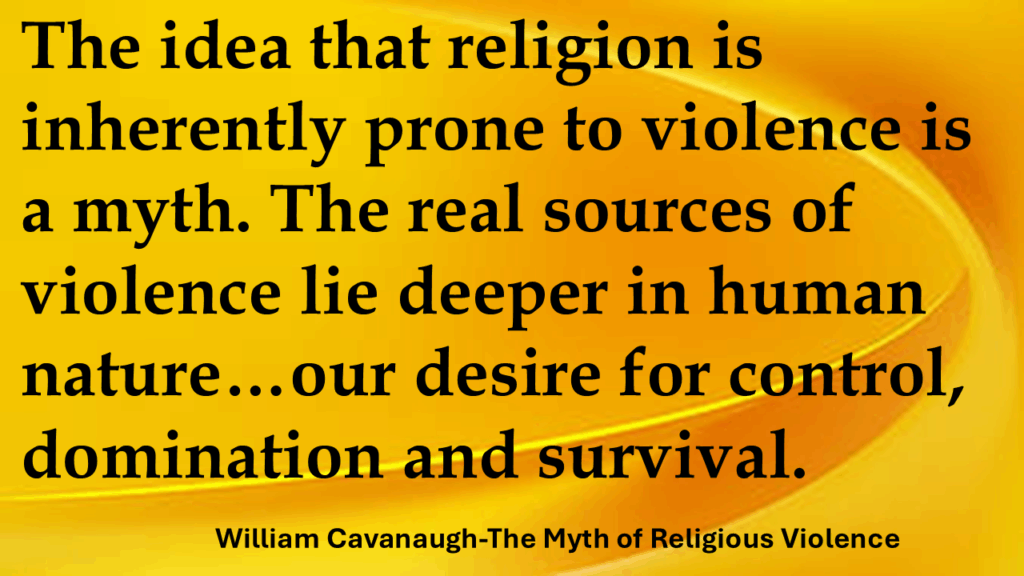
Orthodox Christianity offers the true antidote to the violence, pride, greed, and selfish ambition that fuel conflict—whether on the battlefield, in our cities, or within our homes. Jesus Christ, rightly called the Prince of Peace, not only modeled peace but taught radical love and reconciliation. His command to “love your enemies and pray for those who persecute you” (Matthew 5:44) stands unmatched among the world’s religions. The Bible consistently upholds values that promote human dignity, justice, and peace. In a world torn by division and brutality, the solution is not less Christianity, but a more faithful, more robust Christianity—one that reflects the heart of Christ and brings transformation from the inside out.
Challenge Question : If the historical evidence shows that most wars are rooted in human greed, pride, and the lust for power—not religion—and if orthodox Christianity uniquely calls for love of enemy, peace, and humility, could it be that the real solution to violence is not less religion, but a deeper embrace of true Christianity?
ThinkCube Truth Veracity Grid
- Have I considered the facts carefully and with an open mind?
- Is my conclusion the result of a careful examination of the facts, or is it a conclusion made in spite of the facts?
- Is my conclusion the one that makes the most sense of the evidence?