The world’s clock is always ticking—until, one day, it won’t. For centuries, humanity has lived under the shadow of predictions that the final chime was near. Monks, nuns, astrologers, mystics, poets and prophets have all dared to try and predict the hour when history itself would close. Even Christopher Columbus, fresh from unveiling a New World, warned that the old one had only 150 years left. Centuries later, the cryptic verses of Nostradamus stirred dread with the promise that 1999 would bring a king of terror from the sky. Again and again, voices across time have pointed to the end—each convinced the world’s clock was down to its last beats.
The last act is tragic, however fine the comedy in all the rest of it.
Blaise Pascal
A little earth flung on our head, and it is done forever
From the dawn of civilization, when humanity first learned to shape fears into words and symbols, there have been whispers of when the world would end. Across temples and deserts, cloisters and courts, people have spoken of the world’s final consummation, envisioning the day when time itself would falter. Each voice added its mark upon the great chronicle of human anxiety, mapping moments when history was thought to collapse into eternity. Some spoke with fiery urgency, others with cryptic ambiguity, but all with the conviction that the clock of creation was not infinite.
Famous Prognosticators of the End of the World
| Name | Profession / Background | Date(s) | Main Prediction |
|---|---|---|---|
| Zoroaster (Zarathustra) | Persian prophet, religious reformer | ~1000–500 BC | Cosmic battle of good vs. evil, eventual renewal of the world |
| Sibylline Oracles | Greco-Roman prophetesses / texts | 6th c. BC onward | Cycles of destruction and rebirth, fire consuming the world |
| Montanus | Christian prophet, Montanist sect leader | ~156 AD | New Jerusalem would descend soon in Phrygia |
| Joachim of Fiore | Italian monk & mystic | 1135–1202 AD | “Age of the Spirit” to begin ~1260 AD |
| St. Hildegard of Bingen | German abbess, visionary, polymath | 1098–1179 | Cosmic catastrophes, Antichrist, final judgment |
| Christopher Columbus | Explorer, navigator | ~1500 | End of the world around 1656 (calculated from biblical chronology) |
| Nostradamus (Michel de Nostredame) | French astrologer, physician, seer | 1503–1566 | Cryptic quatrains linked to wars, disasters, some later read as “end of the world” |
| Martin Luther | Reformer, theologian | 1483–1546 | Speculated world would end in ~300 years |
| Mother Shipton (legendary/possibly fictitious) | English folk prophetess | 1488–1561 (legendary) | Verses later attributed to her spoke of fire destroying Earth |
| Charles Taze Russell | Jehovah’s Witnesses precursor | 1852–1916 | End-times dates: 1874, 1914, later revised |
| Edgar Cayce | American “sleeping prophet” | 1877–1945 | Earth changes, pole shifts, catastrophes |
| Hal Lindsey | Author, prophecy writer | 1970 → | The Late Great Planet Earth predicted end in late 20th century |
| Harold Camping | Christian radio preacher | 1921–2013 | Predicted Judgment Day in 1994, then May/Oct 2011 |
| Mayan Calendar Interpreters | New Age writers, pseudoscience | 2012 | December 21, 2012 = world-ending alignment |
| David Meade | Author | 2017 | Claimed “Nibiru” planet would collide with Earth |
Modern times have seen no shortage of doomsayers. Yet unlike Nostradamus, who spoke of mysterious “kings of terror,” today’s prophets of catastrophe warn of threats forged by human hands. Nuclear holocaust, runaway global warming, worldwide pandemics, and the rise of artificial intelligence now dominate the apocalyptic imagination. Among the most recognizable voices is Greta Thunberg, who famously warned that humanity had little more than a decade to act decisively—or risk crossing an irreversible threshold in the climate crisis.
If we haven’t made the changes required by approximately the year 2030, we will probably set off an irreversible chain reaction beyond human control. Then we will pass a point of no return which will be catastrophic.”
Greta Thunberg—Austrian World Summit 2019
As you can see, foretelling the future of humanity is no simple task. Prophets, soothsayers, and modern visionaries alike have staked their reputations on doomsday forecasts—and time and again, they have been proven wrong, spectacularly wrong. Yet what if I told you there truly is a way to predict the end of the world with absolute precision?
prog·nos·ti·cate
/präɡˈnästəˌkāt/
foretell or prophesy a future event.
What if I told you, beyond the faintest shadow of doubt, with 100% certainty, that you—the one reading these words—will personally witness the end of the world? While no man knows the hour when the Earth itself may fall silent, each of us has our own experience of the world one that is very temporary and that will certainly end. A moment is coming when each of us will close our eyes for the last time and our own universe as we know it will come to an end. The great apocalypse foretold by prophets may never arrive, but your own will.
One of the great paradoxes of human nature is this: people often agonize over the possible demise of civilization—the collapse of the corporate whole—yet rarely pause to face the simple truth that they themselves are already standing at the edge of eternity. This very day 173,000 people will die. Half of them suddenly and unexpected.
In fact every second of every day two people die, and according to the World Health Organization 50% do not know it is coming. There is even a World Death Clock that is ominous to watch because the number is clicking up 2 people every second right before your eyes. Ominous! One day you or I will be the tick of the death clock.
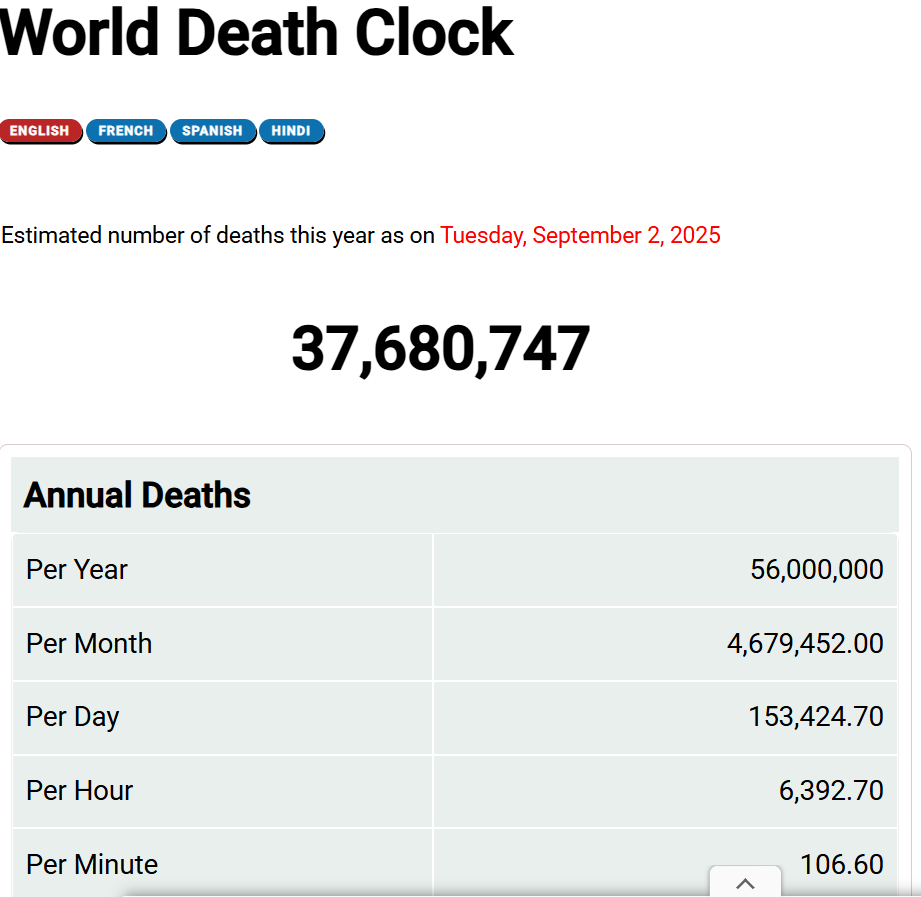
Two deaths per second equals 173,000 people die each day—that’s nearly 60 million every year, or 600 million every decade. Put another way, it is the same as if the entire population of the United States were erased twice in the span of ten years.
In the time it takes to read this paragraph, about 120 men, women, and children will have slipped into eternity—never warned that their world would end today. One person every second dies an unexpected death.
For 80,000 people today the end will come without notice—sudden, absolute, and final.
Have you ever woken from a night’s sleep, brushed your teeth, combed your hair, and while staring into the mirror whispered, “There is no guarantee this will not be my last day on Earth”? For 173,000 people this will be true. Just read your local newspaper, or watch the local news—there are vivid examples either on the news or the obituaries that detail the sudden death of someone who was at the prime of there life. Most of us have gone to funerals of people who had no idea they were going to die.
This is the warning everyone of us should be attending to. Predictions of comets hitting the earth, ice ages, or super volcano eruptions do not pose the imminent threat we should be most concerned about. The most pressing existential crisis each person faces is that they could come face to face with eternity at any moment without being prepared for it. The Bible consistently implies that this is what should be on the front page news.
What Happens After We Die?
According to the Pew Research Center and other cross-cultural studies the majority of the world’s population believes in some form of continued existence after death. Most people in the world believe something happens after death — whether eternal life, reincarnation, or spiritual existence. A smaller but significant share (especially in secular societies) believes death is the absolute end of consciousness.
| Belief About the Afterlife | % of U.S. Adults |
|---|---|
| Believe in Heaven | 73% |
| Believe in Hell | 62% |
| Believe in Reincarnation | 33% |
| Believe in Communication with Spirits | 17% |
| Believe in Nothing after Death | 27% |
Only 29% of Americans say they’re emotionally and mentally prepared for death. Astonishing—consider how carefully we prepare for layoffs, recessions, hailstorms, even gingivitis—yet most have never reckoned with what reality would be if death arrived this very second.
Seventy-three percent say they believe in heaven (many also in hell), but most couldn’t explain what the Bible actually says about the entrance requirements for either. About half believe anyone can go to heaven; about half insist you must have a personal relationship with God. Which is it? And when is the right time to wrestle with the question thoroughly and honestly?
Imagine it. You belong to the half of people who believe a relationship with God is necessary to enter heaven. Deep down, you’ve always thought, “Yes, I need to be right with God.” And yet, the days slipped by—busy, distracted, filled with work, family, and noise. You never sat down to ask, What does the Bible actually say about how to have that relationship? Can I know that I am going to heaven with certainty?
Now imagine today is the day your life ends—suddenly, without warning. A car accident, a heart attack, an unseen medical condition, or simply the frailty of being human. In an instant, your heartbeat stops. You step across the threshold of eternity, carrying only the assumptions you once had—but never tested, never verified against God’s Word. Jesus mercifully warns us that this happens all the time and will happen to many people today.
Not everyone who says to me, ‘Lord, Lord,’ will enter the kingdom of heaven, but the one who does the will of my Father who is in heaven. On that day many will say to me, ‘Lord, Lord, did we not prophesy in your name, and cast out demons in your name, and do many mighty works in your name?’
Matthew 7:21-23
And then will I declare to them, ‘I never knew you; depart from me, you workers of lawlessness.‘
This is the very last thing God desires! There is a reason He inspired men to write the Scriptures—to proclaim the Gospel, the good news that humanity can have sins forgiven, be reconciled to a holy God, and receive eternal life. Yet, as Jesus warned in Matthew 7, there are clear and narrow parameters. It is not as simple as wishing it so, nor as careless as assuming everything will turn out fine in the end.
God created mankind with free will, and though we have misused it, He also designed a plan to save us from the consequences. That plan is not vague or hidden, but neither can it be taken lightly. It must be sought, understood, and embraced. The Bible says that God is not the author of confusion especially when it comes to saving people He sent His own son to die in order to save. He inspired men to write down exactly what needs to happen in plain and certain terms.
I write these things to you who believe in the name of
1 John 5:13
the Son of God, that you may know that you have eternal life.
The most important step any person can take is to ask and seek God about how they must be saved. Jesus warned that humanity is not free to fill in the blanks for themselves. Eternal life is God’s plan, not ours, and to imagine that those in need of salvation can invent their own version of it is not only misguided—it is deadly.
The second most important thing is to not wait! The Apostle Paul declared in 2 Corinthians 6:2, “Behold, now is the favorable time; behold, now is the day of salvation.” His plea is simple and direct: do not delay in seeking God. The opportunity is present now—salvation is not something to push off to “someday.” The truth is, none of us knows how long we have, and this question is the most important one any person could ever face.
Please click on the picture below for a detailed explanation of what the Bible says about salvation, personal relationship with God, and the guarantee of eternal life. If heaven is real, then God is real. And if God is the One who made heaven, shouldn’t we make every effort to discover what He has said about how to receive eternal life with Him? No more Tick, Tick, Tick….Click, Click, Click!