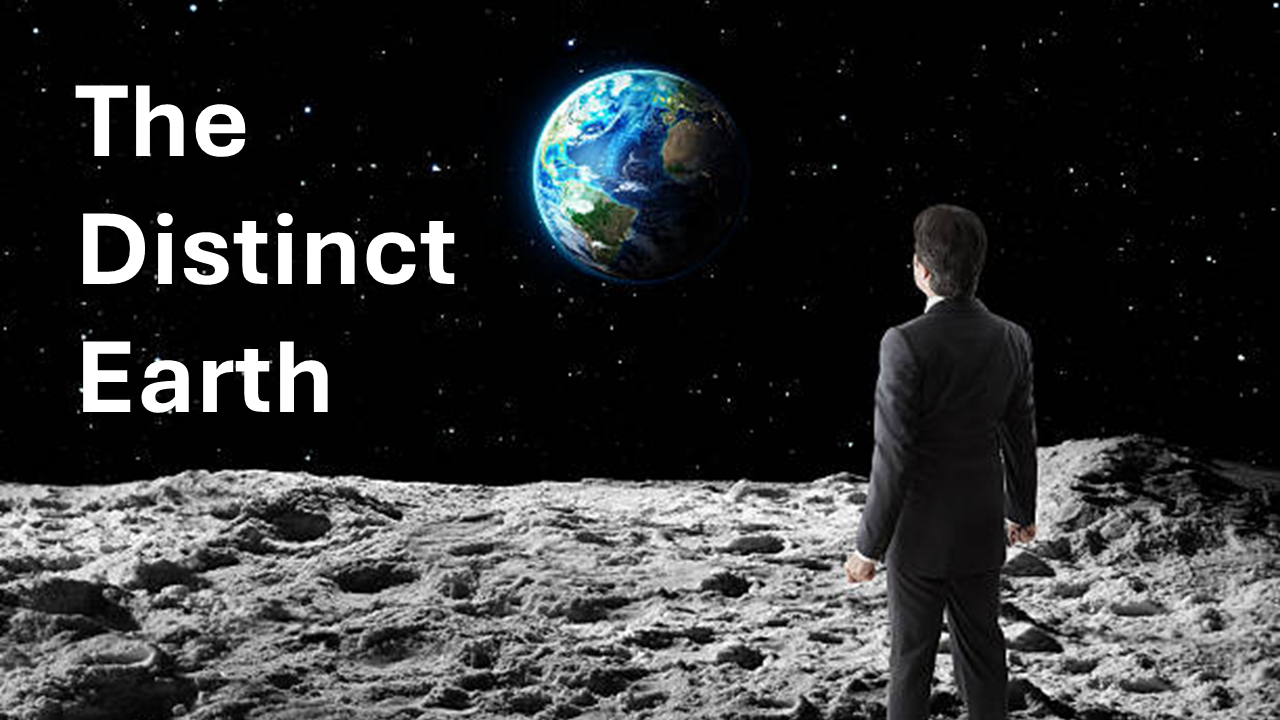
The Earth Is Fine Tuned For Life
What makes the Earth habitable? It is the right distance from the Sun, it is protected from harmful solar radiation by it’s magnetic field, it is kept warm by an insulating atmosphere, and it has the right chemical ingredients for life…no other planet does.
American Museum of Natural History
As we look out into the universe and identify the many accidents of physics and astronomy that have worked together for our benefit, it almost seems as if the universe must in some sense have known that we were coming.
Freeman Dyson —(Theoretical Physicist, Princeton Institute for Advanced Study)
Anthropic fine-tuning is too remarkable to be dismissed as just a happy accident. It cries out for an explanation.
John Polkinghorne— (Physicist & Anglican Priest, University of Cambridge)
The fitness of the cosmos for life is no mere accident. Every aspect of the natural world is uniquely and intricately suited for life’s existence on Earth.
Michael Denton— (Biochemist, University of Otago, NZ)
As we survey all the evidence, the thought insistently arises that some supernatural agency—or, rather, Agency—must be involved. Is it possible that suddenly, without intending it, we have stumbled upon scientific proof of the existence of a Supreme Being? (The Symbiotic Universe, 1988)
George Greenstein— (Astronomer, Amherst College)
The impression of design is overwhelming.
Paul Davies—Physicist
Life, it seams, is not an incidental component of the universe, burped up out of a random chemical brew on a lonely planet to endure for a few fleeting ticks of the cosmic clock. In some strange sense, it appears that we are not adapted to the universe, the universe is adapted to us.
Tim Folger—Discover Magazine
Amazing fine tuning occurs in the laws that make this [complexity] possible. Realization of the complexity of what is accomplished makes it very difficult not to use the word ‘miraculous’ without taking a stand as to the ontological status of the word.
George Ellis—Astrophysicist
Many details as to why Earth is the only planet with liquid water in our solar system needs to be worked out.
Dana Valencia—Earth and Planetary Scientist Harvard University
Earth is the only place we know of inhabited by living things…most notably, Earth is unique in that most of our planet is covered in liquid water.
NASA
The remarkable fact is that the values of these numbers seem to have been very finely adjusted to make possible the development of life.
Stephen Hawking—Theoretical Physicist, Cambridge University
Even if we search the cosmos and come up with a negative result, if we see a bunch of Earth-like planets and none of them have life, we know we hold a very special place in the universe.
James F. Kasting—Astrobiologist Pen State University
Earth is the only known habitable planet in the solar system. Understanding how Earth developed its unique habitability has been the frontier of Earth sciences.
Charles H. Langmuir—Geochemist, Harvard University
There are many such examples of the universe’s life friendly properties, so many, in fact that physicists can’t dismiss them as all mere accidents.
Tim Folger—Discover Magazine
While simple life might be common in the universe, complex life is exceedingly rare. Earth’s unique geological and chemical history has provided the exact conditions necessary for higher organisms to exist.
Peter Ward & Donald Brownlee— (University of Washington, authors of Rare Earth)
The very same narrow circumstances that allow us to exist also provide the best overall setting for making scientific discoveries. The Earth is not only fine-tuned for life; it is fine-tuned for discovery.
Guillermo Gonzalez —(Astrophysicist) & Jay W. Richards (Philosopher of Science)
Our location in the universe is not typical but privileged. Earth has a rare chemical and cosmic history that makes observers like ourselves possible.
Brandon Carter— (Astrophysicist, originator of the Anthropic Principle)
The Earth Cannot Be The Ancestor Of Other Planets
To the surprise of scientists, the chemical makeup of the moon rocks is distinctly different from that of rocks on earth. This difference implies the moon formed under different conditions…and means that any theory on the origin of the planets will have to create the earth and the moon in different ways.
Jerry E. Bishop—Science Digest
We’ve searched carefully for oxygen, carbon, nitrogen, and silicon—the things that are found on Earth and the Sun in abundance, but we don’t find a trace of anything other than hydrogen and deuterium. (After studying gas clouds 12 billion light years away- supposedly left over from the Big Bang)
Michel Fumagalli—Astronomer University of California
The elemental abundances on Earth — the carbon, oxygen, phosphorus, and iron necessary for life — are precisely those required for complex cells, biochemistry, and intelligence. This is no accident; the universe seems fit for life in a way no blind process can explain
Michael Denton— (Biochemist, University of Otago, New Zealand)
The moon landings have permitted man to actually study lunar composition and structure. Enough has been found now to permit the firm conclusion that the earth and it’s moon are of vastly different structure and therefore could not have the same celestial evolutionary ancestor.
Jerry E. Bishop—Science Digest
Life depends on a suite of elements forged in stars — carbon, oxygen, nitrogen, iron, phosphorus. Yet the delivery of just the right balance of these to the early Earth required an extraordinary sequence of cosmic accidents. That Earth exists with this chemical richness is nothing short of remarkable. (The Goldilocks Enigma, 2006)
Paul Davies— (Physicist, Arizona State University)
Earth is chemically unusual, with a large metallic core, abundant water, and a crust enriched in silicon and oxygen. It is this unique chemical makeup, coupled with billions of years of geological activity, that makes it habitable. Other planets lack this recipe.
Peter Ward (Paleontologist, UW)
The conditions on Earth that have allowed life to flourish may be far more special than most scientists are willing to admit. The planet’s particular mixture of elements, its water cycle, and its chemical evolution are rare in the cosmos. (Alone in the Universe: Why Our Planet Is Unique, 2011)
John Gribbin— (Astrophysicist, University of Sussex)
The Earth’s crust is rich in oxygen and silicon, unusual compared with most of the solid matter in the cosmos, which is dominated by carbon and metals. This chemical oddity is critical for continents, plate tectonics, and the regulation of climate — without which advanced life would not exist.
Donald Brownlee —(Astronomer, UW)
Earths Fine-Tuned Laws & Balances That Make Life Possible
| Constant / Balance | What It Is Now | If It Changed Even a Little… | Impact on Life |
|---|---|---|---|
| Gravity | Keeps stars burning at the right pace | Stronger → stars burn out in seconds. We’d be crushed. Weaker → stars never ignite. | ❌ No stars, no planets, no life. |
| Cosmological Constant | Controls universe’s expansion | Larger → universe blows apart too fast. Smaller → universe collapses instantly. | ❌ No galaxies, no Earth, no life. |
| Strong Nuclear Force | Holds atomic nuclei together | 2% stronger → only hydrogen exists. 5% weaker → no carbon, oxygen, or chemistry. | ❌ No atoms for life. |
| Weak Nuclear Force | Powers the Sun’s energy process | Much weaker → no heavy elements form. Stronger → stars burn up too fast. | ❌ No sunlight, no life. |
| Earth’s Tilt (23.5°) | Gives us seasons & stable climate | Tilt wobbles wildly without the Moon’s pull. | 🌪️ Climate chaos, floods, freezing, deserts. |
| Earth’s Rotation (24 hrs) | Balances day & night temps | Much slower → half planet scorched, half frozen. Much faster → hurricane-force winds daily. | 🌡️ ❌ Uninhabitable surface. |
| Distance from Sun | “Goldilocks zone” — not too hot/cold | 5% closer → runaway greenhouse (like Venus). 20% farther → deep freeze (like Mars). | 🔥❄️ Earth becomes a dead world. |
| Oxygen in Air (21%) | Just right for breathing & fire | Below 15% → we suffocate. Above 25% → forests explode into fire. | ❌ Humans & animals perish. |
| Carbon Dioxide (0.04%) | Plants breathe it; climate balance | Too little → Earth ices over. Too much → scorching greenhouse. | ❌ No crops, no climate stability. |
| Earth’s Crust Thickness | Thin enough to recycle nutrients | Too thin → mega-volcanoes, poison gases. Too thick → no oxygen left for us. | 🌋 ❌ No stable biosphere. |
| The Moon’s Size & Distance | Stabilizes Earth’s tilt & drives tides | Without it → tilt shifts chaotically. No tides → stagnant oceans. | 🌊 ❌ Ocean life dies, climates collapse. |
| Jupiter’s Position | Giant planet “shield” against asteroids | Without Jupiter → asteroid bombardment sterilizes Earth repeatedly. | ☄️ ❌ No long-term survival of life. |
How Life’s Parameters Have to Remain Constant and Calibrated
1. The Odds of the Universe
- Roger Penrose (Oxford physicist): “The chance of the universe’s low-entropy beginning being suitable for life is 1 in 10^(10^123) — a 1 with more zeros than there are particles in the universe.”
👉 Translation: The odds of winning the lottery every day for 14 billion years are better than the odds of our universe existing by chance.
2. Distance from the Sun
- Earth is just 93 million miles from the Sun.
- If Earth were 5% closer → runaway greenhouse effect, oceans boil, Earth burns like Venus.
- If Earth were 20% farther → oceans freeze solid, Earth becomes like Mars.
👉 Translation: Move Earth an inch on the cosmic scale, and all life is gone.
3. The Moon’s Distance
- The Moon is 240,000 miles from Earth.
- If it were even a little closer → giant tides would flood continents twice daily.
- If it were farther away → Earth’s tilt would wobble wildly, causing catastrophic climate chaos.
👉 Translation: Without the Moon’s exact placement, Earth is unlivable.
4. Oxygen Balance
- Earth’s air contains 21% oxygen.
- At 15% → humans suffocate.
- At 25% → forests spontaneously ignite.
👉 Translation: One breath proves precision.
5. Strength of Gravity
- Gravity is tuned to 1 part in 10³⁸.
- Stronger → stars burn too fast, no stable planets.
- Weaker → stars never ignite, no chemistry beyond hydrogen.
👉 Translation: One tick off, no stars, no life.
6. Strong Nuclear Force
- If stronger by just 2% → only hydrogen exists.
- If weaker by 5% → no carbon, oxygen, or life chemistry forms.
👉 Translation: Life depends on the razor’s edge of nuclear glue.
7. Earth’s Rotation
- Our 24-hour day keeps temperatures balanced.
- A 48-hour day → one side scorched, the other frozen.
- A 6-hour day → winds over 500 mph daily.
👉 Translation: The clock of life ticks at exactly the right speed.
8. Jupiter’s Shield
- Jupiter is 300 times more massive than Earth.
- Its gravity deflects most comets and asteroids.
👉 Translation: Without Jupiter, Earth would be pummeled into extinction every few million years.
- Its gravity deflects most comets and asteroids.
9. Cosmological Constant
- Must be fine-tuned to within 1 part in 10¹²⁰.
- Larger → universe rips apart.
- Smaller → universe collapses instantly.
👉 Translation: More precise than hitting a bullseye if you threw a dart across the observable universe.
10. Earth’s Water Balance
- Earth has just the right amount of water.
- Too much → continents never form.
- Too little → a barren desert world.
👉 Translation: Earth swims in exactly the right measure of oceans and land.