A key strategy in effective apologetics is building a cumulative case—using multiple lines of evidence that reinforce one another while remaining capable of standing on their own. Together, they form a strong overall case. But each individual point should also be clear and compelling enough to challenge an opposing argument when considered on its own.
Ready Responses are designed with this approach in mind. Each response is a concise, memorable Truth Bullet—a key fact, question, or line of reasoning you can introduce into a conversation. You don’t need to deliver an entire argument at once. Sometimes one well-placed truth is enough to challenge an assumption, expose a weakness, or give someone a reason to reconsider what they believe.
Skeptics often raise difficult questions about creation, the universe, God, and the Bible. Ready Responses gives you concise answers, memorable Truth Bullets, key Scriptures or Quotes to help you understand the issue and explain what you believe in your own words.
Purpose: You don’t need to memorize an argument. Learn the key ideas well enough to explain them in your own words.
The World’s Major Religions Are Doctrinally Opposed
Response
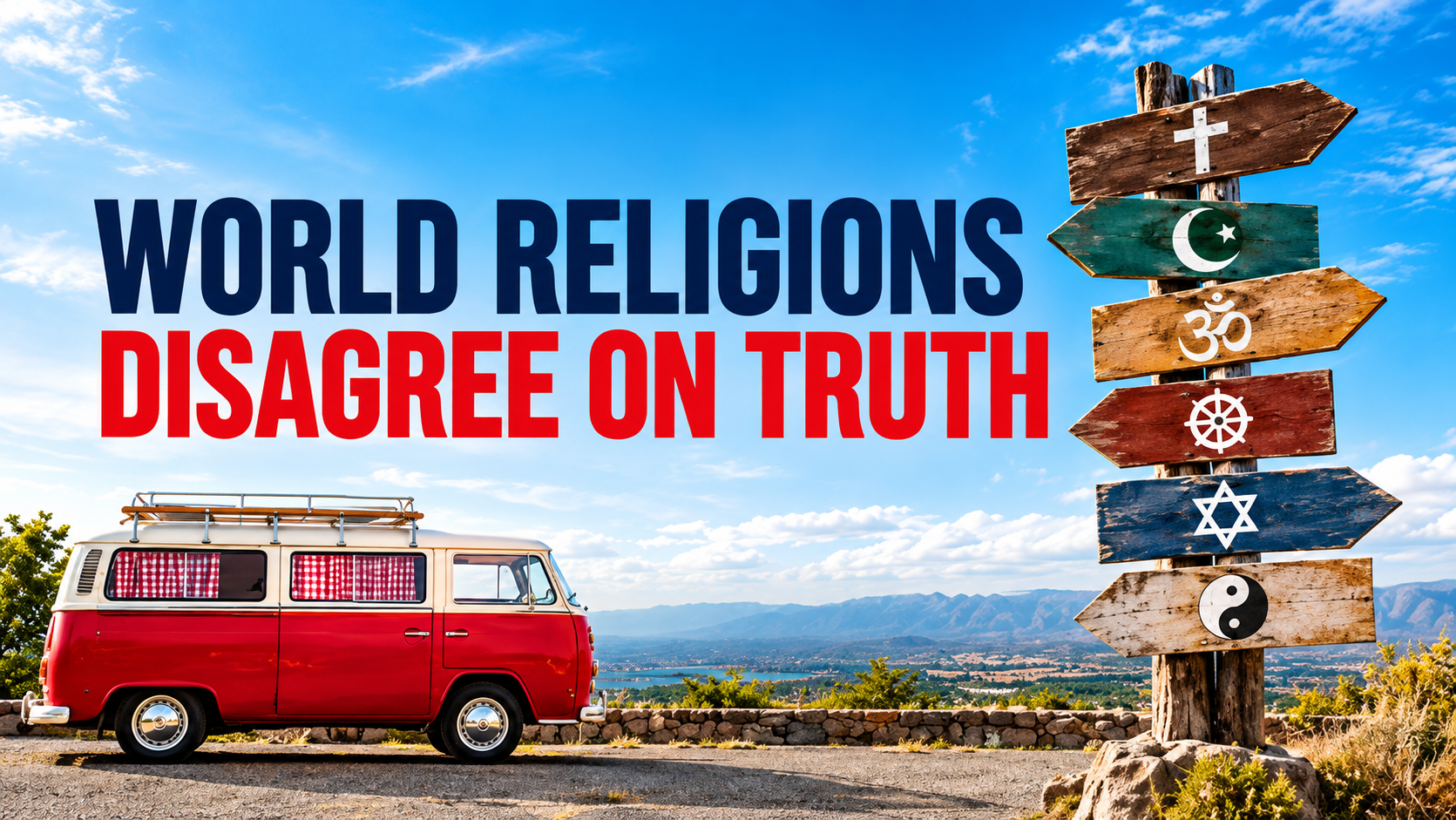
Religious pluralism suggests that the world’s religions are different expressions of the same ultimate truth. But examining what these religions actually teach reveals a very different picture.
Consider their conflicting views about God:
- Christianity: There is one eternal God who exists as Father, Son, and Holy Spirit. Jesus Christ is God incarnate.
- Islam: There is one God, Allah, who is not triune. Jesus is a prophet, not God.
- Judaism: There is one God, but mainstream Judaism rejects the Christian claim that Jesus is God incarnate and the promised Messiah.
- Hinduism: Religious traditions vary widely, but many recognize multiple deities or an ultimate divine reality called Brahman.
- Buddhism: Generally does not teach belief in an eternal creator God; its central concern is liberation from suffering and rebirth.
These teachings cannot all be correct in the same sense.
The Law of Non-Contradiction
One of the most fundamental principles of logic is Aristotle’s Law of Non-Contradiction:
Two contradictory statements cannot both be true at the same time and in the same sense.
For example, Christianity teaches that Jesus is God incarnate. Islam explicitly denies that Jesus is God.
Both claims cannot be true in the same sense. Jesus either is God incarnate or He is not.
This principle doesn’t automatically establish which religion is true. It establishes that contradictory religious doctrines cannot all be equally true.
Truth Bullet: Religions can share moral values without sharing the same truth. Contradictory doctrines cannot all be correct.
Helpful Quote
Ironically, the insistence that doctrines do not matter is really a doctrine itself.
Timothy Keller—The Reason For God
Challenge Question: If Christianity teaches that Jesus is God and Islam teaches that He is not, how can both religions be equally true about who Jesus is?
All of the World’s Major Religions Believe They Are Exclusive
Response
People often criticize Christianity for claiming to possess exclusive truth. But exclusive truth claims are not unique to Christianity.
The world’s major religions have distinct teachings about ultimate reality, spiritual liberation, salvation, and the consequences of following—or rejecting—their teachings.
Consider the differences on the primary issue of salvation:
- Christianity: Salvation is God’s gift of grace through faith in Jesus Christ.
- Islam: Submission to Allah, faith, righteous conduct, and divine mercy are central to salvation.
- Hinduism: Various paths of devotion, knowledge, and disciplined action seek liberation from the cycle of rebirth.
- Buddhism: The Noble Eightfold Path leads toward liberation from suffering and the cycle of rebirth.
These systems do not merely offer different ways of expressing the same solution. They define the human problem and its solution differently.
Exclusivity Is Not Unique to Christianity
Christianity is often portrayed as uniquely intolerant because Jesus declared Himself the only way to the Father.
But every worldview, including religious pluralism, makes claims that exclude competing explanations.
For example, when someone declares, “All religions are equally valid,” they are making a truth claim that contradicts religions teaching that certain doctrines are false.
Ironically, the claim that no religion should make exclusive truth claims is itself an exclusive truth claim.
The issue is not whether a worldview makes exclusive claims. The issue is whether those claims are true.
Truth Bullet: Every worldview excludes beliefs that contradict it. The question is not whether a belief is exclusive, but whether it is true.
Helpful Quote
Like in arithmetic—there’s only one right answer to a sum, and all other answers are wrong.
C.S Lewis
Challenge Question: If religious pluralism declares that all religions are equally valid, doesn’t it contradict the religions that explicitly deny that claim?
All Religions Do Not Lead to the Same Destination
Response
One of the most familiar illustrations of religious pluralism compares religions to different roads leading up the same mountain.
The problem is that the world’s religions don’t agree about what mountain they’re climbing—or even what awaits them at the summit.
They disagree about three essential questions:
1. What is humanity’s fundamental problem?
- Christianity identifies humanity’s separation from God through sin.
- Buddhism emphasizes suffering, craving, and ignorance.
- Hindu traditions commonly emphasize bondage to karma and rebirth.
2. What is the solution?
- Christianity teaches reconciliation with God through Jesus Christ.
- Buddhism teaches a path toward liberation through wisdom, ethical conduct, and mental discipline.
- Hindu traditions describe paths of devotion, knowledge, and action toward liberation.
3. What is the ultimate destination?
- Christianity promises resurrection and eternal life with God in a renewed creation.
- Buddhism seeks nirvana and freedom from suffering and rebirth.
- Hindu traditions describe moksha, or liberation, understood differently among Hindu schools.
These destinations are not interchangeable.
Different Roads Cannot Lead to the Same Place When the Destinations Are Different
Imagine three travelers consulting three maps.
One map leads to the Pacific Ocean. Another leads to the Rocky Mountains. The third leads to the Grand Canyon.
All three travelers may be sincere. They may travel with great dedication. They may even share portions of the same highway.
But sincerity and shared stretches of road cannot make three different destinations identical.
The same principle applies to religion.
Religions may share moral teachings, encourage compassion, and value spiritual discipline. But these similarities do not erase their fundamental disagreements about salvation and eternity.
Truth Bullet
Different religious paths cannot all lead to the same destination when they disagree about what the destination actually is.
Helpful Scripture — Acts 4:12 (ESV)
“And there is salvation in no one else, for there is no other name under heaven given among men by which we must be saved.”
Challenge Question: If one religion teaches resurrection and eternal life with God while another teaches liberation from the cycle of rebirth, how can both be describing the same ultimate destination?