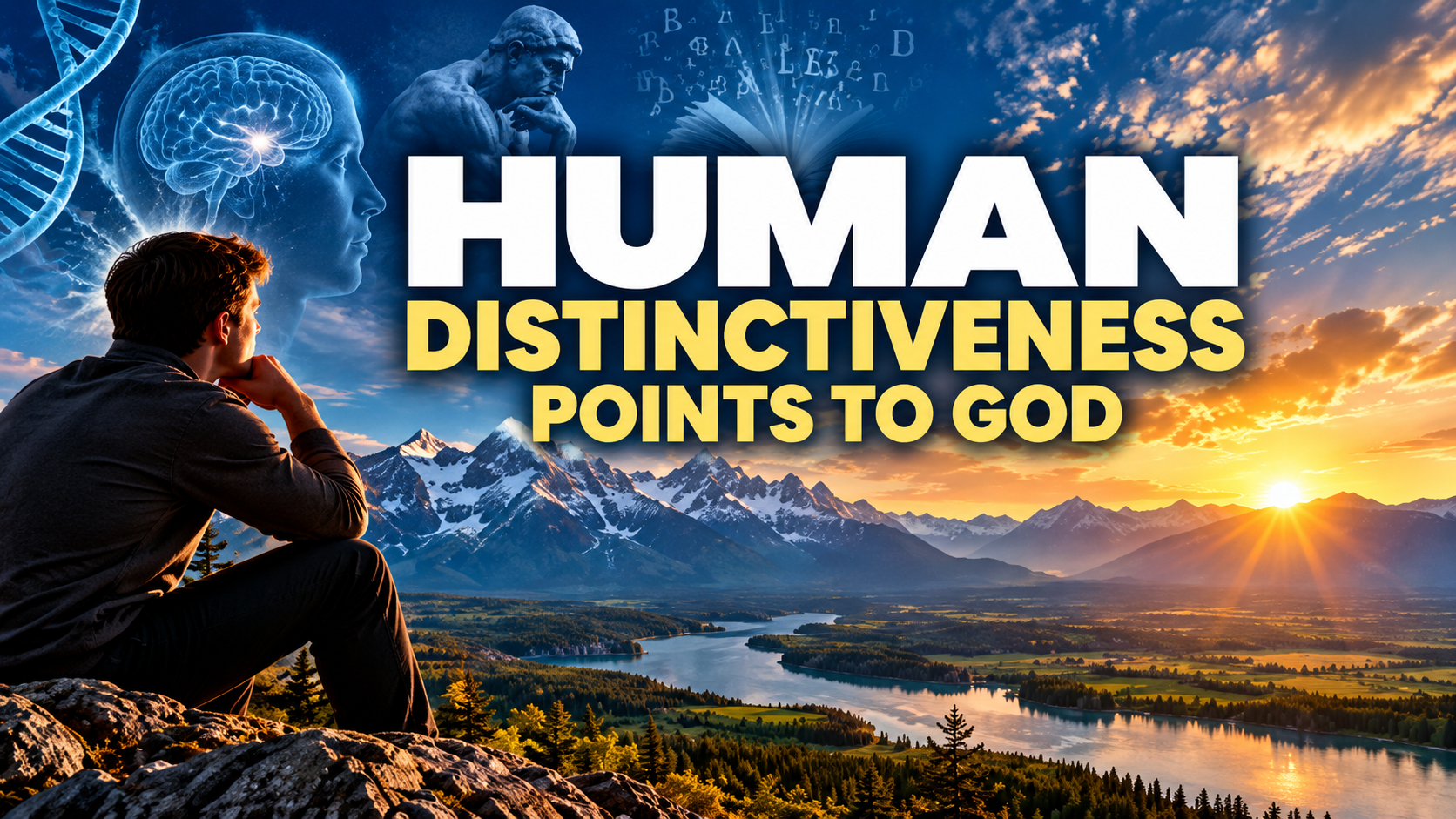
A key strategy in effective apologetics is building a cumulative case—using multiple lines of evidence that reinforce one another while remaining capable of standing on their own. Together, they form a strong overall case. But each individual point should also be clear and compelling enough to challenge an opposing argument when considered on its own.
Ready Responses are designed with this approach in mind. Each response is a concise, memorable Truth Bullet—a key fact, question, or line of reasoning you can introduce into a conversation. You don’t need to deliver an entire argument at once. Sometimes one well-placed truth is enough to challenge an assumption, expose a weakness, or give someone a reason to reconsider what they believe.
Skeptics often raise difficult questions about creation, the universe, God, and the Bible. Ready Responses gives you concise answers, memorable Truth Bullets, key Scriptures or Quotes to help you understand the issue and explain what you believe in your own words.
Purpose: You don’t need to memorize an argument. Learn the key ideas well enough to explain them in your own words.
Why Are Humans So Radically Different From Every Other Species?
Response
Humans share many biological characteristics with animals. But biological similarity does not explain the enormous differences in what human beings are capable of doing.
Humans uniquely demonstrate an extraordinary combination of abstract reasoning, complex language, mathematics, writing, moral reflection, philosophy, art, science, engineering, worship, and cumulative knowledge passed from one generation to another.
Animals can communicate, solve problems, and even use simple tools. But no animal civilization has produced libraries, mathematics, legal systems, universities, symphonies, spacecraft, or written histories. How can such a huge cognitive gap be the product of random, undirected natural processes?
Christianity provides a straightforward explanation for this distinction:
Human beings were uniquely created in the image of God.
Truth Bullet
- Humanity isn’t simply different in degree—we possess capacities that distinguish us radically from the rest of the animal world.
There is no beginning without a “beginner!”
Helpful Memory Verse
God created man in His own image.
Genesis 1:27
Challenge Question: If humans are simply another animal species, what adequately explains the extraordinary gap between mankind and every other species in abstract reasoning, complex language, mathematics, writing, moral reflection, creativity, and cumulative knowledge?
If Humans and Primates Are So Genetically Similar, Why Are Our Minds So Different?
Response
Humans and other primates share much of their biological machinery because we have many similar physical requirements. Both need functioning cells, muscles, organs, nervous systems, metabolism, and countless other biological processes.
The deeper question is whether biological similarity adequately explains the extraordinary difference in cognitive capability.
Human beings don’t merely communicate—we develop complex symbolic languages and writing systems.
We don’t merely solve immediate problems—we investigate mathematics, physics, philosophy, theology, history, and questions about existence itself.
We don’t merely learn—we preserve knowledge outside our brains and transmit it across centuries.
From the Christian perspective, our physical similarities to other creatures do not diminish human uniqueness. Human distinctiveness ultimately comes from being made in God’s image.
Helpful Verse
You have made him a little lower than the heavenly beings and crowned him with glory and honor
Psalm 8:5
Challenge Question: If evolution claims that humans are direct descendents of primates and that we are just a “stones throw” away from them in similarity, then why is there an enormous cognitive gap?
Why Are Humans Driven to Create?
Response:
Human beings don’t simply adapt to their surroundings. We imagine things that don’t exist—and then make them exist.
We turn stone into buildings, sounds into music, pigments into paintings, numbers into mathematics, observations into science, and ideas into machines.
A human being can look at an empty field and envision a city, look at the night sky and design a spacecraft, or imagine a machine that has never existed and then construct it.
Even more remarkably, human creativity is cumulative. One generation’s discoveries become the starting point for the next.
Christianity offers a compelling explanation: the Creator made creatures capable of creating.
Our creativity is not equal to God’s—we create from things that already exist—but our capacity to reason, design, invent, and produce reflects the One whose image we bear.
Truth Bullet
- The Creator made creatures who can think, imagine, design, and create.
Helpful Verse
And God said to them, ‘Be fruitful and multiply and fill the earth and subdue it.’
Genesis 1:28
Challenge Question: What best explains humanity’s unique ability to imagine what does not yet exist and then use reason, creativity, and knowledge to bring it into reality? Random, undesigned natural processes or a Creator making creatures capable of creating?
Why Does Humanity Search for God?
Human beings don’t merely ask how to survive.
We ask:
Why am I here?
Does God exist?
What is the meaning of life?
What happens when I die?
Is there life beyond this one?
Is there an ultimate purpose to existence?
Across civilizations and throughout recorded history, human beings have worshiped, prayed, built temples, contemplated eternity, buried their dead with significance, and searched for realities beyond the material world.
From the Christian worldview, this persistent spiritual awareness isn’t surprising.
Human beings were created by God and for relationship with God.
Truth Bullet
Human beings don’t merely experience the physical world—we continually search for meaning beyond it.
“He has put eternity into man’s heart.”
Ecclesiastes 3:11
Challenge Question: If human beings are entirely material creatures produced only for survival and reproduction, why are we so persistently and universally concerned with God, eternity, ultimate meaning, worship, and what happens after death?